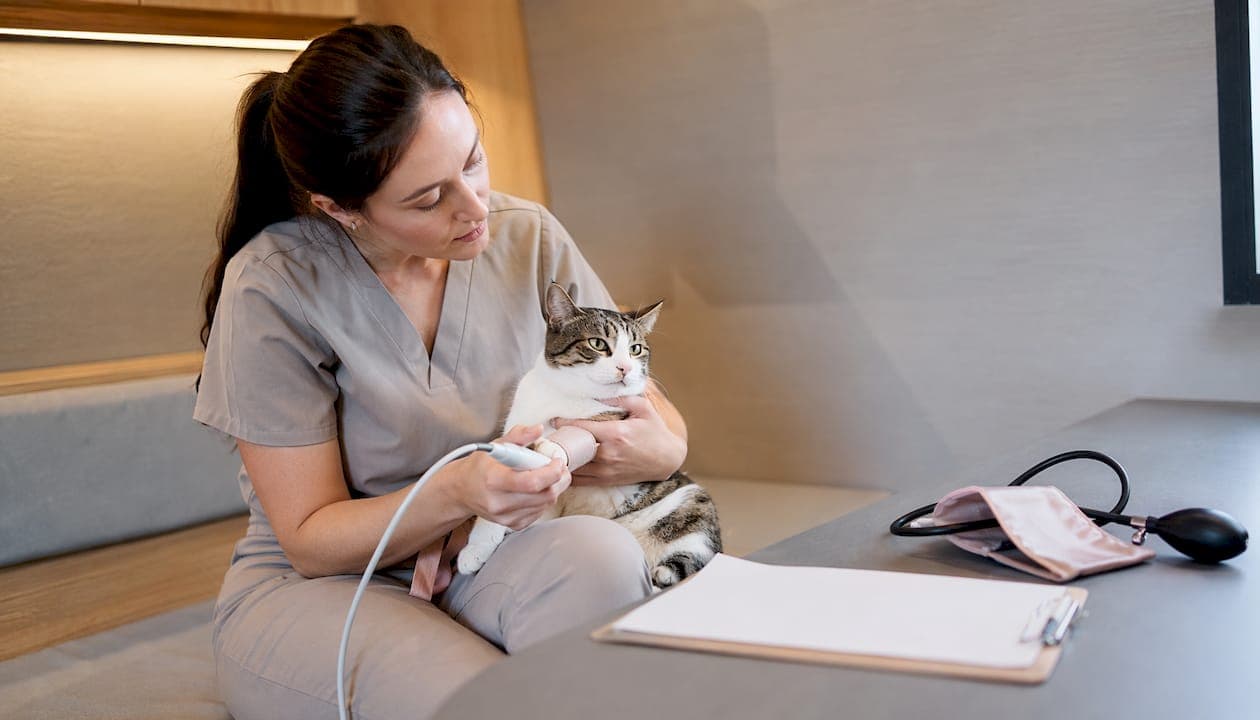
A cat blood pressure test measures systolic blood pressure (SBP) indirectly using a Doppler sphygmomanometer or oscillometric device, and it is one of the most important screening tools a vet can run on an older or at-risk cat. According to the ISFM consensus guidelines, Doppler sphygmomanometry is currently the most reliable indirect method for conscious cats. Here is what the process looks like in practice:
-
A cuff is sized to approximately a third to less than half of the limb or tail circumference and placed on the forelimb, hindlimb, or tail base.
-
The cat acclimatizes in a quiet room for 5–10 minutes before any readings are taken.
-
The first reading is always discarded; multiple subsequent consistent readings are averaged for the clinical result.
-
Results are interpreted against established SBP thresholds indicating categories such as minimal risk, moderate hypertension, and severe hypertension with high risk of target-organ damage (TOD).
The whole appointment typically takes a moderate amount of time. At Cityanimalvet in Brooklyn, NY, the same protocol is available as an in-clinic Fear Free visit or a house call for cats that do not travel well.
Key stat: White-coat hypertension can raise a cat’s SBP by up to ~80 mmHg during a clinic visit, which is why acclimatization and stress reduction are not optional extras — they are built into every reliable measurement protocol.
Table of Contents
-
How do Doppler, oscillometric, and direct arterial methods compare?
-
What equipment does a blood pressure measurement actually require?
-
Step-by-step: how a Doppler blood pressure measurement is performed
-
What owners consistently get wrong about blood pressure monitoring
Why does your cat need a blood pressure check?
Feline hypertension is almost always secondary to another disease. Chronic kidney disease (CKD), hyperthyroidism, diabetes, cardiac disease, and certain drug therapies are the most common drivers. The problem is that cats rarely show obvious symptoms until blood pressure has been elevated long enough to damage the eyes, kidneys, heart, or brain. By the time an owner notices something wrong — sudden blindness, a seizure, a dramatic personality change — the damage is often already done.
Specific indications for a cat hypertension test include:
-
Chronic kidney disease (the single most common cause of secondary hypertension in cats)
-
Hyperthyroidism (even well-controlled cases warrant regular BP monitoring)
-
Diabetes mellitus and adrenal disease
-
Ocular signs: retinal hemorrhage, detachment, or sudden vision loss
-
Neurologic signs: seizures, disorientation, head tilt
-
Pre-anesthetic evaluation before any procedure requiring sedation
-
Age alone: cats 10 years and older benefit from routine baseline checks even without obvious risk factors
Sustained hypertension causes irreversible target-organ damage, and many cats are completely asymptomatic until that damage is advanced. A single normal reading at age 8 does not protect a cat at age 12. Routine monitoring builds an individual baseline, which makes it far easier to spot a real trend versus a one-off situational spike.
Pro Tip: Ask your vet to record the exact cuff site, size, and device used at every visit. That consistency is what turns a series of numbers into a meaningful trend.
How do Doppler, oscillometric, and direct arterial methods compare?
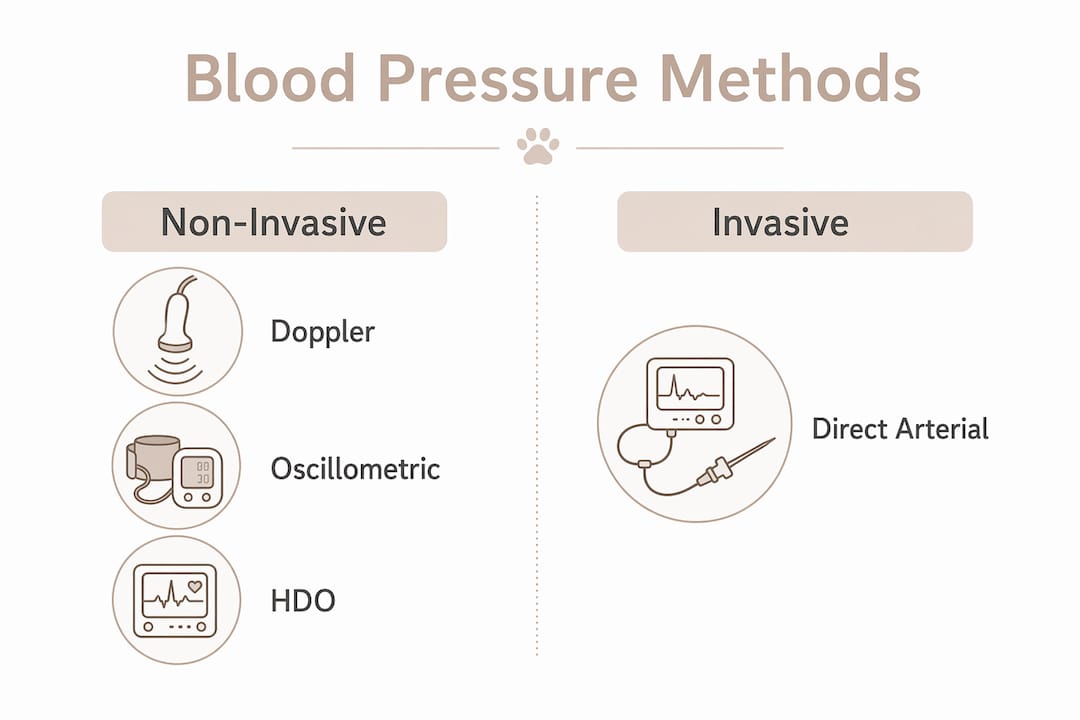
Three measurement approaches are used in veterinary practice, and they are not interchangeable. Understanding the differences helps owners know why a vet chooses a particular device and what the result actually represents.
Doppler sphygmomanometry
A Doppler probe detects the return of blood flow distal to an inflated cuff. The pressure at which flow first returns equals the SBP. It requires gel or alcohol on the shaved or dampened fur for good probe contact, and an experienced technician to locate the signal reliably. The ISFM guidelines identify Doppler as the most repeatable indirect method for conscious cats, and it remains the clinical standard in most U.S. practices.
Oscillometric devices (standard and HDO)
Standard oscillometric units detect oscillations in cuff pressure caused by arterial pulsation. They are easier to operate but historically less accurate in cats, often underestimating values. High-definition oscillometry (HDO) has improved systolic accuracy considerably compared with older oscillometric units. However, HDO and Doppler are not yet fully validated to ACVIM 2007 criteria, and HDO’s diastolic and mean arterial pressure (MAP) readings remain less reliable than its SBP output. Connecting an HDO device to a PC or tablet to visualize the waveform helps flag motion artifacts before they corrupt a reading.
Direct arterial measurement
An arterial catheter placed in the dorsal pedal or femoral artery gives the most accurate reading possible. It is used in intensive care and research settings, not routine outpatient screening. Owners will not encounter this method at a wellness visit.
| Dimension | Doppler | Standard oscillometric | HDO | Direct arterial |
|---|---|---|---|---|
| SBP accuracy | High (gold standard for conscious cats) | Moderate (often underestimates) | Good for SBP; limited for DBP/MAP | Highest (invasive reference) |
| Operator dependence | Moderate to high | Low | Low to moderate | High (requires catheter placement) |
| Stress impact on cat | Low with good technique | Low | Low; tail cuff reduces motion artifact | High (invasive) |
| Restraint/sedation needed | Minimal with trained tech | Minimal | Minimal | Sedation required |
| Clinic vs home suitability | Clinic; portable units exist | Clinic or home (loaner) | Clinic primarily | ICU/research only |
| Ease of use | Requires training | Easy | Moderate (needs PC link for artifact check) | Specialist only |
What equipment does a blood pressure measurement actually require?
Getting an accurate feline blood pressure measurement depends as much on the equipment setup as on the device itself. The cuff is the single most error-prone component.
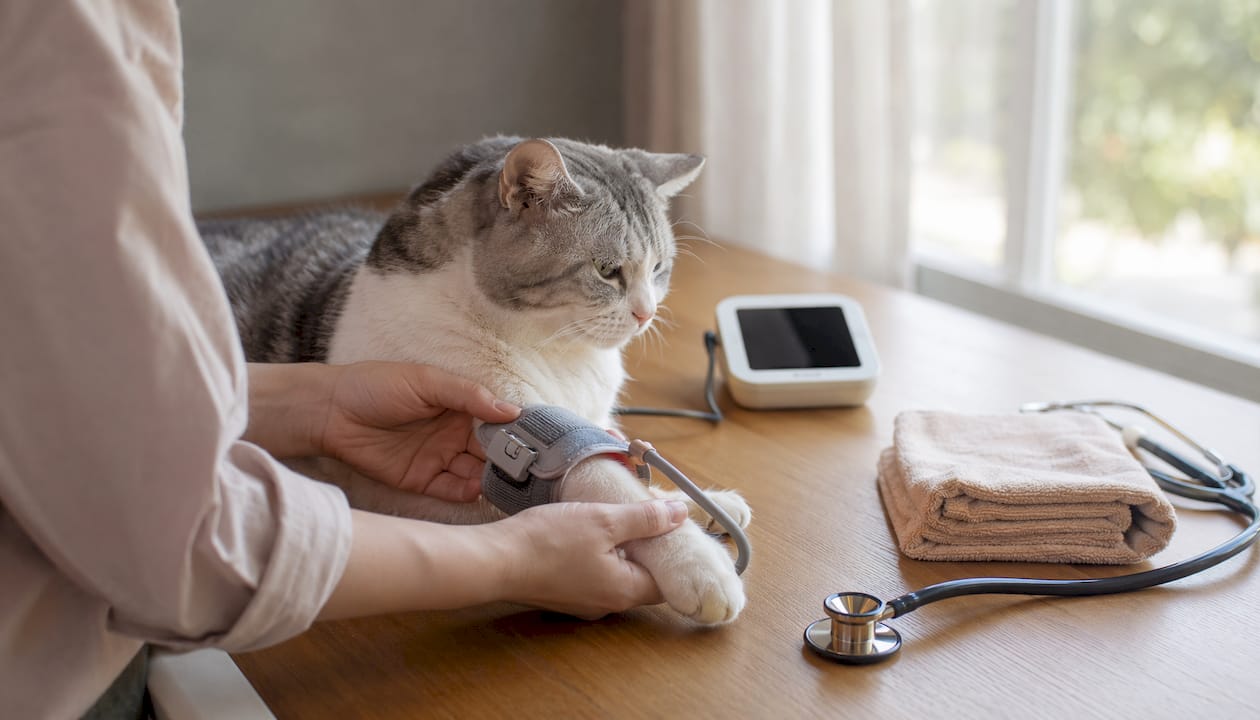
Cuff sizing follows a straightforward rule: cuff width should equal roughly 30–40% of the circumference of the limb or tail at the measurement site. Measure with a soft tape at every visit and record it. A cuff that is too narrow produces a falsely high reading; one that is too wide produces a falsely low one. Most clinics keep a set of at least four cuff sizes to cover kittens through large adult cats.
Placement sites each have trade-offs. The forelimb (just above the carpus) is the most common site in U.S. clinics. The tail base is often preferred for HDO because it reduces motion artifact and is easier to access in cats that resist limb handling. Hindlimb placement is a valid alternative. Whichever site is chosen, the cuff should be positioned at heart level when possible. Cuff placement above the heart gives a falsely low reading; below the heart gives a falsely high one. Consistent site selection across visits matters more for trend tracking than any single absolute value.
Other equipment checklist:
-
Doppler probe and ultrasound gel or isopropyl alcohol (to dampen fur for signal contact)
-
Calibrated aneroid manometer or digital sphygmomanometer
-
Stethoscope or headphones (for Doppler audio)
-
Oscillometric or HDO cuff and monitor (if using oscillometric method)
-
Documentation form or EMR field for cuff site, size, device, posture, and patient demeanor
How do you prepare a cat for blood pressure testing?
Stress is the biggest confounder in feline blood pressure measurement. White-coat hypertension can push SBP up by as much as ~80 mmHg in an otherwise healthy cat, which means a poorly prepared measurement can look like severe hypertension when the cat is actually fine. Every reliable protocol starts with environment management.
At the clinic: Use a separate, quiet room away from dogs, barking, and high foot traffic. Let the cat stay in its carrier for the first few minutes. Avoid unnecessary handling before readings begin. One calm technician is better than two anxious ones. Pheromone spray (such as Feliway) applied to the room or bedding 15–30 minutes before the appointment can reduce baseline anxiety. The AAFP Hypertension Toolkit recommends allowing 5–10 minutes of quiet acclimatization before the first cuff is placed.
At home: Bring the cat’s own bedding or a worn T-shirt into the measurement space. Keep other pets out. Run the session at a time of day when the cat is naturally calm, not right after play or feeding.
When to stop: If the cat is struggling, vocalizing, or showing obvious distress, stop. Forced measurements produce unreliable high readings and make the next session harder. Allow the cat to resettle for several minutes, or reschedule entirely. A reading taken under duress is worse than no reading at all.
Pro Tip: Book a technician-only BP appointment rather than tacking the measurement onto the end of a full physical exam. Cats that have already been palpated, vaccinated, or stressed by a full workup will almost always read higher.
Step-by-step: how a Doppler blood pressure measurement is performed
This is the sequence a trained veterinary technician follows for a standard Doppler measurement. Knowing the steps helps owners understand why the appointment takes the time it does and what each action is for.
-
Acclimatize the cat. Place the cat in a quiet room and allow 5–10 minutes of undisturbed settling. Do not begin cuff placement until the cat is visibly calm.
-
Measure the limb or tail circumference. Use a soft tape measure at the intended cuff site. Record the measurement and select the cuff whose width is 30–40% of that circumference.
-
Position the cat. The cat should be in sternal recumbency (lying on its chest) or sitting naturally. The cuffed limb or tail should be at approximately heart level.
-
Place the cuff snugly. Wrap the cuff around the forelimb just above the carpus (or the chosen site). Snug but not tight — you should be able to slip one finger underneath.
-
Prepare the Doppler probe. Apply a small amount of gel or isopropyl alcohol to the skin distal to the cuff (over the palmar surface of the paw or the ventral tail). Part or dampen the fur for good contact.
-
Locate the Doppler signal. Hold the probe at a shallow angle until a clear pulsatile flow sound is audible.
-
Inflate the cuff. Inflate to 20–40 mmHg above the point where the Doppler signal disappears. This ensures complete occlusion of flow.
-
Deflate slowly and record SBP. Release pressure at roughly 2–3 mmHg per second. The pressure reading on the manometer when the Doppler signal first returns is the SBP. Record it.
-
Discard the first reading. The first reading is nearly always an outlier as the cat acclimatizes to the cuff sensation. Do not include it in the average.
-
Repeat and average. Take 3–5 more readings. Discard any that differ markedly from the cluster. Average the consistent values for the clinical result. Some toolkits recommend up to six total readings (first discarded) for maximum reliability.
-
Document everything. Record cuff site, cuff size, device used, patient posture, staff present, and the cat’s demeanor during the session. Store readings in the patient record for trend comparison at future visits.
Can you check your cat’s blood pressure at home?
Home monitoring is feasible in some situations, but it comes with real limitations that owners should understand before relying on it.
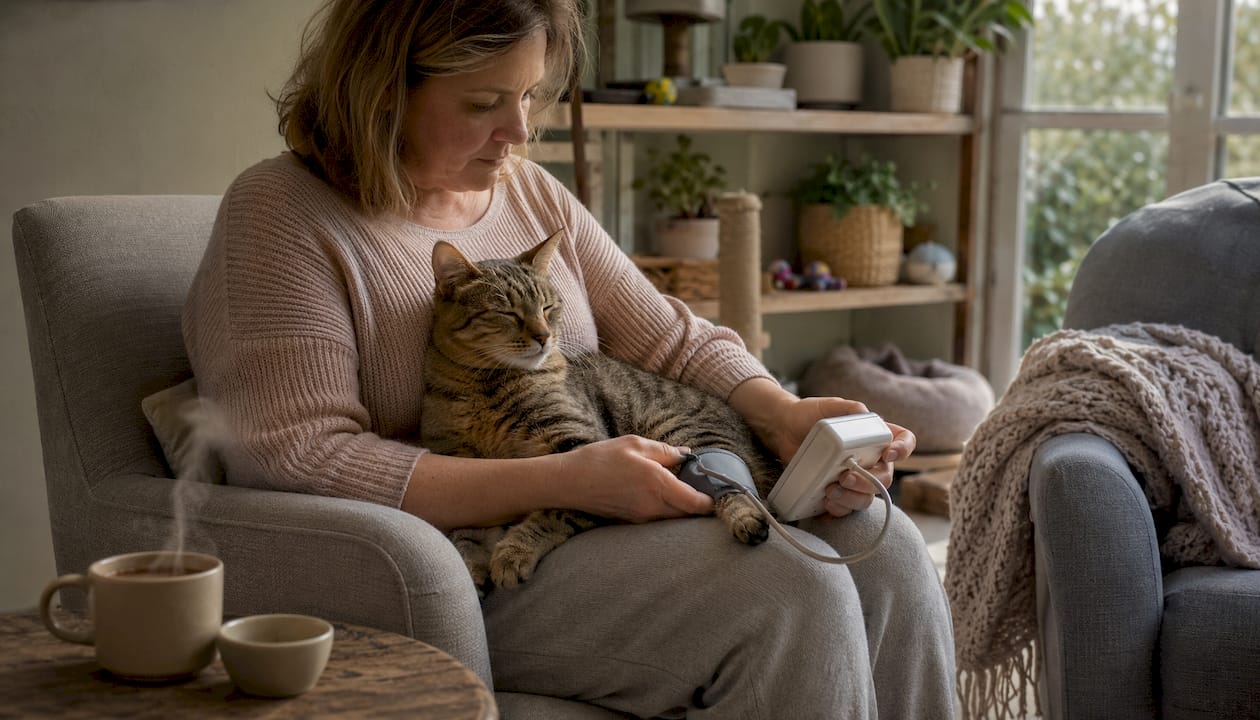
What is realistic: Some clinics offer loaner or rental oscillometric or HDO units for owners who want to track BP between appointments. A trained owner, working under veterinary supervision, can take useful readings at home, particularly for a cat that is extremely anxious at the clinic. House calls from a veterinary technician are another option that brings clinic-grade equipment and technique directly to the cat’s environment.
The limitations are significant. Owner technique variability is the biggest problem. Cuff mis-sizing, inconsistent placement, failure to discard the first reading, and using a single session’s result to make treatment decisions all introduce error. HDO devices connected to a PC or tablet allow waveform visualization to catch artifacts, but most owners are not trained to interpret those waveforms. Home readings should always be shared with the vet and verified periodically against clinic measurements.
A practical home-monitoring checklist:
-
Practice the acclimatization routine at home before the first measurement session.
-
Always use the same site, cuff size, and body position across sessions.
-
Take multiple readings per session and send the averaged result (not individual readings) to your vet.
-
Keep a written log with date, time, site, cuff size, and individual values.
-
Schedule a clinic verification session every few months to calibrate home readings against a technician-performed measurement.
Home monitoring supplements clinic care. It does not replace it.
How do you interpret your cat’s blood pressure results?
The thresholds used in U.S. veterinary practice come from AAFP and ISFM resources and align with ACVIM recommendations. SBP is the primary value assessed.
| SBP range (mmHg) | Risk category | Clinical implication |
|---|---|---|
| Below 140 | Minimal risk | Routine monitoring; recheck per age/risk schedule |
| 140–159 | Borderline (low-moderate risk) | Recheck more frequently; investigate underlying disease |
| 160–179 | Hypertension (moderate risk) | Discuss diagnostics and possible treatment with vet |
| 180 or above | Severe hypertension (high risk of TOD) | Prompt treatment; assess for target-organ damage |
A single elevated reading does not automatically mean a cat is hypertensive. The first reading is always discarded. If the averaged result falls at 160 mmHg or above, the next step is a conversation about further diagnostics (bloodwork, urinalysis, thyroid panel) and whether antihypertensive treatment is appropriate. For readings in the 140–159 range, the standard approach is to recheck sooner and watch for trends rather than treat immediately.
Clinical context shapes every decision. A cat with CKD and an SBP of 158 mmHg warrants closer attention than a healthy 6-year-old with the same number. Evidence of TOD — retinal changes, left ventricular hypertrophy, proteinuria — moves the threshold for action lower regardless of the exact SBP figure.
How often should your cat’s blood pressure be checked?
Frequency depends on age and underlying health status. These intervals reflect current AAFP and ISFM guidance:
-
Healthy adult cats (under 7 years): BP screening is not routinely required but is reasonable as part of a senior wellness workup when other risk factors are present.
-
Senior cats (7–10 years): At least once every 12 months, ideally as part of an annual wellness check.
-
Geriatric cats (11 years and older): Every 6–12 months, or more frequently if the vet identifies risk factors.
-
Cats with CKD, hyperthyroidism, or other known risk factors: Measure at diagnosis and recheck every 3–6 months, or per the treating vet’s recommendation.
-
After starting antihypertensive treatment: Close monitoring until BP stabilizes, then interval per clinician guidance based on IRIS and AAFP recommendations.
-
Pre-anesthetic evaluation: A BP check before any sedation procedure is standard practice for cats with known or suspected cardiovascular or renal disease.
The AAFP Hypertension Toolkit specifically recommends establishing an individual baseline for cats 10 years and older, because a single elevated reading is much harder to interpret without prior values to compare it against.
What causes high blood pressure in cats?
Secondary hypertension — elevated BP driven by an underlying disease — accounts for the majority of feline hypertension cases. The most common causes are:
-
Chronic kidney disease: The single most frequent driver; reduced renal perfusion activates the renin-angiotensin-aldosterone system, raising BP.
-
Hyperthyroidism: Elevated thyroid hormone increases cardiac output and peripheral vascular resistance; BP often normalizes after thyroid treatment, but not always.
-
Diabetes mellitus: Less common than CKD or hyperthyroidism but still a recognized risk factor.
-
Adrenal disease: Hyperaldosteronism (Conn’s syndrome) and pheochromocytoma are rare but important causes to rule out in refractory hypertension.
-
Certain drug therapies: Erythropoietin and some other medications can elevate BP as a side effect.
Primary (idiopathic) hypertension, where no underlying cause is found, does occur in cats. Estimates suggest it may account for roughly 20% of cases, though the true proportion varies across studies. When a cat is diagnosed with hypertension, the workup almost always includes bloodwork and urinalysis to look for CKD and hyperthyroidism first, because treating the underlying disease often reduces BP significantly.
Common pitfalls that skew readings and how to avoid them
Blood pressure measurement in cats is, as one clinical commentary puts it, “as much an art as a science.” Technique errors are the most common source of false highs and false lows.
Pitfalls that produce falsely high readings:
-
Cuff too narrow for the limb circumference
-
Cuff placed below heart level
-
Cat not acclimatized (white-coat effect)
-
First reading included in the average
-
Noisy or chaotic environment during measurement
Pitfalls that produce falsely low readings:
-
Cuff too wide for the limb circumference
-
Cuff placed above heart level
-
Poor Doppler probe contact (insufficient gel or thick fur)
-
Weak signal mistaken for flow return at a lower pressure
Accuracy boosters that actually work:
-
Measure limb or tail circumference at every visit and select the cuff accordingly.
-
Use the same site, position, and device across visits for meaningful trend data.
-
Always discard the first reading.
-
Average at least three consistent subsequent readings.
-
If home and clinic readings consistently conflict, schedule a side-by-side comparison with a technician.
When to call the clinic immediately: repeated home readings at or above 160 mmHg, any sudden vision change, seizure activity, or unexplained behavioral shift in a cat with known hypertension or CKD.
How Cityanimalvet approaches blood pressure testing
At Cityanimalvet, feline blood pressure checks follow the same protocol outlined in ISFM and AAFP guidelines, with one addition that makes a real difference for anxious cats: the option to have it done at home.
In-clinic protocol: Cats are brought into a dedicated quiet room, separate from the main waiting area and away from any dogs. A trained technician allows 5–10 minutes of undisturbed acclimatization before placing the cuff. The first reading is always discarded. Cuff site, size, device, and patient demeanor are recorded in the patient file so every future visit builds on a consistent baseline. Cityanimalvet’s Fear Free approach means minimal restraint, calm handling, and the option to reschedule if a cat is too stressed for a reliable reading.
House-call option: For cats that become severely anxious at the clinic, or for owners who cannot easily transport their pet, Cityanimalvet offers house-call BP appointments using portable Doppler and HDO equipment. Measurements taken in a cat’s home environment often produce lower baseline readings, which can be clinically meaningful when trying to distinguish true hypertension from white-coat effect.
Key Takeaways
Accurate feline blood pressure monitoring requires the right equipment, a stress-minimized environment, and consistent technique — the protocol matters as much as the device.
| Point | Details |
|---|---|
| Doppler is the preferred method | ISFM guidelines identify Doppler sphygmomanometry as the most reliable indirect method for conscious cats. |
| Cuff sizing is critical | Cuff width should equal 30–40% of limb or tail circumference; wrong sizing is the most common source of error. |
| Always discard the first reading | The first reading is nearly always an outlier; average the next 3–5 consistent values for the clinical result. |
| Know the thresholds | SBP below 140 mmHg is minimal risk; 140–159 is borderline, 160–179 is moderate hypertension, and 180 mmHg or above requires prompt action. |
| Cityanimalvet offers both options | In-clinic Fear Free BP checks and house-call appointments are available for cats that do not travel well. |
What owners consistently get wrong about blood pressure monitoring
The most common mistake is treating a single reading as a diagnosis. One number, taken on one day, in one environment, tells you almost nothing on its own. What matters is the trend across multiple sessions, taken consistently, with the same cuff at the same site. Owners who bring in a home reading of 175 mmHg and want to start medication immediately are understandably worried, but a single home reading without a documented baseline, a verified cuff size, or a technician-confirmed technique is not enough to act on.
The second thing owners miss is the log. A BP log does not need to be complicated — date, site, cuff size, individual readings, and averaged result is sufficient. That log is what allows a vet to distinguish a genuine upward trend from normal day-to-day lability. Without it, every appointment starts from scratch.
Ask your vet about loaner devices or house-call options if clinic visits are consistently stressful for your cat. Share your cat’s full medical history at every BP appointment, including any recent medication changes, because several drugs affect BP directly. Accurate blood pressure monitoring is usually quick and painless when done with the right technique and a calm cat.
Blood pressure checks at Cityanimalvet: what to do next
If your cat is 10 years or older, has been diagnosed with CKD or hyperthyroidism, or has shown any signs of high blood pressure — sudden vision changes, unexplained neurologic symptoms, or a recent abnormal reading — a dedicated BP appointment is the right next step.
Cityanimalvet offers technician-led, Fear Free blood pressure checks at its Brooklyn clinic, with the same service available as a house call for cats that do better at home. No full exam required — a standalone BP appointment is available specifically to minimize stress and get a reliable reading. For cats already on antihypertensive treatment, regular rechecks are part of the monitoring plan.
Book online or call to request a BP appointment or house call at Cityanimalvet. Mention that you want a dedicated blood pressure check so the team can set up the quiet room and allow proper acclimatization time before your cat arrives.
Useful sources and further reading
The clinical guidance in this article draws on the following primary references. Owners who want to discuss interpretation or monitoring plans with their vet can bring these documents to the appointment.
-
ISFM Consensus Guidelines on the Diagnosis and Management of Hypertension in Cats — the primary international guideline document covering diagnosis, measurement methods, thresholds, and treatment.
-
AAFP Hypertension Toolkit — Measuring Blood Pressure — practical protocol guidance including cuff sizing, acclimatization, and reading interpretation, produced by the American Association of Feline Practitioners.
-
AAFP Hypertension Toolkit resource page (CatVets) — the online companion resource with SBP thresholds and clinical decision guidance.
-
ISFM Practical Considerations: Blood Pressure Measurement — practical guidance on HDO use, artifact detection, and tail cuff placement.
-
Cornell Feline Health Center — Hypertension — accessible owner-facing overview of feline hypertension from Cornell University College of Veterinary Medicine.
-
EveryCat Health Foundation — Measuring Blood Pressure in Cats — a practical owner-facing summary of why and how BP is measured in cats.
Bring any of these to your next appointment if you want to walk through the measurement protocol or discuss what your cat’s readings mean in the context of its specific health history.