
If you're flying internationally or returning from a country with high rabies risk, you will almost certainly need a USDA-endorsed health certificate for your pet. For domestic flights, many airlines require a Certificate of Veterinary Inspection dated within 10 days of departure. The immediate next step is the same in every case: contact a USDA-accredited veterinarian as early as possible, then verify the rules with USDA APHIS, the CDC, and the U.S. Department of State for your specific destination.
Table of Contents
- When do you need a pet health certificate for travel?
- What does a pet health certificate actually contain?
- How do you get a pet health certificate in the United States?
- What does USDA endorsement mean and how do you get it?
- What do airlines and TSA actually check?
- How do you verify destination-country rules and U.S. re-entry requirements?
- Special cases that need extra planning
- Your pre-travel checklist and sample timelines
- Key Takeaways
- The part of pet travel paperwork most owners get wrong
- Cityanimalvet makes the travel certificate process straightforward
- Official sources and next steps
When do you need a pet health certificate for travel?
The answer depends on where you're going and how you're getting there.
Domestic flights. Most major U.S. carriers require a Certificate of Veterinary Inspection for pets traveling in-cabin or as checked baggage. The certificate must typically be dated within 10 days of departure, though each airline sets its own window. Some states, including Hawaii, Guam, Puerto Rico, and the U.S. Virgin Islands, have their own entry requirements that go beyond what any airline asks. APHIS does not regulate interstate pet movement; each state or territory sets its own rules.
International outbound travel. There is no single universal health certificate accepted everywhere. Destination-specific requirements determine what documentation, vaccinations, and tests your pet needs. Most countries require a USDA-endorsed certificate, and many also require microchipping, rabies titers, parasite treatments, or import permits completed in a specific sequence before the certificate can even be issued.
Returning to the U.S. This is where owners are most often caught off guard. Re-entry is treated as a distinct import event. Pets arriving from countries the CDC classifies as high-risk for rabies face stricter rules that can include quarantine or denial of entry at the owner's expense. Prior U.S. residency does not bypass current CDC import rules.
- Hawaii, U.S. territories, and rabies-free countries typically impose the strictest requirements and longest lead times.
- Dogs from high-rabies countries may need additional permits or advance CDC approval before departure.
- Cats generally face fewer restrictions than dogs, but destination rules still apply.
- Exotic species and wildlife often require separate federal permits entirely outside the pet travel framework.
Pro Tip: Confirm both the airline's certificate requirements and the destination country's import rules before you book anything. Airline rules and country rules are independent of each other, and both can block travel.
What does a pet health certificate actually contain?
A standard certificate captures the animal's identity, health status, and fitness to travel. Most include: owner name and contact information, animal species and breed, age, sex, and color, microchip number, current vaccinations (rabies vaccine manufacturer, lot number, and expiration date), clinical examination findings, a fitness-to-travel statement, and the issuing veterinarian's name, license number, accreditation number, signature, and date.

Beyond the certificate itself, you'll likely need to carry supporting documents. Rabies vaccination records are nearly universal. Many destinations require serologic titer test results proving adequate rabies antibody levels, and those tests must be done at an approved laboratory with results meeting the destination's minimum threshold. Some European countries require documented tapeworm treatment administered within a specific window before arrival. Import permits, parasite treatment records, and certified translations may also be required depending on where you're going.
APHIS Form 7001 is a general-purpose export health certificate used when no country-specific form exists. If a country-specific certificate is available on the APHIS pet travel pages, that form is the only one APHIS will endorse for entry into that country. Airlines sometimes require a separate form for boarding, and APHIS will only endorse the destination country's certificate, not an airline-specific form. Ask your accredited veterinarian which forms your trip requires before the appointment.
How do you get a pet health certificate in the United States?
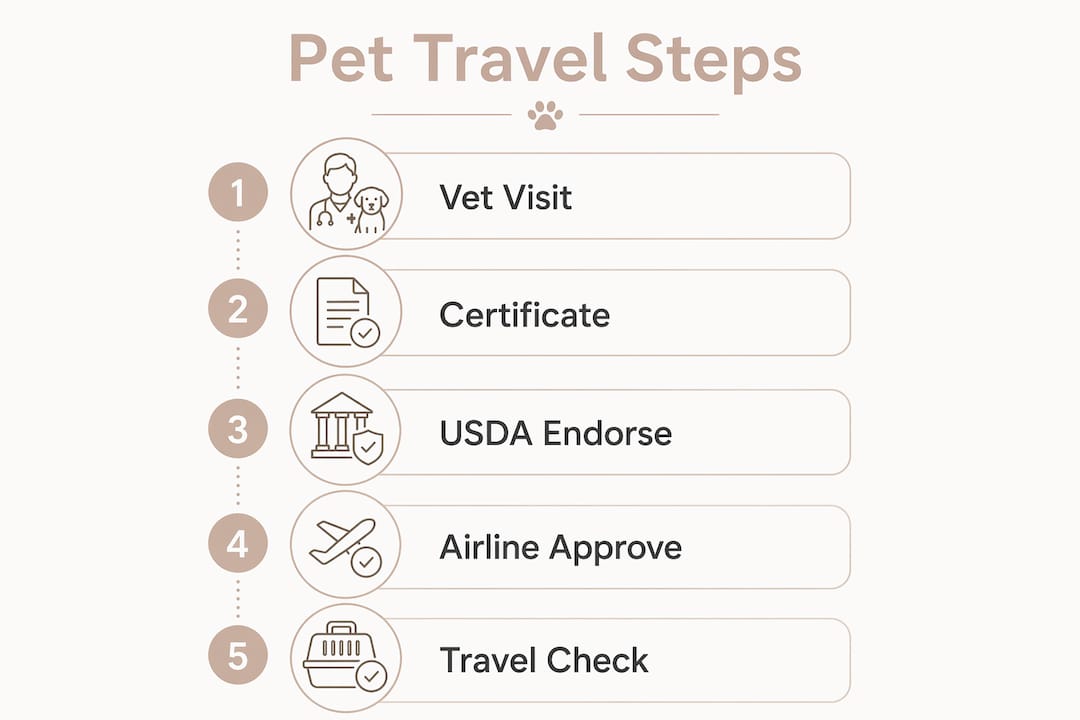
The certificate is the end product of a sequence of medical steps. Getting the sequence wrong can invalidate the whole process, so the order matters as much as the tasks themselves.
- Locate a USDA-accredited veterinarian. Only accredited vets can issue certificates that require USDA endorsement. Accreditation is voluntary and state-specific; a standard wellness exam with a non-accredited vet will not satisfy international requirements. Use the NVAP Lookup Tool on the APHIS website to find one near you.
- Schedule an early assessment visit. Before any vaccines or tests, have the vet evaluate whether your pet is a safe travel candidate. Brachycephalic breeds, very young or senior animals, and pets with chronic conditions may face restrictions or need medical clearance. This visit also maps out your testing timeline.
- Complete required vaccinations and tests in the correct order. Rabies vaccination must precede titer testing, and titer results must meet the destination's minimum level before the certificate can be issued. Some destinations require the microchip to be implanted before the rabies vaccine is given, or the vaccine may not count.
- Confirm microchip compatibility. Many countries require an ISO 11784/11785-compliant 15-digit microchip. If your pet has an older 9- or 10-digit chip, bring a compatible scanner or have a second chip implanted.
- Collect all supporting documents. Lab results, import permits, prior vaccination records, and any consular approvals must be assembled before the final exam.
- Schedule the final pre-travel exam and certificate issuance. The vet completes the physical exam, fills out the required forms, and signs the certificate. For most airlines, this exam must happen within 10 days of departure.
- Submit for USDA endorsement. The vet submits via VEHCS or provides the signed paperwork for you to ship to the USDA Endorsement Office.
| Trip type | Earliest action needed | Typical lead time |
|---|---|---|
| Domestic flight | Book vet exam | 10 days before departure |
| Travel to EU/EFTA | Titer test after rabies vaccine | 4–8 weeks minimum |
| Travel to rabies-free countries (e.g., Australia, Japan) | Microchip, vaccine, titer, permit | up to six months or more |
| Return from high-rabies country | Verify CDC/USDA re-entry rules | Begin before leaving the U.S. |
Complex international destinations can require up to six months of advance planning for titers, permits, and sequencing. Start earlier than you think you need to.
Pro Tip: Even if VEHCS is used for electronic submission, many border officials require the physical original endorsed paperwork with wet-ink signatures or an embossed stamp. Carry originals; digital copies are a backup, not a substitute.
What does USDA endorsement mean and how do you get it?
Endorsement is the USDA's counter-signature and embossed or stamped seal applied to a completed health certificate. It is what transforms a vet-signed document into an officially recognized export certificate. Many destination countries will not accept a certificate without it.
There are two submission methods, and you must choose one:
- VEHCS (Veterinary Export Health Certification System): Your USDA-accredited veterinarian logs into VEHCS, completes and electronically signs the certificate, and submits it directly to APHIS for review and endorsement. Some countries also accept a digitally endorsed certificate returned through VEHCS, meaning the entire process can happen without paper. Check the VEHCS Country Acceptance List to confirm whether your destination qualifies.
- Physical shipment: The vet signs the paper certificate and gives it to you. You then overnight-ship the complete package (certificate, supporting documents, and payment) to your regional USDA Endorsement Office.
Do not use both methods for the same certificate. Submitting via VEHCS and simultaneously shipping paper creates duplicate submissions and delays.
Common reasons endorsements are delayed or rejected: incomplete forms, missing lab reports, wrong payment method, or supporting documents not included in the shipment package. If a country requires tapeworm treatment after endorsement, include all original documents when shipping so the vet can add the treatment record before travel.
Pro Tip: Call your USDA Endorsement Office before submitting to confirm accepted payment methods and current processing times. Processing windows vary by office and season, and a missed payment method is one of the most common causes of avoidable delays.
What do airlines and TSA actually check?
Airlines and TSA play separate roles, and conflating them causes confusion.

Airlines set their own pet travel rules independent of USDA and CDC. Before booking, contact the carrier directly to confirm: whether they accept the destination country's endorsed certificate for boarding, whether they require a separate fitness-to-fly statement, the allowed carrier dimensions for in-cabin versus cargo travel, and any breed restrictions. Many airlines require a certificate dated within 10 days of departure, but the exact window varies by carrier. Some airlines have suspended pet cargo programs entirely for certain routes or seasons.
For multi-leg itineraries, verify every carrier that will physically transport your pet, including connecting carriers. Each airline on the ticket may have different requirements, and the strictest one governs.
TSA screens passengers and baggage for security purposes. TSA does not endorse veterinary paperwork and has no role in approving or rejecting health certificates. For in-cabin pets, you will remove your pet from the carrier at the security checkpoint; the carrier goes through the X-ray machine. Gate agents, not TSA, are the ones who may ask to see documentation for in-cabin animals.
How do you verify destination-country rules and U.S. re-entry requirements?
Rules change, and the consequences of getting them wrong range from a rejected certificate to a pet denied entry at the border. Use primary sources, not travel blogs.
- USDA APHIS country pages: The starting point for outbound travel. Search your destination country to find the required forms, vaccinations, tests, and treatments. If your destination is not listed, APHIS has not received that country's requirements; contact the destination country's embassy or consulate directly and get any guidance in writing.
- CDC importation pages and Yellow Book: Essential for re-entry planning and for understanding restrictions on dogs from high-rabies countries. The CDC Yellow Book chapter on traveling with pets covers both outbound health prerequisites and return requirements.
- U.S. Department of State travel pages: Country-level alerts, consular contact information, and links to destination veterinary authorities. Useful when APHIS pages don't list your destination's requirements.
- Destination veterinary authority and consulate: For countries with complex or frequently updated rules, contact the destination's ministry of agriculture or its U.S. consulate directly. Request all guidance in writing and in English.
For return trips: verify CDC and USDA re-entry rules before you leave the U.S. Some requirements, such as pre-departure microchipping or titer testing, must be completed on U.S. soil to count toward re-entry. Waiting until you're abroad to check is too late.
Special cases that need extra planning
Brachycephalic breeds (bulldogs, pugs, French bulldogs, Persian cats, and similar short-nosed animals) face respiratory risks in cargo holds. Many airlines have banned them from cargo entirely, and some restrict them in-cabin during hot months. An early assessment with your vet is not optional for these animals.
Very young or geriatric pets and those with chronic conditions may not be safe travel candidates at all. A vet-issued fitness-to-travel statement carries real weight here; no certificate can override a medical contraindication.
Exotic species and certain wildlife fall outside the standard pet travel framework. They may require U.S. Fish and Wildlife Service permits, CITES documentation, or both, in addition to any USDA or CDC requirements. Start with the destination country's wildlife import rules and work backward.
Service animals travel under separate airline and entry rules that differ from standard pet certificates. Documentation requirements vary by carrier and destination; confirm with the airline and the destination country's consulate well ahead of travel.
High-rabies countries and quarantine destinations require the most lead time. If your pet cannot meet entry requirements, neither you nor APHIS can waive another country's rules. The only path is a written waiver from the destination country's ministry of agriculture, which is rarely granted quickly. If the animal is not a safe or eligible travel candidate, consider ground transport alternatives, postponing the trip, or arranging qualified local care. A pet sitter guide can help you evaluate care options when travel is not feasible.
Your pre-travel checklist and sample timelines
What to bring to the vet appointment:
- Microchip documentation (chip number and brand)
- Current rabies vaccination certificate
- Previous titer test results (if applicable)
- Import permit from the destination country (if already obtained)
- Any prior health certificates or treatment records
- Airline pet policy printout confirming their certificate requirements
What to carry during travel:
- Original signed and USDA-endorsed health certificate
- Rabies vaccination certificate (original)
- Titer test results (original lab report)
- Import permit (original, if required)
- Microchip documentation
- Scanned PDFs accessible by email and saved to your phone
Sample timelines:
- Local or state travel by car: Check destination state rules; some require a Certificate of Veterinary Inspection. Schedule vet exam within 10 days of travel.
- Domestic flight: Book vet exam within 10 days of departure; confirm airline's exact window.
- Travel to EU/EFTA: Begin at least 4–8 weeks out; titer test must follow rabies vaccination with a waiting period before the certificate can be issued.
- Travel to Australia, Japan, or other rabies-free countries: Begin up to six months or more before departure; import permits, titers, and parasite treatments must be completed in sequence.
- Return from a high-rabies country: Verify CDC and USDA re-entry rules before leaving the U.S.; some steps cannot be completed abroad.
Pro Tip: Store scanned copies of every document in two places: your phone's photo roll and a cloud folder you can access without cell service. Originals travel with you; backups save you if originals are lost or damaged.
Key Takeaways
A valid pet health certificate for travel requires completing vaccinations, tests, and microchipping in the correct sequence, then obtaining USDA endorsement before departure.
| Point | Details |
|---|---|
| Start with an accredited vet | Only USDA-accredited veterinarians can issue certificates that qualify for USDA endorsement; find one via the NVAP Lookup Tool on APHIS. |
| Timing is the biggest risk | Domestic certificates require a vet exam within ~10 days; international destinations can require up to six months of advance planning for titers, permits, and sequence requirements. |
| USDA endorsement is mandatory for most international travel | Only USDA can apply the counter-signature and embossed stamp; submit via VEHCS or overnight shipment, never both. |
| Carry originals, not just digital copies | Many border officials require physical endorsed paperwork; digital backups supplement but do not replace originals. |
| Cityanimalvet handles the full process | Cityanimalvet offers USDA-accredited travel exams, VEHCS assistance, and house calls for pets in the Brooklyn area. |
The part of pet travel paperwork most owners get wrong
Most of the stress around pet travel certificates comes from treating the certificate as the task, when it's actually the result of a sequence of medical steps that have to happen in the right order. A rabies vaccine given after microchipping is fine; a rabies vaccine given before microchipping may not count toward a titer test in countries that require the chip to precede the vaccine. That one sequencing error can push your timeline back by months.
The other thing owners consistently underestimate is the re-entry side. Traveling out of the U.S. with a pet feels like the hard part, but returning from a high-rabies country can be more complicated. The CDC treats it as a fresh import event, and the rules have tightened in recent years. Checking re-entry requirements before you leave U.S. soil is not overcautious; it's the only way to guarantee you can bring your pet home without a quarantine or a denied entry.
The practical fix is an early assessment visit with a USDA-accredited veterinarian, not a standard wellness exam. That visit is where you map the timeline, catch sequencing risks, and confirm whether your pet is actually a safe travel candidate. Everything else follows from there.
Cityanimalvet makes the travel certificate process straightforward
Getting a pet health certificate right the first time means working with a veterinarian who knows the USDA endorsement process, not just the exam. Cityanimalvet, based in Brooklyn, NY, has USDA-accredited veterinarians on staff who handle the full workflow: the pre-travel health assessment, required vaccinations and titer coordination, certificate completion, and VEHCS submission for endorsement. For pets who find clinic visits stressful, Cityanimalvet's Fear Free approach and house call service mean the exam can happen in a familiar environment, which matters when you need a calm, accurate clinical assessment on a tight timeline.
Book your travel health assessment well ahead of your departure date. For domestic flights, aim for within 10 days of travel. For international destinations, book the initial assessment as soon as you know you're traveling. Schedule your appointment at Cityanimalvet online or by phone, and bring your destination country's import requirements to the first visit.
Official sources and next steps
The table below lists the primary authorities to consult for your specific trip, what to look for on each, and the immediate action to take.
| Source | What to look for | Next step |
|---|---|---|
| USDA APHIS Pet Travel | Destination country requirements, required forms, endorsement instructions | Search your destination country; note required forms, vaccines, and tests |
| USDA APHIS Accredited Vet FAQ | Form requirements, VEHCS eligibility, country-specific certificate guidance | Confirm which certificate form your destination requires |
| USDA Export Health Certificates | Step-by-step export process, endorsement office contacts | Find your regional endorsement office and confirm processing times |
| CDC Traveling with Pets | Health prerequisites, titer requirements, re-entry rules | Check re-entry rules for your destination before leaving the U.S. |
| U.S. Department of State | Country alerts, consular contacts, destination veterinary authority | Look up your destination country for embassy contacts and local import rules |
| Cityanimalvet (Brooklyn, NY) | USDA-accredited travel exams, VEHCS assistance, house calls | Contact the clinic to schedule your pre-travel assessment |
This article is general information, not veterinary or legal advice. Pet travel rules change frequently; confirm current requirements with USDA APHIS, the CDC, and your destination country's authorities before travel.