Most puppies start their first vaccines at 6–8 weeks of age, receive boosters every 2–4 weeks until at least 16 weeks, and get their rabies vaccine somewhere in the 12–16 week window. That three-to-four-visit series is the backbone of every puppy immunization schedule, and completing it on time is the single most important thing you can do for your new dog's health.
Here's the quick-reference checklist most vets follow:
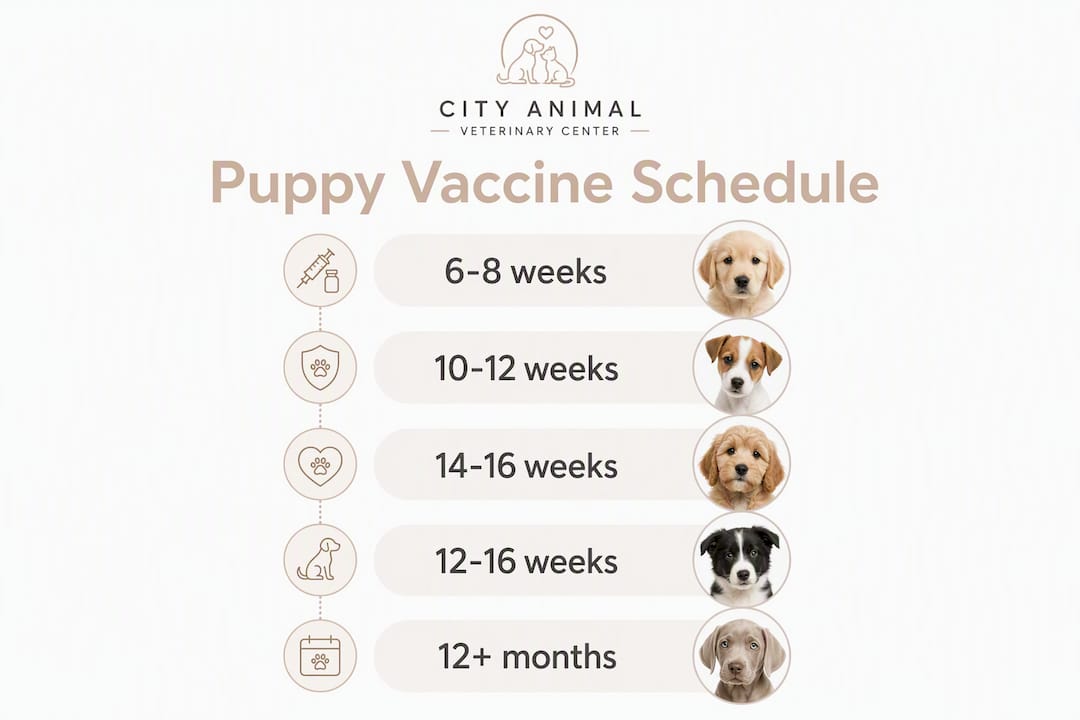
- 6–8 weeks: DA2PP (distemper, adenovirus, parvovirus, parainfluenza) — first dose
- 10–12 weeks: DA2PP booster; optional lifestyle vaccines (bordetella, leptospirosis, Lyme) begin
- 12–16 weeks: Rabies vaccine (timing depends on your state's law)
- 14–16 weeks: DA2PP final primary dose; lifestyle vaccine boosters as needed
- Optional: Optional additional booster in early adulthood for puppies in high-risk situations
A puppy is considered fully vaccinated once the final primary dose is given and 1–2 weeks have passed for protective antibodies to form. Until that window closes, skip the dog park.
Table of Contents
- Which vaccines does your puppy actually need?
- What does the standard puppy vaccination timeline look like?
- What diseases are these vaccines actually preventing?
- What should you expect after vaccines, and when should you call your vet?
- How vets tailor schedules and reduce stress during visits
- Rabies rules, vaccine records, and what "fully vaccinated" really means
- Quick checklist: the most important puppy vaccine actions to take now
- What our team tells every new puppy owner
- Puppy vaccines, Fear Free™ visits, and house calls at City Animal Veterinary Center
- Key Takeaways
- Trusted references and further reading
Which vaccines does your puppy actually need?
Not every vaccine on the market belongs on every puppy's schedule. Veterinarians divide them into two clear categories: core and non-core (also called lifestyle vaccines).
Core vaccines are recommended for every puppy, regardless of where they live or how they spend their days. The four core vaccines are:
- Canine parvovirus (CPV): Highly contagious, often fatal in young dogs
- Canine distemper virus (CDV): Attacks the respiratory, gastrointestinal, and nervous systems
- Canine adenovirus-2 (CAV-2): Protects against infectious hepatitis and respiratory disease
- Rabies: Legally required in most U.S. jurisdictions; fatal to animals and people
According to UC Davis vaccination guidelines, modified live vaccines (MLV) for parvovirus, distemper, and adenovirus should be given every 3–4 weeks starting at 6–8 weeks, with the final dose no earlier than 16 weeks. That timing is non-negotiable — it's built around how maternal antibodies fade.
Lifestyle (non-core) vaccines are recommended based on your puppy's specific exposure risk, geography, and daily routine. These include:
- Leptospirosis: Increasingly recommended for urban dogs, including those in cities like New York
- Bordetella (kennel cough): Required by most boarding facilities and doggy daycares
- Lyme disease: Relevant for puppies in tick-heavy regions
- Canine influenza: Recommended for dogs that socialize frequently or travel
Leptospirosis is worth a special mention: some veterinary authorities now consider it a core vaccine in urban and suburban settings because of widespread wildlife exposure. Your vet will know whether your neighborhood warrants it.
Combo vaccines like DA2PP (also labeled DHPP or DAPP depending on the manufacturer) bundle the four core antigens into a single injection, which means fewer needles per visit and a simpler vaccination schedule for puppies.
Pro Tip: Before your first appointment, jot down your puppy's typical week: Does she go to a dog park? Will she board? Do you hike in wooded areas? That five-minute exercise helps your vet decide which lifestyle vaccines make sense — and which ones you can skip.
What does the standard puppy vaccination timeline look like?
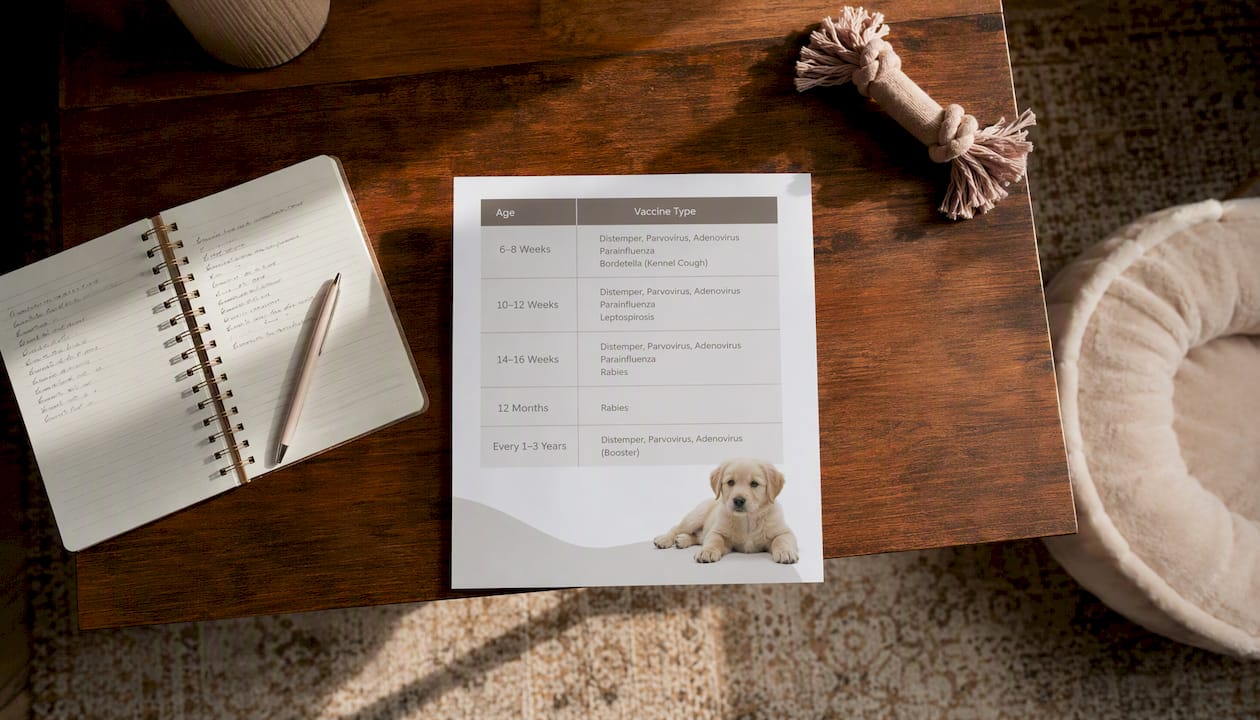
The table below reflects the schedule most U.S. veterinarians follow, based on WSAVA and AKC guidance. Exact timing may shift slightly depending on your vet's protocol and your puppy's health history.
| Age | Core Vaccines | Common Lifestyle Vaccines |
|---|---|---|
| 6–8 weeks | DA2PP (first dose) | — |
| 10–12 weeks | DA2PP (second dose) | Bordetella, leptospirosis (first dose) |
| 12–16 weeks | Rabies (per local law) | Lyme, canine influenza (first dose) |
| 14–16 weeks | DA2PP (final primary dose) | Leptospirosis, Lyme, canine influenza boosters |
| ~6 months | Optional DA2PP booster | Lifestyle boosters as needed |
Why the 2–4 week spacing matters
The gap between doses isn't arbitrary. Maternal antibodies — the immunity a puppy inherits from her mother's milk — gradually decline over the first weeks of life, but they decline at different rates in different puppies. A vaccine given while maternal antibodies are still high may be neutralized before the puppy's own immune system can respond. Spacing doses 2–4 weeks apart gives the immune system repeated opportunities to respond as maternal protection fades.
The final core dose must be given at or after sixteen weeks for this reason. A puppy vaccinated only through 12 weeks may still have had enough maternal antibodies to block the earlier doses, leaving her unprotected without anyone realizing it.
In high-risk situations, some vets may extend the series beyond sixteen weeks. The WSAVA vaccination guidelines also suggest considering an additional booster around 6 months of age to catch puppies whose early immune responses were blunted by lingering maternal antibodies.
Practical scheduling tips
- Space appointments 2–4 weeks apart — closer than 2 weeks doesn't give the immune system enough time; longer than 4 weeks may leave gaps in protection.
- Combine vaccines when possible — combo shots like DA2PP reduce the number of injections per visit without compromising effectiveness.
- Ask about the 6-month booster — not every puppy needs it, but for those in high-exposure environments, it's a reasonable safety net.
- Bring records from the breeder or shelter — if your puppy already received a first dose at 6 weeks, your vet can build the schedule from there rather than starting over.
What diseases are these vaccines actually preventing?
Understanding what each vaccine targets makes the timing feel less like a bureaucratic checklist and more like a genuine health strategy.
Canine parvovirus
Parvovirus is one of the most serious threats to unvaccinated puppies. It attacks the gastrointestinal tract and immune system, causing severe vomiting, bloody diarrhea, and rapid dehydration. The virus survives in soil and on surfaces for months, which means a puppy can be exposed without ever meeting another dog. Survival rates improve significantly with aggressive veterinary treatment, but the disease is brutal and expensive to manage.
Canine distemper
Distemper spreads through respiratory secretions and attacks multiple body systems simultaneously. Early signs look like a bad cold — runny nose, coughing, lethargy — but the disease progresses to neurological damage in many cases. There is no cure; treatment is supportive. Vaccination has made distemper rare in well-vaccinated populations, but outbreaks still occur in areas with low vaccine coverage.
Adenovirus (infectious canine hepatitis)
CAV-2 vaccination protects against both infectious canine hepatitis (caused by CAV-1) and respiratory disease. Hepatitis caused by CAV-1 can cause acute liver failure in young dogs. The CAV-2 vaccine provides cross-protection against CAV-1 with fewer side effects than the older CAV-1 vaccine, which is why it replaced it in modern combo shots.
Parainfluenza
Parainfluenza is one of several pathogens that contribute to kennel cough (infectious tracheobronchitis). On its own it causes a persistent, honking cough that's more annoying than dangerous in healthy dogs, but it can be serious in puppies or immunocompromised animals. It's included in most DA2PP combo vaccines.
Rabies
Rabies is fatal to virtually all mammals once clinical signs appear, including humans. The CDC identifies rabies vaccination of pets as one of the most effective public health measures available. Most U.S. states require dogs to be vaccinated against rabies by law — not just as a veterinary recommendation, but as a legal obligation. Failing to vaccinate puts your dog, your family, and your community at risk.
Leptospirosis
Leptospirosis is a bacterial infection spread through the urine of infected wildlife, including rats, raccoons, and deer. Dogs pick it up by drinking from puddles or standing water contaminated with infected urine. It can cause kidney and liver failure, and it's transmissible to humans. Urban dogs are at real risk, particularly in cities where rodent populations are dense.
Bordetella (kennel cough)
Bordetella bronchiseptica is the primary bacterial cause of kennel cough. The disease spreads rapidly in any setting where dogs are in close contact: boarding facilities, dog parks, groomers, training classes. Most boarding kennels and daycares require proof of bordetella vaccination before entry. The vaccine is available as an injection, nasal spray, or oral dose.
Lyme disease
Lyme disease is caused by Borrelia burgdorferi, transmitted by deer ticks. It's most prevalent in the Northeast, upper Midwest, and Pacific Coast. Signs in dogs include lameness, joint swelling, fever, and in severe cases, kidney disease. The vaccine is recommended for puppies in endemic regions and for dogs that spend time in wooded or grassy areas.
Canine influenza
Two strains of canine influenza virus (H3N2 and H3N8) circulate in the U.S. The disease spreads quickly in social settings and causes coughing, nasal discharge, and fever. Most dogs recover, but severe cases can develop into pneumonia. The bivalent influenza vaccine covers both strains and is recommended for dogs that board, attend daycare, or travel frequently.
What should you expect after vaccines, and when should you call your vet?
Most puppies handle vaccines without any drama. Mild reactions are normal and typically resolve within 24–48 hours.
Common mild reactions:
- Soreness or mild swelling at the injection site
- Low-grade fever
- Decreased appetite for a day
- Lethargy or reduced energy
For mild reactions, the best approach is simple: let your puppy rest, keep fresh water available, and skip intense exercise for the rest of the day. Most puppies bounce back by the next morning.
Call your vet immediately if you notice:
- Facial swelling, hives, or itching around the face and ears
- Vomiting or diarrhea that starts within an hour of the appointment
- Difficulty breathing or wheezing
- Collapse or extreme weakness
- Swelling that spreads beyond the injection site
- Pale gums
Severe allergic reactions (anaphylaxis) are rare, but they can happen within minutes to an hour after vaccination. Staying near the clinic for 15–20 minutes after the appointment gives you a safety window. Serious reactions are uncommon enough that they shouldn't discourage vaccination, but any unexpected response deserves a call to the clinic so it can be documented and factored into future appointments.
How vets tailor schedules and reduce stress during visits
No two puppies are identical, and a good veterinarian doesn't treat them as if they are. Several factors can prompt a modified vaccination schedule for puppies.
When maternal antibodies change the plan
The multi-dose primary series exists precisely because maternal antibodies decline at unpredictable rates. A puppy from a highly vaccinated mother may carry strong maternal immunity well past 12 weeks, which can block vaccine response. For puppies in high-risk environments — dense urban areas, shelters, or households with multiple dogs — vets may extend the series to 18–20 weeks to maximize the chance of a successful immune response. This isn't a sign something is wrong; it's the schedule doing its job.
Other reasons a schedule might shift
- Prior vaccine reactions: A puppy that had a significant reaction to a previous dose may need premedication, a modified product, or a longer interval before the next shot.
- Illness or immunocompromise: Vaccines work best in healthy immune systems. A puppy fighting an infection or on immunosuppressive medication may need to wait.
- Geographic disease prevalence: A puppy in a Lyme-endemic county gets the Lyme vaccine; one in a low-tick urban apartment probably doesn't need it.
- High-exposure lifestyle: Puppies headed for boarding, daycare, or dog sports need bordetella and possibly canine influenza earlier in the schedule.
Making the appointment less stressful
Fear Free™ veterinary care is a structured approach to reducing anxiety during vet visits, and it makes a measurable difference in how puppies experience medical care. Fear Free™ techniques include using high-value treats, minimizing wait times in stressful areas, using gentle handling, and creating positive associations with the exam table and equipment.
Things you can do before the appointment:
- Bring your puppy's absolute favorite treat — something she doesn't get at home
- Take a few short car rides before the first vet visit so the car itself isn't stressful
- Consider an Adaptil pheromone collar or spray, which can reduce anxiety in some puppies
- Schedule the appointment at a quieter time of day if your puppy is easily overstimulated
If your puppy is extremely anxious about travel or the clinic environment, a house call is worth considering. City Animal Veterinary Center offers home visit veterinary care as an alternative to in-clinic appointments, which removes the car ride, the waiting room, and the unfamiliar environment from the equation entirely. For puppies with high anxiety or owners who find transport difficult, it's a practical option that doesn't compromise the quality of care.
Pro Tip: Ask your vet to do a "happy visit" before the first vaccine appointment — a brief, treat-filled visit with no procedures. Puppies that associate the clinic with good things before anything uncomfortable happens tend to be calmer patients for life.
When deciding whether to add lifestyle vaccines, run through this quick checklist with your vet:
- Does your puppy go to dog parks, boarding, or daycare? → Bordetella, canine influenza
- Do you live in or visit tick-heavy areas? → Lyme
- Does your puppy have access to puddles, ponds, or wildlife? → Leptospirosis
- Are you in a high-density urban area with rodent exposure? → Leptospirosis
Rabies rules, vaccine records, and what "fully vaccinated" really means
Rabies timing and the law
Rabies vaccination isn't optional in the United States. Most states require it by law, and the timing varies by jurisdiction. As a concrete example, California requires the first rabies vaccine by four months of age, with a minimum age of 12 weeks. Your state may have a different deadline, so check with your local animal control authority or ask your vet for the specific rule in your area.
The rabies vaccine is typically given at a separate appointment from the DA2PP series, or at the same visit as the 12–16 week DA2PP dose, depending on your vet's protocol and local law.
What "fully vaccinated" actually means
"Fully vaccinated" doesn't mean "had at least one shot." It means the complete primary series is finished and the immune system has had time to respond. According to AAHA canine vaccination guidelines, it typically takes 1–2 weeks after the final primary dose for protective antibodies to reach adequate levels. During that window, your puppy is still vulnerable. Dog parks, boarding facilities, and high-traffic areas should wait until that period has passed.
Keeping records
Vaccine documentation matters more than most owners realize. Boarding kennels, daycares, groomers, and airlines all require proof of vaccination, and some require specific formats.
Practical records checklist:
- Request a written vaccine certificate at every appointment
- Record the vaccine name, lot number, and date given
- Ask for an electronic copy stored in your clinic's patient portal
- Keep a physical copy somewhere easy to find (a folder in the car works well)
- Note the date the next booster is due on your phone calendar
If you're planning to travel with your puppy, especially internationally, vaccine documentation requirements become significantly more detailed. Preparing for a move or trip with pets well in advance makes the paperwork far less stressful.
Quick checklist: the most important puppy vaccine actions to take now
The vaccination schedule for puppies is straightforward when you break it into concrete steps. Here's what to do:
- Book the first appointment as soon as your puppy arrives home, ideally at 6–8 weeks of age
- Space boosters 2–4 weeks apart and don't skip or delay doses without a vet's guidance
- Get the rabies vaccine in the 12–16 week window per your state's law
- Wait 1–2 weeks after the final primary dose before visiting dog parks or boarding facilities
- Keep all vaccine records with lot numbers, dates, and next-due reminders
- Discuss lifestyle vaccines at the first appointment — bordetella, leptospirosis, Lyme, and canine influenza may all be relevant depending on your puppy's routine
- Ask about Fear Free™ options or house calls if your puppy shows signs of anxiety around travel or the clinic
One thing that often surprises new owners: the schedule doesn't end at 16 weeks. After the primary series, your dog will need a booster one year later, then adult boosters on a schedule your vet recommends. The puppy series is the foundation, not the finish line.
What our team tells every new puppy owner
Every puppy that comes through our door — or whose owner we visit at home — starts the same conversation: what does this puppy need right now, and what's the plan for the next four months?
The answer is almost always the same in structure, even when the details vary. Start the core series at 6–8 weeks, keep the boosters on schedule, add lifestyle vaccines based on real exposure risk rather than anxiety or habit, and give the immune system its 1–2 weeks to catch up after the final dose. That's the whole framework.
What changes is the texture. A puppy headed for a Brooklyn apartment with a rodent-active building gets a different lifestyle vaccine conversation than one going to a house in a low-tick suburb. A puppy that trembled through the car ride gets a different appointment experience than one who trotted in wagging. City Animal Veterinary Center's Fear Free™ approach and house call option exist because we've seen how much the environment of a vaccine visit shapes a puppy's relationship with veterinary care for years afterward. Getting the shots right matters. Getting the experience right matters just as much.
If you have questions after a vaccine appointment — a lump at the injection site, a puppy who seems off the next day, a reaction you're not sure about — call us. That's what follow-up is for.
Puppy vaccines, Fear Free™ visits, and house calls at City Animal Veterinary Center
Keeping a new puppy's vaccination schedule on track is easier when you have a clinic that fits your life, not the other way around.
City Animal Veterinary Center in Brooklyn offers pediatric wellness exams, complete puppy immunization schedules, and Fear Free™ appointments designed to make vaccine visits genuinely calm rather than just tolerable. For puppies who find the clinic environment stressful, or for owners who can't easily transport a young dog, house call appointments bring the same quality of care directly to your home. The team also provides vaccine record copies in formats accepted by boarding facilities, daycares, and travel authorities.
Ready to get your puppy's vaccination timeline started? Book an appointment with City Animal Veterinary Center, or call to ask about house call availability in your area. Bring whatever health records you have from the breeder or shelter — even partial records help us build the right schedule from day one.
Key Takeaways
Completing the full primary series on schedule, with the final core dose at or after 16 weeks, is the single most critical step in protecting your puppy from serious infectious disease.
| Point | Details |
|---|---|
| Start at 6–8 weeks | The first DA2PP dose should be given at 6–8 weeks; earlier than 6 weeks is not recommended. |
| Boosters every 2–4 weeks | Space each dose 2–4 weeks apart until the final primary dose at or after 16 weeks. |
| Rabies by 12–16 weeks | Rabies timing is set by state law; check your local requirement and don't delay. |
| Wait before socializing | Protective antibodies take 1–2 weeks to form after the final dose; skip dog parks until then. |
| City Animal Veterinary Center | Offers Fear Free™ puppy vaccine appointments and house calls in Brooklyn for a low-stress start. |
Trusted references and further reading
The guidance in this article draws on the following primary and authoritative sources. For local rules and a schedule tailored to your puppy, always speak directly with your veterinarian.
- CDC — Rabies and Public Health: U.S. government guidance on rabies prevention, legal requirements, and public health context.
- AAHA Canine Vaccination Guidelines: The American Animal Hospital Association's core and non-core vaccine recommendations, including timing and booster intervals.
- WSAVA Vaccination Table for Dogs: World Small Animal Veterinary Association's global reference table for core vaccine timing and the 6-month booster consideration.
- UC Davis Vaccination Guidelines: Detailed clinical guidance on MLV vaccine timing, maternal antibody interference, and rabies law examples.
- AKC Puppy Vaccination Schedule: Owner-facing schedule reference covering DA2PP timing and combo vaccine explanations.
- PetMD Puppy Vaccination Guide: Practical overview of core and lifestyle vaccines, Fear Free™ approaches, and booster cadence.
- CareCredit Vaccination Timeline: Owner-friendly vaccination timeline covering the three-dose core series and lifestyle vaccine scheduling.
Your veterinarian is the best source for rules specific to your state, your puppy's breed, and the disease risks in your area. No online guide replaces a direct conversation with the professional who knows your dog.