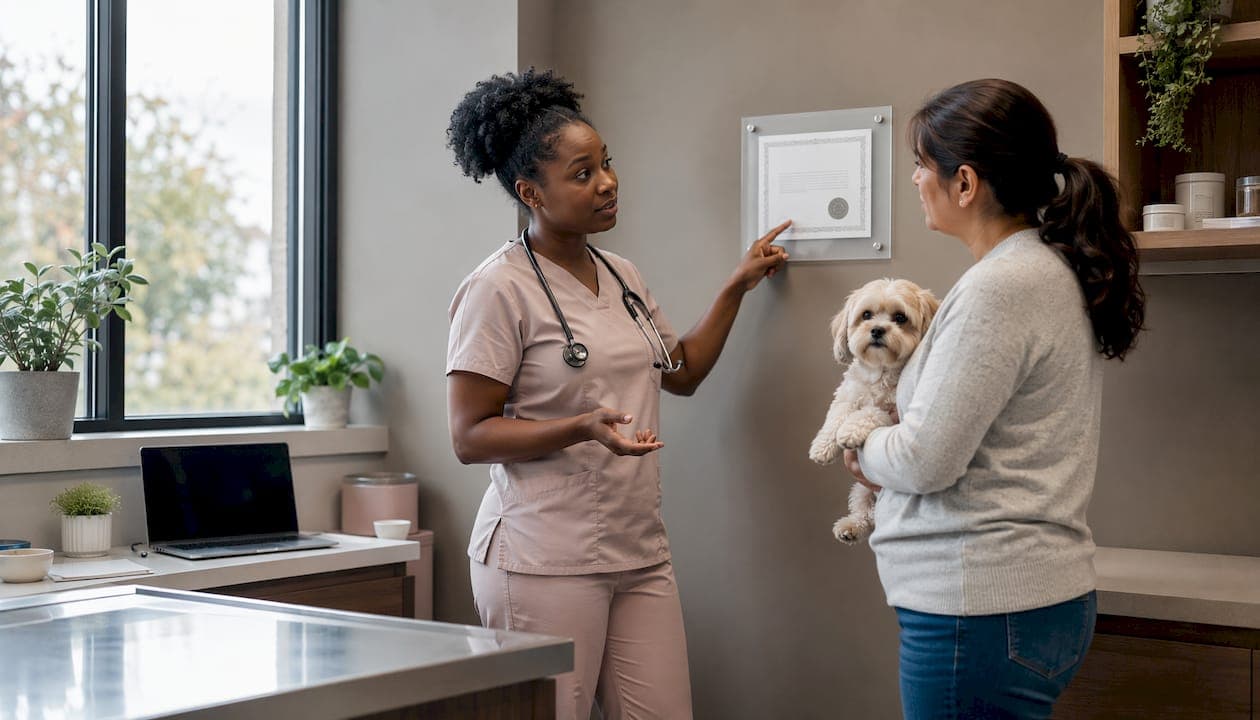
A USDA-accredited veterinarian is a licensed vet who has completed NVAP training and is authorized by USDA APHIS to examine animals and sign official health certificates for international travel. Not every licensed vet qualifies. The fastest way to find one is the APHIS "Find Accredited Veterinarians" search tool, which lets you filter by state, county, and accreditation category.
Here is what you need right now:
- Find a vet: Run the APHIS NVAP search filtered to your state and the correct category (Category I for dogs, cats, and rabbits).
- Verify the individual: Accreditation belongs to the veterinarian, not the clinic. Confirm the specific doctor who will sign your certificate.
- Use VEHCS: Ask whether your vet submits through the Veterinary Export Health Certification System (VEHCS). That is the fastest route to APHIS endorsement.
- Local option: If you are in Brooklyn, Cityanimalvet offers accredited certificate issuance and VEHCS submission support.
Table of Contents
- What a USDA-accredited veterinarian is and why NVAP categories matter
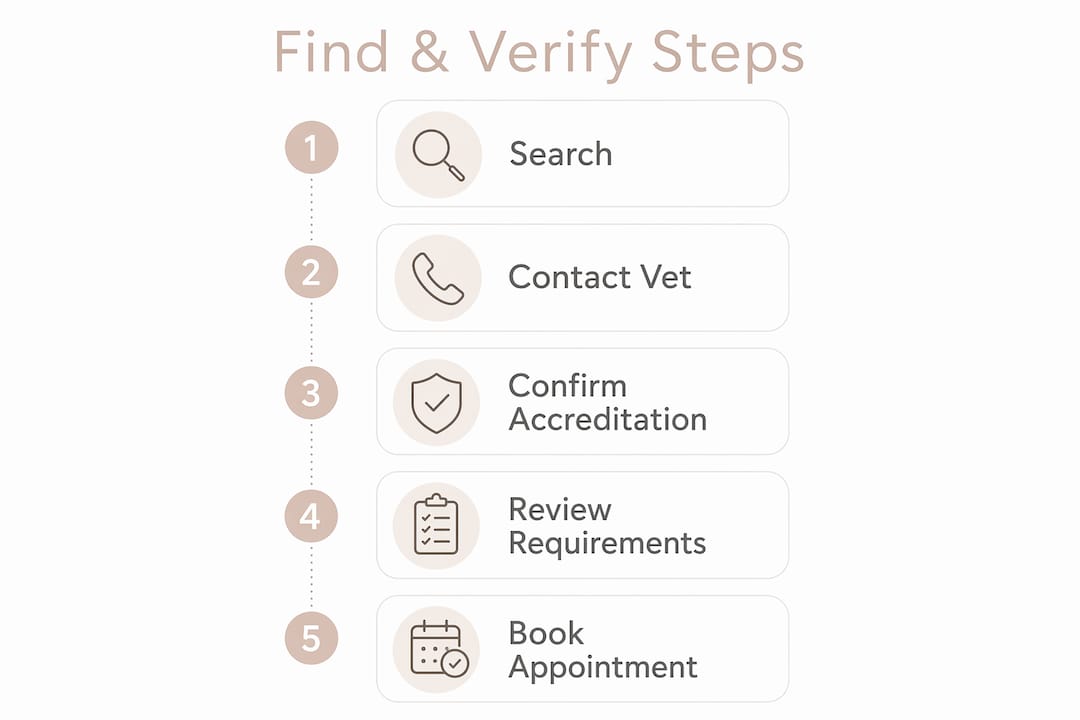
- How to find and verify an accredited veterinarian step by step
- What a USDA pet health certificate is and when you need one
- How VEHCS and APHIS endorsement actually work
- Realistic timeline and cost factors for international pet travel
- What to do when your vet does not appear in the NVAP search
- Key Takeaways
- What the process actually looks like from the clinic side
- Cityanimalvet handles USDA health certificates for Brooklyn pet owners
- Official resources for USDA pet travel and accreditation
What a USDA-accredited veterinarian is and why NVAP categories matter
USDA accreditation is granted through the National Veterinary Accreditation Program (NVAP), a voluntary, state-specific program that authorizes private-practice vets to perform regulatory duties on behalf of the federal government. Completing NVAP training is what separates an accredited vet from any other licensed practitioner. A standard state veterinary license alone does not authorize a vet to issue official export health certificates.
There are two accreditation categories, and the distinction matters for your pet:
- Category I: Covers companion animals, including dogs, cats, and rabbits. If you are traveling internationally with a pet, this is the category you need.
- Category II: Covers all animals, including livestock, poultry, and birds. A Category II vet can also issue certificates for companion animals, so they qualify for pet travel as well.
Accreditation is issued to the individual veterinarian, not the clinic or practice. A large corporate clinic may employ both accredited and non-accredited doctors. Always confirm the specific vet who will examine and sign your certificate before booking.
One more wrinkle: accreditation is state-specific. A vet accredited in California may not hold accreditation in New York. For your certificate to be valid, the vet must be accredited in the state where the physical exam and certificate issuance take place.

How to find and verify an accredited veterinarian step by step
The process is straightforward when you know what to check. Here is the sequence that avoids the most common mistakes.
Steps to locate an accredited vet
- Go to the APHIS NVAP search tool at vsapps.aphis.usda.gov/vsps/public/VetSearch.do.
- Select your state from the dropdown. Add your county if you want to narrow results.
- Choose the correct category. For a dog, cat, or rabbit, select Category I. For livestock or birds, select Category II.
- Review the results and note the individual veterinarian's name, not just the clinic name.
- Call the clinic and ask specifically: "Is Dr. [Name] currently USDA-accredited in this state, and will they be the one to sign the health certificate?"
- Ask about VEHCS. Confirm the vet submits certificates electronically through VEHCS rather than by paper mail.
- Request proof of accreditation if you want written confirmation before your appointment.
Questions worth asking before you book
- Are you accredited in this state, and under which category?
- Will you personally examine my pet and sign the certificate?
- Do you submit through VEHCS, or will I need to mail the paper certificate myself?
- How far in advance do you need to schedule a pre-travel exam?
Pro Tip: Confirm accreditation and go over your destination's requirements before you schedule the appointment itself. Discovering a paperwork gap the day of the exam costs time you may not have.
What a USDA pet health certificate is and when you need one
A USDA animal health certificate is an official document that records your pet's physical exam, vaccination history, microchip number (when required), and any lab test results the destination country demands. It is signed by a USDA-accredited veterinarian and, for most international destinations, must also be endorsed by APHIS before your pet can enter the country.
When is it required?
- Almost every international destination requires an official health certificate for dogs and cats.
- Domestic state-to-state travel generally does not require APHIS endorsement, though airlines may ask for a health certificate from any licensed vet.
- The APHIS endorsement step is specific to international export.
What the certificate typically documents:
- Physical examination findings and the date of the exam
- Current vaccinations (rabies is nearly universal; others vary by destination)
- Microchip number and implant site
- Lab test results such as a rabies titer test when required
- Any treatments completed (tick treatment, tapeworm treatment, etc.)
Some countries also accept a digitally endorsed certificate returned entirely through VEHCS, which eliminates the need for a physical stamp. Others still require a paper original with a physical APHIS embossment.
Certain destinations add requirements beyond the standard certificate. The CDC, for example, requires a "Certification of U.S.-Issued Rabies Vaccination" form for U.S.-vaccinated dogs that have recently traveled to high-risk countries for rabies within the past six months.
Pro Tip: Always verify your destination country's current entry requirements directly with that government or its consulate before the vet issues the certificate. Requirements change, and a certificate issued against outdated rules will not be accepted.
How VEHCS and APHIS endorsement actually work
There are two routes to get a certificate endorsed: electronic submission through VEHCS or paper submission by mail. VEHCS is the right choice almost every time.
The VEHCS workflow (recommended)
- The accredited vet completes and signs the certificate electronically in VEHCS.
- The vet attaches supporting documents (vaccination records, lab reports, payment).
- APHIS receives the submission and reviews it during staffed hours.
- APHIS endorses the certificate electronically; some countries accept the digital endorsement directly, others require a printed copy with a physical stamp.
- The endorsed certificate is returned to the vet, who forwards it to you.
The paper workflow (discouraged)
The vet issues a paper certificate, you or the vet mails it to the appropriate APHIS endorsement office, and APHIS mails it back with a physical stamp. Paper is slower, adds mail-transit risk, and APHIS actively discourages it.
Key constraints to know:
- APHIS endorsement offices are staffed Monday through Friday, 7:00 a.m. to 4:30 p.m. Central Time, excluding federal holidays.
- No in-person or drop-off services are available at any endorsement office.
- The vet must have funds in their VEHCS account or a USDA APHIS User Fee Credit Account to cover endorsement fees before submission.
- APHIS endorsement fees are separate from the veterinarian's own exam and certificate fees.
Pro Tip: Ask your vet to submit through VEHCS and to handle the submission themselves. When APHIS needs a correction, they communicate directly with the vet in VEHCS. If you submitted the paper certificate yourself, you become the go-between for every back-and-forth.
Realistic timeline and cost factors for international pet travel
Start early. Some destinations require a rabies titer test, and the waiting period between the blood draw and an acceptable result can run several weeks. Missing that window means your pet cannot travel on your planned date.
| Step | What happens | Timing before departure |
|---|---|---|
| Initial consultation | Review destination requirements, confirm vaccinations are current | several months out |
| Vaccinations and microchipping | Administer any missing vaccines; implant microchip if needed | several months out |
| Rabies titer test (if required) | Blood draw sent to approved lab; await results | months out |
| Pre-travel exam and certificate issuance | Accredited vet examines pet, completes and signs certificate | about a week before departure (check destination rules) |
| VEHCS submission and APHIS endorsement | Vet submits; APHIS reviews and endorses | Allow several business days minimum |
| Airline and destination confirmation | Submit endorsed certificate to airline; carry copies | At check-in and upon arrival |
Common cost factors to budget for:
- Accredited vet exam and certificate fee (set by the clinic)
- Microchip implantation if not already done
- Rabies titer test lab fee (varies by lab and destination requirement)
- APHIS endorsement fee (set by USDA; service animals under the ADA are exempt)
- Any required treatments such as tick or tapeworm medication
- Potential quarantine or re-vaccination costs if a deadline is missed
Keep digital and paper copies of every document. Airline staff and border officials at your destination will ask for them, and having backups prevents a single lost page from derailing the trip.
Pro Tip: For destinations that require a rabies titer test, begin the process at least three months before travel. Some labs take two to four weeks to return results, and many countries require a waiting period after a passing titer before the pet can enter.
What to do when your vet does not appear in the NVAP search
A missing listing does not necessarily mean the vet is not accredited. Not all accredited veterinarians authorize APHIS to release their contact information publicly, so the search results are not exhaustive.
Steps to take
- Double-check your search filters. Confirm you selected the correct state and category. A typo or wrong state will return no results for a perfectly valid vet.
- Ask the clinic directly. Request written confirmation of the vet's NVAP accreditation number and the state in which they are accredited.
- Contact the State NVAP Coordinator. State coordinators maintain complete accreditation lists and can confirm whether a specific vet is currently accredited. Find your state coordinator through the NVAP program page.
- Ask what to say. When you call the coordinator, give the vet's full name, the clinic address, and the state. Ask: "Is this veterinarian currently accredited in this state, and under which category?"
- If the answer is no or uncertain, use the NVAP search to find the nearest accredited vet in your county or the next county over.
If your travel date is close:
- Schedule a teleconsult with an accredited vet to map out the paperwork before the in-person exam.
- Consider traveling to a nearby accredited practice rather than waiting for your regular vet to complete NVAP training.
- Relying on unverified sources or informal assurances about a vet's accreditation status is one of the most common reasons pet owners end up with a certificate that APHIS cannot endorse. Treat verification as a non-optional step, the same way you would verify a breeder's credentials before purchasing a pet.
Key Takeaways
A valid USDA-endorsed international health certificate requires a currently accredited veterinarian, the correct NVAP category for your animal, and VEHCS submission to avoid endorsement delays.
| Point | Details |
|---|---|
| Accreditation is individual | Confirm the specific vet who will sign, not just the clinic name. |
| Use the NVAP search first | Filter by state and Category I or II at the APHIS search tool to find verified vets. |
| VEHCS beats paper every time | Electronic submission is faster, supports direct APHIS-to-vet corrections, and reduces errors. |
| Start months early | Titer tests and vaccination windows can require three or more months of lead time. |
| Cityanimalvet for Brooklyn clients | Cityanimalvet offers accredited certificate issuance, VEHCS submission support, and Fear Free exams for pet travel preparation. |
What the process actually looks like from the clinic side
The paperwork side of international pet travel trips up more owners than the medical side. The most common mistake is arriving at the exam with incomplete vaccination records, a microchip that was never registered, or a destination requirement the owner discovered the day before departure. By then, the timeline is already broken.
At Cityanimalvet, the pre-travel consultation exists specifically to catch those gaps before they become problems. The clinic's Fear Free approach matters here too: a stressed pet during the physical exam can produce findings that complicate the certificate, and an anxious owner rushing through paperwork is more likely to miss a required form. Slowing the process down, doing it once, and doing it right is faster in the end than correcting a rejected certificate.
For clients who cannot easily bring their pet to the clinic, house call appointments let the exam happen in the animal's own environment. That is particularly useful for pets that travel poorly or for owners managing multiple animals at once. The goal is a clean, complete submission to APHIS on the first attempt, which is the only version of this process that does not cost extra time.
Cityanimalvet handles USDA health certificates for Brooklyn pet owners
Getting your pet's travel paperwork right the first time comes down to working with a vet who knows the process cold. Cityanimalvet, located in Brooklyn, NY, is a USDA-accredited veterinary practice that issues international health certificates, submits through VEHCS, and handles the full pre-travel consultation from microchip verification to destination-specific requirements.
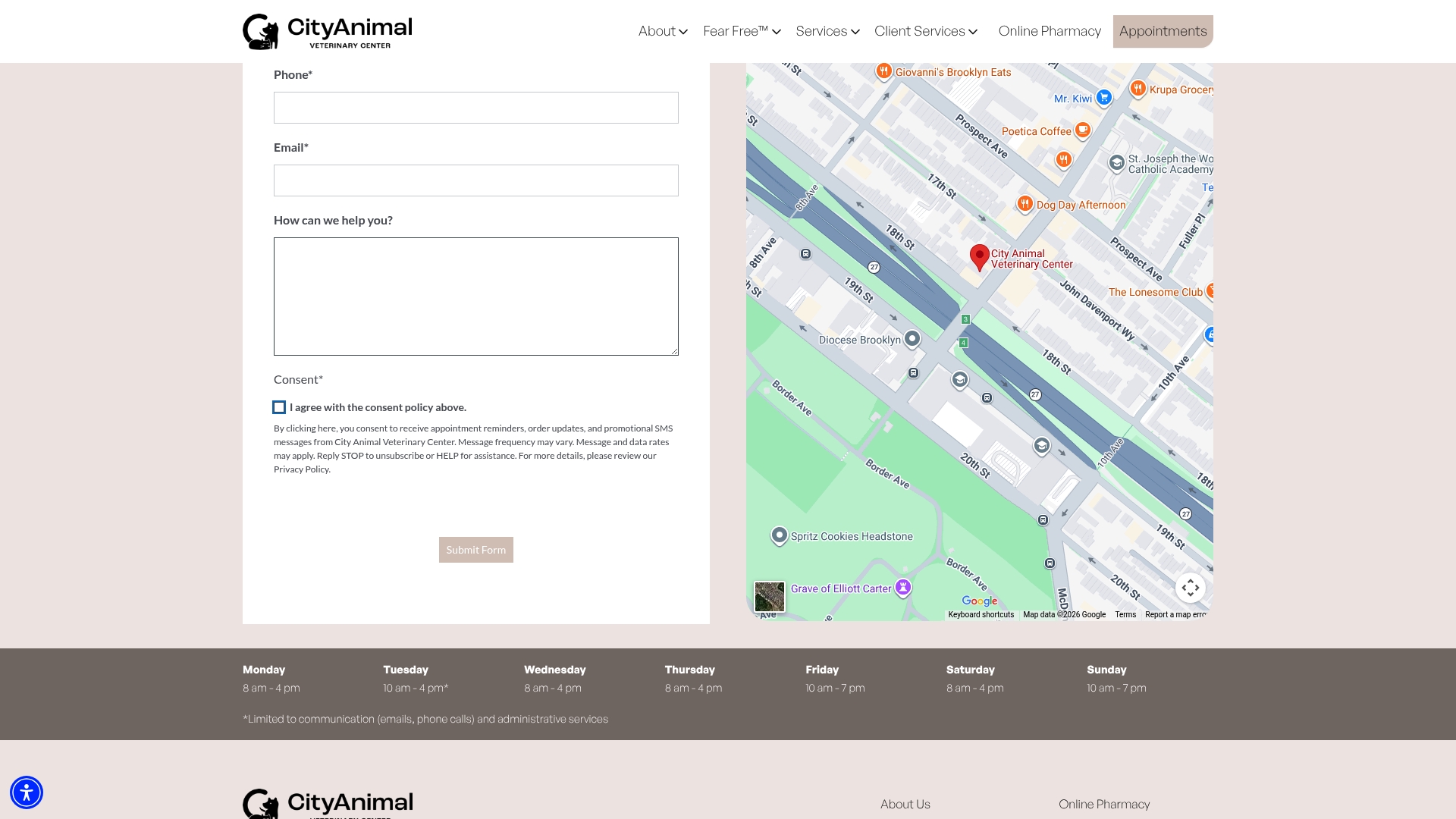
The clinic's Fear Free exams reduce stress for pets during the physical exam, and house call appointments are available for Brooklyn clients who need the exam done at home. When you book a pre-travel appointment, bring your pet's full vaccination history, microchip documentation, and the entry requirements for your destination country. The team will review everything, identify any gaps, and submit the completed certificate through VEHCS so APHIS can communicate directly with the clinic if any correction is needed.
Book your pre-travel exam at cityanimalvet.com before your departure window closes.
Official resources for USDA pet travel and accreditation
These are the primary USDA APHIS sources for any regulatory question about accreditation, health certificates, or endorsement. When in doubt, go to the source.
- Find Accredited Veterinarians (APHIS NVAP search): Run this search to locate a currently accredited vet by state, county, and category. Use it before every trip, even if you have used the same vet before.
- VEHCS (Veterinary Export Health Certification System): The electronic platform where accredited vets submit certificates for APHIS endorsement. Ask your vet to use this system.
- APHIS Pet Travel FAQ: Answers the most common questions about international travel requirements, certificate timing, and destination rules.
- Working With an APHIS Endorsement Office: Explains endorsement office hours, no-drop-off policy, and how to track a submission.
- USDA-Accredited Veterinarians: Certifying Pets To Travel: The vet-facing page that outlines responsibilities under 9 CFR 161.4, including what must be verified before a certificate is issued.
- NVAP Program Page: Find your State NVAP Coordinator here when a vet does not appear in the public search.
- Cost To Endorse Your Pet's Health Certificate: Current APHIS endorsement fee schedule. Note that APHIS fees are separate from your vet's own charges.
This article is general information, not legal or regulatory advice. Requirements change by destination and animal type. Confirm current rules with USDA APHIS, your destination country's government, or a qualified accredited veterinarian before travel.