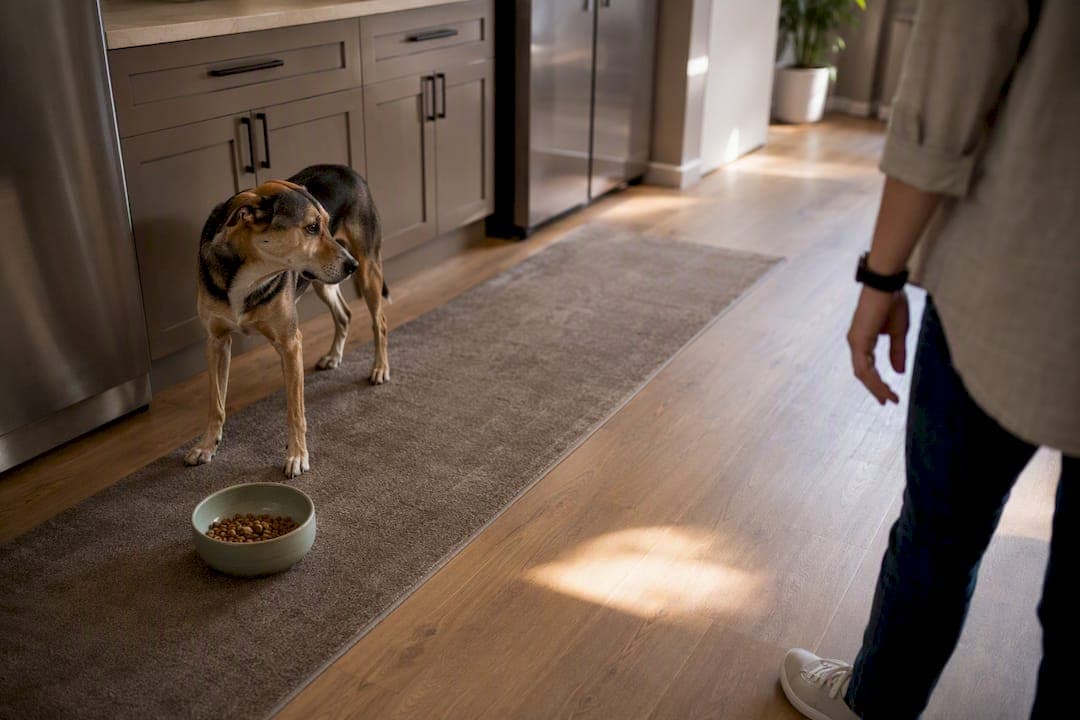
Most dogs that guard food, toys, or spaces can be managed and often significantly improved with consistent, force-free training. The priority order matters: safety first, then behavior change. Separate dogs at mealtimes, keep kids and visitors away from anything your dog protects, and rule out pain or illness with your veterinarian if the guarding appeared suddenly. Progress is usually gradual, and dogs with a bite history or severe aggression need a qualified professional before you attempt anything at home.
TL;DR:
- Dogs with resource guarding are influenced by past scarcity, learned success, medical issues, and household competition, making their behavior highly individual.
- Reading early warning signs like whale eye and stiffening can prevent escalation to bites, which often result from ignored gradual signals.
- Management strategies such as separate feedings, physical barriers, and consistent household rules effectively reduce immediate risks and prevent future guarding issues.
- Desensitization and counterconditioning, performed gradually and cautiously, can rewire a dog’s emotional response to protected items over weeks or months.
- Medical evaluation by a veterinarian is critical before treatment, especially if guarding starts suddenly or involves aggression around children or in severe cases.
Table of Contents
- What Resource Guarding Dogs Actually Do, and Why
- How to Read the Warning Signs Before They Escalate
- Immediate Safety Steps to Take Today
- The Step-by-Step Training Protocol That Changes the Underlying Fear
- Preventing Resource Guarding Before It Starts
- When to Get Professional Help: Vet First, Then a Qualified Trainer or Behaviorist
- The Fear Free Way City Animal Veterinary Center Approaches Guarding Cases
- Why the Same Dog Can Guard at Home but Not at Daycare
- Keeping Progress: Long-Term Maintenance After the Behavior Improves
- Introducing New Toys, Food, or Pets Without Triggering a Setback
- Two Households, Two Very Different Outcomes
- What We'd Tell Every Owner Facing This
- Ready to Talk to Someone About Your Dog's Guarding?
- Sources
What Resource Guarding Dogs Actually Do, and Why
Resource guarding dogs use body language, growling, snapping, or biting to keep another animal or a person away from something they value. The "something" varies wildly. It might be a bowl of kibble, a stolen sock, a favorite napping spot on the couch, a bully stick, or even a specific person the dog has decided is theirs. Some dogs guard one item obsessively and ignore everything else. Others guard almost anything that briefly becomes valuable, including a dropped tissue.
The instinct is older than domestication. Wild canids that failed to defend a kill went hungry, so guarding behavior stuck around because it worked. In a modern living room, that same wiring gets triggered by a toddler reaching for a chew toy. This is a fear-based response rooted in anxiety about losing something important, not a power play, according to COAPE. A dog who growls over a bone isn't trying to run the household. It's trying to prevent a loss it genuinely believes is coming.
Several things tend to make guarding more likely or more intense:
- Past scarcity. Dogs who competed for food as strays, in crowded shelters, or in large litters often carry that anxiety into a home with a full bowl every day.
- Learned success. If growling has ever made a hand or another dog back away, the dog has learned it works. That lesson sticks fast.
- Pain or underlying illness. A dog that suddenly guards a spot it never cared about before may be protecting a sore hip or an aching tooth, not a possession.
- Multi-dog households. Competition between housemates, especially over high-value items like a new toy or a stuffed Kong, is one of the most common guarding triggers.
- Startling encounters. A visitor reaching down suddenly, a toddler crawling toward a food bowl, or another dog crowding in during a meal can all provoke a defensive reaction even in a dog with no history of guarding.
Any dog can develop resource guarding. Breed tendencies exist, but they don't determine outcome the way genetics, environment, and individual history do, notes the American Kennel Club. A relaxed Labrador and a tense rescue terrier can both guard a rawhide, for different reasons entirely.
How to Read the Warning Signs Before They Escalate
Dogs rarely bite without warning. They usually give a series of signals first, and most bites happen because those signals got missed, ignored, or punished out of the dog. Learning to read the sequence is the single most useful skill an owner can build.
- Subtle signals. Freezing over the item, a stiff body, a lowered head hovering protectively, and "whale eye" (where you see the whites of the eyes as the dog side-glances at you without turning its head) are the earliest cues. Most owners miss these because the dog isn't making noise yet.
- Clear warnings. A low growl, lip lifting, hard stare, or a fast gulp of food are the next level. This is the dog explicitly asking for space.
- Escalated warnings. Snapping at the air, lunging without contact, or a hard body block are close to the top of the ladder. At this point, the dog has already tried quieter signals and felt they didn't work.
- Bite-risk behaviors. Air snaps that connect, muzzle punches, or an actual bite mean the dog has run out of warnings it trusts. This is the level where professional help stops being optional.
Never punish a growl. It feels like the natural response, but it removes the dog's early warning system without addressing the underlying fear, which raises bite risk rather than lowering it. A dog scolded for growling doesn't stop feeling threatened. It just learns that warning you doesn't work, so next time it skips straight to a snap. Trainers sometimes call this "silencing the growl," and it's one of the most consistent mistakes owners make with a guarding dog.
Finding your dog's distance threshold is the practical skill that everything else in this guide depends on. Threshold is the closest distance you can get to your dog and its guarded item before you see a stress signal. Here's how to find it without provoking a reaction:
Give your dog a low-value chew or a small handful of kibble in an open area. Starting from across the room, walk slowly toward your dog and stop the instant you notice freezing, whale eye, or a stiffened body. That distance is your starting threshold. Write it down. Some dogs have a five-foot threshold, others have a fifteen-foot one, and it can differ depending on the item. A dog guarding a raw bone might have a much wider threshold than the same dog guarding a plain kibble bowl.
Knowing this number turns training from guesswork into something measurable. It also tells you immediately when a dog is regressing, because the threshold will widen again if a session pushed too hard too fast.
Immediate Safety Steps to Take Today
Training takes weeks. Safety needs to start now, and it doesn't require any special skill, just consistency.
Separate mealtimes completely. If you have more than one dog, feed them at least 10 feet apart or in separate rooms with a closed door between them, a standard recommendation from behaviorist Patricia McConnell. This single change resolves a surprising share of multi-dog guarding conflicts on its own, because most fights happen when one dog finishes first and drifts toward the other's bowl.
Use physical barriers deliberately. Baby gates, closed doors, and crates aren't a failure to train, they're a legitimate management tool. A dog eating safely behind a gate isn't practicing guarding behavior on anyone, which means the behavior isn't getting reinforced by a "win."
Tether or leash during high-risk moments if you're actively working on a protocol and need full control of distance. This is a short-term tool for structured sessions, not a lifestyle.
Remove tempting items when you can't supervise. If your dog guards a specific toy, don't leave it lying around during unsupervised time. Pick it up between sessions. This isn't giving in. It's preventing a rehearsal of the behavior you're trying to change.
Handling rules matter just as much as physical setup:
- Never forcibly grab an item out of your dog's mouth. Confirming the dog's fear that a hand approaching means an item disappearing is exactly how guarding gets worse, not better, according to COAPE.
- Never punish a growl, snarl, or stiffening. Address the fear, not the symptom.
- Never let children approach a dog that's eating or chewing, even a dog that's "never done anything." Kids move unpredictably and don't read canine body language.
- Brief every visitor before they enter the house. A five-second warning ("don't reach for anything he's chewing") prevents most incidents.
- Keep rules identical across the household. If one family member allows the dog on the couch with a bone and another tries to remove it, you're teaching the dog that hands are unpredictable, which fuels guarding rather than reducing it.
If children live in the home with a dog that has already guarded something around them, treat that as a genuine red flag rather than a project to solve solo, according to the ASPCA. Get professional guidance before attempting any hands-on protocol.
Pro Tip: Keep a small notebook or phone note logging every guarding incident: what the item was, who was present, the distance, and what the dog did. Patterns show up fast, and that log is exactly what a trainer or veterinary behaviorist will ask for at your first consult.
For many mild cases, these management changes alone resolve the day-to-day risk without needing a formal desensitization program, according to Hill's Pet. Not every guarding dog needs the full staged protocol below. Some just need consistent separation and clear household rules.
The Step-by-Step Training Protocol That Changes the Underlying Fear
Management keeps everyone safe. Desensitization and counterconditioning are what actually change how your dog feels about someone approaching a valued item. The ASPCA recommends this staged approach as the standard treatment, and it works by rewiring the dog's expectation: approach should predict something better arriving, not something being taken away.
This only works while your dog stays relaxed. If you see a stress signal at any point, you've gone too far, too fast. That's not failure, that's information. Back up a step and go slower.
Before you start: setup and assessment
Confirm your dog's distance threshold using the method described earlier. Choose a treat your dog finds genuinely exciting (small pieces of chicken, cheese, or hot dog work well for most dogs) and reserve it exclusively for these sessions so it stays high-value. Pick a quiet time of day with no other pets, kids, or distractions in the room. And keep every session short. Three to six repetitions of thirty to ninety seconds each, done multiple times a day, works better than one long session, according to the ASPCA.
The four-stage progression
- "I come in peace" passes. Give your dog a low-value item at their normal eating spot. From outside their threshold distance, walk past and toss an even better treat toward the bowl without stopping, slowing down, or making eye contact. Keep walking. Repeat this several times across a session. You're teaching your dog that a person approaching predicts a bonus, not a threat.
- Closing the distance. Once your dog shows visible relaxation at the current distance (loose body, tail at a neutral position, continued eating without pausing to watch you), shrink the distance by a foot or two on the next session. You're not rushing this. Some dogs need days at each distance; others move faster. Let the dog's body language set the pace, not a schedule.
- Hand-present and trade. When your dog is comfortable with you standing right next to the bowl, start offering a higher-value treat directly from your hand while the lower-value item is still down. Once the dog reliably looks up at your hand instead of guarding the bowl, you can introduce a formal "trade": offer the better item, and as the dog releases the original one, hand over the reward. Never grab. The trade only works if the dog chooses to disengage.
- Generalize the skills. Teach or reinforce a solid "drop it" cue using the same trade-based method, and practice "go to place" so your dog has a default, guarding-free behavior to offer when something new appears. Once these are reliable with food, slowly repeat the same four stages with a couple of other guarded items. Skills don't transfer automatically. A dog perfectly relaxed about kibble bowls can still guard a rawhide fiercely until you've walked it through the same protocol.
If another dog is present anywhere in the household during any of these stages, keep that second dog leashed and focused on its own handler, well outside the guarder's threshold. If that's not manageable, get a professional in the room. Inter-dog guarding work is one of the easiest areas to accidentally worsen, per Whole Dog Journal.
Watching for the stop signs
Regression is normal and doesn't mean the protocol failed. Signs you need to pause and back up a stage: any return of whale eye, stiffening, or freezing at a distance the dog was previously fine with; faster or gulping eating; refusing treats they'd normally take eagerly (a strong sign the dog is too stressed to engage); or any growl. A growl during training isn't a setback to punish, it's data telling you the session moved too fast.
Never force access to the item and never use punishment, physical correction, or "showing the dog who's boss" at any stage. Beyond being unnecessary, it directly undermines the mechanism the whole protocol depends on, since the dog needs to believe approach is safe, not just be forced to tolerate it.
Outcomes vary by dog and by context. Shelter studies looking at dogs assessed for guarding found the behavior persisted in a wide range, from roughly 10% to 55%, after rehoming, which points to how much environment and consistent handling influence whether guarding continues or fades, per Dogster. That's a wide range, and it's exactly why the setup you build at home, calm feeding routines, consistent handling, low household stress, does as much work as the formal exercises themselves.
Preventing Resource Guarding Before It Starts
If you're raising a puppy or bringing home a new adult dog, a handful of habits make guarding far less likely to develop in the first place.
Don't snatch food away "to prove you can." This outdated advice, sometimes framed as teaching dominance, does the opposite of what people intend. It teaches puppies that hands near food mean loss, which is the exact fear that produces guarding later. Instead, occasionally walk by and drop something better into the bowl while your puppy eats. You're building the same "approach predicts good things" association proactively instead of fixing it after damage is done.
Teach "drop it" early, using trades, not force. A puppy that's traded a boring toy for a better one dozens of times before six months old rarely develops guarding around that cue later.
Keep feeding predictable. Same times, same location, same routine. Dogs that don't know when the next meal is coming are more likely to treat the current one as scarce and worth defending.
Provide enough resources, especially in multi-dog homes. Multiple water bowls, multiple resting spots, and enough toys that dogs aren't forced to compete reduce the friction that turns into guarding. This doesn't mean identical toys for every dog; it means enough variety and volume that scarcity isn't the daily reality.
Build in structured enrichment. Puzzle feeders and food-dispensing toys given on a schedule, rather than randomly, teach dogs that good things show up reliably, which lowers baseline anxiety around resources generally.
For households with more than one dog, some system-level habits help long after puppyhood:
- Feed dogs separately, permanently, even after guarding issues resolve. This isn't a temporary fix, it's smart long-term management.
- Rotate high-value toys and chews rather than leaving them out constantly, so no single item accumulates outsized value.
- Supervise directly any time a new high-value item (a fresh bully stick, a stuffed Kong) is introduced to more than one dog at once.
- Give each dog its own crate or defined space where nothing is ever taken from them, so they have a reliable zone of safety.
When to Get Professional Help: Vet First, Then a Qualified Trainer or Behaviorist
Before any training plan, rule out medical causes with your veterinarian. Pain (arthritis, dental disease, an injury), metabolic changes, or cognitive decline in older dogs can all cause a sudden onset of guarding that looks behavioral but isn't. If your dog resource guards but has never done so before, that timing alone is worth a vet visit before you start any protocol. A Fear Free exam minimizes the stress of that visit, which matters since a frightened dog at the clinic is harder to examine thoroughly.
Once medical causes are ruled out, the right professional depends on severity:
- A Certified Professional Dog Trainer (CPDT) is a solid fit for mild guarding, like a dog that stiffens over a toy but has never snapped or bitten.
- A veterinary behaviorist (Dip ACVB) or a Certified Applied Animal Behaviorist (CAAB/ACAAB) is the right call for guarding that involves biting, guarding directed at children, inter-dog aggression, or any case where you feel genuinely unsafe managing it yourself. These credentials mean years of specialized training in diagnosing and treating aggression specifically, not general obedience.
A real behavior consult should produce a concrete safety plan first: specific management rules for your household, a measured, staged protocol tailored to your dog's actual threshold, and referrals to other specialists (like your regular vet, for pain management, or a trainer for follow-through) when needed. If a professional's first move is punishment-based correction rather than a safety and desensitization plan, that's worth questioning.
The Fear Free Way City Animal Veterinary Center Approaches Guarding Cases
Because pain and anxiety are so often tangled up with guarding, City Animal Veterinary Center starts every behavior-related concern with a Fear Free physical exam. That means slower handling, treats and positioning designed to keep a dog under threshold in the clinic itself, and enough time to actually watch how a dog reacts to being touched near sore spots, not just a rushed once-over. A dog that suddenly starts guarding its bed at eleven years old deserves a hip and joint check before anyone assumes it's a training problem.
For dogs whose anxiety makes a clinic visit itself a trigger, home visits let our team assess guarding behavior in the environment where it actually happens. Watching how a dog behaves around its own food bowl, its own resting spot, and its own household members often reveals context a clinic exam room never could.
Why the Same Dog Can Guard at Home but Not at Daycare
Resource guarding isn't a fixed trait that travels identically with a dog everywhere. Environment shapes it constantly. A dog that guards fiercely at home might show almost nothing at daycare, not because the daycare dog is a different animal, but because the resource stakes are different: no owner to compete for, no favorite couch cushion, no history of scarcity in that space.
Household dynamics matter just as much as physical layout. Inconsistent rules between family members, where one person allows resource possession and another tries to remove items, teach a dog that hands are unpredictable, which increases guarding rather than reducing it. Homes with chaotic feeding schedules or frequent, unstructured competition between pets tend to see more guarding overall than calm, predictable ones.
This is good news in practice. If environment drives so much of the behavior, then changing the environment, consistent rules, predictable routines, reduced competition, is doing real therapeutic work, not just papering over a problem. It also explains why a guarding case that looks alarming in one household can look completely different after a move, a new routine, or simply everyone in the family agreeing to the same handling rules.
Keeping Progress: Long-Term Maintenance After the Behavior Improves
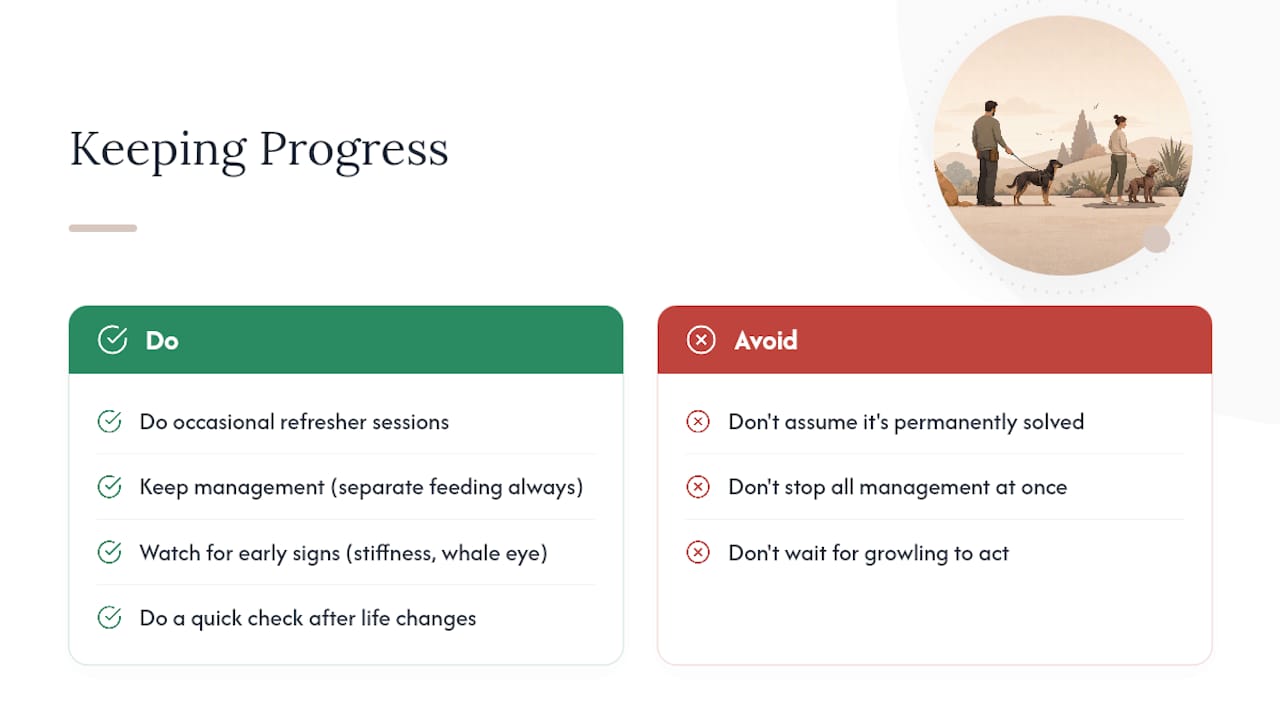
Guarding that's improved isn't guarding that's cured forever, and treating it as a permanently solved problem is the most common reason it comes back. Dogs that have made real progress still benefit from occasional refresher sessions, especially after a stressful life event like a move, a new pet, or an owner's absence.
Keep management habits in place even after training success. Separate feeding for multi-dog households should stay permanent, not conditional on how well things are going. The dogs that relapse most often are the ones whose owners declared victory and dropped every management step at once.
Watch for early signals the way you did during initial training. A returning stiffness at mealtimes or a flicker of whale eye around a new toy is a cue to revisit a stage of the protocol, not a sign everything has failed. Catching it early, at the freezing-and-stiffening stage, is far easier to correct than waiting until it becomes a growl again.
Life changes are the highest-risk moments for relapse: a new baby, a new dog, a household move, or even rearranged furniture that changes where a dog eats. Building in a quick "back to basics" check during any major transition, confirming the dog is still relaxed at its established threshold, catches problems before they become incidents.
Introducing New Toys, Food, or Pets Without Triggering a Setback
New resources are one of the highest-risk moments for a dog with a guarding history, and the mistake most owners make is introducing them casually, the same way they would with a dog that's never guarded anything.
Start any new high-value item, a new brand of chew, a new toy, a new bed, in a low-stress moment with plenty of space, and observe from a distance before assuming it's safe. Treat it as a fresh threshold test rather than assuming past training automatically covers new objects. If your dog was worked through the full desensitization protocol with a kibble bowl, that progress doesn't automatically extend to a raw bone; run the "I come in peace" stage again with the new item before assuming your dog is comfortable with it.
When bringing home a new pet, introduce feeding routines with full separation from day one rather than waiting to see if there's a problem first. It's far easier to start two dogs on separate feeding stations than to fix a fight that's already happened. The same logic applies to a new baby: begin practicing "go to place" and calm-around-food routines well before the baby arrives, so the dog already has a reliable, rewarded behavior to fall back on when a small, unpredictable human starts reaching for things.
Two Households, Two Very Different Outcomes
Consider two common scenarios that illustrate how much setup matters. In one, a two-dog household saw the older dog snap at the younger one over a food bowl left out between meals. The fix wasn't complicated: permanent separate feeding stations, gates during meals, and removing all bowls once eating finished. No formal desensitization was needed. Within a few weeks, the tension around mealtimes disappeared entirely, matching what Hill's Pet describes as the outcome for many milder cases resolved through management alone.
In another, a rescue dog with a documented history of guarding rawhides toward children required a slower path: a veterinary exam that ruled out dental pain, several weeks of daily "I come in peace" sessions building from a fifteen-foot threshold down to arm's length, and strict household rules preventing any child from approaching the dog during chewing. Progress there took months, not weeks, and included at least one regression after a house move reset the dog's comfort level temporarily. Both outcomes count as success. The difference was case severity, not effort.
What We'd Tell Every Owner Facing This
The conventional advice on resource guarding still leans too hard on outdated dominance framing, the idea that a dog guarding a bone is testing who's "alpha" and needs to be shown otherwise. That thinking gets dogs bitten and makes guarding worse, because it treats a fear response as a behavior problem to be forced out rather than an emotional state to be changed.
What actually works is less dramatic and takes longer: consistent management, a genuine medical rule-out, and slow, staged trust-building that never asks the dog to tolerate something scary in exchange for a treat, but instead teaches the dog that scary things simply don't happen anymore. Owners who skip the medical exam because "it's obviously behavioral" get this wrong more often than they'd expect. Pain hides well in dogs.
If you take one thing from this guide, let it be this: read the early signals, not the bite. Every dog that eventually bites over a resource gave quieter warnings first. Catching guarding at the freezing-and-whale-eye stage, rather than the growling stage, is the difference between a two-week fix and a months-long rebuild.
— CAVC
Ready to Talk to Someone About Your Dog's Guarding?
If your dog's guarding started suddenly, involves a bite, or happens around children, don't try to work through it alone. City Animal Veterinary Center's Fear Free exams start with ruling out pain or illness, the kind of underlying cause that mimics a training problem but isn't one. For dogs too anxious to handle a clinic visit calmly, our home visit service lets us evaluate the behavior in the setting where it actually happens, without adding a stressful car ride and waiting room on top of an already tense situation.
Before your appointment, it helps to gather a short video of the guarding behavior, a rough timeline of when it started, a list of specific triggers (food, toys, spaces, people), and any prior vet records if your dog has seen another clinic. That preparation lets us build a safety plan and a realistic training path in one visit instead of several. If dietary changes or allergies are part of the picture, our elimination diet guide is worth a look before your visit too. You can also browse general behavior resources through our partners at Haven Freedom's guides for additional reading between visits.
Ready to get your dog evaluated? Schedule a visit with City Animal Veterinary Center and start with a plan built around your dog's actual history, not guesswork.
Sources
- Food Guarding — ASPCA
- Resource guarding: why it happens and what to do — COAPE
- Resource Guarding, Dog to Dog — Patricia McConnell
- Resource Guarding in Dogs — AKC
- Food aggression in dogs — Hill's Pet