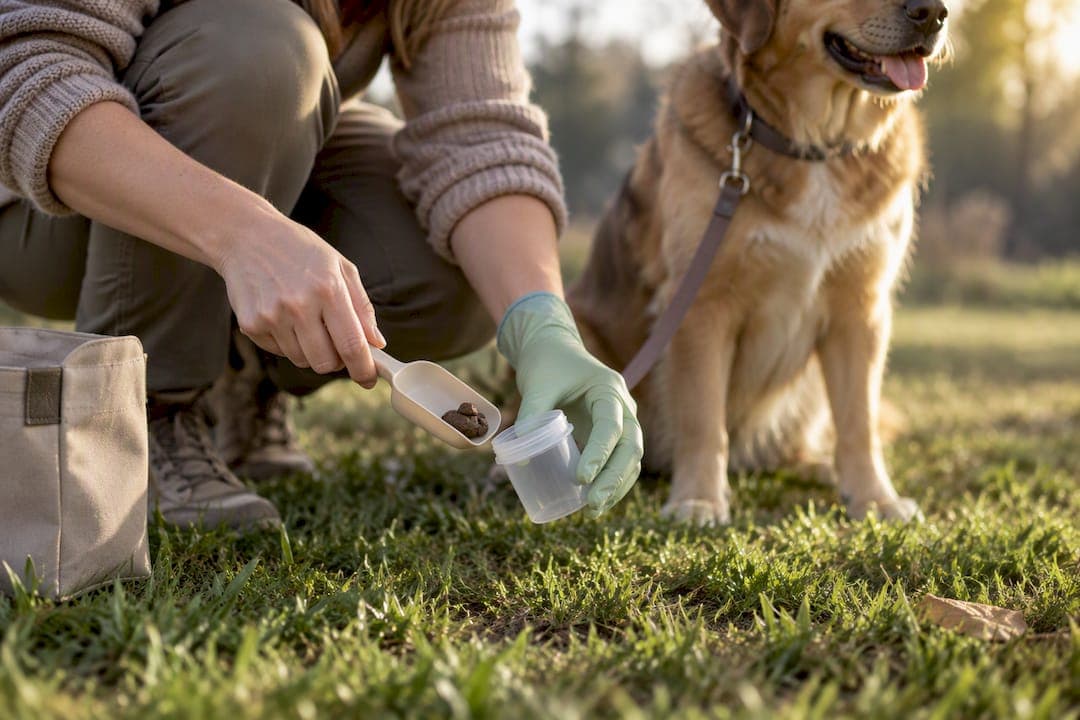
Yes, veterinarians diagnose giardia in dogs using fecal exams, antigen tests, or DNA-based methods, and often more than one. Because giardia cysts shed on and off rather than every day, a single stool sample can miss the parasite even when a dog is infected. That is why vets frequently ask for multiple samples collected over a few days. If your dog has diarrhea, the fastest first step is bringing a fresh stool sample to your vet or booking a house call for collection.
TL;DR:
- Multiple stool samples collected over several days improve the likelihood of detecting intermittent giardia cyst shedding.
- Combining various tests like flotation, antigen detection, and DNA analysis increases diagnostic accuracy and reduces false negatives.
- Fresh samples should be tested within 30 minutes for trophozoite detection or kept cool and processed the same day for cyst identification.
- Positive results in asymptomatic dogs require cautious interpretation, as shedding may persist post-treatment, and infection may not cause illness.
- Disinfection with bleach and environmental cleaning are essential to prevent reinfection, especially in multi-pet households or outbreak settings.
Table of Contents
- Which diagnostic tests veterinarians use and how they differ
- How to collect, handle, and submit fecal samples for accurate results
- Interpreting test results: what positive, negative, and equivocal results mean
- When and how to retest after treatment and follow-up guidance
- Cleaning, prevention, and reducing reinfection risk at home
- Evidence summary: what studies and guidelines say about test accuracy and best practice
- How City Animal Veterinary Center helps owners test and manage giardia with low-stress care
- Veterinarian perspective: when testing improves outcomes
- How to book testing or a house call with City Animal Veterinary Center
- Sources
- FAQ
Which diagnostic tests veterinarians use and how they differ
There is no single test that catches every giardia infection, so vets choose based on the dog's symptoms, how the sample looks, and what equipment is available. Each method has a different job.
A direct smear takes a small amount of fresh, usually watery or diarrheic stool and examines it under a microscope right away. This test looks for trophozoites, the active, swimming form of the parasite, which only survive briefly outside the body. It works best on loose stool collected within a short window because trophozoites die and become unrecognizable as the sample dries out or cools.
Centrifugal fecal flotation using zinc sulfate solution is the standard microscopy method for finding giardia cysts, the dormant, environmentally hardy form of the parasite. According to the Companion Animal Parasite Council, zinc sulfate is preferred over sugar-based flotation solutions because sugar solutions can collapse or distort the cysts, making them harder to identify. This test works on formed or semi-formed stool and is often the first test run in-house.
Antigen ELISA and rapid lateral-flow tests detect giardia proteins rather than the organism itself. These are useful when a vet suspects giardia, but flotation comes back clean, since antigen shedding does not always line up perfectly with cyst shedding. They are quick, often producing results within minutes to an hour, which makes them convenient for in-clinic use.
IFA and DFA (immunofluorescent and direct fluorescent antibody) testing are reference laboratory methods. DFA is widely considered a gold-standard method for confirming giardia because it directly visualizes cysts using fluorescent antibody staining, which improves detection compared to standard microscopy alone.
PCR (polymerase chain reaction) testing detects giardia DNA and can be the most sensitive option available. It also allows labs to identify which genetic assemblage of giardia is present, information that matters for tracking outbreaks or understanding whether a strain has zoonotic potential.
Because no individual test catches every case, vets often combine methods:
- Flotation plus antigen testing catches cases where one method misses cysts or antigen shedding.
- DFA or PCR gets called in reference labs when standard in-house tests are inconclusive or when outbreak investigation requires strain identification.
- Repeat testing across several days addresses the intermittent shedding pattern rather than relying on one snapshot.
This layered approach is exactly what guidelines from CAPC recommend: use more than one method and more than one sample when giardia is suspected clinically but not immediately confirmed.
How to collect, handle, and submit fecal samples for accurate results
Getting a useful sample matters as much as choosing the right test. A perfect antigen assay run on a degraded sample still produces an unreliable result.
"Fresh" means different things depending on the test. For a direct smear looking for trophozoites, the sample should ideally be examined within about 30 minutes of collection, since the motile form breaks down quickly once stool cools or dries. For flotation, antigen, or PCR testing, a same-day sample kept cool is generally acceptable, but older or dried-out stool reduces the chance of finding intact cysts.
Given intermittent shedding, most vets ask owners to gather more than one sample rather than a single specimen:
- Collect a small sample, roughly a teaspoon to a tablespoon, using a clean scoop or glove and place it in a sealed, leak-proof container.
- Label each container with the date and time collected, since multiple stool samples over several days improve the odds of catching the parasite during a shedding window.
- Repeat this over three to five days, aiming for two to three total samples rather than one.
- Refrigerate samples you cannot deliver immediately, but avoid freezing, which damages cyst structure and trophozoites alike.
- Transport samples to the clinic as soon as practical, ideally the same day they are collected, keeping them cool but not frozen in transit.
Tell your vet about anything relevant beyond the stool itself: when diarrhea started, whether other pets in the household have symptoms, recent boarding or daycare stays, and any exposure to ponds, puddles, or communal water bowls. These details help the clinical team decide which combination of tests makes sense and how urgently to act. Our guide to preparing for a fecal test appointment walks through what to expect when you drop off or bring in a sample.
Pro Tip: Keep a small log of collection dates and stool consistency. It takes thirty seconds and gives your vet a clearer timeline than "sometime this week."
Interpreting test results: what positive, negative, and equivocal results mean
A positive or negative result rarely tells the whole story by itself. Vets weigh the result against the dog's symptoms, age, and history before deciding on treatment.
- A positive test in a dog with diarrhea usually leads to treatment, since the parasite is a reasonable explanation for the clinical signs.
- A positive test in a dog with no symptoms is interpreted more cautiously. CAPC guidelines note that a positive result in an asymptomatic dog should not automatically trigger treatment, since giardia can be present without causing illness, and the bigger concern in that case may be environmental contamination and shedding to other animals.
- A negative test does not rule out infection. Because of intermittent shedding, a single negative flotation or antigen test can miss an active infection, which is why repeat sampling or a second test method often follows a negative result in a dog that still looks sick.
- Antigen tests can stay positive after successful treatment. The Cornell University College of Veterinary Medicine notes that antigen persistence after a dog is clinically cured can create a misleading impression that treatment failed, when in fact the antigen is simply clearing more slowly than the infection itself.
This is why clinical judgment matters as much as the lab report. A vet weighing a positive antigen result in a dog that already looks and acts healthy will factor in the timing of treatment, the dog's current symptoms, and household risk before deciding whether more testing or treatment is warranted. Our overview of giardia symptoms, diagnosis, and treatment covers how these decisions typically play out in practice.
When and how to retest after treatment and follow-up guidance
Retesting is not automatic, and running it at the wrong time can create confusion rather than clarity.
Guidance from the CDC recommends retesting only if symptoms persist after treatment, not as a routine check on every treated case. This matters because antigen tests, the most convenient option for a quick recheck, can remain positive for a period after a dog is clinically cured. Running an antigen test too soon after treatment risks a false impression that the medication failed.
- If diarrhea has resolved and the dog looks and acts normally, most vets do not recommend retesting at all.
- If diarrhea or other symptoms continue after a full course of treatment, a fecal flotation or DFA recheck, sometimes timed around 24 to 48 hours after finishing therapy, can clarify whether the infection is still active.
- PCR testing is more likely to be used in follow-up when there's an outbreak setting, such as a boarding facility or multi-dog household, where strain identification or higher sensitivity matters more.
- Ongoing diarrhea after treatment also prompts vets to consider other causes, since giardia is not the only parasite or condition that produces similar signs.
The practical takeaway is that a clean bill of health depends more on how the dog looks than on how fast you retest. Rushing back to the antigen test the week after treatment tends to muddy the picture rather than clarify it.
Cleaning, prevention, and reducing reinfection risk at home
Medication treats the dog, but the environment is often what determines whether the infection comes back. Cornell's veterinary school points out that cleaning and exposure management matter as much as the medication itself, particularly in homes with multiple dogs or in boarding and daycare settings.
- Remove feces from the yard, litter areas, or crate promptly, ideally the same day, since cysts in stool are the main source of reinfection.
- Wash food and water bowls, bedding, and toys with hot water and detergent, since residual cysts on shared items can restart the cycle.
- Bathe the treated dog, especially around the hindquarters, to remove cysts clinging to fur.
- Disinfect non-porous surfaces such as floors, crates, and kennels with steam cleaning or a diluted bleach solution where the material allows it safely.
- Launder fabric bedding and towels on the highest heat setting the material tolerates.
- Avoid standing water, puddles, and shared community water bowls until the dog has recovered and is no longer symptomatic.
In multi-pet households, isolating the treated dog's food, water, and sleeping area during treatment reduces the chance of passing cysts to other animals. This is especially relevant when only one dog in the household is showing symptoms, since apparently healthy housemates can still be shedding the parasite.
Pro Tip: Bleach solutions need contact time to work. A quick wipe-down does little; let the surface stay wet for several minutes before rinsing.

Evidence summary: what studies and guidelines say about test accuracy and best practice
Diagnostic comparisons back up what clinical guidelines already recommend: rely on more than one method rather than a single test.
DFA is generally treated as a reference standard for confirming giardia because it directly visualizes cysts through fluorescent staining, while PCR can be the most sensitive option available and adds the ability to identify assemblages for outbreak or zoonotic tracing, according to CDC guidance.
- Peer-reviewed comparisons of antigen ELISA, fecal flotation, and molecular testing in asymptomatic dogs found variable sensitivity between methods, supporting the case for combining tests rather than trusting one result alone.
- No single test performs at 100% sensitivity across all infection stages and shedding patterns, which is the core argument for repeated sampling.
- Antigen and lateral-flow assays are convenient and fast but their sensitivity and specificity vary enough that pairing them with flotation, or repeating the test, improves overall diagnostic confidence.
Diagnostic comparison studies in asymptomatic dogs show variable sensitivity across antigen, flotation, and molecular tests, which is why no single method is treated as definitive on its own. (source)
The practical conclusion for owners is straightforward even if the underlying microbiology is not: there is no perfect one-and-done giardia test. Combining a microscopy method with an antigen test, and collecting samples across multiple days, closes the gaps that any single approach leaves open.
How City Animal Veterinary Center helps owners test and manage giardia with low-stress care
City Animal Veterinary Center runs in-house laboratory testing, which allows fecal flotation and antigen testing to happen without the delay of shipping samples out, and the clinic can also arrange reference-lab PCR or DFA testing when a case calls for more sensitive or specialized diagnostics.
Collecting a stool sample and holding still for an exam is not always easy for an anxious dog, and it is not always easy for the owner managing the leash and the carrier at the same time. A Fear Free approach focuses on reducing stress during exams and sample collection, which matters most for dogs that already associate vet visits with anxiety.
For owners who cannot easily transport a sick or elderly dog, or who are managing a multi-pet household during a suspected outbreak, the home visit and house call service brings sample collection and evaluation to the dog's own environment instead.
Readers preparing for an appointment can also check the clinic's blog post on fecal tests for dogs, which covers what to expect and how to prepare a usable sample before you arrive.
Veterinarian perspective: when testing improves outcomes
Testing earns its place when a dog is symptomatic, very young, or part of a group exposure like a boarding facility or daycare outbreak. In those situations, a clear diagnosis changes what happens next: treatment starts, other dogs get screened, and the environment gets cleaned before more animals pick up the parasite.
The harder call is the asymptomatic carrier. A healthy-looking dog with a positive result does not automatically need medication, and treating every incidental positive can do more to disrupt a dog's gut flora than to help it. The better approach usually weighs the household's risk, whether there are puppies or immunocompromised pets nearby, against the discomfort of unnecessary treatment.
Either way, cleaning the environment matters as much as any prescription. A dog can be perfectly treated and still get reinfected from a contaminated yard or a shared water bowl within weeks.
— CAVC
How to book testing or a house call with City Animal Veterinary Center
If your dog has diarrhea, has been exposed to other dogs at daycare or boarding, or you simply want a clear answer instead of a guess, a wellness exam is the place to start. Bring a fresh stool sample if you can, along with notes on when symptoms started and whether any other pets in the house are affected. In-house lab testing means results on flotation and antigen tests often come back the same visit.
Fear Free techniques shape how the visit runs from the moment you walk in: handling is slower and gentler, and the goal is a dog that leaves calmer than it arrived rather than more anxious. For dogs that struggle with clinic visits, or for owners who cannot easily bring a pet in, the home visit service brings the exam and sample collection to your door instead.
Book a wellness exam or a house call today to get a clear answer on what is causing your dog's symptoms and a treatment plan that fits.
Sources
The guidance in this article draws on established veterinary and public health sources rather than general assumptions about parasite testing.
- Companion Animal Parasite Council (CAPC) — Giardia
- CDC — Clinical testing and diagnosis for giardia infection
- Comparison of 3 Diagnostic Tests for the Detection of Giardia and Cryptosporidium spp. in Asymptomatic Dogs — PMC
- Cornell University College of Veterinary Medicine — Giardia in dogs
This article is general information, not a substitute for advice from a qualified doctor. Consult a qualified healthcare professional about your own circumstances before acting on anything here.
FAQ
Can I test my dog for giardia at home?
There is no reliable at-home test for giardia in dogs. Diagnosis depends on microscopy or antigen testing performed by a veterinary laboratory, so the useful step at home is collecting a fresh stool sample correctly and bringing it to your vet or arranging a house call.
How long will a dog test positive for giardia?
Antigen tests can remain positive for a period after a dog is clinically cured, since the antigen clears more slowly than the active infection, according to Cornell's veterinary college. That is one reason routine retesting is not recommended unless symptoms persist.
What are the first signs of giardia in dogs?
The most common early sign is sudden, foul-smelling diarrhea that may be watery, soft, or contain mucus, sometimes with vomiting, weight loss, or lethargy, according to CAPC. Many infected dogs show no signs at all, which is part of why testing rather than guessing matters.
Can giardia spread from dogs to humans?
Certain giardia assemblages found in dogs have zoonotic potential, and PCR testing can identify which assemblage is present when that distinction matters for a household or outbreak investigation, per CDC guidance. Good hygiene, such as washing hands after handling stool and cleaning shared surfaces, remains a sensible precaution regardless of strain.
Why does my vet want multiple stool samples for giardia testing?
Giardia cysts shed intermittently rather than every day, so a single stool sample can miss an active infection. Collecting two to three samples over several days substantially improves the chance of catching the parasite during a shedding window.