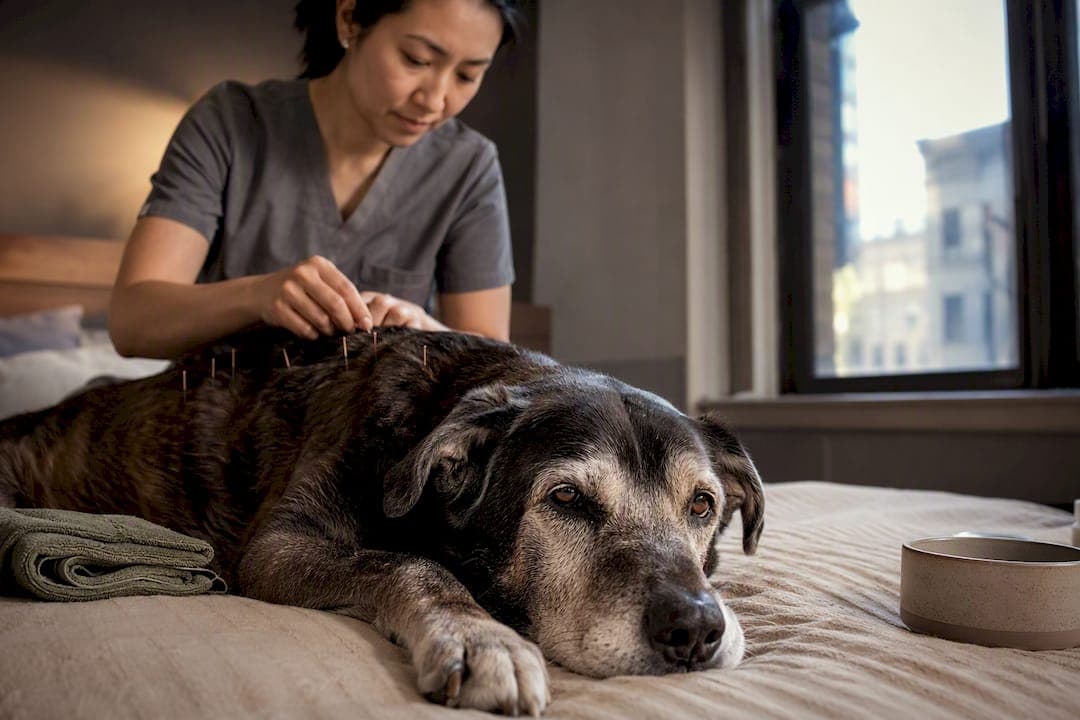
Acupuncture can help many dogs with arthritis when it's used as part of a veterinarian-directed, multimodal pain-management plan. The AAHA-aligned guidance and peer-reviewed clinical trials support it as a safe, drug-free option, though owner-reported comfort tends to improve more consistently than objective mobility scores. Talk to your veterinarian before adding it to your dog's routine.
TL;DR:
- Owner-reported improvements in pain and comfort are common, but objective measures like ground reaction forces often show inconsistent or no change.
- Multiple acupuncture sessions over several weeks are necessary to see meaningful benefits, with weekly treatments typically recommended.
- Different techniques, such as dry needling, electroacupuncture, laser, or aquapuncture, vary in intensity and suitability depending on the dog’s response and needs.
- Acupuncture is particularly valuable for dogs that cannot safely take NSAIDs due to kidney or liver issues, as it can provide pain relief without systemic drugs.
- Finding a qualified veterinarian with proper certification and equipment, and integrating acupuncture into a comprehensive care plan, maximizes the potential benefits.
Table of Contents
- How Does Acupuncture Reduce Arthritis Pain in Dogs?
- Does Acupuncture Actually Work for Dogs With Arthritis?
- What Happens During a Dog's Acupuncture Session?
- How Acupuncture Fits Into a Full Arthritis Care Plan
- How Do You Find a Qualified Veterinary Acupuncturist?
- City Animal Veterinary Center's Approach to Acupuncture Care
- Get Fear Free Acupuncture Care for Your Dog in Brooklyn
- Our Take: Why Consistency Matters More Than the Modality
- Sources
How Does Acupuncture Reduce Arthritis Pain in Dogs?
Acupuncture works by stimulating specific points on the body, mostly clustered near nerves, blood vessels, and muscle bundles. That stimulation triggers a cascade of physiologic responses that add up over a course of treatment rather than delivering instant relief.
The mechanisms behind it include:
- Nervous-system modulation that interrupts pain signals traveling to the brain
- Endorphin and enkephalin release, the body's natural pain-relieving chemicals
- Improved local blood flow, which helps deliver oxygen and clear inflammatory byproducts around arthritic joints
- Anti-inflammatory signaling that can reduce swelling and stiffness over repeated sessions
Delivery methods vary. Traditional dry needling inserts thin, sterile needles into specific points and leaves them in place for the session. Electroacupuncture adds a mild electrical current through those needles, which some studies use to intensify nerve stimulation. Laser acupuncture skips needles entirely, using focused light on the same points, a good fit for needle-shy dogs. Aquapuncture injects a small amount of sterile saline or vitamin B12 into acupoints for a longer-lasting effect between visits.
Because the benefit builds with repetition, one session rarely tells you much. Many dogs visibly relax, and some doze off, which vets take as a sign the nervous system is responding rather than the dog simply tolerating discomfort.
Pro Tip: Track your dog's mobility on a simple 1 to 10 scale before each session. Trends across several visits tell you more than how any single appointment looks.
Does Acupuncture Actually Work for Dogs With Arthritis?
The clinical picture is genuinely mixed, and that's worth saying plainly instead of glossing over it. A randomized, placebo-controlled trial in 32 client-owned dogs found that owner-completed pain and mobility scores improved with acupuncture, but objective measures like ground reaction forces and accelerometry activity data showed no consistent change. That gap between what owners see at home and what force plates measure in a lab shows up repeatedly in this research.
A separate trial on electrostimulated acupuncture for elbow arthritis found no significant effect on ground reaction forces despite owners reporting improvement, reinforcing how much protocols and endpoints vary between studies.
Laser acupuncture has encouraging early data from a small randomized controlled trial which found the treated group improved on pain and joint mobility measures, alongside favorable shifts in inflammatory and oxidative stress markers. That's a real signal, but the sample size means it needs replication before anyone calls it settled.
Three limitations show up across nearly every study in this space:
- Small sample sizes, often fewer than 40 dogs, limit statistical power
- Sham acupuncture isn't a truly inert control, since superficial needle placement can still trigger a physiological response
- The caregiver placebo effect is well documented in veterinary pain trials, meaning an owner's hope for improvement can color their scoring
None of this means acupuncture doesn't work. It means the strongest, most honest claim is that many dogs and their owners report feeling better, while lab instruments don't always agree yet.
What Happens During a Dog's Acupuncture Session?
A first visit starts with a full assessment, not needles. Your vet acupuncturist reviews your dog's history, watches gait and posture, checks joint range of motion, and coordinates with any existing medications, imaging, or bloodwork already on file.
From there, a typical course looks like this:
- Point selection and setup. The vet chooses acupoints based on which joints are affected and how your dog tolerates handling.
- Needle placement. Sessions commonly use a moderate number of needles appropriate to the dog's size and condition, though it varies by dog size and condition.
- Stimulation, if used. Electroacupuncture protocols in clinical trials often use 2 Hz stimulation, sometimes alternating with higher frequencies, applied through the needles for part of the session.
- Hold time. Most sessions run 15 to 20 minutes, occasionally up to 30, with the dog lying calmly on a mat or bed.
- Wind-down. Needles come out, and many dogs act noticeably looser or sleepier for the rest of the day.
Trials that show benefit typically use weekly sessions for several weeks before tapering frequency based on response. Watch for gradual gains: easier stairs, less morning stiffness, more willingness to walk. Minor, short-lived soreness at needle sites or brief drowsiness are the most commonly reported side effects, and dogs tend to tolerate treatment well overall.
Pro Tip: Schedule sessions after a quiet part of the day, not right after a high-energy walk. A calm dog settles into treatment faster and gets more out of it.
How Acupuncture Fits Into a Full Arthritis Care Plan
Acupuncture rarely stands alone, and it shouldn't. The strongest arthritis outcomes come from combining several tools rather than betting on one.
A typical multimodal plan includes:
- Weight management, since even a few extra pounds add measurable load to arthritic joints
- Exercise modification and physical rehab, building supportive muscle without overloading damaged cartilage
- Joint supplements, often glucosamine or omega-3 based, used alongside other therapies
- NSAIDs, when appropriate and when kidney or liver function allows
Acupuncture's real value shows up when medication options are limited. Dogs with kidney or liver disease often can't take NSAIDs safely, and acupuncture or laser acupuncture can fill that gap without added systemic drug load. It can also let some dogs get by on a lower medication dose than they'd otherwise need.
The key is coordination. Tell your vet what you're hoping to see, whether that's easier mornings or more stamina on walks, and ask them to track both what you observe at home and any objective benchmarks they can measure in the clinic.
How Do You Find a Qualified Veterinary Acupuncturist?
Not every practitioner offering "acupuncture" for pets has the training to do it safely. Start with credentials, then check practical details before booking.
Look for these credentials first:
- A licensed veterinarian with formal certification through a recognized veterinary acupuncture training program, not a course taken by a non-veterinary technician
- Membership or diplomate status with an established veterinary acupuncture organization
Confirm these practical details:
- Sterile, single-use needles for every session
- A calm, low-stress handling approach, ideally a Fear Free certified environment
- Willingness to coordinate directly with your regular vet on medications and diagnostics
- Access to laser or electroacupuncture options if needle treatment isn't a fit for your dog
Before your first visit, ask these questions:
- How many sessions do you typically recommend before reassessing?
- How will we measure whether it's working?
- Are there any conditions my dog has that would make acupuncture unsafe?
- What's the plan if my dog reacts poorly to a session?
City Animal Veterinary Center's Approach to Acupuncture Care
Anxious or arthritic dogs often struggle most with the car ride and waiting room, not the needles themselves. City Animal Veterinary Center built its Fear Free approach around that reality, using low-stress handling, treats, and a calm pace so a dog already in pain isn't also fighting fear.
For dogs who can't easily travel, or who get more anxious the moment they leave home, City Animal Veterinary Center offers home-visit acupuncture. Treating a stiff, arthritic senior dog on their own bed, in a familiar room, tends to produce a more relaxed session and a more accurate picture of how they're really moving day to day.
Get Fear Free Acupuncture Care for Your Dog in Brooklyn
City Animal Veterinary Center gives Brooklyn pet owners something most clinics can't: acupuncture delivered by a Fear Free team, either in-office or at your dog's own home, so a painful joint doesn't also mean a stressful car ride and waiting room. That matters most for arthritic dogs, since stress itself can tighten muscles and make stiffness worse.

Whether your dog needs a first acupuncture consult, a follow-up session, or a broader multimodal plan built around their specific joints and medical history, the team coordinates the whole picture rather than treating acupuncture as a standalone add-on. If you've read this far because your dog is slowing down on walks or struggling with stairs, the next step is simple: schedule a visit with City Animal Veterinary Center and ask about acupuncture as part of your dog's care plan.
Our Take: Why Consistency Matters More Than the Modality
Most of the debate around canine acupuncture gets stuck on the wrong question. People want to know if it "works," as if that's a yes or no answer waiting to be settled by one more study. The more useful question is whether it works for this dog, in this combination of therapies, tracked consistently enough to tell.
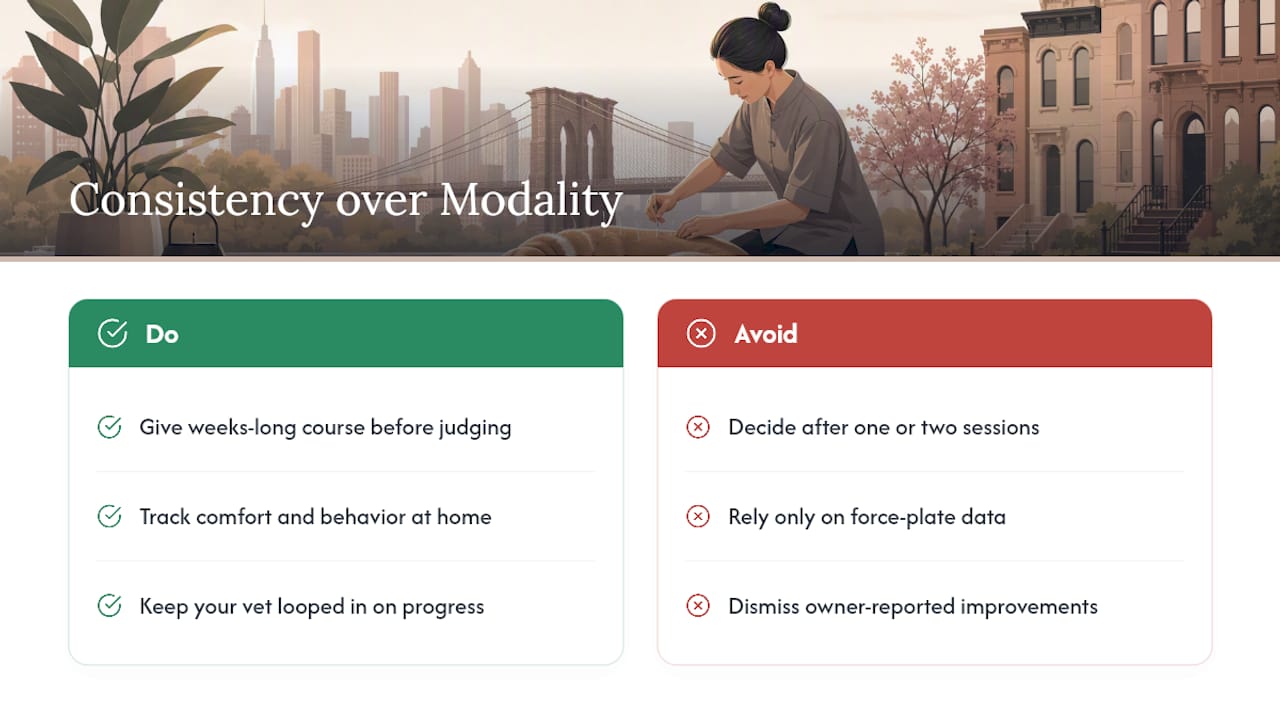
What we find striking in the research is how often owner-reported comfort improves while lab measurements stay flat. That's not proof the effect is imaginary. Force plates measure gait mechanics; they don't measure whether a dog is sleeping better or willing to greet you at the door again. Both types of data matter, and dismissing either one oversimplifies a genuinely complicated picture.
The mistake we see most often isn't choosing acupuncture. It's treating one or two sessions as a verdict. The trials showing benefit used weeks of consistent treatment, not a single visit. If you try acupuncture for your dog's arthritis, give it a real course before deciding whether it's earning its place in the plan, and keep your vet looped in on what you're seeing at home.
— CAVC
This article is general information, not a substitute for advice from a qualified doctor. Consult a qualified healthcare professional about your own circumstances before acting on anything here.
Sources
- Acupuncture for chronic pain in dogs | Washington State University Veterinary Teaching Hospital
- Evaluation of acupuncture for the treatment of pain associated with naturally-occurring osteoarthritis in dogs
- Laser acupuncture effects on chronic pain, inflammatory response, and biochemical and oxidative stress markers in osteoarthritic dogs: A randomized controlled trial
- Effects of electrostimulated acupuncture on ground reaction forces and pain scores in dogs with chronic elbow joint arthritis (JAVMA)