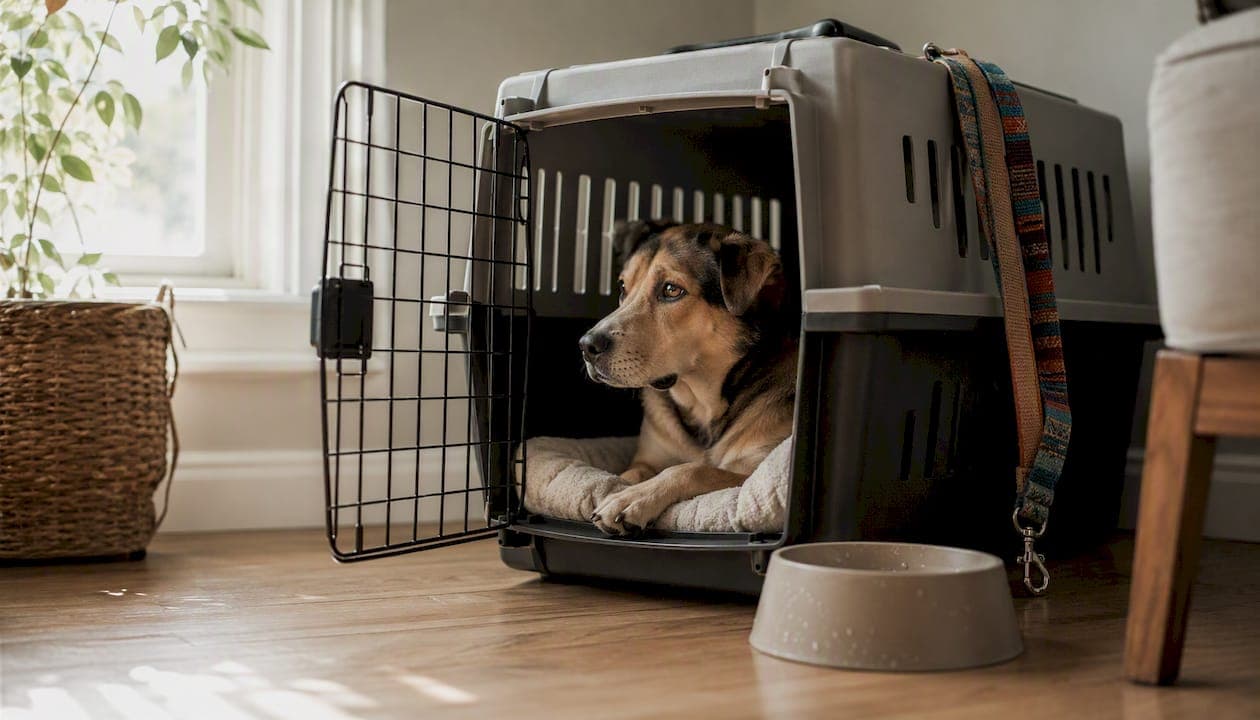
Yes. You can bring a dog or cat to Hawaii and skip extended quarantine entirely, but only by meeting the Hawaii Department of Agriculture's requirements for Direct Airport Release or the 5-Day-Or-Less program. That means a working microchip, a passing FAVN rabies antibody test, an APHIS health certificate, and every document received on time.
Three players make this happen: the Hawaii Department of Agriculture's Animal Quarantine Station, a USDA/APHIS-accredited veterinarian who signs your health certificate, and an approved FAVN laboratory that runs the blood test. Get all three aligned early and Direct Airport Release (DAR) lets your pet walk off the plane and go home with you the same day.
- DAR (fastest): Same-day release at the airport if your packet is complete and on time.
- Miss a deadline or a form: Your pet gets rerouted into 5-Day-Or-Less or, worst case, the 120-day quarantine program.
- The one rule that trips people up: Hawaii will not fix paperwork problems after your flight lands.
Key Takeaways
Direct Airport Release depends entirely on hitting Hawaii's FAVN waiting period, microchip verification, and document deadlines before your pet ever boards a flight.
| Point | Details |
|---|---|
| Start the FAVN clock early | The 30-day wait begins when the lab receives the sample, so draw blood 90-plus days before travel. |
| Submit one complete packet | AQS generally won't process piecemeal documents, so bundle the AQS-279 form, certificates, and lab results together. |
| Match your program to your airport | Honolulu follows DAR/5-Day-Or-Less rules; neighbor islands require a Neighbor Island Inspection Permit with earlier deadlines. |
| Time your flight around inspection hours | Landing after inspection hours can mean an overnight hold even with perfect paperwork. |
| Get help from an accredited clinic | City Animal Veterinary Center coordinates APHIS endorsements, FAVN sampling, and pre-travel exams using Fear Free handling. |
Where to Confirm the Latest Forms and Deadlines
- The Animal Quarantine Information Page and its official checklists for DAR and NIIP cover every current form and deadline.
- USDA APHIS state-to-state guidance answers health certificate questions, and each airline's pet policy page covers carrier-specific cargo and in-cabin rules.
- Reach the Animal Quarantine Station directly at rabiesfree@hawaii.gov, and always submit your documents as one complete set.
Table of Contents
- 90-Plus Days to Departure: Your Immediate Checklist
- What's the Exact Timeline to Qualify for Direct Airport Release?
- How Do Airline Rules Affect Your Pet's Trip to Hawaii?
- What Happens at the Airport When Your Pet Arrives?
- What Mistakes Actually Cause Pets to Get Quarantined?
- Where Do You Find an Accredited Vet and FAVN Lab?
- Frequently Asked Questions
- Sources
90-Plus Days to Departure: Your Immediate Checklist
Start the clock now, not the week before your flight. The FAVN test alone builds in a mandatory 30-day wait, and lab delays are common.
- Draw blood for the FAVN test and verify the microchip at least 90 days before you plan to travel. The chip has to be implanted and scanning correctly before the blood sample goes to the lab.
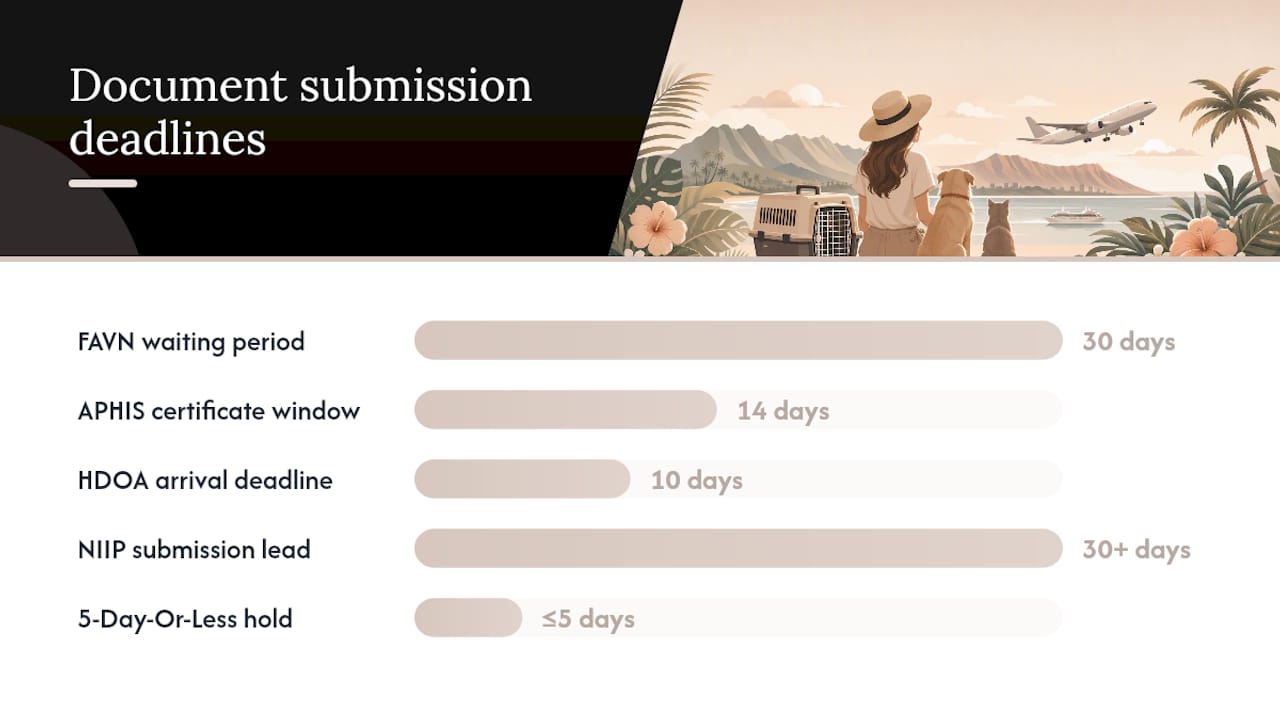
- Book your USDA-accredited veterinarian appointment now. Your APHIS health certificate has to be dated within 14 days of arrival, so timing this right matters as much as getting it done.
- Pick your arrival airport before you book flights. Honolulu follows different document deadlines than Kona, Kahului, or Līhuʻe, and neighbor island arrivals require a separate permit.
What's the Exact Timeline to Qualify for Direct Airport Release?
Every deadline in this process chains off one thing: the day your pet's blood sample lands at the lab. Miss that window and DAR is off the table no matter how organized everything else is.
- Confirm the microchip first. It has to be implanted and scanning clean before your vet draws blood for FAVN. A chip that can't be read at arrival is treated the same as no chip at all.
- Send the FAVN sample with "HAWAII" marked on the lab form. This isn't a formality. HDOA requires a passing result of greater than 0.5 IU/ml, and the 30-day waiting period starts the day the lab receives the sample, not the day you drop it off.
- Time the rabies vaccinations correctly. Hawaii cares about the interval between doses and how recent the last shot was relative to your travel date. Get this wrong and your FAVN result can be invalidated even if the numbers look fine.
- Get the APHIS health certificate issued within the required window, typically within 14 days of arrival, and signed by your accredited veterinarian.
- Submit the complete document packet on time. For Honolulu DAR, HDOA must receive everything at least 10 days before arrival. Neighbor island arrivals under the Neighbor Island Inspection Permit (NIIP) generally need documents submitted even earlier, often 30-plus days out.
Here's how the four programs differ in practice: DAR releases your pet at the airport same-day. 5-Day-Or-Less holds your pet at a state facility for a short stay when one small piece of paperwork or timing falls short. NIIP applies specifically to direct flights into Kona, Kahului, or Līhuʻe and requires a confirmed inspection by an approved private veterinary facility before the permit can even be processed. 120-day quarantine is the fallback for pets that don't meet FAVN, vaccination, or documentation standards at all.
Pro Tip: Send your entire packet, including the AQS-279 form, original rabies certificates, and lab results, as one bundle. HDOA processes complete submissions, not piecemeal ones, and a form that arrives three days after the rest can knock your pet out of DAR eligibility.
How Do Airline Rules Affect Your Pet's Trip to Hawaii?
Your airline choice matters as much as your paperwork. Carriers flying to Hawaii enforce their own breed, age, and seasonal restrictions on top of the state's rules, and not every airline even allows pet travel to the islands.
- Check in-cabin vs. cargo policies before booking. Hawaiian Airlines and other major carriers serving Hawaii distinguish sharply between small pets that ride in-cabin and larger animals that travel as checked baggage or cargo.
- Flight timing controls whether your pet gets released the same day. Airport quarantine inspectors keep set hours, so a flight that lands after those hours often means an overnight hold.
- Reserve pet space early and print your NIIP if you're flying to a neighbor island. Airlines can deny boarding without it.
Pro Tip: Book a morning or early-afternoon arrival whenever possible. Landing right before inspection hours close is one of the most common, and most avoidable, reasons pets miss same-day release.
What Happens at the Airport When Your Pet Arrives?
Your pet doesn't walk straight into your arms. Airlines deliver arriving animals to the Airport Animal Quarantine Holding Facility (AAQHF) at HNL, where an inspector checks the documents before anything else happens.
- Inspector verifies your packet against the microchip, FAVN result, and health certificate. If everything matches and deadlines were met, your pet clears for Direct Airport Release.
- If something's incomplete, your pet transfers to the Animal Quarantine Station (AQS) for further processing under 5-Day-Or-Less or longer quarantine.
- Arriving outside inspection hours often means an overnight hold, even with a perfect packet, so confirm inspection windows before you finalize flight times.
- Only the registered owner or an authorized designee can pick up a released pet, and airport security limits where you can remove an animal from its carrier on the property.
What Mistakes Actually Cause Pets to Get Quarantined?
The pattern behind most quarantine cases isn't a rare disease risk. It's a paperwork gap that couldn't be fixed once the plane landed.
- Submitting documents piecemeal instead of as one complete packet is the single most common trigger, since AQS generally won't process an incomplete file.
- An unreadable or unregistered microchip invalidates the FAVN result tied to it, even if the blood test itself came back clean.
- FAVN samples not marked "HAWAII" on the lab submission form can get processed under the wrong protocol or delayed past your deadline.
- Flying into a neighbor island without a NIIP leaves your pet without an approved inspection path, regardless of how solid the rest of your paperwork is.
- Arriving before the 30-day FAVN waiting period ends disqualifies DAR outright, since the clock starts at lab receipt, not sample collection.
If your pet gets flagged, transfer to AQS happens automatically and you cannot argue your way around missing documents at the gate. Contact the Animal Quarantine Station directly at rabiesfree@hawaii.gov as soon as you know there's an issue so you can coordinate pickup and next steps instead of finding out cold at the airport.
Where Do You Find an Accredited Vet and FAVN Lab?
Start with a USDA-accredited veterinarian early, since not every general practice holds that accreditation, which is required to sign your APHIS endorsement.
- Confirm your vet will complete APHIS Form 7001 and the accreditation endorsement, then schedule your FAVN blood draw and microchip scan in the same visit if possible.
- Documents flow from vet to lab to owner to AQS. Bundle everything together rather than mailing pieces separately.
- Ask directly: will you label the FAVN sample "HAWAII"? Will you confirm submission to AQS? Can you issue the certificate inside the 14-day window? A pre-travel health certificate visit is the right time to lock all three answers down.
A Fear Free Clinic's Role in Reducing Travel Stress
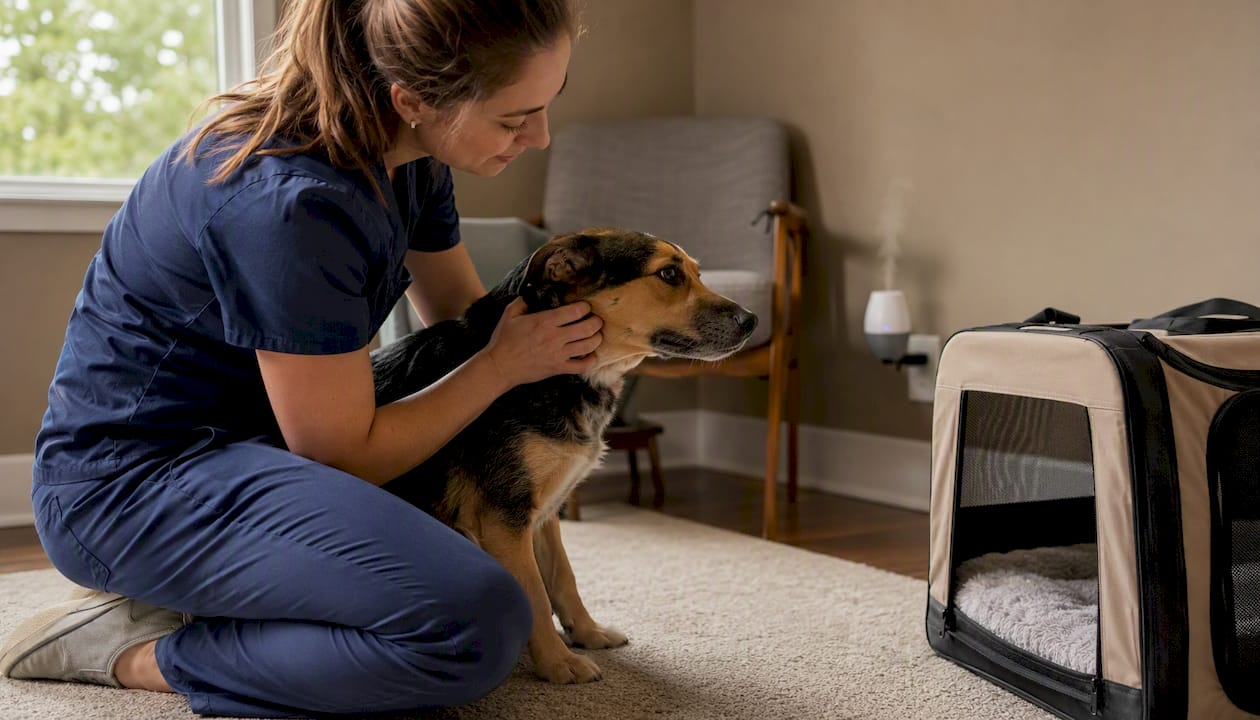
Airplane travel is stressful enough for a pet without a chaotic vet visit stacked on top of it. A Fear Free approach uses gentler handling and crate acclimation guidance so the FAVN draw, microchip scan, and health exam don't become the worst part of the trip. City Animal Veterinary Center handles APHIS forms, FAVN sampling, and pre-travel consultations for clients working through Hawaii's requirements, and that hands-on coordination is often what keeps a travel timeline from slipping.
Let City Animal Veterinary Center Handle Your Travel Paperwork
Most of the risk in this process isn't the flight. It's the forms, timing, and lab coordination that have to line up months in advance, and one missed signature or mislabeled sample can undo everything. City Animal Veterinary Center is the local alternative to piecing this together yourself: our USDA-accredited veterinarians complete APHIS endorsements, coordinate FAVN sample collection with approved labs, and run pre-travel health checks in one visit, using Fear Free handling so the appointment itself doesn't add stress to an already complicated process.
Bring your pet's vaccination records and microchip information to your first appointment so we can map out your FAVN and health certificate timeline against your travel date. If a house call fits your schedule better, our home visit services can handle parts of this prep without a trip to the clinic. Book your pre-travel consultation with City Animal Veterinary Center now, since the earlier we start your FAVN clock, the more travel dates stay open to you.
Frequently Asked Questions
Can I bring my dog to Hawaii without quarantine? Yes, through Direct Airport Release, as long as your pet has a passing FAVN result, a readable microchip, and a valid APHIS health certificate submitted on time.
How long does the FAVN test take? The test itself returns results within days, but HDOA requires a mandatory 30-day wait starting from the day the lab receives your pet's blood sample.
Do neighbor island flights have different rules than Honolulu? Yes. Flights directly into Kona, Kahului, or Līhuʻe require a Neighbor Island Inspection Permit and generally need documents submitted earlier than Honolulu's DAR deadline.
What happens if my paperwork is incomplete when my pet arrives? Your pet transfers to the Animal Quarantine Station and enters 5-Day-Or-Less or longer quarantine. Airport staff cannot fix missing documents on the spot.
Which airlines fly pets to Hawaii? Hawaiian Airlines and Alaska Airlines both serve Hawaii with published pet policies, though breed, age, and seasonal restrictions vary by carrier and cabin vs. cargo placement.
Sources
- Animal Quarantine Information Page | Animal Industry Division
- Checklist 1 – Direct Airport Release & 5 Day Or Less (Honolulu) | Animal Quarantine Station
- Checklist 3 – NIIP & Direct Airport Release for Neighbor Islands | HDOA
- Traveling With Pets - Hawaiian Airlines
- Pet travel: state-to-state | USDA APHIS