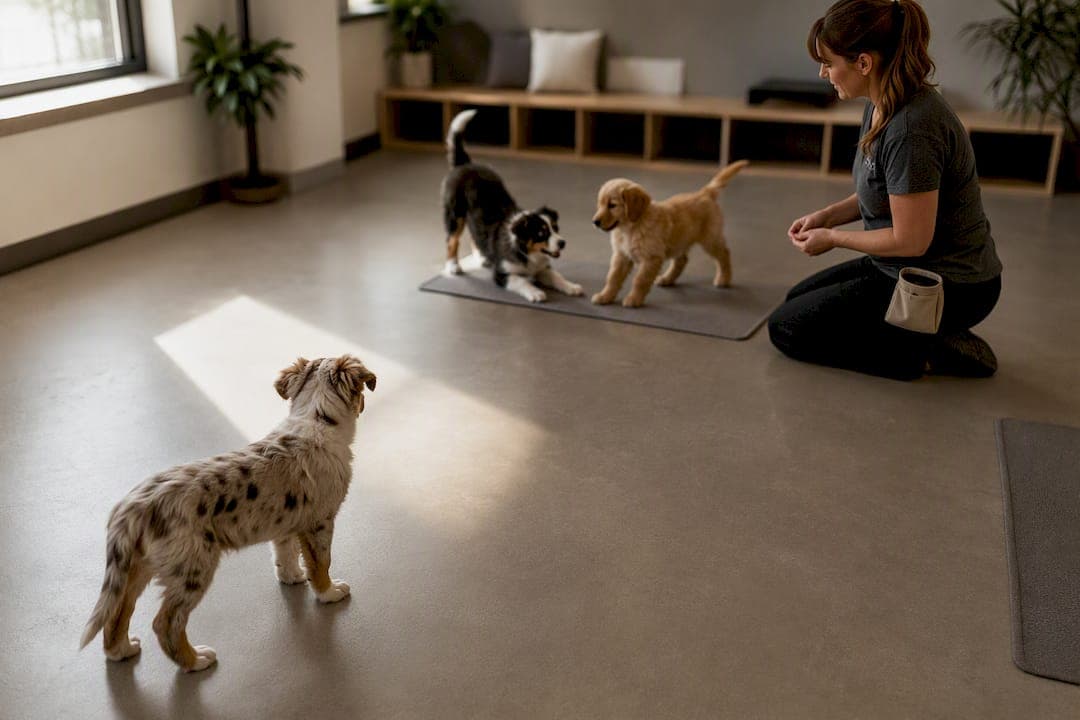
Start socializing your puppy now, during the first three months of life, using short, graded exposures paired with tasty rewards. Begin safe classes as early as 7 to 8 weeks once the first vaccine and deworming are done. Weave handling practice and Fear Free vet visits into the routine from day one, and always stop before your puppy feels overwhelmed.
TL;DR:
- Early socialization starting at 7 to 8 weeks allows puppies to safely build confidence before the full vaccination schedule; delayed exposure can lead to fear issues later.
- Socialization should be gradual, starting from a distance, rewarding calm attention, and progressively increasing exposure to surfaces, sounds, people, and other animals over weeks.
- Handling and vet-visit prep using Fear Free techniques should begin early with short, positive exercises that incorporate treats and routine practice before stressful situations occur.
- Avoid high-traffic dog parks and unvetted group events; small, controlled outings and supervised playdates with vaccinated dogs are safest for infectious disease prevention.
- Recognizing stress signals such as pinned ears or whale eye and adjusting exposure accordingly can prevent overstimulation and foster positive associations from the start.
Table of Contents
- When to start: the socialization window, vaccines, and safety rules
- Practical puppy socialization checklist you can use weekly
- Handling and vet-visit prep: clinic-backed Fear Free steps owners can do at home
- Puppy classes, playdates, and safe public outings, how to choose and run them
- Reading puppy body language and preventing overstimulation
- Clinic perspective: why calm, reward-based socialization prevents long-term problems
- How City Animal Veterinary Center supports your puppy's socialization
- Sources
- FAQ
When to start: the socialization window, vaccines, and safety rules
The AVSAB position statement identifies the first three months of a puppy's life as the primary and most important window for socialization. Waiting until a puppy is fully vaccinated, often close to 16 weeks, means missing most of this window.
The same guidance says puppies can safely start classes at 7 to 8 weeks old if they have had at least one set of vaccines given at least 7 days earlier and a first deworming, and are otherwise healthy. Your puppy's first vet visit is where that timeline gets confirmed, so book it as soon as you bring your puppy home.
Not every class meets that bar. Choose a sanitized venue that checks vaccine records at the door, favors small groups over crowds, and is ideally hosted by a veterinary clinic rather than an unregulated meetup. A controlled 2013 study found vaccinated puppies attending supervised socialization classes were not at higher risk of parvovirus than vaccinated puppies that stayed home, which is the evidence behind starting classes early rather than waiting.
Practical puppy socialization checklist you can use weekly
Socialization works best when it is graded: distance first, then intensity, then duration. Start far enough away that your puppy is curious but not scared, reward calm attention, then close the gap over several short sessions rather than one long one.
A useful checklist covers five categories:
- People: children, adults using canes or wheelchairs, people in hats or uniforms.
- Animals: a calm, tolerant adult dog before an excitable puppy, plus supervised puppy playdates.
- Surfaces: tile, carpet, grass, gravel, and metal grates.
- Sounds: vacuum cleaners, traffic, doorbells, and crowd noise at low volume first.
- Handling: paws, ears, mouth, and brief gentle restraint.
A simple weekly progression might look like this:
- Week 1: introduce two or three new people at a distance, paired with treats.
- Week 2: add a new surface and a quiet household sound.
- Week 3: arrange a short playdate with one calm, vaccinated adult dog.
- Week 4: practice paw and ear handling daily for under a minute.
- Week 5: introduce a busier sound, like a vacuum in another room.
- Week 6: combine two familiar exposures, such as a new person on a new surface.
Keep sessions to a few minutes, end on a good note, and log what worked so you can repeat it before adding something new.
Handling and vet-visit prep: clinic-backed Fear Free steps owners can do at home
Cooperative handling is easiest to build before a puppy has any reason to be nervous. A short daily drill works well: touch the paws, ears, and mouth for a few seconds each, giving a treat after every touch, then gradually extend the time before the reward appears. Once your puppy tolerates that calmly, add brief, gentle restraint, holding for a few seconds and releasing before any struggle starts.

Vet-visit prep follows the same logic. Practice short car rides and let your puppy explore an open carrier at home so neither feels new on exam day. Bring a non-skid mat or towel to sit on, since slippery exam tables are a common source of stress, and ask about a brief "hello" visit where your puppy gets treats and attention from the team without any procedures.
Pro Tip: Practice the handling drill right before mealtime so your puppy associates being touched with something rewarding that's already coming.
Requesting Fear Free techniques means asking staff to slow down, use food generously, and let your puppy set the pace. If travel or a busy schedule makes appointments difficult, a house-call visit brings that same low-stress approach into your own home.
Puppy classes, playdates, and safe public outings, how to choose and run them
A good puppy class checks vaccine records before letting anyone through the door, keeps class sizes small, and uses positive reinforcement rather than corrections. The instructor should be comfortable explaining why a nervous puppy needs space rather than pushing exposure.
When a formal class is not available, smaller options can fill the gap:
- Supervised playdates with one or two known, healthy, vaccinated dogs.
- Clinic-hosted or vetted events run by a veterinary practice.
- Carried outings, using a sling or stroller, to expose a puppy to busy sidewalks or stores without ground contact.
Skip high-traffic off-leash dog parks, gatherings where vaccination status is unknown, and situations with too many unfamiliar dogs at once. Those settings raise both infectious-disease risk and the odds of a scary encounter that undoes weeks of careful work.
Reading puppy body language and preventing overstimulation
A relaxed puppy has loose, wiggly body language, soft eyes, and a tail held naturally. Stress looks different: a tucked tail, pinned ears, whale eye (showing the whites), lip licking, yawning outside of tiredness, or trying to hide behind your legs.

The moment you see those signals, back up. Increase distance from whatever triggered the response, shorten the session, and let your puppy choose whether to re-approach rather than dragging them forward. Ending on a familiar, easy activity, like a known trick for a treat, helps close the session on a calm note.
Progress should be gradual and repeatable rather than pushed. If a puppy consistently reacts fearfully to ordinary situations, or if stress signals do not ease with slow, positive exposure, it is worth talking to your veterinarian about a referral to a behavior professional.
Clinic perspective: why calm, reward-based socialization prevents long-term problems
Managed well, the behavioral upside of early socialization outweighs the infectious-disease risk, which is why waiting for a full vaccine series is rarely the safer choice. Puppies who build positive associations with new people, handling, and vet visits early on carry that confidence into adulthood, while puppies whose first vet experiences are stressful can develop lasting fear around care. Booking a wellness check while your puppy is young is the simplest way to start a socialization plan that a veterinary team can help you shape.
— CAVC
How City Animal Veterinary Center supports your puppy's socialization
A puppy's early weeks go faster than most owners expect, and having a veterinary partner nearby makes the checklist above easier to actually follow. A veterinary center in Brooklyn, NY, builds its puppy visits around a Fear Free approach designed to keep exams calm rather than stressful.
That shows up in a few concrete ways:
- Puppy wellness exams that double as handling practice, using treats and a slow pace.
- Vaccinations scheduled to align with the socialization window rather than delaying it.
- Home visits for owners who find travel with a young puppy difficult or stressful.
If you are ready to start your puppy's socialization plan with a veterinary team that uses Fear Free handling from the first appointment, book a puppy wellness exam or ask about a home visit instead.
Sources
The AVSAB position statement sets the timing framework, the 2013 PubMed study supports early class attendance, AVSAB on graded exposure explains the method, and AKC guidance offers a practical checklist format.
- AVSAB puppy socialization position statement (via Purdue Canine Welfare)
- 2013 study on puppy socialization class safety (Journal source via PubMed)
FAQ
What is the 7-7-7 rule for puppies?
The 7-7-7 rule is a popular shorthand suggesting puppies be exposed to seven new surfaces, people, and experiences by seven weeks of age, but it is not an official veterinary standard. The safer, evidence-based approach from the AVSAB is graded, positive exposure spread across the first three months rather than a fixed count by a fixed date.
Is 20 weeks too late to socialize a puppy?
Socialization does not stop mattering after the primary three-month window, but that period is the most sensitive, according to AVSAB. A puppy older than that can still build new positive associations through slow, reward-based exposure, it just takes more patience and often benefits from guidance from a veterinarian or trainer.
What is the hardest month for a puppy?
Many owners find the weeks right around a puppy's early socialization period, often starting at 7 to 8 weeks, particularly challenging because ordinary events can suddenly seem frightening. Sticking with calm, graded exposures and watching for stress signals during this stretch helps prevent a single bad experience from becoming a lasting fear.
Can I leave my 8-week-old puppy alone for 3 hours?
This depends more on house training and separation comfort than socialization timing specifically, and there is no single research-backed number that fits every puppy. Building up alone time gradually, starting with short absences and rewarding calm behavior on your return, works better than jumping straight to several hours.