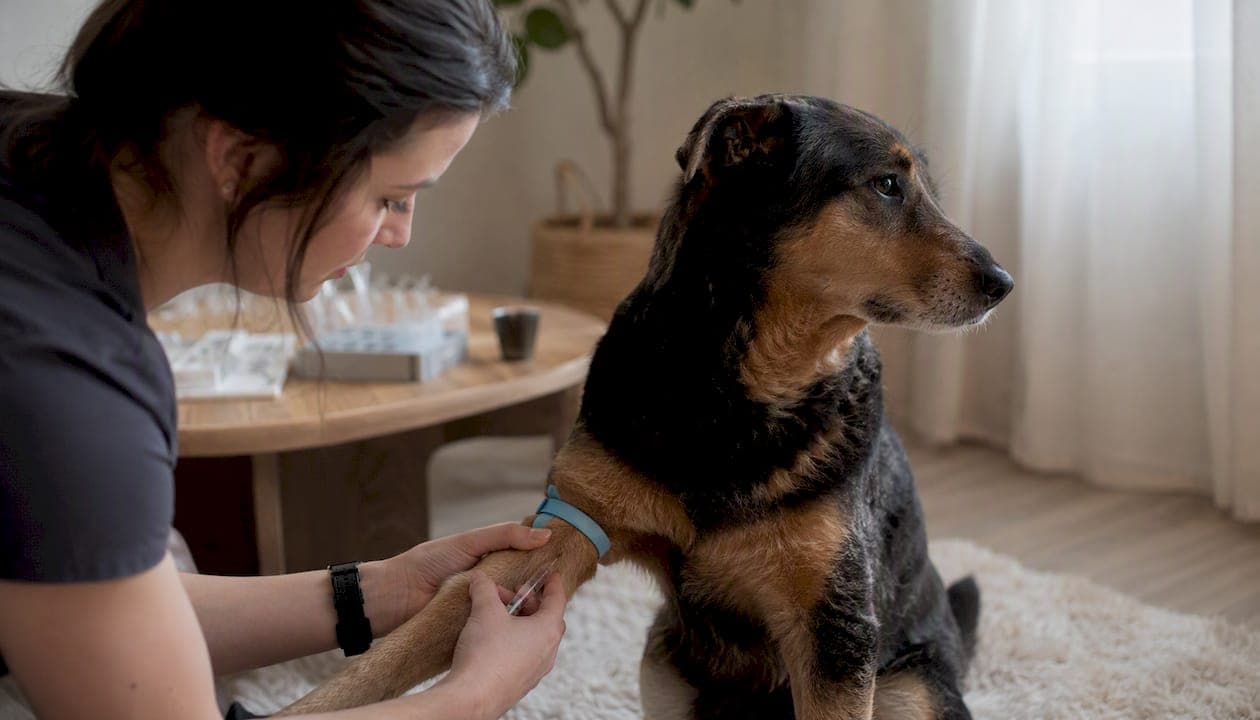
The FAVN rabies titer is the internationally recognized blood test that confirms a dog or cat has adequate virus-neutralizing antibodies for international travel requirements. A result of ≥0.50 IU/mL passes. If you are planning international travel with a pet, start the process now: confirm your destination's approved-lab list, book a USDA-accredited veterinarian for microchip verification and blood draw, and give yourself at least 60 days before departure.
FAVN stands for Fluorescent Antibody Virus Neutralization, and it is the method recognized by the World Organisation for Animal Health (WOAH, formerly OIE) for official rabies serology. Most rabies-free destinations and several U.S. import rules require it specifically, not just any rabies antibody test.
U.S. labs commonly accepted for FAVN submissions:
- Kansas State University Rabies Laboratory (KSU Rabies Lab)
- Auburn University Serology-Virology Laboratory
- University of Missouri Veterinary Medical Diagnostic Laboratory (MU VMDL)
- Texas A&M Veterinary Medical Diagnostic Laboratory (TVMDL) — referral only; direct submission to KSU is faster
- DoD Food Analysis & Diagnostic Laboratory, Fort Sam Houston
One timing detail that catches owners off guard: for destinations like Hawaii, the quarantine countdown starts the day the lab receives the blood sample, not the day it was drawn. Confirm the received date on every lab report before counting forward.
Key Takeaways
The FAVN rabies titer requires precise timing, an approved lab, and complete documentation — starting at least 60 days before travel is the single most effective way to avoid quarantine or a missed departure.
| Point | Details |
|---|---|
| Passing threshold | A result of ≥0.50 IU/mL is required by WOAH standards and most destination authorities. |
| Lab receipt date matters | Quarantine countdowns (including Hawaii's 120-day window) start when the lab receives the sample, not when blood is drawn. |
| Use approved labs only | Submit to a CDC- or destination-approved lab such as KSU, Auburn, MU VMDL, or directly to KSU via TVMDL referral. |
| Typed forms prevent rejections | Handwritten FAVN forms and mismatched microchip numbers are leading causes of sample rejection and delays. |
| City Animal Veterinary Center | Provides microchip verification, rabies vaccination, blood draw, typed FAVN form completion, and travel document guidance in Brooklyn, NY. |
Table of Contents
- What does the FAVN rabies titer actually measure?
- Who actually needs a FAVN titer?
- When should blood be drawn relative to vaccination?
- Sample, labeling, and submission requirements
- Designated and CDC-approved laboratories
- How to interpret results and what to do next
- Turnaround times, shipping, and the most common delays
- Clinic-ready timeline and checklist for veterinarians and owners
- What an experienced travel clinic actually sees
- City Animal Veterinary Center handles the full FAVN process for you
- Sources
What does the FAVN rabies titer actually measure?
FAVN measures virus-neutralizing antibodies (VNAs) in a pet's serum. The lab mixes the serum with live rabies virus and adds a cell culture. If the antibodies in the serum neutralize the virus, the cells survive and fluoresce. The stronger the antibody response, the higher the titer reading.
Passing threshold: ≥0.50 IU/mL, as defined by international standards and required by the CDC, WOAH, and most destination authorities. Labs report results within a quantitative range of approximately 0.1–12.50 IU/mL, or as a qualitative screen (≥0.50 IU/mL or <0.50 IU/mL).
The two reporting formats matter for paperwork. Some destinations accept a qualitative screen (pass/fail). Others, particularly EU member states, require the exact quantitative IU/mL value on the official lab report. Ask your destination authority which format they require before submitting.
How FAVN differs from RFFIT
The Rapid Fluorescent Focus Inhibition Test (RFFIT) is the other widely used rabies serology method. Both measure VNAs, but the FAVN uses a slightly different protocol and is the method specifically listed by WOAH for international trade. Several rabies-free destinations, including Japan, Australia, and New Zealand, require FAVN by name. RFFIT results from a non-designated lab are not interchangeable for those destinations, even if the titer value looks identical.
Who actually needs a FAVN titer?
Not every international trip triggers a titer requirement. Here is where it typically applies.
Scenarios that usually require a FAVN titer:
- Entering rabies-free or rabies-controlled countries (Japan, Australia, New Zealand, the UK, Hawaii, Guam, and others) — these destinations require documented proof of adequate antibody response before or upon arrival.
- Dogs vaccinated abroad entering the U.S. from high-risk countries — the CDC requires a passing titer from a CDC-approved lab to avoid a mandatory 28-day quarantine at an approved facility.
- Export health certificate requirements — some countries require official serology as part of the endorsed health certificate package, even when the destination is not strictly rabies-free.
Common exceptions to check:
- Hawaii and Guam have their own specific programs with additional requirements beyond a passing titer (direct airport release vs. quarantine depends on the full documentation package — confirm with the Hawaii Department of Agriculture).
- Pets traveling between the continental U.S. and Canada generally do not require a titer, though a current rabies vaccination certificate is still required.
- Some destinations list exempt countries of origin where a titer is waived if the pet has been resident there for a defined period.
A passing titer is one piece of the puzzle. It does not replace a microchip, a current rabies vaccination certificate, or a USDA-endorsed health certificate for most destinations.
When should blood be drawn relative to vaccination?
Timing is where most travel plans go wrong. Draw too early and the result is invalid. Draw too late and there is no time to retest before departure.
| Vaccination event | Minimum wait before blood draw | Notes |
|---|---|---|
| First valid rabies vaccination (primary series) | 30 days | CDC rule for dogs from high-risk countries; WOAH standard for most destinations |
| Booster after lapsed coverage | 30 days | Treat as a new primary if coverage lapsed; confirm with destination authority |
| Booster with continuous coverage | No mandatory wait in most cases | Some destinations still prefer 30 days — verify |
| Redraw after a failed titer | After revaccination + 30 days | Revaccinate first, then wait before redrawing |
CDC-specific note: For foreign-vaccinated dogs entering the U.S. from high-risk countries, the blood draw must occur at least 30 days after the first valid rabies vaccination and at least 28 days before U.S. entry. A dog that arrives without a passing titer goes to a CDC-registered facility for a 28-day quarantine at the owner's expense.
If there has been any lapse in vaccination coverage, treat the situation as a new primary series. Do not assume a booster reactivates prior titer validity for travel purposes — destination authorities generally do not.
Practical rule: Aim to complete microchip placement, primary vaccination, and blood draw at least 60 days before travel. That window absorbs a lab turnaround of 10–15 business days plus time to correct any paperwork or resubmit a failed sample. Aligning your puppy's vaccine schedule with a future travel date is far easier than retrofitting it later.
Sample, labeling, and submission requirements
Getting the sample right the first time saves weeks. Most rejections are preventable.
Specimen requirements:
- Volume: 1–2 mL of clear serum (some labs specify a minimum of 1 mL; submit more when possible)
- Tube type: Red-top or gold-top serum separator tube; confirm the specific lab's preference before drawing
- Clarity: Serum must be clear, not lipemic (cloudy from fat) or hemolyzed (pink or red from broken red blood cells)
- Labeling: Each tube must be labeled with the animal's name and microchip number — the microchip number is the official identifier that ties the sample to the lab report
Form and signature requirements:
- A completed FAVN submission form is required for each sample; the original is retained on file at the lab
- All entries should be typed, not handwritten — illegible entries are a leading cause of rejection
- A USDA-accredited veterinarian signature is required when the result will be used for export documentation; confirm whether your destination requires this before the appointment
Common rejection causes:
- Lipemic or hemolyzed serum
- Insufficient volume
- Microchip number on the tube does not match the form
- Missing or illegible veterinarian signature
Pro Tip: Before packaging the serum tube, hold it up to a light source and try to read printed text through it. If you cannot clearly read numbers on a calendar through the tube, the sample is likely too compromised to pass quality checks — redraw before shipping. This quick test, recommended by the KSU Rabies Lab, takes ten seconds and can save two weeks.
Ship samples early in the week (Monday or Tuesday) using overnight courier service. Samples that sit in a shipping facility over a weekend are a common source of hemolysis.
Designated and CDC-approved laboratories
Not every diagnostic lab can run a FAVN. The test requires live rabies virus, which limits it to biosafety-level-appropriate facilities. For travel purposes, the sample must go to a lab that is recognized by the destination authority, not just any accredited veterinary lab.
| Laboratory | Location | Accreditation / designation notes | Expedited service |
|---|---|---|---|
| Kansas State University Rabies Laboratory | Manhattan, KS | WOAH-recognized method; widely accepted by destination authorities including EU-listed | Contact lab directly |
| Auburn University Serology-Virology Laboratory | Auburn, AL | AAVLD-accredited; accepted by many destination authorities | Contact lab directly |
| University of Missouri VMDL | Columbia, MO | AAVLD-accredited; accepted for many travel destinations | Contact lab directly |
| Texas A&M TVMDL | College Station, TX | Referral only — forwards to KSU; processing and delivery fee applies | Direct to KSU is faster |
| DoD Food Analysis & Diagnostic Laboratory, Fort Sam Houston | San Antonio, TX | Primarily serves military personnel and dependents | Limited availability |
On accreditation: Look for AAVLD (American Association of Veterinary Laboratory Diagnosticians) accreditation and confirmation that the lab uses the WOAH FAVN method. For EU entry, the European Commission maintains a list of designated laboratories — not all U.S. labs appear on it, so verify before submitting if the destination is an EU member state.
Direct vs. referral submission: Texas A&M TVMDL does not perform FAVN in-house. If you submit through TVMDL, the sample is forwarded to KSU with an added processing and delivery fee. Submitting directly to KSU eliminates that delay. Most other labs on the list accept direct submissions from veterinary clinics and, in some cases, directly from owners.
The CDC's approved-labs list is the definitive reference for dogs entering the U.S. from high-risk countries. Always cross-check that list against your destination authority's own approved-lab list — they are not always identical.
How to interpret results and what to do next
Passing result (≥0.50 IU/mL)
A passing result means the pet demonstrated adequate virus-neutralizing antibody response at the time of the draw. Per CDC guidance, a passing titer may remain valid for the life of the animal as long as vaccination coverage stays current, but many destination authorities impose their own validity windows (commonly 24 months). Confirm the destination's rule before assuming the result carries forward indefinitely.
After receiving a passing report, assemble the full travel documentation package:
- Lab report with the official lab sticker or letterhead, quantitative or qualitative result, and the lab-received date
- Rabies vaccination certificate showing the vaccine brand, lot number, expiration date, and administering veterinarian
- USDA-endorsed health certificate (required for most international destinations) — your veterinarian completes the APHIS 7001 form, which a USDA-accredited vet endorses; find guidance on working with a USDA-accredited veterinarian
- Microchip documentation confirming the ISO 11784/11785 chip number matches the lab report
Failing result (<0.50 IU/mL)
Do not rebook travel yet. Revaccinate the pet with a valid rabies vaccine, wait at least 30 days, then redraw. Some destinations require the full wait period to restart from the revaccination date, which can push travel back by two months or more. The sooner a failing result is addressed, the less it disrupts the travel timeline.
Turnaround times, shipping, and the most common delays
Most U.S. FAVN labs report results in approximately 10–15 business days from the date the sample is received. Some labs note that processing can extend to 3–4 weeks during high-demand periods (typically spring and early summer, when international travel peaks).
Scheduling note: The lab's received date, not the blood draw date, often starts destination quarantine countdowns. For Hawaii, the 120-day quarantine-release countdown begins the exact day the lab receives the sample. Owners who count from the draw date can miss their travel window by several days.
Shipping tips:
- Ship Monday or Tuesday via overnight courier to avoid weekend delays in transit
- Use an insulated container with a cold pack (not frozen) to maintain serum integrity
- Mark the package clearly as a biological specimen per carrier requirements
- Include a copy of the completed FAVN form inside the package and keep a copy for the clinic file
Administrative delays that are entirely avoidable:
- Incomplete or handwritten FAVN forms
- Missing USDA-accredited veterinarian signature when required
- Microchip number on the tube does not match the submission form
- Serum rejected for lipemia or hemolysis after a weekend in transit
Confirm the lab's received date by calling or emailing after shipment. Do not rely solely on courier tracking — the lab's internal receipt log is what counts for official documentation.
Clinic-ready timeline and checklist for veterinarians and owners
This workflow integrates every step from microchip placement through final documentation. Use it as a clinic handout with date placeholders filled in at the appointment.
Step-by-step timeline:
- Microchip placement — ISO 11784/11785 chip implanted and registered; confirm number is readable before proceeding
- Primary rabies vaccination — administered by a USDA-accredited veterinarian; record vaccine brand, lot number, and expiration
- Wait 30 days — minimum interval before blood draw is valid for most destination authorities
- Blood draw — collect 1–2 mL serum; label tube with microchip number and animal name; confirm serum clarity
- Complete FAVN form — typed entries only; include microchip number, draw date, and veterinarian signature where required
- Ship to approved lab — overnight courier, Monday or Tuesday; include form copy; note tracking number
- Confirm lab received date — call or email the lab; record this date on the owner's checklist
- Receive results — typically 10–15 business days from receipt; review result against ≥0.50 IU/mL threshold
- Assemble documentation — lab report, vaccination certificate, USDA-endorsed health certificate
- Verify destination rules — confirm the result format, validity window, and any additional entry requirements with the destination authority
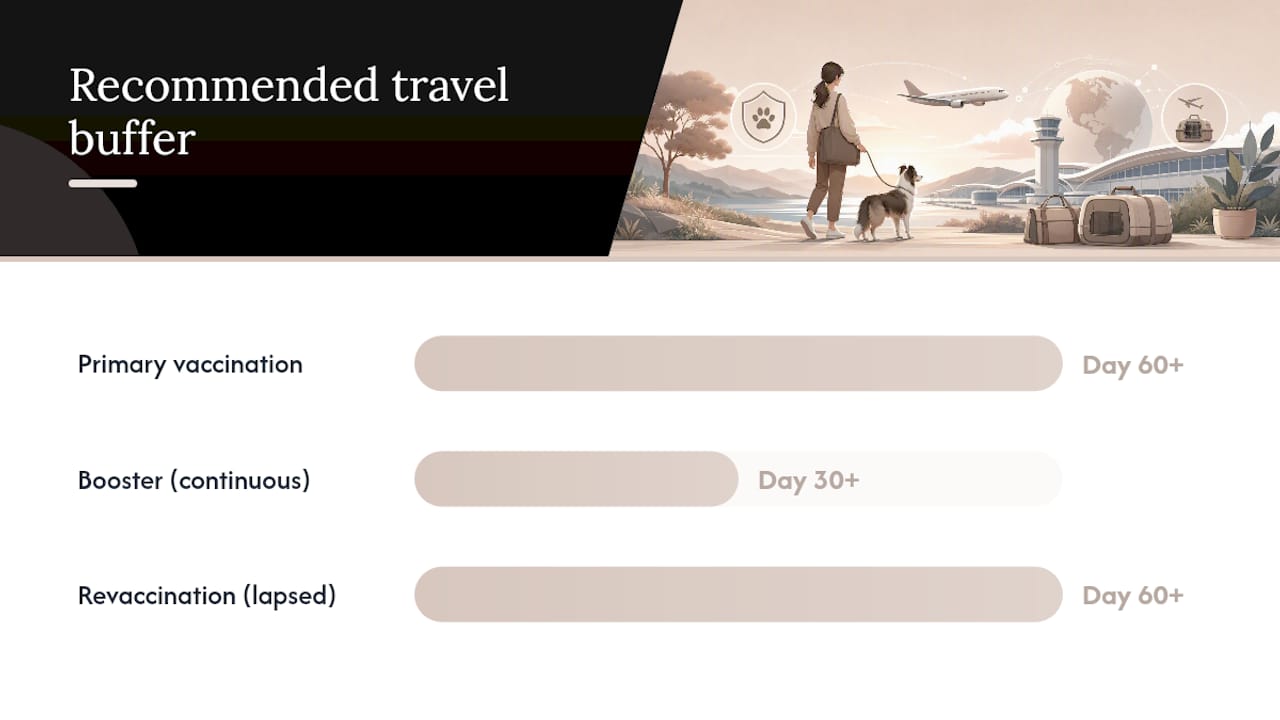
| Vaccination event | Earliest valid draw date | Recommended buffer before travel |
|---|---|---|
| Primary vaccination (Day 0) | Day 30 | Day 60+ (allows lab turnaround + corrections) |
| Booster with continuous coverage | Immediate in most cases | Day 30+ to allow lab turnaround |
| Revaccination after lapsed coverage | Day 30 | Day 60+ |
Pro Tip: Before sealing the submission envelope, run a two-point check: (1) confirm the microchip number on the tube matches the FAVN form exactly, digit for digit; (2) confirm the lab you are sending to accepts direct submissions from your clinic rather than requiring a referral through a regional diagnostic lab. Both errors are invisible until the result comes back rejected.
What an experienced travel clinic actually sees
At City Animal Veterinary Center, the most common reason a pet misses a travel window is not a failed titer. It is a scheduling gap that nobody caught until it was too late.
Owners often arrive with a departure date six weeks out, a pet that has never been microchipped, and a vaccination record from a previous clinic that does not include the lot number. Each of those gaps adds time. Microchip placement is straightforward, but the 30-day wait after a primary vaccination cannot be compressed. A lot number missing from the vaccine record can stall a health certificate endorsement.
The fix is procedural, not complicated. Typed FAVN forms, microchip verification at the start of every travel appointment, and same-day packaging instructions handed to the owner eliminate the three most common rejection causes before the sample leaves the building. When the form is typed, the chip number is confirmed, and the serum is clear, the lab almost always returns a result without incident.
The process is genuinely manageable when it starts early enough. Sixty days is comfortable. Thirty days is stressful. Two weeks is a problem.
City Animal Veterinary Center handles the full FAVN process for you
Pet travel paperwork has real consequences when it is wrong. City Animal Veterinary Center in Brooklyn provides every step of the FAVN preparation process in one place: microchip verification, rabies vaccination by a USDA-accredited veterinarian, blood draw with typed FAVN form completion, serum quality check, and guidance on selecting the right approved lab for your destination.
For owners who cannot easily bring their pet to the clinic, house call appointments are available for travel consultations, microchip placement, and vaccination. The team walks through lab selection, submission logistics, and the documentation checklist so nothing is missed before the sample ships.
Book a travel planning appointment at City Animal Veterinary Center and leave with a completed FAVN form, a confirmed lab submission plan, and a clear timeline to your departure date.
Sources
Always confirm your destination authority's current approved-laboratory list and timing rules before submitting. Requirements change, and a lab accepted last year may not appear on the current list.
- FAVN Test
- Pet Owners Serology FAQs | Auburn University College of Veterinary Medicine
- Documents for Veterinarians to Complete for Dogs Being Imported into the United States | CDC
- Rabies Virus Fluorescent Antibody Virus Neutralization (FAVN) Referral - Texas A&M TVMDL
This article provides general informational guidance and does not substitute for advice from a licensed veterinarian or the destination authority's official import requirements. Confirm current rules with the relevant government authority before travel.
This article is general information, not a substitute for advice from a qualified doctor. Consult a qualified healthcare professional about your own circumstances before acting on anything here.