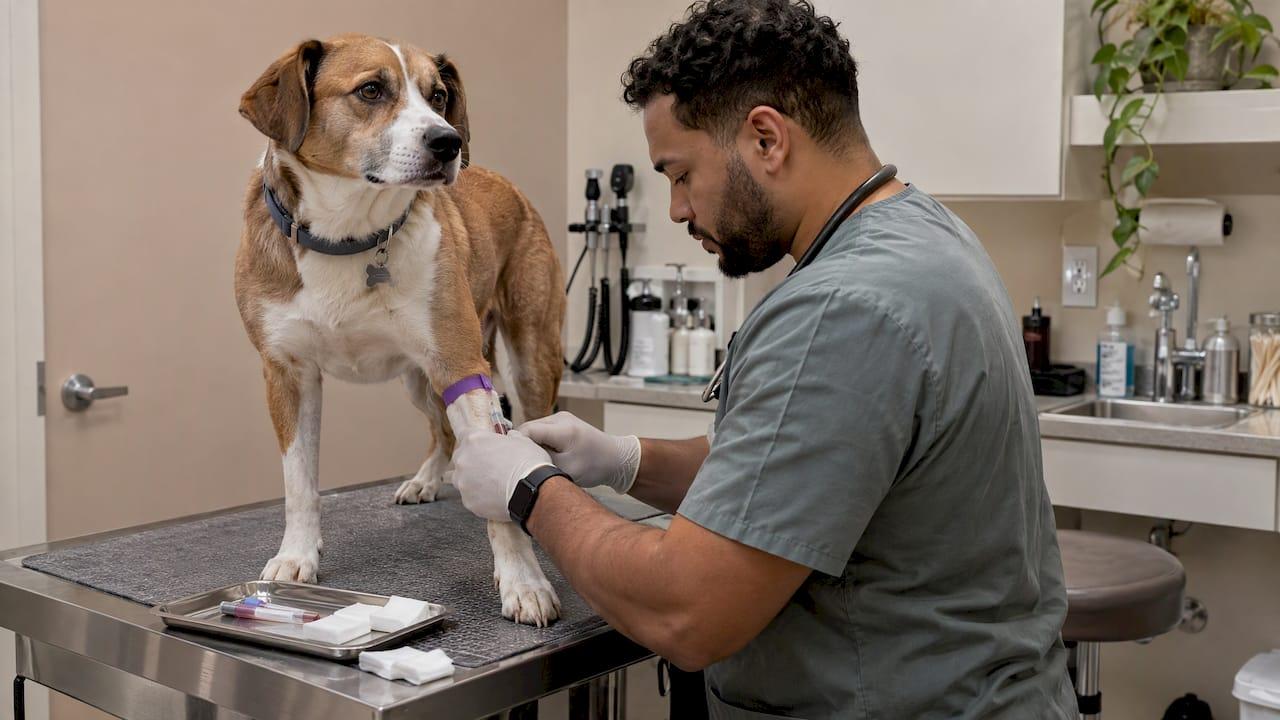
A thyroid test for a dog is a blood draw that measures thyroid hormones, and no single number settles the question. Your veterinarian reads several results together alongside your dog's signs, age, breed and medications. At City Animal Veterinary Center in Brooklyn, we run those visits the Fear Free way, and we can bring the appointment to your door through our home visit service if getting a nervous dog into a carrier is the hard part.
This guide covers who gets tested and why, which tests exist, how the results are read, what throws them off, and how to get your dog ready.
TL;DR
- Vets test for hypothyroidism (an underactive thyroid) when a dog shows a cluster of signs such as weight gain, lethargy, a thinning coat or recurring skin and ear infections.
- The usual tests are total T4, free T4 and TSH. A diagnosis rests on how they line up with each other and with your dog's signs, not on one value.
- Other illnesses, certain medications and breed can push thyroid values low in a dog with a healthy thyroid, so your vet may time or repeat the test.
- Tell your vet about every medication and supplement before the draw, including steroids and anti-seizure drugs.
- If the diagnosis is confirmed, treatment is a daily thyroid hormone tablet, followed by periodic recheck blood tests.
Table of Contents
- Why a vet orders a thyroid test
- The blood tests, one by one
- Reading T4, free T4 and TSH together
- What can throw a thyroid test off
- Getting your dog ready for the test
- If the results point to hypothyroidism
- Where City Animal Veterinary Center fits in
- Our perspective
- FAQ
- Sources
Why a vet orders a thyroid test
The thyroid is a small gland in the neck that sets the pace of the body's metabolism. Because thyroid hormones affect virtually every cell, the FDA explains that a dog with too little of them can show problems in many body systems. The gland usually fails slowly, so the signs creep in and are easy to miss at first.
The AAHA's 2023 guidelines list the signs that most often prompt testing:
- Skin and coat changes: hair loss along the trunk without itching, a 'rat tail' look, poor coat quality, greasy or flaky skin, darkened skin, and recurring skin infections
- Lethargy, mental dullness and reluctance to exercise
- Weight gain without eating more, or obesity
- Seeking warm spots
- Less commonly, facial nerve paralysis, balance problems (vestibular disease) or nerve damage in the limbs
The same guidelines put the average age at diagnosis at about 6.8 years, so this is mostly a middle-aged dog's condition. The FDA's list adds scaly, smelly skin, ear infections and cold intolerance, with hair loss that tends to spare the head and legs.
None of these signs is unique to thyroid disease. Skin allergies, for instance, can also cause recurring ear and skin infections, which is why a vet looks at the whole picture. If your dog is itchy, see our guide to dog allergy testing. Our team also treats chronic skin and ear problems through our dermatology service.
Clues in routine blood work
Often the first hint comes from a general blood panel rather than a thyroid test. The AAHA notes that these initial findings are nonspecific, most commonly high cholesterol and triglycerides on a fasted sample and mild anemia. The Merck Veterinary Manual reports high cholesterol in about 80% of hypothyroid dogs and a particular type of anemia in 40 to 50%. These are reasons to look closer, not a diagnosis. If you want to understand the other numbers on that report, our article on dog blood work explained walks through them.
The blood tests, one by one
A thyroid workup is built from a handful of measurements. The Cornell University Animal Health Diagnostic Center lists them among the tests it offers, singly or as a full canine thyroid panel.
| Test | What it measures | What it is most useful for |
|---|---|---|
| Total T4 (TT4) | All thyroxine in the blood, bound and unbound | First screening step; a normal result makes hypothyroidism very unlikely |
| Free T4 (fT4) | The small, biologically active fraction of T4 | Confirming low thyroid function, especially when TT4 is borderline or the dog is on other medication |
| TSH (canine thyroid-stimulating hormone) | The pituitary signal telling the thyroid to work harder | Supporting evidence: it tends to rise when the thyroid is underactive |
| Thyroglobulin autoantibody (TgAA) | Antibodies against the dog's own thyroid | Showing immune-driven thyroid inflammation, the common cause, and flagging results that can mislead |
| Total T3 | The more active hormone made from T4 | Less often helpful; usually part of a broader panel |
Why free T4 gets extra weight
The AAHA's interpretive guidelines describe free T4 as the form that most accurately reflects thyroid function. Cornell notes that measuring it by equilibrium dialysis is historically considered the gold standard, while a faster immunoassay method gives comparable results in dogs. Free T4 also removes the effect of autoantibodies, which matters when a dog has thyroid inflammation.
Reading T4, free T4 and TSH together
The textbook picture of hypothyroidism is a low total T4, a low free T4 and a high TSH. The AAHA guidelines call that the definitive pattern. But roughly 20 to 40% of dogs that are clearly hypothyroid have a normal TSH, so a normal TSH does not rule the disease out. According to the guidelines, two of the three hormones pointing toward hypothyroidism is enough to support a diagnosis, provided the dog also has compatible signs or lab changes. A single low total T4 should not be the only criterion.
Here is how that logic usually plays out:
- Total T4 comes back normal. The AAHA says a value of 2.0 µg/dL or higher makes hypothyroidism highly unlikely. The search usually moves on to other causes of the signs.
- Total T4 is low. That is suspicious but not confirmation. The Merck manual puts the sensitivity of total T4 as a screen at about 90%, and says a low value alone is not diagnostic because other factors can lower it.
- Free T4 is also low. Now the case is much stronger. If TSH is high as well, the pattern is the classic one.
- Free T4 is low but TSH is normal. The vet weighs the dog's signs, age, breed, other lab findings and medications. Sometimes the answer is to treat and watch the response, sometimes to retest.
The AAHA task force stresses that hypothyroidism is commonly overdiagnosed, because the signs are vague and the test results are tricky to interpret. That is the real reason a careful vet takes a stepwise approach rather than starting a lifelong medication on one low number. Your dog gets the right answer, and avoids a drug it does not need.
What can throw a thyroid test off
A low result does not always mean a failing thyroid. Several things can lower hormone levels in a dog with a healthy gland.
Other illness
Serious illness elsewhere in the body can suppress thyroid hormones, a pattern vets call euthyroid sick syndrome. The AAHA advises testing ideally after the dog has stabilized or recovered. Cornell recommends free T4 to help tell true hypothyroidism from reduced function caused by chronic disease such as Cushing's disease, liver disease or diabetes, or by steroid use or malnutrition.
Medications
The FDA names drugs that may lower thyroid hormone levels without hypothyroidism: phenobarbital, prednisone and other steroids, some anti-inflammatory drugs (NSAIDs), propranolol, clomipramine and sulfa antibiotics. Michigan State University's veterinary diagnostic laboratory notes that a withdrawal of three to four weeks from steroids is ideal before testing. Never stop a medication on your own. Ask your vet whether and how to adjust timing, because stopping some drugs abruptly can be unsafe.
Breed
Some healthy breeds run low. The FDA lists Greyhounds, Irish Wolfhounds and Whippets, and the AAHA's categorical approach adds Alaskan sled dogs, Shar-Peis, Salukis and Deerhounds. For these breeds the AAHA recommends breed-specific reference ranges, especially when the dog has no clinical signs.

Autoantibodies
In dogs with thyroid inflammation, antibodies can cross-react with the T4 assay and falsely raise the total T4. Cornell points out that unexpectedly high T3 or T4 values may signal autoantibodies. This is one reason the full panel, including TgAA, can be worth running.
Age, stress and timing
The AAHA also lists advancing age and periods of stress or illness as reasons total T4 can dip. When a result does not fit the dog, repeating the test later, once the dog is well and off interfering drugs where safe, is a normal and sensible step.
Getting your dog ready for the test
Preparation is simple, and it protects the accuracy of the result.
- Bring a full medication list. Include supplements, flea and tick products, and anything given for seizures, allergies or pain. Say what your dog has taken in the past several weeks.
- Mention recent illness. A recent infection, surgery or a bout of vomiting can affect results, and your vet may suggest waiting.
- Ask about fasting. The AAHA refers to fasted samples for the cholesterol and triglyceride findings, so ask whether to withhold breakfast.
- If your dog already takes thyroid medication, ask about timing. Michigan State's laboratory notes that T4 peaks three to four hours after a dose, so the draw time relative to the pill matters.
- Keep the visit calm. A relaxed dog is easier to sample and less stressed, which helps everyone.
The last point is where our Fear Free approach is designed to help. Blood draws are quick, but they are not pleasant for an anxious dog. Our team is Fear Free certified, and our approach to visits aims to minimize stress for pets. For dogs that panic in the car or the waiting room, a home visit removes the trip altogether.
If the results point to hypothyroidism
Treatment is straightforward for most dogs. The AAHA 2023 guidelines recommend levothyroxine, a synthetic thyroid hormone given twice daily, ideally on an empty stomach, at a starting dose of 0.02 mg/kg. For obese dogs the dose is based on estimated lean body weight. Your vet will not use these figures as a recipe for home dosing: the dose is set and adjusted by your veterinarian.
After starting, the plan generally looks like this:
- A recheck blood sample about four weeks in, taken four to six hours after the morning pill.
- Dose adjustments, as needed, until the post-pill total T4 sits in the upper half of the reference range or slightly above.
- Ongoing monitoring every six to twelve months once stable.
The guidelines say clinical signs typically improve quickly, though skin and coat problems can take longer to clear. Our pharmacy can supply your dog's prescription so refills fit into your routine.
Where City Animal Veterinary Center fits in
A thyroid question usually starts as something small: a dog gaining weight, a coat that will not come back, ear infections that keep returning. We start with a wellness exam, where we go through your dog's history, signs and medications, and use diagnostics, including our in-house laboratory and digital imaging, to look at the whole picture. If your dog seems unwell beyond the slow changes described above, our urgent care team can see them.
Prefer not to travel? Our house call service brings veterinary care to your Brooklyn home, a good fit for busy professionals and for dogs that get stressed in transit.
To discuss your dog's signs or book a visit, start at City Animal Veterinary Center.
Our perspective
Thyroid disease is one of the conditions where patience and good history-taking matter more than any single machine or number. Signs build slowly, so many owners tell us they noticed 'something is off' months before the diagnosis.
We think the best thyroid workup starts with listening: what has changed, what your dog takes, how they behave at home. That is also why we value being able to examine a dog in a calm setting. A dog that is relaxed gives us a clearer picture of their coat, skin, energy and weight, and a smoother, safer blood draw.
Our Fear Free certified approach, our house call service and our holistic options, including acupuncture and pain management alongside conventional care, are built around the same idea: care that works for the whole dog and the whole family.
CAVC
FAQ
What are the early signs of a thyroid problem in a dog?
The earliest signs are usually gradual: weight gain without eating more, tiredness, a dull or thinning coat, and recurring skin or ear infections. The FDA notes that because the thyroid typically fails slowly, these changes are easy to miss at first. If you notice several together, especially in a middle-aged dog, ask your vet about testing.
Can other conditions affect a dog's thyroid blood test?
Yes. Illness elsewhere in the body, medications such as steroids and phenobarbital, and breed can all lower thyroid hormone values in a dog whose thyroid works normally. That is why vets often combine several tests and sometimes repeat them once the dog has recovered or the medication plan has been reviewed.
Does my dog need to fast for a thyroid test?
Your vet will tell you, but fasting is often requested because cholesterol and triglycerides, which are commonly checked at the same time, are interpreted on a fasted sample. Do not skip any medication without asking first. Mention all medications and supplements when you book.
How long does thyroid treatment last?
When a dog is confirmed hypothyroid, the daily medication is generally lifelong. The AAHA guidelines call for monitoring blood tests every six to twelve months once the dose is stable, so your vet can keep the dose right as your dog ages.
Can my dog get a thyroid test at home?
In many cases, yes. Our house call service brings veterinary care to your home, which can be easier for anxious dogs and busy owners. Contact us to discuss what your dog's visit needs.
Sources
- AAHA 2023 guidelines: Canine Hypothyroidism Diagnostic Testing and Monitoring
- AAHA 2023 guidelines: Categorical Approach to Diagnosis
- AAHA: Interpretive Guidelines for Thyroid and Cortisol Testing
- AAHA: 2023 Selected Endocrinopathies of Dogs and Cats Guidelines
- FDA: Hypothyroidism in Dogs
- Merck Veterinary Manual: Hypothyroidism in Animals
- Cornell University: Canine Thyroid Testing
- Michigan State University Veterinary Diagnostic Laboratory: Canine thyroid profile