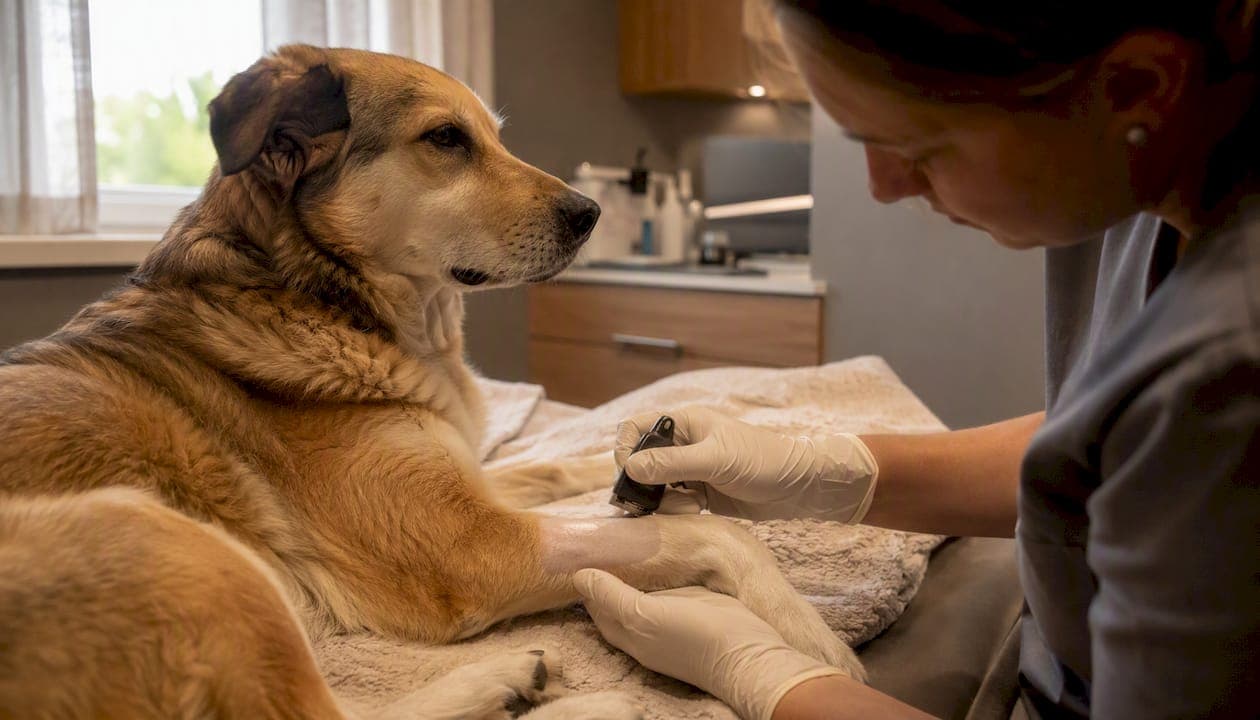
If your dog has been scratching for months and nothing seems to help, allergy testing might be on your mind. Here is the honest answer: testing is not the first step. According to 2023 AAHA management of allergic skin diseases guidelines, atopic dermatitis is a diagnosis of exclusion, meaning your veterinarian needs to rule out parasites, infections, and food triggers before any allergy test makes clinical sense. The right first move is a veterinary exam and a minimum dermatologic database. If environmental allergens are confirmed and you want a treatment aimed at the cause rather than just the symptoms, that is when dog allergy testing becomes genuinely useful, primarily to guide allergen-specific immunotherapy (ASIT).
The International Committee on Allergic Diseases of Animals (ICADA) and the American Animal Hospital Association (AAHA) share the same position: testing is a management tool, not a diagnostic shortcut. Favrot's clinical criteria, a validated set of eight history and physical findings, help clinicians identify dogs likely to have canine atopic dermatitis before any lab work is ordered. Schedule a vet exam first. Bring a written history of your dog's itch pattern, any seasonal flares, and every medication your dog has taken in the past few months.
Key Takeaways
Allergy testing is most useful when it follows a complete diagnostic rule-out and is paired with a clear plan for how results will change treatment, primarily through ASIT for environmental allergens.
| Point | Details |
|---|---|
| Vet exam comes first | Complete a minimum dermatologic database and rule out infections, parasites, and food allergy before ordering any allergy test. |
| IDT for environmental allergens | Intradermal skin testing is the gold standard when ASIT is planned; serum IgE is an accessible alternative but requires careful clinical correlation. |
| Elimination diet for food allergy | Feed a strict novel or hydrolyzed diet for at least eight weeks; blood, saliva, and hair tests cannot diagnose food allergy. |
| Interpret results in context | False positives from CCDs and lab variability are real; results that do not match the clinical history should not drive treatment decisions. |
| City Animal Veterinary Center | City Animal Veterinary Center offers diagnostic dermatology, supervised elimination diet programs, and ASIT coordination in Brooklyn, NY, with Fear Free and home visit options. |
Table of Contents
- When does dog allergy testing actually make sense?
- What each allergy test actually does
- How to prepare and what to expect during testing
- How test results actually change your dog's care
- Understanding accuracy limits and ambiguous results
- How a vet-supervised elimination diet works
- Veterinary testing vs. at-home kits: which one is right?
- Why the vet-first approach is the one worth trusting
- City Animal Veterinary Center can guide your dog's allergy workup
- Useful sources and further reading
When does dog allergy testing actually make sense?
Testing is appropriate for a specific subset of dogs, not every itchy one. The clinical picture matters more than the owner's urgency.
Signs that commonly prompt a testing conversation:
- Chronic or recurrent pruritus (itching) lasting at least one year
- Itch that is seasonal or tied to specific environments (pollen allergies, dust mite exposure)
- Recurrent ear infections (otitis externa) with no other clear cause
- Characteristic lesion distribution: face, paws, armpits, groin, and skin folds
- Partial but incomplete response to steroids or antihistamines
Before any test is ordered, your veterinarian should complete what AAHA calls the minimum dermatologic database: skin cytology, skin scrapings for mites, flea combing, and ear cytology when relevant. Favrot's criteria add structure to the clinical picture by scoring history and physical findings. A dog meeting five or more of the eight criteria has a high probability of canine atopy, which helps justify the next diagnostic step.
The rule-out checklist matters because testing too early wastes money and produces misleading results. Flea allergy dermatitis, sarcoptic mange, and secondary bacterial or yeast infections all cause itch that can mimic atopic dermatitis. Treating those first sometimes resolves the problem entirely.
Before asking for allergy tests, confirm:
- Pruritus has been documented for at least one year or is clearly seasonal
- Strict flea control has been applied to all pets in the household
- Active skin infections have been treated and resolved
- You are open to ASIT if environmental allergens are identified, since that is the primary reason to test
Pro Tip: Ask your veterinarian whether your dog's signs have been present for at least one year or are clearly seasonal. This single piece of history improves both test selection and result interpretation more than most owners realize.
What each allergy test actually does
Not all allergy tests answer the same question. Choosing the wrong test for the wrong question is one of the most common mistakes owners make.
| Test | Sample Type | Primary Purpose | Accuracy Considerations |
|---|---|---|---|
| Intradermal skin test (IDT) | Intradermal allergen injections | Environmental allergens for ASIT | Gold standard for environmental allergens; results must match clinical history |
| Serum allergen-specific IgE | Blood draw | Environmental allergens for ASIT | Variable correlation; lab and extract variability; not reliable for food allergy |
| Elimination diet trial | Owner-managed feeding protocol | Food allergy diagnosis | Gold standard for food allergy; requires strict compliance and provocation challenge |
| At-home commercial kits | Hair, saliva, or blood spot | Marketed as allergy screening | Limited clinical validation; not suitable for food allergy or ASIT formulation |
Intradermal skin testing (IDT) involves injecting small amounts of individual allergens directly into the skin and reading the wheal response after 15–20 minutes. The MSD Veterinary Manual confirms IDT as the test of choice in dogs for identifying environmental allergens when ASIT is planned. It requires light sedation, a clipped test site, and is typically performed by a veterinary dermatologist or a trained general practitioner.
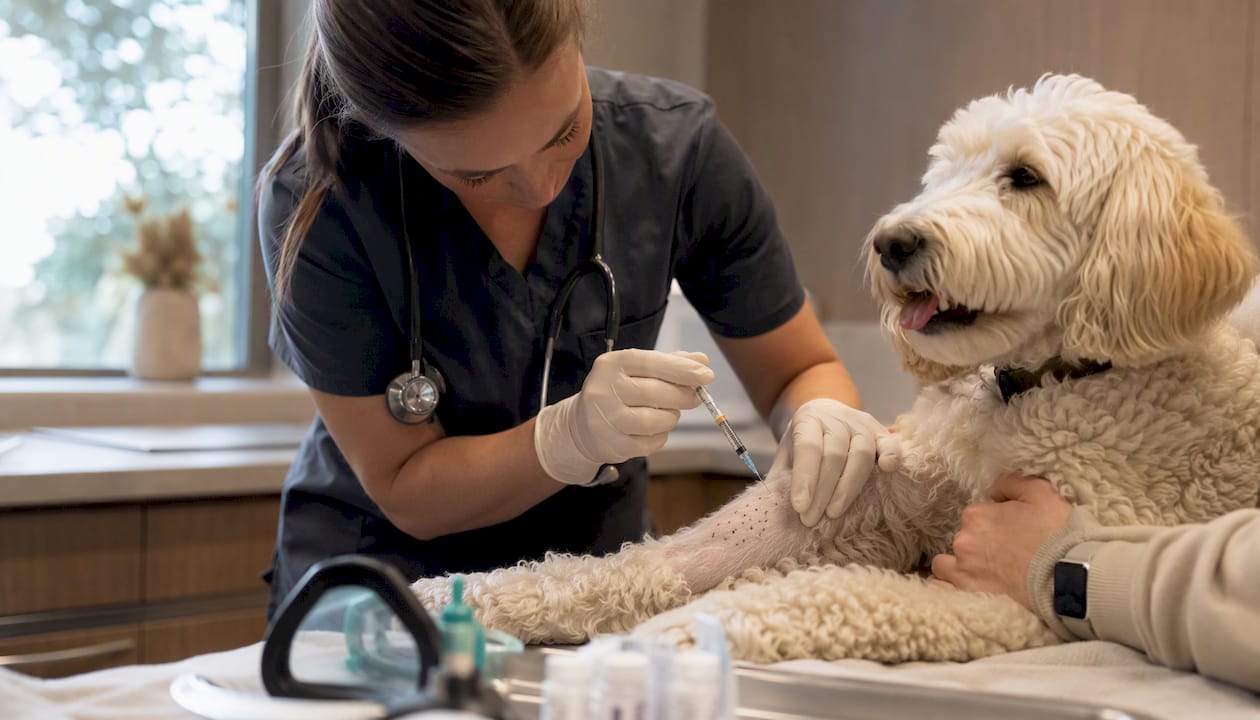
Serum IgE testing uses a blood draw sent to a reference laboratory. It is more accessible than IDT since any clinic can collect the sample, but the PMC review on canine atopic dermatitis notes that results have variable correlation with IDT and must be interpreted alongside the dog's clinical history and seasonality. A positive serum result for tree pollen in a dog whose signs appear only in winter is not clinically actionable.
Elimination diet trials are the only reliable way to diagnose food allergy. Blood, saliva, and hair tests marketed for food sensitivity have no validated diagnostic value in dogs. The trial requires feeding a single novel protein or hydrolyzed diet strictly for at least eight weeks, then reintroducing the original diet to confirm the diagnosis by provocation.
At-home kits vary widely in methodology. Some measure IgE from a hair or saliva sample; others use blood spots. None have been validated against IDT or elimination diets in peer-reviewed studies, and none can formulate ASIT.
Callout: IDT is the most accurate test for identifying environmental allergens when ASIT is the goal. An elimination diet is the only valid test for food allergy. No at-home kit replaces either.
How to prepare and what to expect during testing
Testing is a process, not a single appointment. Knowing the steps ahead of time prevents delays and invalid results.
Typical testing pathway:
- Initial vet exam — full history, physical exam, and Favrot's criteria assessment
- Minimum dermatologic database — skin cytology, scrapings, flea check, ear cytology
- Treat active infections — resolve bacterial or yeast infections before testing
- Medication withdrawal — stop interfering drugs per the table below
- Choose the test — IDT (dermatologist referral) or serum IgE (in-clinic blood draw)
- Sample collection — IDT at the dermatology appointment; blood draw shipped to lab
- Results and follow-up — serum results typically return within one to two weeks; IDT results are immediate
- Interpretation visit — review results in context of history and seasonality
Medication withdrawal before testing:
| Drug Class | Examples | Recommended Withdrawal |
|---|---|---|
| Antihistamines | Diphenhydramine, cetirizine | 1–2 weeks before IDT |
| Short-acting oral corticosteroids | Prednisone, prednisolone | 4–6 weeks before IDT |
| Long-acting injectable corticosteroids | Triamcinolone, methylprednisolone acetate | 8–12 weeks before IDT |
| Oclacitinib (Apoquel) | Oclacitinib | 2 weeks before IDT |
| Lokivetmab (Cytopoint) | Lokivetmab | Discuss with dermatologist; may affect IDT |
| Topical corticosteroids | Hydrocortisone sprays/creams | 2–4 weeks at test site |
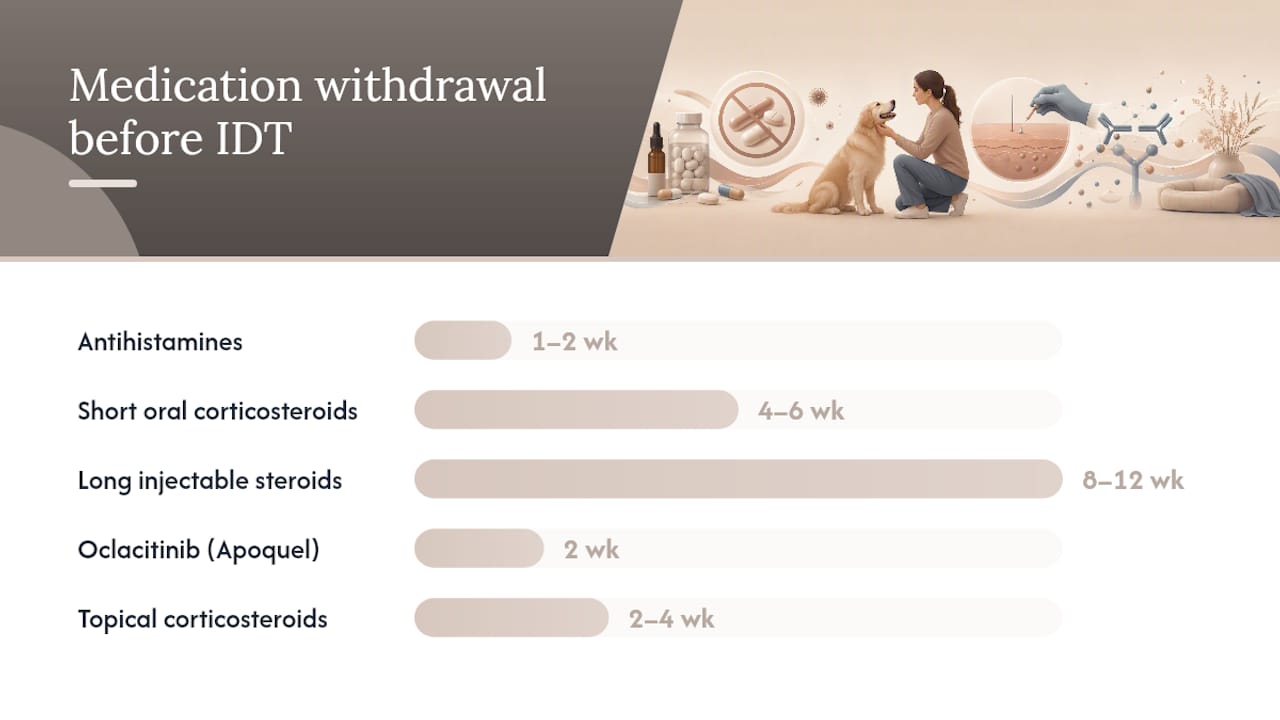
Withdrawal windows are general veterinary guidance; your veterinarian or dermatologist will confirm the exact timing for your dog's situation.
What to bring to the appointment:
- Written itch diary: when it started, seasonal patterns, body areas affected
- Photos of lesions at their worst
- Complete medication list, including flea prevention and supplements
- Prior lab results, skin culture reports, or diet trial records
- Notes on any foods, treats, or chews your dog has received
IDT is typically performed by veterinary dermatologists or trained veterinarians. The dog is lightly sedated, a patch of hair is clipped on the lateral thorax, and a grid of allergen injections is read at 15–20 minutes. Serum testing requires only a blood draw and lab shipping, making it more accessible for general practice. Elimination diets need no lab at all, just strict owner compliance and veterinary supervision.
How test results actually change your dog's care
A positive allergy test result does not cure anything on its own. What it does is give your veterinarian a list of specific allergens to work with.
The primary use of environmental allergy test results is to formulate ASIT, a series of injections or sublingual drops containing the dog's specific allergens in gradually increasing doses. The goal is to desensitize the immune system over time. According to the PMC review, a meaningful minority of dogs achieve an excellent response, a larger proportion have a satisfactory response, and some do not respond sufficiently. ASIT should be continued for a minimum of 12 months before concluding it has not worked.
How results guide decisions:
- Positive environmental allergens compatible with history and seasonality → strong ASIT candidate
- Positive results that do not match the clinical pattern → do not formulate ASIT from those results alone; reassess
- Negative environmental results with persistent signs → focus on symptomatic management and revisit food allergy workup
- Confirmed food allergy via elimination diet → strict long-term dietary management
Beyond ASIT, test results can direct environmental control. A dog with confirmed dust mite allergy benefits from HEPA air filtration, washing bedding weekly in hot water, and reducing carpet exposure. A dog reactive to specific tree pollens can have outdoor time managed during peak pollen seasons. These measures do not replace treatment but can reduce the allergen load enough to lower medication requirements.
Symptomatic management remains part of the picture for most dogs regardless of test results. Oclacitinib, lokivetmab, cyclosporine, and topical therapies all address itch and inflammation without requiring allergen identification. Testing adds the option of a cause-directed treatment, not a replacement for symptom control during the months ASIT takes to build effect.
Studies report that about 20% of dogs on ASIT achieve an excellent response, 40–50% see a satisfactory response, and 30–40% do not respond sufficiently. Plan for a long-term commitment and discuss realistic expectations with your veterinarian before starting.
Understanding accuracy limits and ambiguous results
This is where many owners get confused, and where the most important questions to ask your veterinarian live.
Core limitations of allergy testing:
- Testing does not diagnose atopic dermatitis. Diagnosis is clinical, based on history, physical exam, and rule-outs.
- Serology can produce false positives due to cross-reactive carbohydrate determinants (CCDs), plant-derived glycoproteins that bind IgE antibodies without representing true clinical sensitivity.
- A 2025 systematic review of 72 studies found high variability in test methods, cutoff points, and inconsistent application of Favrot's criteria across laboratories, making broad recommendations about test accuracy difficult.
- Serologic tests for food allergy have no validated diagnostic value. An elimination diet is the only reliable method.
- Lab variability means the same serum sample can produce different results at different laboratories.
When results are borderline or unexpected, the right move is clinical correlation, not automatic action. A result showing strong reactivity to an allergen your dog has never been exposed to is a flag, not a prescription. Retesting is occasionally warranted after resolving active infections, completing medication withdrawal, or switching laboratories, but retesting without addressing those confounders rarely changes the picture.
Pro Tip: Ask your veterinarian which laboratory they use and whether it applies CCD-blocking techniques. Labs that block CCDs before running serology produce fewer false positives. This one question can meaningfully change how you interpret the results.
The University of Minnesota's Small and Large Animal Dermatology Handbook reinforces this: there is no single diagnostic test for atopy, and clinicians should use clinical criteria, confirm drug withdrawal, and use elimination diets to diagnose food allergy rather than relying on serology alone.
How a vet-supervised elimination diet works
Food allergy accounts for a meaningful portion of dogs with chronic pruritus, and it cannot be diagnosed with a blood test. The elimination diet is the only tool that works.
Step-by-step protocol:
- Select the diet with your veterinarian: a prescription hydrolyzed diet (proteins broken down below the molecular weight that triggers IgE) or a novel protein diet (a protein source the dog has never eaten, such as venison or kangaroo).
- Feed strictly for eight weeks. No other food, treats, flavored medications, chews, or table scraps. Eight weeks is the standard for diagnostic confidence; some dogs need up to 12 weeks.
- Control everything that enters the mouth. Flavored toothpastes, pill pockets, and even some heartworm preventives contain food proteins. Check every product with your veterinarian.
- Monitor and document. Keep a daily itch score. Many dogs improve noticeably within four to six weeks; others take the full eight.
- Perform the provocation challenge. After the trial, reintroduce the original diet for up to two weeks. If signs return, food allergy is confirmed. This step is required for a definitive diagnosis.
- Identify specific triggers (optional). After confirmation, individual ingredients can be reintroduced one at a time to identify the specific culprit.
Why owners struggle with compliance:
- Other pets in the household eat different food and share bowls
- Children or visitors give treats without realizing the impact
- Flavored medications are overlooked
- Owners stop early when improvement is not immediate
The AAHA guidelines recommend diet trials of several weeks, commonly around eight weeks, as the standard for diagnostic confidence. If your dog is miserable during the trial, contact your clinic. Symptomatic support (short-course anti-itch medication) can be used during the trial without invalidating the result in most cases, but confirm this with your veterinarian first.
Veterinary testing vs. at-home kits: which one is right?
At-home allergy kits are widely marketed and genuinely appealing. They are inexpensive, require no vet visit, and promise a list of allergens within days. The reality is more complicated.
Veterinary testing:
- Clinically validated methods (IDT, serum IgE from accredited labs)
- Results interpreted in the context of history, physical exam, and rule-outs
- Required for ASIT formulation
- Elimination diet is the only valid food allergy test
- Performed or supervised by a licensed veterinarian
At-home commercial kits:
- Typically use hair, saliva, or blood spot samples
- No peer-reviewed validation against IDT or elimination diets
- Cannot formulate ASIT
- Not suitable for diagnosing food allergy
- Results lack clinical context and can generate long lists of "sensitivities" that do not correspond to actual allergic disease
The Whole Dog Journal notes that veterinary testing is generally more reliable than at-home kits, and that at-home kits should not replace veterinary diagnostics, especially for food allergies. An at-home kit might help an owner start thinking about allergens and prompt a vet conversation, but acting on those results without veterinary guidance risks unnecessary dietary restriction, delayed diagnosis, and money spent on management that does not address the actual problem.
Pro Tip: If you have already used an at-home kit, bring the raw results to your veterinarian. Treat them as a hypothesis to discuss, not a diagnosis to act on. Your vet can tell you which findings, if any, are worth pursuing through validated testing.
Why the vet-first approach is the one worth trusting
The allergy testing conversation in veterinary medicine has a recurring problem: owners arrive having already spent money on at-home kits or having read that a blood test will tell them exactly what their dog is allergic to. The expectation is a clean list and a clean solution. The reality is that canine atopy is a complex, lifelong condition that does not yield to shortcuts.
What AAHA and ICADA have gotten right is the insistence on clinical context. A positive IgE result for dust mites means nothing if the dog lives in a climate where dust mite exposure is negligible, or if the dog's signs appear only in summer when dust mite counts are low. The test result has to fit the dog in front of you. That is not a limitation of the test; it is how immunology works.
The other thing worth saying plainly: ASIT is not a cure. It is a long-term commitment with variable outcomes. Around 20% of dogs achieve an excellent response, 40–50% have a satisfactory response, while 30–40% do not respond sufficiently. Even dogs who respond well usually need concurrent symptomatic management during the first year. Owners who go into ASIT with realistic expectations tend to stay the course long enough to see benefit. Those who expect a quick resolution often stop too early.
At City Animal Veterinary Center, the Fear Free approach matters here specifically because IDT and skin procedures are stressful for anxious dogs. A dog that is calm during the workup produces more reliable results and recovers faster. That is not a marketing point; it is a clinical one.
City Animal Veterinary Center can guide your dog's allergy workup
Persistent itching, recurrent ear infections, and seasonal flares deserve a thorough diagnostic approach, not a guessing game. City Animal Veterinary Center in Brooklyn, NY offers the full range of services a proper allergy workup requires: skin cytology and scrapings as part of the minimum dermatologic database, serum IgE sample collection, supervised elimination diet programs, ASIT coordination, and referral to veterinary dermatology when IDT is indicated.

Every appointment follows the Fear Free protocol, which means lower stress for your dog and more reliable exam findings. For dogs or owners who cannot easily travel, home visit options are available. The first allergy appointment focuses on building a complete history, completing the minimum dermatologic database, and mapping out a testing plan that fits your dog's clinical picture and your goals for treatment.
Book a diagnostic dermatology appointment at City Animal Veterinary Center to start the rule-out process and discuss whether allergy testing is the right next step for your dog.
Useful sources and further reading
- 2023 AAHA management of allergic skin diseases guidelines
- Current Knowledge on Canine Atopic Dermatitis: Pathogenesis and Treatment — PMC
- Efficacy of diagnostic testing for allergen sensitization in canine atopic dermatitis: a systematic review
- Atopic dermatitis in dogs — Small and Large Animal Dermatology Handbook, Vol. 1
- Atopic dermatitis in dogs — MSD Veterinary Manual
- Does my dog need an allergy test? — Whole Dog Journal
This article is general educational information, not a substitute for professional veterinary advice. Consult a licensed veterinarian for guidance specific to your dog's health.