
Trazodone is a prescription medication veterinarians commonly prescribe off-label to reduce anxiety and promote calm in dogs. It works well for situational anxiety (vet visits, thunderstorms, travel), post-surgical confinement, and as part of a long-term behavior plan. It is not appropriate for every dog, and a few combinations with other medications can be dangerous. The right next step is a conversation with your veterinarian before the first dose.
A few things every owner should know upfront:
- Trazodone requires a veterinary prescription. You cannot safely dose it by guessing from human labels.
- Peer-reviewed research supports its use for post-orthopedic surgical confinement, and it has a solid safety record when used correctly.
- ASPCA Animal Poison Control data from 104 symptomatic canine cases show that sedation and lethargy account for 43% of adverse effects, ataxia for 16%, and vomiting for 14%. Most cases resolve with supportive care.
- Combining trazodone with other serotonergic drugs (SSRIs, MAOIs, tramadol) can trigger serotonin syndrome, a potentially life-threatening emergency.
If your dog shows hyperthermia, uncontrolled tremors, seizures, or severe disorientation after taking trazodone, go to an emergency veterinary clinic immediately or call the ASPCA Animal Poison Control Center at (888) 426-4435.
Pro Tip: Before your appointment, write down every medication, supplement, and herbal product your dog currently takes. Drug interactions are the single biggest risk factor with trazodone, and a complete list takes two minutes to prepare but can prevent a serious adverse event.
Table of Contents
- How does trazodone work in dogs?
- When do veterinarians prescribe trazodone for dogs?
- How is trazodone dosed and administered?
- How quickly does trazodone start working, and how long does it last?
- What are the side effects of trazodone in dogs?
- Which medications and health conditions interact with trazodone?
- How should you monitor your dog when starting trazodone?
- What are the alternatives to trazodone, and can it be combined with other therapies?
- How a Fear-Free clinic approaches trazodone and post-operative anxiety management
- Key Takeaways
- The case for treating anxiety as seriously as physical illness
- City Animal Veterinary Center can help your anxious dog
- Sources and further reading
How does trazodone work in dogs?
Trazodone belongs to a drug class called serotonin antagonists and reuptake inhibitors, or SARIs. At low-to-moderate doses, it blocks serotonin 2A (5-HT2A), histamine H1, and alpha-1 adrenergic receptors. That combination produces sedation and reduces anxiety. At higher doses, the drug can shift toward serotonin agonist activity, which is where the risk of serotonin syndrome enters the picture.
Mechanism in plain terms: Trazodone does not simply sedate a dog the way a tranquilizer does. It reduces the emotional reactivity that drives anxious behavior by modulating serotonin signaling. The result is a calmer dog who can still respond to its environment, not a dog that is knocked out.
Veterinarians prescribe trazodone off-label for dogs. "Off-label" means the FDA approved the drug for use in humans, not animals, but veterinarians are legally permitted to prescribe approved medications for species not listed on the label when clinical evidence supports it. This is routine in veterinary medicine and does not mean the drug is experimental.
Key pharmacology points owners should understand:
- Onset: Immediate-release tablets typically begin working within 30–60 minutes.
- Tablet forms: Trazodone is manufactured in 50 mg, 100 mg, 150 mg, and 300 mg human tablets. Veterinarians calculate the dose by body weight, so compounding into smaller or liquid forms is common for small dogs.
- Metabolism: The drug is processed by the liver, which matters for dogs with hepatic disease and for interactions with drugs that affect cytochrome P450 enzymes.
- Duration: Owner-observed effects can last four hours or more in many dogs, though individual variation is significant.
Clinical evidence supporting trazodone's use in veterinary patients has grown substantially since Gruen and Sherman's foundational work, and it is now one of the most commonly prescribed behavioral medications in small animal practice.

When do veterinarians prescribe trazodone for dogs?
Trazodone fits into three broad clinical categories, and understanding them helps you recognize whether your dog's situation is a good candidate for discussion with your vet.
Situational and event-based anxiety
This is the most common use. A single dose given 1–2 hours before a stressor reduces reactivity during the event itself. Typical situations include:
- Veterinary or grooming visits
- Car travel or air travel
- Thunderstorms and fireworks
- Boarding or kennel stays
- Exposure to unfamiliar people or environments
Post-surgical confinement and recovery
After orthopedic surgery, dogs need strict rest for weeks. Keeping an energetic dog calm enough to protect a repair site is genuinely difficult. Gruen et al.'s research found that trazodone is effective and safe for facilitating this confinement, promoting calm behavior during recovery without the heavy sedation that would interfere with eating, drinking, or basic mobility.
Chronic behavioral conditions
For dogs with separation anxiety, generalized anxiety disorder, or noise phobia that occurs frequently, veterinarians sometimes prescribe trazodone on a scheduled daily or twice-daily basis. In this context, it typically works alongside behavior modification, not instead of it.
Pro Tip: Trazodone is not a substitute for training or desensitization. Dogs with chronic anxiety tend to do best when medication reduces the emotional ceiling enough for behavior work to actually land. Ask your vet for a referral to a veterinary behaviorist or certified applied animal behaviorist if anxiety is severe.
| Use Case | Dosing Approach | Typical Goal |
|---|---|---|
| Pre-vet or pre-grooming | Single event dose, 1–2 hrs before | Reduce reactivity during visit |
| Post-surgical confinement | Daily or twice-daily scheduled | Promote calm rest during recovery |
| Separation anxiety | Daily scheduled, long-term | Reduce baseline anxiety; support behavior work |
| Thunderstorms/fireworks | Single event dose, 1–2 hrs before | Blunt acute fear response |
| Travel anxiety | Single event dose, 1–2 hrs before | Reduce motion-related distress |
How is trazodone dosed and administered?
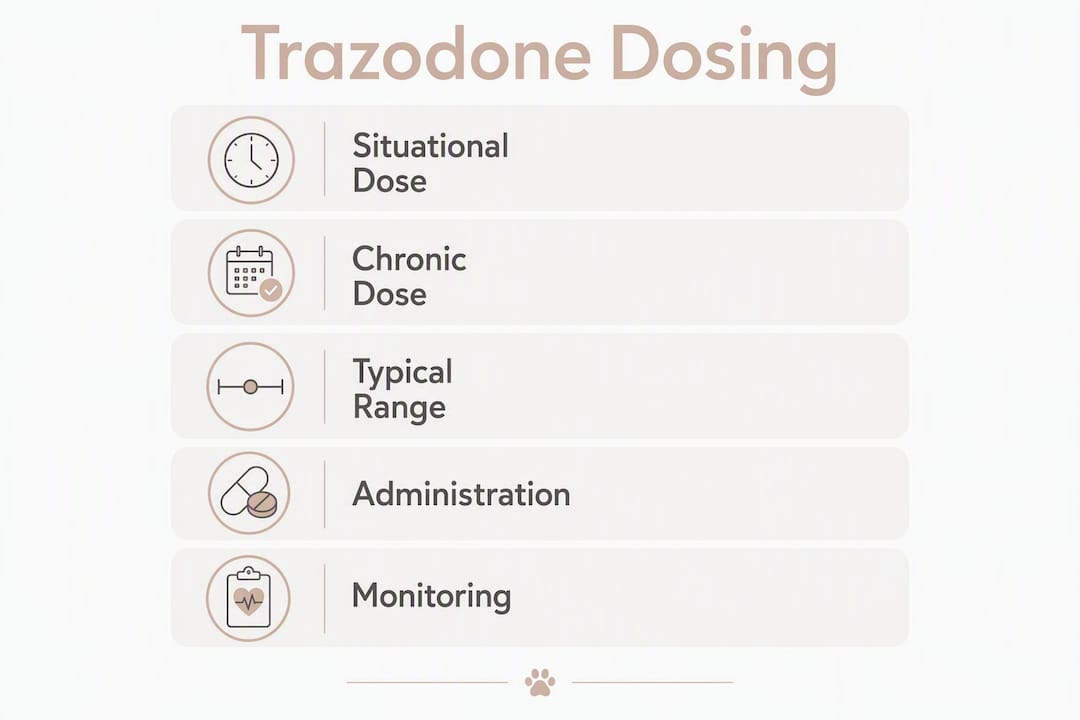
Dosing depends on whether the use is situational or chronic, and your veterinarian will calculate the exact amount based on your dog's weight, health status, and concurrent medications. The ranges below are reference points for discussion, not a prescription.
| Dosing Context | Typical Range | Notes |
|---|---|---|
| Situational (single event) | 3–10 mg/kg given once | Higher end of range; give 1–2 hrs before stressor |
| Chronic / daily | 2–5 mg/kg every 12 hours | Start low; titrate up with vet oversight |
| Post-surgical confinement | 5–7.5 mg/kg every 12 hours | Range used in controlled studies |
Trazodone comes in 50 mg, 100 mg, 150 mg, and 300 mg tablets. For a 20-pound dog, a typical situational dose might fall in the 30–90 mg range. A 70-pound dog might receive 100–300 mg. Because the math varies significantly by individual, always confirm the exact dose with your prescribing veterinarian.
Compounding is frequently used for small dogs or when a liquid form is needed. A compounding pharmacy can prepare trazodone in a flavored liquid or in a smaller tablet size, making accurate dosing much easier. This requires a veterinary prescription.
Administration tips:
- Give with a small amount of food to reduce nausea. Administering trazodone with a small meal or treat often reduces GI upset without impairing effectiveness.
- Do not crush extended-release formulations. Standard immediate-release tablets can be split if scored.
- Missed dose (daily regimen): Give the missed dose as soon as you remember, unless it is close to the time of the next scheduled dose. Never double up.
- Store at room temperature, away from moisture and out of reach of children and other pets.
Pro Tip: For situational use, do a "test dose" at home on a low-stakes day before the actual event. This lets you see how your dog responds, whether sedation is heavier than expected, and whether any GI upset occurs, without the added stress of a vet visit or thunderstorm.
How quickly does trazodone start working, and how long does it last?
Immediate-release trazodone tablets typically begin producing noticeable effects within 30–60 minutes of administration. For situational use, veterinary guidance recommends giving the dose 1–2 hours before the anticipated stressor to allow full absorption and avoid the window where a dog is still anxious but partially sedated.

Timing matters more than most owners realize. Giving trazodone too late, after a dog has already escalated into high arousal, reduces its effectiveness. The drug works better as a preventive buffer than as a rescue medication once panic has set in.
Factors that affect onset and duration:
- Food in the stomach: A full meal can slow absorption slightly, which is why the recommendation is a small snack rather than a full feeding.
- Age and metabolism: Older dogs and those with liver disease may metabolize the drug more slowly, leading to longer or more pronounced sedation.
- Concurrent medications: Drugs that inhibit cytochrome P450 enzymes (certain antifungals and antibiotics) can increase trazodone blood levels and extend its effects.
- Individual variation: Some dogs show effects for 4+ hours; others metabolize it faster. The test-dose approach mentioned above helps you calibrate this for your dog.
Pro Tip: For a scheduled event like a vet appointment, set a phone alarm for the dose time rather than relying on memory. Missing the timing window is the most common reason owners report that trazodone "didn't work."
What are the side effects of trazodone in dogs?
Most dogs tolerate trazodone well. The side effects that do occur are usually mild and resolve as the drug clears the system. Serious adverse events are rare but real, and knowing the difference between expected sedation and a genuine emergency matters.
Common side effects
ASPCA Animal Poison Control data from 104 symptomatic canine cases found:
| Adverse Effect | Frequency in Symptomatic Cases |
|---|---|
| Sedation / lethargy | 43% |
| Ataxia (stumbling gait) | 16% |
| Vomiting | 14% |
| Other GI signs | Less common |
ASPCA Animal Poison Control data found sedation, lethargy, and ataxia/stumbling gait as the most common effects in symptomatic cases. Keep sedated dogs away from stairs and elevated furniture until you know how your dog responds.
Serious risks
Serotonin syndrome is the most dangerous risk associated with trazodone. Signs include hyperthermia, muscle tremors, seizures, rapid heart rate, dilated pupils, and severe disorientation. This is a medical emergency. If you see these signs, do not wait.
Other serious but less common adverse events:
- Paradoxical excitation: A minority of dogs become more agitated rather than calmer. This idiosyncratic reaction is unpredictable and tends to appear after the first few doses.
- Priapism: Prolonged, painful erection in male dogs. Rare but requires immediate veterinary attention.
- Seizures: Reported at high doses or in dogs with a seizure history.
- Cardiac effects: A controlled study found a statistically significant decrease in platelet aggregation (P = .002) at standard doses (5–7.5 mg/kg every 12 hours), though QT intervals and other hemostasis markers were unchanged. The clinical significance for healthy dogs is unclear, but this finding matters for dogs with bleeding disorders or those scheduled for surgery.
Overdose
Overdose signs include extreme sedation, vomiting, tremors, and seizures. Contact your veterinarian, an emergency clinic, or the ASPCA Animal Poison Control Center (888-426-4435) immediately. Most dogs recover fully with prompt supportive care.
Which medications and health conditions interact with trazodone?
Drug interactions are where trazodone's risk profile concentrates. Before your veterinarian prescribes it, they need a complete picture of everything your dog is currently taking.
High-risk drug combinations
- SSRIs and SNRIs (fluoxetine, sertraline, paroxetine): Combining two serotonergic drugs significantly raises the risk of serotonin syndrome.
- MAOIs (selegiline, amitraz in some flea collars): This combination is particularly dangerous and is generally contraindicated.
- Tramadol: Also serotonergic; concurrent use requires careful veterinary evaluation.
- CYP3A4 inhibitors (certain azole antifungals like ketoconazole, some macrolide antibiotics): These slow trazodone metabolism, raising blood levels and increasing both sedation and adverse-event risk. When dogs are on drugs that affect cytochrome P450 pathways, veterinarians may choose lower starting doses or schedule closer monitoring including bloodwork or ECG.
- CNS depressants (benzodiazepines, opioids, phenobarbital): Additive sedation; dose adjustments may be needed.
Health conditions requiring caution or contraindication
- Liver disease: Impaired metabolism leads to drug accumulation.
- Kidney disease: Affects drug clearance; monitoring is warranted.
- Cardiac disease: Given the platelet aggregation finding and potential for cardiovascular effects, dogs with known heart conditions need careful evaluation.
- Bleeding disorders or coagulopathies: The platelet aggregation data makes trazodone a higher-risk choice for dogs with von Willebrand disease or other clotting issues.
- Seizure history: Trazodone can lower the seizure threshold at high doses.
Pro Tip: Include supplements on your medication list. St. John's Wort, 5-HTP, and SAMe are all serotonergic and can interact with trazodone just as prescription drugs do. Many owners forget to mention supplements because they seem harmless.
How should you monitor your dog when starting trazodone?
The first 24–72 hours after starting trazodone, or after a dose increase, are the window when most adverse events appear. Knowing what to watch for makes a real difference in catching problems early.
What to observe
Watch for these in the first three days:
- Sedation level: Some drowsiness is expected. Sedation so heavy that your dog cannot stand, eat, or drink is not.
- Coordination: Mild stumbling is common. A dog that cannot walk or falls repeatedly needs veterinary attention.
- Appetite and GI signs: Mild nausea or one episode of vomiting is manageable. Sustained vomiting or refusal to eat for more than 24 hours warrants a call to your vet.
- Behavior: Note whether anxiety is actually reduced. If your dog seems more agitated than before the dose, that paradoxical excitation is worth reporting.
- Any signs of serotonin syndrome (tremors, hyperthermia, rapid breathing, severe disorientation): these require emergency care, not a wait-and-see approach.
Practical preparation before the first dose: Write down your dog's baseline behavior, note the time you gave the medication, and keep emergency contacts (your vet's after-hours line and the nearest emergency clinic) accessible. If your dog is heavily sedated, keep them in a safe, low space away from stairs.
When to call your vet vs. go to emergency care
| Situation | Action |
|---|---|
| Mild drowsiness, one episode of vomiting | Monitor; call vet if it persists |
| Sustained vomiting, refusal to eat | Call your veterinarian |
| Collapse, inability to stand | Emergency clinic immediately |
| Tremors, seizures, hyperthermia | Emergency clinic + ASPCA Poison Control (888-426-4435) |
| Paradoxical agitation | Call your vet; do not redose |
ASPCA Animal Poison Control data confirm that the majority of adverse events are manageable with supportive care, but prompt action improves outcomes.
Pro Tip: Keep a simple log for the first two weeks: time of dose, food given with it, sedation level (1–5 scale), and any unusual behavior. This data is genuinely useful at follow-up appointments and helps your vet decide whether to adjust the dose.
What are the alternatives to trazodone, and can it be combined with other therapies?
Trazodone rarely works best in isolation. Most veterinary behaviorists treat anxiety as a multi-modal problem, meaning medication, behavior modification, and environmental management each play a role.
Non-pharmacologic options
These are appropriate as first-line approaches for mild anxiety or as complements to medication for moderate-to-severe cases:
- Desensitization and counter-conditioning: Systematic, gradual exposure to triggers paired with positive reinforcement. Requires consistency but produces lasting change.
- Pheromone products (Adaptil diffusers and collars): Synthetic dog-appeasing pheromone; evidence is mixed but side effects are essentially zero.
- Pressure wraps (Thundershirt and similar): Useful for some dogs during acute events; works best combined with other strategies.
- Environmental management: White noise machines, covered crates, and predictable routines reduce baseline arousal.
Pharmacologic alternatives and adjuncts
| Drug Category | Typical Use Case | Key Difference from Trazodone |
|---|---|---|
| Gabapentin | Pre-vet sedation, post-op pain and anxiety | Also analgesic; often combined with trazodone for post-op use |
| Benzodiazepines (diazepam, alprazolam) | Acute, severe situational anxiety | Faster onset; higher abuse/dependence potential; controlled substance |
| SSRIs (fluoxetine) | Chronic generalized or separation anxiety | Requires weeks to reach full effect; not situational |
| Alpha-2 agonists (dexmedetomidine gel) | Acute noise phobia | Transmucosal; very fast onset; prescription only |
Gabapentin and trazodone are frequently prescribed together, particularly for pre-veterinary-visit sedation and post-surgical recovery. The combination produces additive sedation, so doses of each are typically lower than when either is used alone. Never combine them without explicit veterinary guidance on the adjusted doses.
Combining trazodone with any serotonergic drug (SSRIs, tramadol, certain supplements) requires careful risk-benefit evaluation. The additive serotonin load is the concern, not the sedation.
How a Fear-Free clinic approaches trazodone and post-operative anxiety management
A Fear-Free practice does not treat trazodone as a last resort but as a tool that makes the entire care experience better for the dog, the owner, and the clinical team.
At City Animal Veterinary Center, the workflow for a dog with significant anxiety starts before the appointment. Owners are asked to bring a complete medication list and a brief behavior log so the veterinarian can assess baseline anxiety, identify interaction risks, and tailor the dose to the individual dog rather than applying a generic weight-based formula.
For post-operative patients, the approach combines trazodone with structured confinement guidance and scheduled follow-up. The goal is not just to keep the dog still; it is to keep the dog calm enough that the recovery period does not become a source of new anxiety or behavioral problems.
What owners often underestimate: The veterinary visit itself can be a trigger that sensitizes anxious dogs over time. Pre-visit trazodone, combined with Fear-Free handling techniques, breaks that cycle. Dogs who arrive already calm are easier to examine, require less restraint, and leave with a more neutral association with the clinic.
Practical checklist for your appointment:
- Complete list of all medications, supplements, and flea/tick preventives
- Brief written description of anxiety triggers and severity (1–10 scale works fine)
- Note the last time your dog ate and drank
- Questions written down in advance (see below)
Questions worth asking your veterinarian:
- Is trazodone appropriate given my dog's current medications and health history?
- Should we do a test dose at home before the event?
- What dose should I give, and exactly when?
- What signs should prompt me to call you or go to emergency care?
- Is behavior modification something we should pursue alongside medication?
City Animal Veterinary Center also offers house call services for dogs whose anxiety makes clinic visits genuinely difficult. A home visit removes the travel and waiting-room stressors entirely, which can make the initial behavioral evaluation more accurate and less traumatic for the dog.
Pro Tip: If your dog needs trazodone before a vet visit, the prescription has to come from a prior exam. Schedule a behavioral consult or wellness visit first so your veterinarian can evaluate your dog and write the prescription before the stressful event you are trying to manage.
Key Takeaways
Trazodone is a well-supported, prescription-only option for canine anxiety and post-surgical confinement, but its safety depends entirely on correct dosing, drug interaction screening, and veterinary supervision.
| Point | Details |
|---|---|
| Prescription required | Trazodone must be prescribed by a veterinarian after a physical exam; never dose from a human label. |
| Main uses | Situational anxiety, post-surgical confinement, and adjunct therapy for chronic behavioral conditions. |
| Most common side effects | Sedation, lethargy, and ataxia/stumbling gait are most common per ASPCA data; most resolve with supportive care. |
| Biggest safety risk | Combining trazodone with other serotonergic drugs can cause serotonin syndrome; always provide a full medication list. |
| City Animal Veterinary Center | Offers Fear-Free behavioral evaluations, post-op follow-up, and house call services for dogs with anxiety in Brooklyn, NY. |
The case for treating anxiety as seriously as physical illness
Trazodone is genuinely useful. But the way it gets discussed online, you would think the main decision is which dose to pick. The harder question is whether medication alone is the goal.
Dogs with anxiety are not just uncomfortable. Chronic stress affects immune function, sleep, digestion, and the quality of every interaction they have with their family. Trazodone can lower the emotional ceiling enough to make a dog's life meaningfully better, and that matters. What it cannot do is teach a dog that the world is safe. That part requires time, consistency, and often professional behavioral guidance.
The other thing worth saying plainly: the Fear-Free movement in veterinary medicine exists because traditional handling was making anxious dogs worse. Restraint-heavy exams, cold tables, and waiting rooms full of unfamiliar smells are not neutral experiences for a dog that already struggles with anxiety. Pre-visit medication is not a workaround for poor handling; it is part of a philosophy that takes the dog's emotional state seriously as a clinical variable.
Owners who combine trazodone with active behavior work, structured desensitization, and a veterinary practice that prioritizes low-stress handling tend to see the best outcomes. Medication opens the door. What happens next is up to the whole team.
City Animal Veterinary Center can help your anxious dog
Anxious dogs deserve more than a prescription handed over at the end of a stressful exam. At City Animal Veterinary Center in Brooklyn, NY, behavioral consultations are built into the care model, not treated as an add-on. The Fear-Free approach means your dog's emotional state is evaluated and managed from the moment you book, not just when things go wrong.
For dogs who need trazodone before a vet visit, for post-surgical patients who need calm confinement support, or for owners trying to build a long-term anxiety management plan, City Animal Veterinary Center offers in-clinic appointments and house call services. House calls are particularly valuable for dogs whose anxiety is severe enough that the trip to the clinic is itself the problem.
Bring your medication list, a brief behavior log, and your questions. The team will handle the rest. Book a behavioral consult or house call to get started.
This article provides general information and is not a substitute for professional veterinary advice. Always consult a licensed veterinarian before starting, changing, or stopping any medication for your pet.
Sources and further reading
The claims in this article are grounded in peer-reviewed veterinary literature, clinical practice reviews, and ASPCA poison-control data. The sources below are the primary references.
| Source | Why It Matters |
|---|---|
| Gruen & Sherman: Trazodone for Post-Surgical Confinement (PMC) | Randomized controlled study; foundational evidence for post-op confinement use in dogs |
| Platelet Aggregation Study (PMC) | Controlled crossover study; documents decreased platelet aggregation at standard doses |
| Today's Veterinary Technician: Trazodone in Veterinary Medicine | ASPCA poison-control data on 104 symptomatic canine cases; adverse-effect frequency breakdown |
| Today's Veterinary Technician: Foss Clinical Review | Mechanism, pharmacokinetics, dosing guidance, and timing recommendations |
| BluePearl Veterinary Partners: Serotonin Syndrome | Clinical description of serotonin syndrome signs and emergency management |
| AKC: Trazodone for Dogs | Owner-facing clinical guidance on common side effects and safety monitoring |
| GoodRx Pet: Trazodone for Dogs | Administration tips including GI management with food |
| Dogster: Trazodone for Dogs, Vet Answer | Veterinary-reviewed overview of off-label use, indications, and long-term safety |