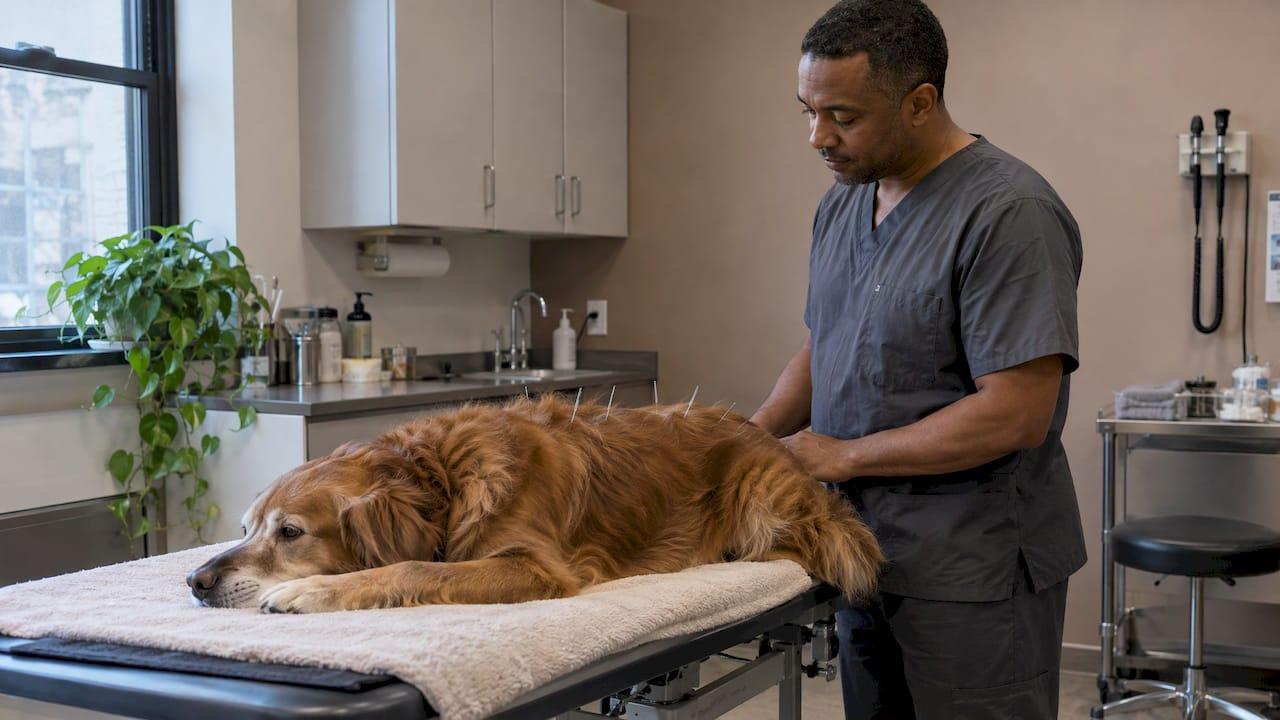
Dog acupuncture has a good safety record. The side effects owners actually see are mild and short: a sleepy or sore dog for a day, and occasionally a small bruise where a needle went in. Serious problems are uncommon, and most of the risk comes down to who places the needles and whether your dog is a good candidate. At City Animal Veterinary Center in Brooklyn, acupuncture is part of a Fear Free approach, so the session itself is designed to keep your dog calm, and you can ask us about anything that happens afterward.
This guide covers what to expect in the first 24 to 48 hours, which reactions are normal, which are not, who should skip needling, and how to prepare so the session goes smoothly.
TL;DR
- The most common effects are temporary soreness, mild tiredness and, rarely, a small bruise at a needle site, according to Washington State University's veterinary hospital.
- A sleepy, deeply relaxed dog after a session is often a normal response, not a sign that something went wrong.
- Needles should never go into infected skin, open wounds, tumors or fracture sites, and dogs with clotting problems need special caution.
- Call your veterinarian if your dog is in worsening pain, bleeding that won't stop, swelling, discharge, or acting very unlike themselves.
- Choosing a veterinarian who does the exam first, explains the risks and adjusts the plan keeps the risk low.
Table of Contents
- What dogs usually feel after an acupuncture session
- How long side effects last
- Rare complications worth knowing about
- When to call the vet after acupuncture
- Which dogs need extra caution
- What good acupuncture care looks like
- Preparing your dog and what to do afterward
- Acupuncture as part of pain management
- Our perspective
- Book a calm, well-planned acupuncture visit
- FAQ
- Sources
What dogs usually feel after an acupuncture session
Acupuncture uses hair-thin sterile needles placed at specific points on the body. Most dogs tolerate it very well. The University of Florida's small animal hospital describes acupuncture as generally well tolerated by veterinary patients, with minimal to no side effects when a professional performs it, and notes that needle insertion is virtually painless.
When effects do show up, they tend to fall into a short list:
- Mild soreness or stiffness. The treated area, or the whole body, may feel a little tender.
- Tiredness. Many dogs nap heavily for the rest of the day.
- Small bruise or a drop of blood. A needle can nick a tiny vessel under the skin. Today's Veterinary Practice lists minor bleeding, soreness, muscle spasm, tiredness and increased water intake as common minor effects that typically resolve quickly.
- A short-lived change in symptoms. Occasionally a dog seems a little more uncomfortable for a day or so before improving.
Washington State's hospital puts the overall picture simply: side effects are typically mild, and serious complications are uncommon.
Relaxed or lethargic?
Owners sometimes read a calm dog as a sick one. The American Academy of Veterinary Acupuncture explains that a treatment can produce a deeply relaxed state that owners may mistake for lethargy or worsening. That state is temporary. If you are unsure, tell the veterinarian at the next visit, who can adjust the treatment.
A useful way to tell the difference: a relaxed dog still wakes up for food, water, a walk or a familiar voice. A dog who is truly unwell stays flat, hides, or will not respond to the things they love.
How long side effects last
For soreness, tiredness and minor bruising, the published veterinary sources describe the effects as temporary and quick to resolve rather than giving a fixed number of hours. In practice, expect your dog to be back to normal within a day or two. A short-lived flare of the original symptoms before improvement is also described as something that passes.
If an effect lasts longer than that, or gets worse instead of fading, treat it as a reason to call us rather than waiting it out. A bruise that keeps spreading, soreness that intensifies, or tiredness that lasts beyond a couple of days deserves a look.

Rare complications worth knowing about
You should know the rare ones, mostly so you can recognize them early.
Infection at a needle site. Needles are sterilized, so the American Academy of Veterinary Acupuncture says infection from a needle site is extremely rare. Watch for heat, redness, swelling or discharge at a site in the days after treatment.
Skin irritation or a broken needle fragment. Today's Veterinary Practice includes infection, dermatitis and broken needle fragments among the rare complications.
Needle injury to deeper structures. The Merck Veterinary Manual says the risk of injuring a major organ or blood vessel is reportedly limited provided the practitioner knows the relevant anatomic landmarks. It also says that an extreme negative reaction during needling may mean a needle has entered a nerve, and that the needle should be withdrawn immediately. This is one reason treatment should be done by a veterinarian trained in anatomy, who watches your dog throughout the session.
Swallowed needles. A dog could in theory swallow a needle. The same manual notes there are no published reports of injury from this. Staying with your dog and keeping the session supervised handles it.
Reactions seen in people. Fainting, skin infections and hepatitis are listed as adverse reactions in human acupuncture. The Merck manual says they have apparently not been reported in veterinary patients.
On the numbers: a 2024 review in the Brazilian Journal of Animal and Environmental Research found that the most commonly reported adverse effects in animals are needle-induced injuries and temporary discomfort at insertion sites, and that removing the needle generally corrects them. It cites a Swiss study that estimated adverse events in about 1 in 150 equine treatments. That figure is for horses, so it is a rough guide to how rare events are, not a dog-specific rate.

When to call the vet after acupuncture
Most dogs go home, nap, and wake up fine. Contact a veterinarian promptly if you see any of the following:
- Bleeding that continues or a bruise that keeps growing
- Swelling, heat, redness or discharge at a needle site
- Pain that is getting worse rather than easing after a day or two
- Limping or weakness that is new, or loss of use of a limb
- Refusing food or water, or tiredness that does not lift within a day or two
- Vomiting, difficulty breathing or collapse
Collapse, trouble breathing or uncontrolled bleeding are emergencies. Go straight to an emergency hospital or call us. Our urgent care service exists for situations that cannot wait for a routine appointment. For anything less dramatic, a quick call to the veterinarian who treated your dog is the right first step, and they can tell you whether to bring your dog in or adjust the next session.
Which dogs need extra caution
Acupuncture is generally regarded as safe when performed correctly, according to the Merck Veterinary Manual, but certain situations change the plan. These are the ones the veterinary literature names.
| Situation | What the sources say |
|---|---|
| Infected or inflamed skin, open wounds | Needles should not be placed there |
| Tumors and fracture sites | Needles should not be placed at these sites |
| Pregnancy | Avoid needling around the abdomen |
| Clotting abnormalities | Use cautiously or avoid, because of the bleeding risk |
| Immune compromise | May be a contraindication if needling could lead to local infection |
| Heart disease or pacemaker | Do not apply electro-acupuncture across the chest |
| Dogs who cannot stay still | May not be safe to needle |
The first four rows and the heart-related row come from Today's Veterinary Practice, and the clotting, immune and stillness points are supported by the Merck Veterinary Manual.
That last row matters for anxious dogs, and it is where a calm setting helps. A dog who is frightened and thrashing is harder to needle safely and less likely to benefit. Our Fear Free approach is built to lower stress during visits, and home visits mean your dog can be treated on their own bed or couch instead of after a car or subway ride.
Before the first session, tell the veterinarian about every condition and medication your dog has, including heart disease, seizures, clotting problems, or recent surgery. That information decides whether acupuncture is the right choice and which points or techniques are used.
What good acupuncture care looks like
Side effects are largely about process. A few things lower the risk further.
- An exam comes first. Acupuncture is one tool inside a full veterinary workup. Knowing what is causing your dog's pain, whether arthritis, a disc problem or something else, keeps you from treating a symptom while a bigger problem goes unnoticed. If diagnostics are needed, our diagnostic imaging and in-house laboratory can be part of that picture.
- Informed consent. Today's Veterinary Practice stresses that veterinarians performing acupuncture must obtain informed consent, covering not just the benefits but realistic expectations and possible adverse effects, since not every patient responds.
- A trained veterinarian places the needles. Knowing anatomy is what keeps needle injuries rare.
- Sterile, single-use needles and a watched session. Your dog should never be left alone with needles in place.
- A plan for follow-up. If a session leaves your dog sore or sleepy, the next one can be adjusted.
Preparing your dog and what to do afterward
Before the visit
- Bring a list of medications and supplements, and any past records.
- Let your dog settle first. A short, easy walk beforehand helps many dogs relax.
- Bring a favorite blanket or a few high-value treats. For dogs who get tense, our guide to calmer vet visits has practical steps.
After the session
- Offer water and a quiet place to rest.
- Keep activity gentle for the rest of the day. A short leash walk to relieve themselves is fine, but skip the dog park.
- Check the needle sites once or twice for bruising, redness or swelling.
- Note any change in appetite, energy, thirst or mobility so you can report it accurately.
Don't give pain medication or supplements you have not discussed with your veterinarian, especially if your dog already takes anti-inflammatories.
Acupuncture as part of pain management
Dogs most often get acupuncture for chronic pain such as arthritis. Today's Veterinary Practice reports that pain management guidelines from the American Animal Hospital Association, the American Association of Feline Practitioners and the World Small Animal Veterinary Association endorse acupuncture as a safe adjunct treatment, to be strongly considered in a multimodal pain regimen. "Multimodal" means combining several approaches, so acupuncture works alongside medication, weight management and rehabilitation rather than replacing them.
We use it that way. Our pain management service sits alongside acupuncture, and our guide on acupuncture for arthritic dogs explains how Fear Free home visits fit in. If you want the broader picture of what a course of treatment involves, see what dog owners need to know about acupuncture.
Our perspective
We offer acupuncture because we see it as one part of caring for the whole dog, not a stand-alone fix. Our approach to veterinary care combines traditional medicine with holistic options, and we try to keep the experience as calm for your dog as it is for you.
For us, safety starts before any needle: a conversation about your dog's history, an exam, and a clear explanation of what to expect afterward, including the normal sleepiness and soreness that can follow a session. Because we are Fear Free, we pay close attention to how your dog is feeling throughout.
For dogs who find travel stressful, or owners who cannot easily get to us, a home visit can make treatment far more comfortable. And if anything about your dog's recovery worries you, we would rather hear from you early than have you wonder.
CAVC
Book a calm, well-planned acupuncture visit
If your dog has chronic pain, stiffness or trouble getting up, our team can examine them and talk through whether acupuncture belongs in their plan. Visits are Fear Free, and home visits are available for dogs who do better in familiar surroundings. See our acupuncture page to learn more, or reach us through our website to book.

FAQ
What is the most common side effect of acupuncture in dogs?
Temporary tiredness and mild soreness are the most commonly described. Some dogs also get a small bruise or a spot of blood at a needle site. These typically fade quickly, and serious complications are uncommon.
Is acupuncture safe for senior dogs?
Many older dogs are treated, often for arthritis and chronic pain, and acupuncture is generally regarded as safe when performed correctly. The veterinarian will first consider other conditions such as heart disease or clotting problems, which change how needles are used. Our geriatric care team can look at the whole picture.
Can acupuncture make my dog worse?
A brief flare of symptoms for a day or two can happen before improvement, and a very relaxed dog can look as if they are declining when they are not. If your dog seems worse for more than a day or two, or you see swelling, bleeding or discharge, call the veterinarian so the next treatment can be adjusted.
Does acupuncture hurt dogs?
The University of Florida's small animal hospital describes needle insertion as virtually painless, and most dogs relax during the session. A calm environment helps, which is why we build our visits around Fear Free handling.
Should my dog eat before acupuncture?
In general a light meal or normal routine is fine, and treats help many dogs stay relaxed. Ask the veterinarian for instructions specific to your dog, especially if other procedures are planned the same day.
Sources
- Acupuncture for chronic pain in dogs, Washington State University Veterinary Teaching Hospital
- Acupuncture, University of Florida Small Animal Hospital
- What is Acupuncture?, American Academy of Veterinary Acupuncture
- Acupuncture in Veterinary Patients, Merck Veterinary Manual
- Use of Acupuncture for Pain Management, Today's Veterinary Practice
- The efficacy of acupuncture in animals, Part 2, Brazilian Journal of Animal and Environmental Research