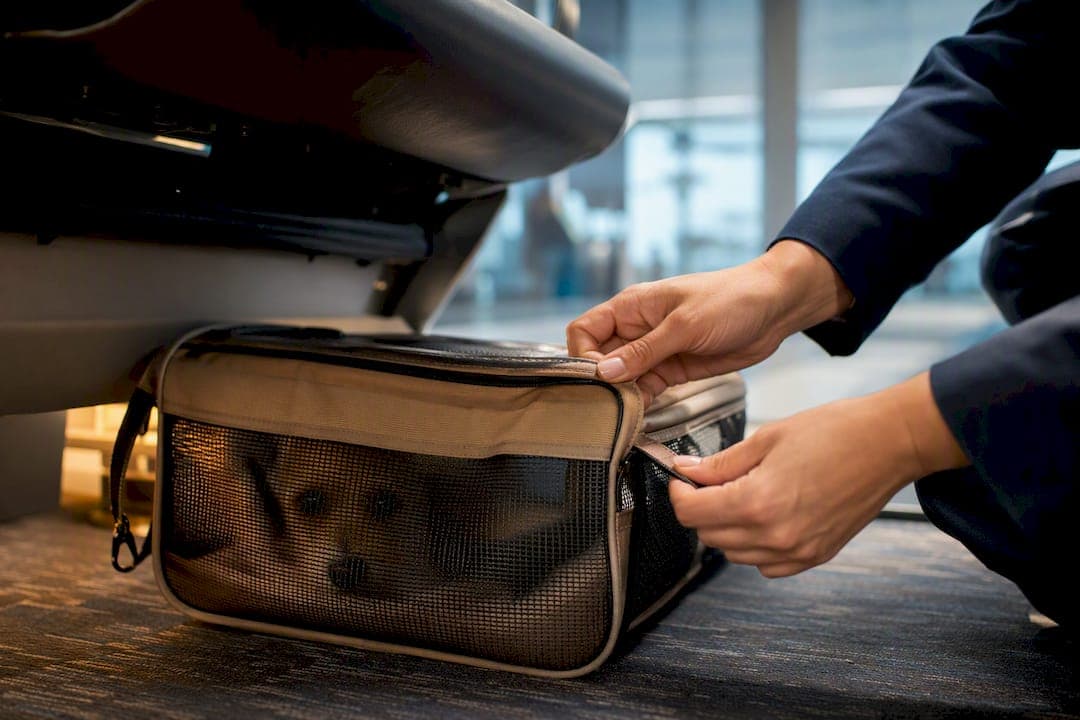
A carrier is airline-approved only when it fits completely under the seat in front of you, gives your pet room to stand, turn, sit, and lie down, and meets your specific airline's published limits. There is no universal size, because the FAA sets the baseline for cabin stowage while each airline decides its own dimensions. Confirm the exact numbers for your booked flight before you buy a carrier or arrive at the airport.
TL;DR:
- Airlines, not the FAA or industry standards, determine acceptable pet carrier sizes, making compatibility vary widely between carriers and routes.
- The most common carrier measurements are around 18 x 11 x 11 inches externally for soft-sided models, but internal space after fabric and structure often shrinks below these figures.
- Gate inspections focus on fit, ventilation, and structural integrity rather than exact measurements, so carriers must be tested for compressibility and airflow before travel.
- Pet weight and breed alone do not guarantee fit; internal dimensions and your pet’s natural standing and turning space are critical for carrier suitability.
- Booking early, verifying airline-specific rules, and preparing documentation well in advance reduce the risk of travel disruptions or carrier rejection at the gate.
Table of Contents
- What Are the FAA and IATA Rules Behind Airline Pet Carrier Size?
- Why Do Airlines Publish Different Pet Carrier Sizes?
- How Do You Read a Published Airline Pet Carrier Dimension?
- What Do Gate Agents Actually Check Before Boarding?
- How Do You Choose a Carrier That Will Pass Airline Checks?
- What Should You Do in the Days Before a Flight With Your Pet?
- How City Animal Veterinary Center Helps Pets Fly More Comfortably
- Get Your Pet's Travel Paperwork Handled Before You Book
- Where to Verify Airline-Specific Pet Carrier Rules
- Sources
- FAQ
What Are the FAA and IATA Rules Behind Airline Pet Carrier Size?
The FAA doesn't publish a single pet carrier size chart. Instead, it treats your carrier as carry-on baggage, which means it falls under the same cabin stowage rules as a backpack or roller bag. Under 14 CFR 121.589, anything in the cabin has to be stowed so it can't slide, block the aisle, or interfere with an evacuation during taxi, takeoff, and landing. For a pet carrier, that translates into one hard requirement: it has to fit entirely under the seat in front of you, for the whole flight, not just at boarding.
The FAA doesn't dictate ventilation percentages or interior square inches. That level of technical detail comes from the International Air Transport Association, whose Container Requirement 1 (CR1) sets the construction standard most U.S. airlines lean on when writing their own pet policies. CR1 requires that an in-cabin container be:
- Leak-proof, with a solid, spill-resistant base
- Escape-proof, so zippers and seams hold under pressure
- Ventilated on at least 16% of the total area across all four vertical sides
- Roomy enough for the animal to stand, sit, turn around, and lie down in a natural position
It's the number IATA's operational guidelines used to define "well-ventilated," and it's the benchmark most carrier manufacturers design against, even when they don't say so on the packaging.
Here's the part that trips people up: FAA rules are binding federal regulation. IATA's CR1 is an industry standard, not U.S. law, which means individual airlines choose how strictly to enforce it and what exact inch measurements to publish. That's why one airline's "small dog carrier" limit might read 17 x 12 x 8 and another's reads 18 x 11 x 11. Both can be following CR1 in spirit while landing on different numbers. The FAA itself recommends contacting your airline directly for exact requirements, because federal aviation law stops at "must fit under the seat" and airline policy fills in everything else.
Why Do Airlines Publish Different Pet Carrier Sizes?
Airlines, not the federal government, decide whether pets fly in the cabin at all, how many are allowed per flight, and what dimensions they'll accept. That authority is why a carrier that sails through check-in on one airline gets flagged on another, even though both flights operate under the same FAA rules.
Aircraft design drives most of the variation. Under-seat space isn't standardized across the industry, or even across a single airline's fleet. A regional jet with a lower seat frame might offer less clearance than a mainline Airbus or Boeing aircraft flying the same route under a different flight number. Bulkhead rows, exit rows, and many premium cabin seats often have no under-seat storage space at all, because the seat mechanism or extra legroom eliminates it. Book a lie-flat business seat and you may find there's simply nowhere for a pet carrier to go.
Airlines also set their own rules around:
- Number of pets per cabin. Most carriers cap in-cabin pets at a low number, often just a handful per flight, on a first-booked, first-served basis.
- Species restrictions. Dogs and cats are the most commonly accepted in-cabin pets; many airlines exclude other species entirely or restrict them to cargo.
- Aircraft-type exceptions. Delta's pet travel policy, for example, notes limits that can shift depending on the aircraft assigned to a route.
- Cabin class restrictions. Some premium or first-class cabins don't permit in-cabin pets regardless of carrier size, simply because of seating configuration.
This is also why booking early matters more with pets than with almost any other travel accessory. If an airline allows six in-cabin pets per flight and you book late, the size of your carrier becomes irrelevant. You may not get a slot at all. Once you've booked, treat the airline's website as the only source that matters for your specific itinerary. A blog post, including this one, can tell you what's typical. Only the airline can tell you what's true for your flight.
How Do You Read a Published Airline Pet Carrier Dimension?
Soft-sided carriers around 18 x 11 x 11 inches show up repeatedly across major carrier websites as a reasonable starting point, and American Airlines lists similar figures among its representative examples. Hard-sided carriers tend to run smaller, often closer to 17 x 12 x 7.5 inches, because rigid plastic doesn't compress the way fabric does. Neither number is a federal standard. Both are airline-published examples meant to help you shop, and they can shift depending on which aircraft operates your route.
The distinction that matters most, and the one most shoppers skip, is external versus internal dimensions. A carrier's exterior might measure exactly to an airline's stated limit, but the internal usable space, after fabric thickness, structural framing, and the seams needed to keep it escape-proof, will always run smaller. This is where a lot of "airline-approved pet carrier" purchases go wrong: the label matches the outside measurement, and the pet still barely fits inside once the padding and internal frame are accounted for.
That mismatch is exactly what makes a carrier fail at the gate even when it's advertised as approved. The same labeled product can be waved through on one flight and rejected on another, because acceptance depends on fit against your specific seat and aircraft, not against a sticker on the box.
A few practical notes on reading dimensions:
- Manufacturers list external dimensions almost universally, so check product descriptions carefully for an internal measurement or usable interior height.
- Soft-sided carriers are generally the safer bet for tight under-seat spaces because they compress slightly to conform to odd seat-frame shapes, something IATA's guidance on in-cabin pet transport specifically notes as an advantage.
- Widebody aircraft on international routes sometimes offer more generous under-seat clearance than narrow-body domestic jets, but this varies by seat row and should never be assumed.
- If you're flying with a dog in a dense hub like New York, keep in mind that regional connections into or out of the city often use smaller aircraft than the mainline flight, so a carrier that fit on the first leg may not fit on the second.
What Do Gate Agents Actually Check Before Boarding?
Your carrier gets evaluated at two points: check-in and the gate. Staff aren't measuring with a ruler in most cases. They're doing a fit-and-function check, and understanding what they're looking for is the difference between a smooth boarding and a stressful rebooking.
- Under-seat fit test. Some gate agents will ask you to demonstrate that the carrier slides fully under the seat in front of your assigned row.
- Ventilation check. Agents look for mesh panels that remain open and unobstructed, not compressed shut by the carrier being squeezed into a tight space.
- Structural integrity. Torn mesh, broken zippers, or a sagging base are common reasons for denial, since Delta and other carriers treat a compromised carrier as a safety issue, not a cosmetic one.
- Pet condition and paperwork. Staff may glance at the animal to confirm it looks calm and healthy, and they'll often ask for a health certificate or vaccination proof if your airline requires one.
- Protrusion check. If a paw, nose, or tail is visible outside the carrier at any point, that's an almost automatic denial, since it violates the escape-proof and full-enclosure requirement.
The most common reason for denial isn't an oversized carrier. It's a carrier that was compressed to fit and ended up with its ventilation panels folded shut in the process. A carrier can technically slide under the seat and still fail inspection if the airflow is blocked.
If a gate agent refuses your carrier, don't argue with the person at the podium. Ask to speak with a supervisor or call the airline's customer service line immediately, since agents sometimes have discretion to accept a borderline case that a phone rep can authorize. If your pet exceeds cabin weight or size limits entirely, ask whether the airline offers a cargo or checked-pet program as an alternative, since not all carriers do.
Pro Tip: Take a photo of your carrier's ventilation panels fully expanded before you compress it for travel. If a gate agent questions airflow, you can show them the uncompressed state and demonstrate the mesh isn't damaged, just temporarily folded.
How Do You Choose a Carrier That Will Pass Airline Checks?
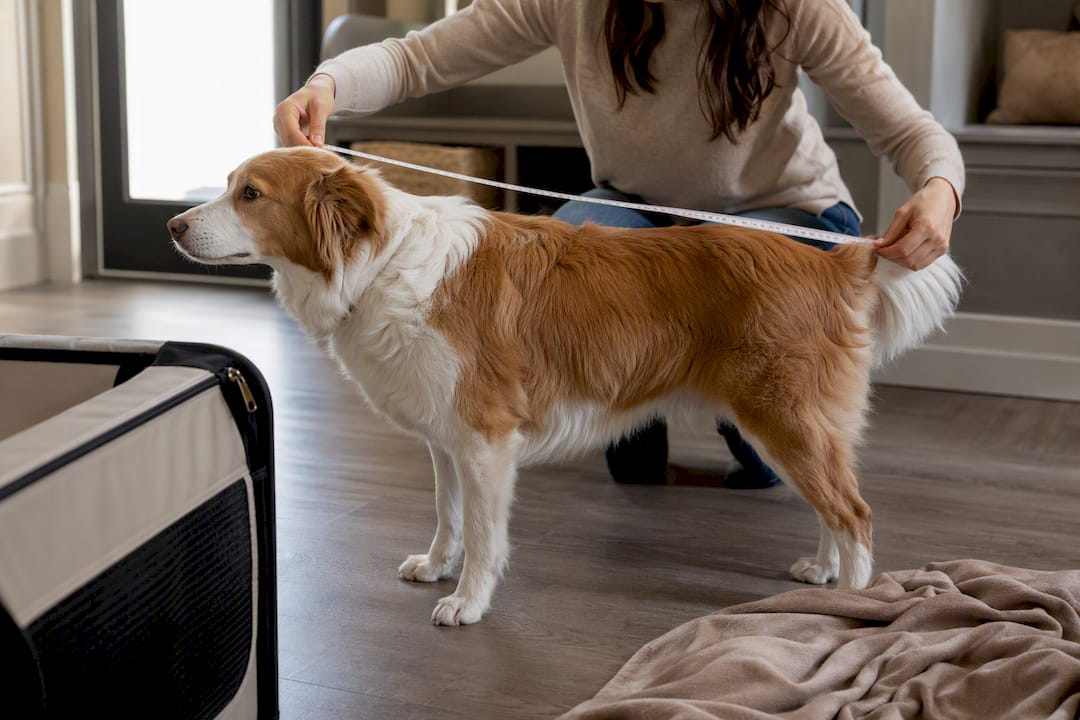
Start with your pet, not the product listing. Measure nose-to-base-of-tail length and height to the top of the head or ears while your pet is standing naturally. Compare those numbers against a carrier's internal clearance, not the exterior dimensions printed on the box. Your pet needs enough room to turn around and lie flat without their head brushing the roof.
Soft-sided carriers with a semi-rigid or wire-framed base tend to perform best under airline seats. They compress slightly to accommodate odd-shaped seat frames, but a good one won't collapse so much that it pinches the ventilation mesh, a compression risk IATA guidance flags directly.
Before you book anything, run through this checklist:
- Ventilation covers roughly 16% or more of the vertical sides and stays open when the carrier is compressed
- Zippers are double-stitched and don't gap under light pulling pressure
- The base is solid and leak-proof, ideally with a removable, washable liner
- A visible tag or label identifies the carrier for airline staff to recognize at a glance
- Combined weight of pet and carrier falls under your airline's stated limit, since several airlines cap this together rather than separately
Pro Tip: Do a "compression test" in your living room before travel day. Push the carrier's sides in the way an under-seat space would, then check whether your pet can still stand and turn, and whether the mesh panels remain open. If either fails, size up before you get to the airport, not after.
What Should You Do in the Days Before a Flight With Your Pet?
Preparation starts well before departure day, and rushing it is one of the most avoidable causes of a stressful boarding experience; for practical tips on making this easier, see this helpful οδηγός για γονείς.
- Begin carrier acclimation 7 to 14 days out. IATA's passenger guidance recommends short, positive sessions that gradually build up to flight-length durations, so your pet associates the carrier with calm rather than confinement.
- Confirm documentation requirements early. Some airlines and destinations require a health certificate issued within a specific window before travel; check both the airline's policy and your destination's entry rules well ahead of your trip.
- Schedule your vet visit with enough lead time. International trips especially can require timelines measured in days or weeks, not hours, so don't leave paperwork for the week of departure.
- Pack smart on travel day. Bring printed and digital copies of paperwork, a familiar-smelling blanket or towel, and a small absorbent pad in case of accidents.
- Arrive early and keep the carrier zipped. Most airlines want pets inside the carrier from check-in through deplaning, with limited exceptions for security screening.
How City Animal Veterinary Center Helps Pets Fly More Comfortably
Carrier acclimation works best when it mirrors the techniques we use in the exam room. Our Fear Free approach relies on short, low-pressure exposures rather than forcing a pet into a stressful situation all at once, which is exactly how IATA recommends introducing a travel carrier: gradually, positively, and well before the actual flight.
If your pet gets anxious in unfamiliar settings, a home visit can make more sense than a clinic exam before a big trip, since your pet stays in a familiar environment while paperwork and physical check can be handled. When you come in for a travel-related appointment, ask specifically about documentation timing, destination-specific vaccine requirements, and any carrier behavior concerns you've noticed during practice sessions at home. The more specific your questions, the more useful the appointment.
— CAVC
Get Your Pet's Travel Paperwork Handled Before You Book
Pet travel health certificates and pre-travel exams most airlines and destinations require can be issued and performed, without asking anxious pets to sit through a stressful clinic visit if a home visit fits better.
Between carrier acclimation and airline paperwork, travel prep has a lot of moving pieces, and getting the documentation wrong is one of the few mistakes that can actually cancel a trip. Our wellness exam and travel certificate services cover the pre-travel physical and paperwork most airlines expect, and our home visit program lets nervous pets get examined and acclimated in a space they already know. Before you schedule, double-check your airline and destination's exact documentation requirements, since those vary by carrier and by country. Once you know what you need, book a travel appointment with our Brooklyn team and we'll walk you through the rest.
Where to Verify Airline-Specific Pet Carrier Rules
For the federal baseline, start with FAA guidance on flying with pets. For the construction standard most airlines reference, review IATA's operational guidelines for in-cabin pet transport. Then confirm your exact flight's limits directly on your airline's pet policy page, since published dimensions and pet counts change by aircraft and route.
Sources
- Fly with pets | Federal Aviation Administration
- Operational guidelines for in-cabin pet transport | IATA
- Pets | American Airlines
- Pet travel overview | Delta Air Lines
FAQ
How Strict Are Airlines With Pet Carrier Size?
Strict, but the strictness applies at the gate, not just at booking. A carrier can meet an airline's published dimensions and still be denied if compression blocks ventilation or a paw pokes through the mesh, so gate agents make the final call based on fit and function, not just measurements on a tag.
Can a 20-Pound Dog Fit Under an Airplane Seat?
It depends entirely on the dog's build and the aircraft's under-seat clearance, not just weight. A dog with a compact frame may fit comfortably in a soft-sided carrier near 18 x 11 x 11 inches, while a longer-bodied breed of the same weight might not have enough room to turn around, which is a hard requirement under IATA's CR1 standard.
What Is the Largest TSA-Approved Pet Carrier?
TSA doesn't set or approve pet carrier sizes. Its screening role covers security procedures at the checkpoint, not cabin stowage dimensions, so the actual size limit always comes from your airline, following the FAA's requirement that the carrier fit fully under the seat.
Can My 70-Pound Dog Fly With Me in the Cabin?
Almost never in a standard carrier, since in-cabin space simply can't accommodate a dog that size while still meeting the under-seat fit and pet-movement requirements. Dogs that large typically need to travel as checked or cargo pets, or you'll need to check with your specific airline about any larger-breed exceptions they may offer.
What Size Pet Carrier Should I Buy for a Flight?
There's no single correct size, since it depends on your pet's dimensions and your airline's published limits for the aircraft you're booked on. A soft-sided carrier near 18 x 11 x 11 inches works for many small pets and airlines, but you should always confirm the exact figure with your airline before purchasing, since dimensions vary by carrier and route.