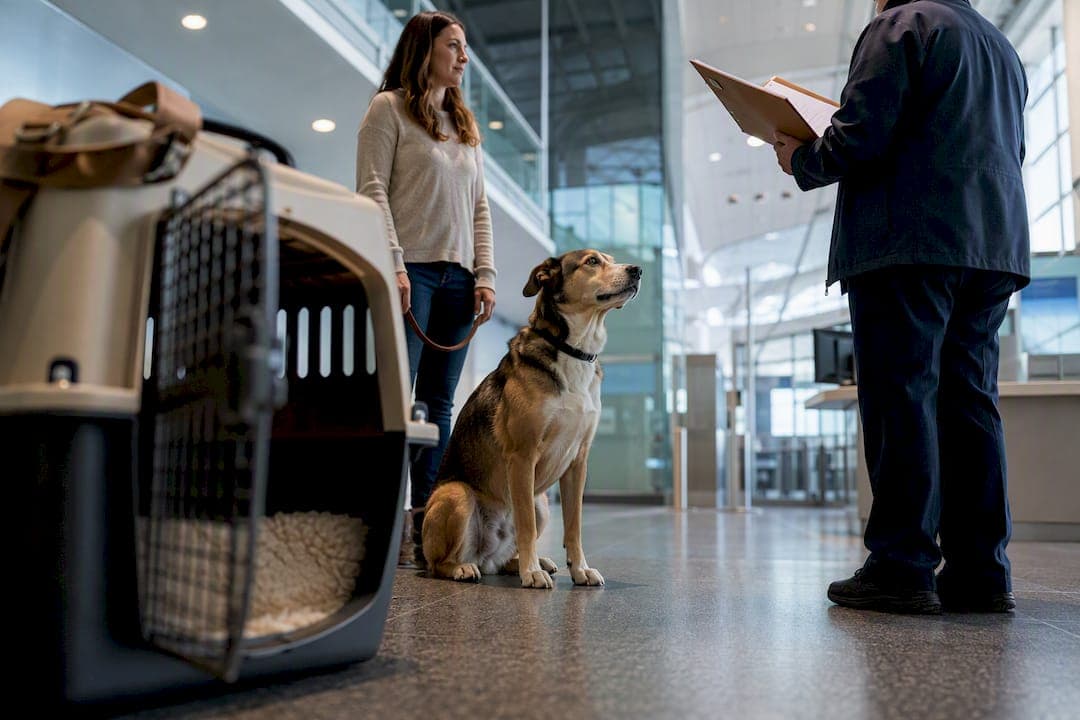
Yes, you can bring your dog to Europe only if three things line up exactly: an ISO-compliant microchip, a correctly timed rabies vaccination, and an EU animal health certificate endorsed by USDA within a strict 10-day window before arrival. Miss the timing on any one of these, and the trip doesn't happen. Everything else in this guide exists to help you hit that window.
TL;DR:
- Adequate preparation requires microchipping, rabies vaccination administered after the chip, and an endorsed USDA health certificate within a 10-day window before travel.
- Confirm the dog’s microchip is ISO-compliant, the vaccination date is correct, and the USDA certificate appointment is booked within the strict endorsement period.
- Some countries require additional tapeworm treatment just before arrival, and breed restrictions may apply depending on the destination.
- Airlines have separate, often stricter, pet travel rules regarding crate specifications, in-cabin or cargo travel, and limited pet slots per flight.
- Starting the process at least five to six weeks before travel allows time for paperwork, vet appointments, endorsement, and booking pet space properly.
Table of Contents
- What Are the Requirements for Dog Travel to Europe?
- Required Identification and Health Documentation
- How to Build Your Travel Timeline Backward From Arrival
- Country-Specific Rules You Need to Check Before Departure
- How Airlines Determine Whether Your Dog Can Actually Fly
- What Happens at Border Control When You Arrive
- Common Problems and How to Fix Them Fast
- How City Animal Veterinary Center Supports Your Travel Plans
- Does Travel Insurance Cover Pet Health Issues in Europe?
- What Do You Need to Bring Your Dog Back to the US?
- Should You Get an EU Pet Passport for Future Trips?
- How Do EU Countries Differ on Customs and Import Checks?
- How Should You Prepare Your Dog Physically for the Flight?
- Editorial Recommendation: Plan Earlier Than You Think You Need To
- Book Your Travel-Ready Exam With City Animal Veterinary Center
- Sources
What Are the Requirements for Dog Travel to Europe?
Before you book anything, confirm these five things. This is the checklist to run through right now, not after you've bought plane tickets.
- Microchip status: Your dog needs an ISO 11784/11785-compliant microchip, and you should have the chip number written down somewhere you can find it.
- Vaccination sequence: Check the date on your dog's rabies vaccine record. If it was given after the microchip was implanted (or the same day), you're on track. If the chip went in after the rabies shot, that vaccine doesn't count and the clock resets.
- Waiting period: A minimum waiting period is required between a qualifying rabies vaccination and travel.
- Tapeworm treatment: If your destination is Finland, Ireland, Malta, Norway, or Northern Ireland, your dog needs an Echinococcus treatment from a vet 24 to 120 hours before arrival.
- Vet and airline access: Confirm you can get an appointment with a USDA-accredited veterinarian for the health certificate, and that your airline has confirmed pet space on your actual flight.
The decision rule is simple: work backward from your flight date, and treat the 10-day endorsement window as the tightest constraint in the whole process. Everything else has some flexibility. That window doesn't.
Required Identification and Health Documentation
Three documents make or break a dog's entry into the European Union, and they have to happen in a specific order.
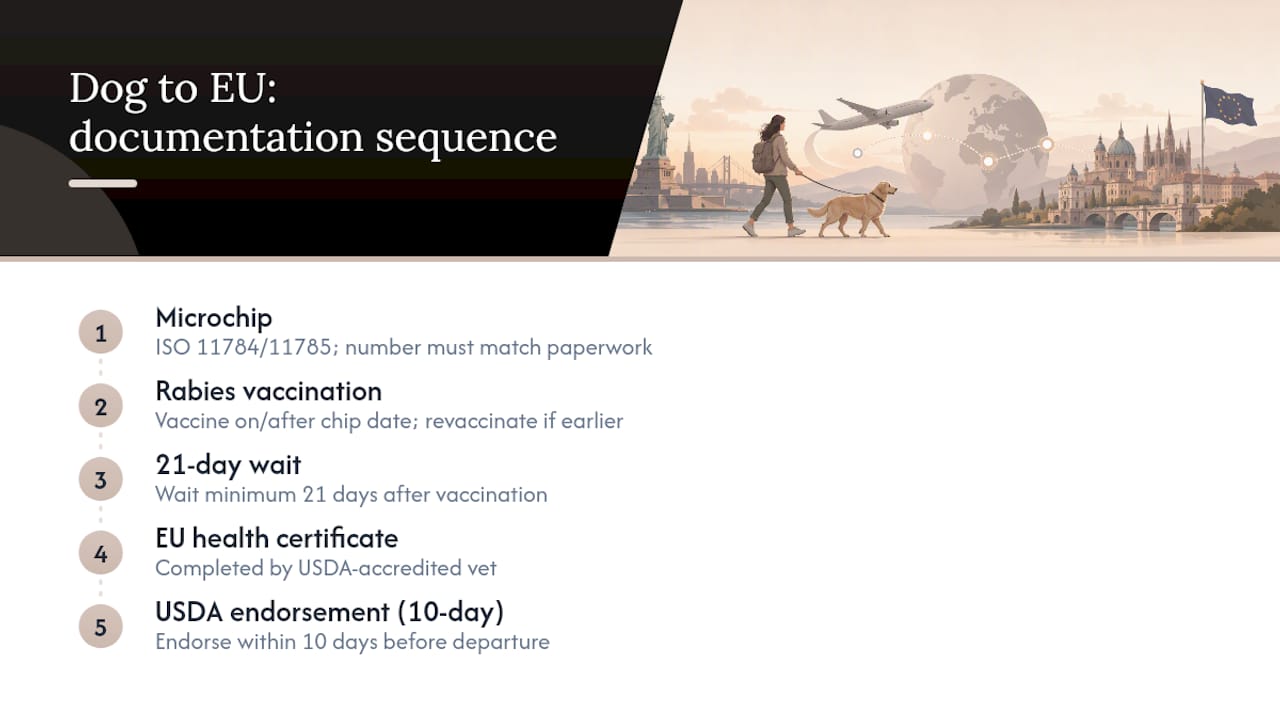
The microchip comes first. It must meet ISO 11784/11785 standards, which is the standard used by virtually every microchip issued in the US and EU today. Border agents scan the chip against the number listed on your paperwork, so a mismatch, even a single digit, can hold up entry. If your dog already has an older or non-ISO chip, you may need a compatible scanner or a second ISO chip implanted before travel.
Rabies vaccination comes second, with one rule that trips up more owners than any other requirement. The vaccine has to be administered on or after the day the microchip was implanted. A dog vaccinated before getting chipped has to be revaccinated, because the EU wants a documented, verifiable chain: chip first, then vaccine, then proof. After that valid vaccination, you wait a minimum of 21 days before the dog can enter the EU. This isn't a suggestion. It's a hard biological and regulatory floor tied to how long it takes rabies immunity to develop.
A 10-day window decides whether your trip happens. The EU animal health certificate must be endorsed by USDA within a short period before your dog's departure for Europe, and that certificate stays valid for onward EU travel for a limited period after entry, or until the rabies vaccine expires, whichever comes first. Book your vet appointment for the certificate only once your flight dates are locked.
The EU animal health certificate is the final piece, and it has to be completed by a USDA-accredited veterinarian. This isn't just any vet with a license. Accreditation is a separate federal designation through USDA's National Veterinary Accreditation Program. Your vet fills out the certificate documenting the microchip number, vaccination history, and general health status, then submits it to your regional USDA/APHIS office for endorsement. That endorsement step is what makes the certificate valid for entry, and it's what starts the 10-day clock. To find an accredited vet, ask directly when booking. Not every general practice veterinarian holds this credential.
How to Build Your Travel Timeline Backward From Arrival
Start with your EU arrival date and count backward. Every appointment gets scheduled relative to that anchor point, not the other way around.
- Set your arrival date. This is the fixed point everything else revolves around.
- Subtract 10 days to find the earliest date your health certificate can be endorsed by USDA.
- Book the certificate appointment with your accredited vet inside that 10-day window, leaving a few days of buffer for USDA processing.
- Confirm rabies vaccination happened at least 21 days before arrival, and that it was given after the microchip.
- If your dog isn't chipped or vaccinated yet, add the chip and vaccine appointment at least 25 to 30 days before arrival to leave room for the waiting period plus scheduling slack.
- If a rabies titer test is involved (relevant mainly for return travel from certain countries, or dogs with an uncertain vaccine history), build in extra weeks, since titer results take time to process and don't shorten the standard waiting period for EU entry.
A dog that's already chipped and current on rabies has the simplest path. You just need to book the certificate appointment inside the 10-day window and confirm the airline booking. A dog starting from zero needs closer to five or six weeks of total lead time once you stack the microchip, vaccine, 21-day wait, and certificate appointment in sequence.
Pro Tip: Book your USDA endorsement appointment before you buy plane tickets, not after. Regional APHIS offices can have limited appointment slots, and building your flight dates around vet availability is far easier than the reverse.
Country-Specific Rules You Need to Check Before Departure
General EU rules cover most of the bloc, but several countries add requirements on top of the baseline, and skipping them is one of the more common reasons trips get stopped at the border.
- Tapeworm treatment: Finland, Ireland, Malta, Norway, and Northern Ireland require a documented Echinococcus multilocularis treatment given by a vet between 24 and 120 hours before arrival. The treatment date and time have to be recorded on the health certificate, so timing this around a long flight itinerary takes some planning.
- Breed and import restrictions: Some EU countries restrict or ban entry for specific breeds considered dangerous under local law. These rules vary by country and change periodically, so check the destination government's own agriculture or customs page for your specific breed before booking anything.
- Designated entry points: Your dog's first point of entry into the EU matters, because that's typically where inspection happens, even if it isn't your final destination. If you're flying into one country and connecting to another, confirm which country's rules govern the check, since layover countries within the EU generally don't re-inspect once you've cleared the first entry point.
None of these exceptions show up in the general EU pet travel overview, which is exactly why checking your specific destination's government page matters more than relying on a generic checklist.
How Airlines Determine Whether Your Dog Can Actually Fly
Government paperwork gets your dog legally allowed into the EU. It does nothing to guarantee an airline seat. Those are two separate systems, and airline rules are often the more restrictive of the two.
- In-cabin travel usually requires the dog and carrier to fit under the seat, with combined weight limits that vary by airline, typically in the 15 to 20 pound range.
- Checked hold travel puts the crate in a pressurized, temperature-controlled cargo hold, separate from the cabin but on the same flight, with its own size and breed restrictions.
- Manifest cargo ships the dog as freight, sometimes on a different schedule than passengers, and usually requires a separate booking process through the airline's cargo division.
Aircraft type changes what's available. A wide-body jet on a transatlantic route might allow hold travel; a smaller regional aircraft covering the connecting leg might not accept any live animals at all. Airlines also cap the number of pets allowed per flight, so a route that works in October might have zero pet slots left by the time you actually try to book in July.
Crate specifications matter too: airlines generally require hard-sided, leak-proof carriers with ventilation on multiple sides, secure but not padlocked doors, and clear identification labels with your contact information and destination address.
Pro Tip: Call the airline before you finalize your vet appointments, not after. Confirm the exact aircraft type for your route, ask about current pet slot availability, and get any airline-specific health attestation forms in writing so your vet can complete everything in one visit.
What Happens at Border Control When You Arrive
Border officials at your first EU entry point check a specific set of items, and knowing what they're looking for helps you present everything cleanly.
Officials typically verify the microchip number against the certificate, confirm the rabies vaccination date meets the 21-day rule, check that the health certificate carries a valid USDA endorsement inside its window, and confirm tapeworm treatment documentation if your destination requires it.
- Bring originals, not just copies. Some officials will accept scanned copies as backup, but the original endorsed certificate should travel with you, not in checked luggage.
- Have the certificate's translation ready if needed. Certificates are typically issued in English and the destination country's language, but confirm this with your accredited vet ahead of time.
- Know who to contact if there's a problem. Airport veterinary or customs officials handle on-the-spot issues; your accredited vet or regional USDA office can sometimes provide supporting documentation remotely if something looks incomplete.
Noncompliance outcomes range from a delay while officials verify records, to quarantine at the traveler's expense, to outright denial of entry, and the dog being returned on the next available flight. Which outcome applies depends on the specific country and the nature of the gap. A missing tapeworm treatment tends to be handled differently than an expired endorsement window.
Common Problems and How to Fix Them Fast
Even careful planning runs into snags. Here's how to handle the ones that come up most.
- USDA endorsement is delayed or lost. Contact your regional APHIS office directly, ask about expedited processing options, and keep a digital copy of everything your vet submitted so you can resend it quickly if needed.
- The microchip and rabies vaccine were done in the wrong order. There's no shortcut here. The dog needs a new qualifying rabies vaccination administered after the chip, followed by the full 21-day wait. Adjust your travel date rather than trying to argue the original vaccine still counts.
- Your flight gets delayed past the certificate's validity window. This is why building in buffer days matters. If your endorsed certificate is going to expire before a rescheduled flight, contact your accredited vet immediately. A new certificate and endorsement cycle takes time, so this isn't something you solve the night before a rebooked flight.
Pro Tip: Keep your accredited vet's direct contact information with your travel documents. If a flight changes on short notice, a quick call about revalidation options beats discovering a problem at the airport counter.
How City Animal Veterinary Center Supports Your Travel Plans
Getting the sequencing right, chip, vaccine, waiting period, certificate, endorsement, is where most travel plans go wrong. Travel-ready exams, EU animal health certificate completion, and appointment timing assistance around the 10-day endorsement window are important services to consider for your pet's travel needs. For pets who find clinic visits stressful, the practice's Fear Free approach and home visit service mean travel exams can happen in a calmer setting. When you book an appointment, bring your dog's full vaccination history and your intended flight dates so the timeline can be built correctly from the start.
Does Travel Insurance Cover Pet Health Issues in Europe?
Standard travel insurance policies for human travelers almost never cover a pet's veterinary costs, so if you want coverage for your dog while abroad, you need a policy that explicitly includes pet health as a line item. Some pet insurance providers offer international coverage riders or standalone travel policies that cover emergency veterinary treatment, illness, or injury while your dog is outside the US.
Before you leave, check three things with your provider: whether the policy covers treatment in the specific countries you're visiting, whether it covers costs upfront or requires reimbursement after you pay out of pocket, and whether there's a claims process that works from abroad. Some policies also cover the added expense of extending your dog's boarding or care if your own return flight gets delayed, which is worth checking given how often international travel schedules shift.
Separately, ask your regular US-based pet insurer whether your existing policy has any international provisions at all. Many domestic pet insurance plans stop coverage the moment your dog leaves the country, so a supplemental international policy or rider may be the only way to have any safety net during the trip. Keep digital copies of your policy documents and your vet's contact information together with your travel paperwork, since a pet emergency abroad is stressful enough without also hunting for the right phone number.
What Do You Need to Bring Your Dog Back to the US?
Re-entry to the United States after traveling with your dog to Europe is generally more straightforward than the outbound trip, but it's not automatic. CDC requirements focus heavily on rabies vaccination status, and the specifics depend on where your dog was vaccinated and whether it's considered to be coming from a country at high risk for dog rabies.
If your dog was vaccinated in the US before departure and that vaccination remains current, re-entry documentation is usually limited to proof of that valid rabies vaccine. Keep the original paperwork from your outbound trip, since it documents the vaccination date and microchip number that customs officials may want to cross-reference.
Bring the EU health certificate used for outbound travel, your dog's rabies vaccination certificate, and any veterinary records issued while in Europe, particularly if your dog received any treatment or a booster while abroad. If a booster was given in Europe, check current CDC guidance before departure, since a booster administered outside the US can sometimes trigger additional documentation requirements depending on the country of vaccination.
Airlines also have their own rules for the return leg, so reconfirm your dog's cabin, hold, or cargo booking for the flight home just as carefully as you did for the outbound trip. A return itinerary with a tight connection and a different aircraft type isn't automatically compatible with the same travel arrangement you used getting there.
Should You Get an EU Pet Passport for Future Trips?
EU pet passports exist, but they're issued to pets owned by EU residents, not to US travelers making a single trip. If you live in the US, your dog travels on the non-commercial EU animal health certificate every time, not a reusable passport, regardless of how many times you've visited before.
This distinction catches people off guard, especially if they've read about pet passports being convenient for repeat travel within Europe. That convenience applies to EU citizens whose pets are chipped, vaccinated, and registered under an EU member state's veterinary system. A pet passport, once issued to an EU resident's animal, can be used for repeat travel across the Schengen Area without a new certificate for each trip.
For US-based travelers, every trip to the EU requires a fresh animal health certificate completed by a USDA-accredited veterinarian and endorsed within the 10-day window before departure. There's currently no mechanism for a US traveler to obtain a standing EU pet passport for a dog that lives primarily in the United States. If you're planning to make multiple trips to Europe with the same dog over the course of a year, budget time and a vet visit for a new certificate before each departure, rather than assuming one certificate or one passport carries you through future travel.
How Do EU Countries Differ on Customs and Import Checks?
While the EU sets baseline requirements, each member state's customs and border authority carries out the actual inspection, and procedures vary somewhat in practice even when the underlying rules are shared. France, Germany, and the Netherlands, as high-traffic entry points for transatlantic flights, tend to have more standardized processing at major international airports simply due to higher volume of pet travelers passing through.
Smaller or less-trafficked entry points may have less staff familiarity with the full document set, which can mean more questions or a longer check, even when your paperwork is fully compliant. This is one reason experienced pet travelers often choose a major hub airport for their first EU entry point rather than a smaller regional airport, even if it adds a connecting flight.
Some countries also apply extra scrutiny, or additional treatment requirements, as covered earlier with the tapeworm treatment rule for Finland, Ireland, Malta, Norway, and Northern Ireland. Beyond that specific requirement, always check the destination country's own government or agriculture ministry page directly rather than relying solely on the general EU overview, since country-level implementation details, like which airport terminal handles animal inspections, aren't part of the EU-wide guidance and can change without much notice.
How Should You Prepare Your Dog Physically for the Flight?
Crate training matters more than most owners expect. A dog that's never spent time in an airline-compliant crate before the actual travel day is far more likely to show stress during a long flight, and airlines can deny boarding to an animal that appears distressed or aggressive in its carrier. Start crate acclimation weeks before departure, not days.
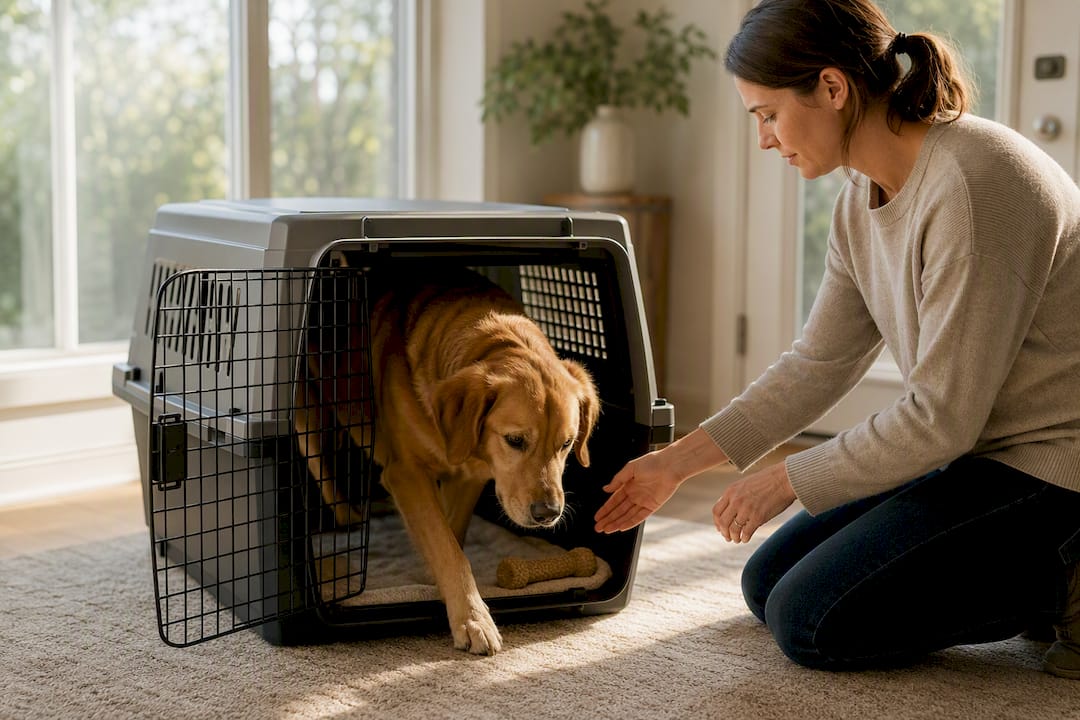
Airline-compliant crates need to be large enough for the dog to stand, turn around, and lie down naturally, with solid sides, secure ventilation, and no wheels or protruding hardware that could catch during handling. Practice feeding and resting your dog in the crate at home so the space feels familiar rather than confining on travel day.
On sedation, the general veterinary guidance is to avoid it. Sedatives can affect a dog's ability to regulate body temperature and balance, which becomes riskier at altitude and in cargo holds where staff can't monitor the animal directly. Most airlines actively discourage or outright prohibit sedating pets before flights for exactly this reason. If your dog has significant anxiety around travel, talk to your vet about non-sedating calming approaches, and consider a Fear Free style pre-flight visit to practice handling and crate time in a low-stress setting well before the trip.
Feed a light meal several hours before the flight rather than immediately beforehand, and make sure water access is available up until close to departure, with a spill-resistant bowl attached inside the crate for longer flights.
Editorial Recommendation: Plan Earlier Than You Think You Need To
Give yourself at least six to eight weeks for a dog starting from zero on paperwork, and two to three weeks even if your dog is already chipped and current on rabies. Secure airline pet space and confirm your USDA endorsement appointment window before you buy plane tickets, not after. Contact an accredited vet early and build every other date backward from your EU arrival.
— CAVC
Book Your Travel-Ready Exam With City Animal Veterinary Center
If you're staring down a departure date and a stack of paperwork, This process can include completing the EU animal health certificate, coordinating USDA endorsement timing, and running the pre-travel exam your airline may require. For dogs who get anxious at the vet, Fear Free approaches and home visit options can mean the exam happens without adding a stressful clinic trip on top of an already stressful travel week.
Book an appointment through City Animal Veterinary Center and bring your dog's microchip number, vaccination history, and planned flight dates. Your vet will map your certificate and endorsement appointment against the 10-day window so nothing gets scheduled too early or too late. Whether you're starting from scratch or just need the final certificate signed off, book the visit as soon as your travel dates are set.
Sources
Confirm your specific destination's rules on the EU's official travel guidance and check USDA APHIS country pages for export procedures. Review CDC guidance for return travel, and always confirm pet policies directly with your airline for your exact route and aircraft.
- EU rules on travelling with pets and other animals in the EU
- APHIS pet travel (USDA)
- Bringing a dog into the United States — CDC
- U.S. Department of Transportation — airline rules for travelling with animals