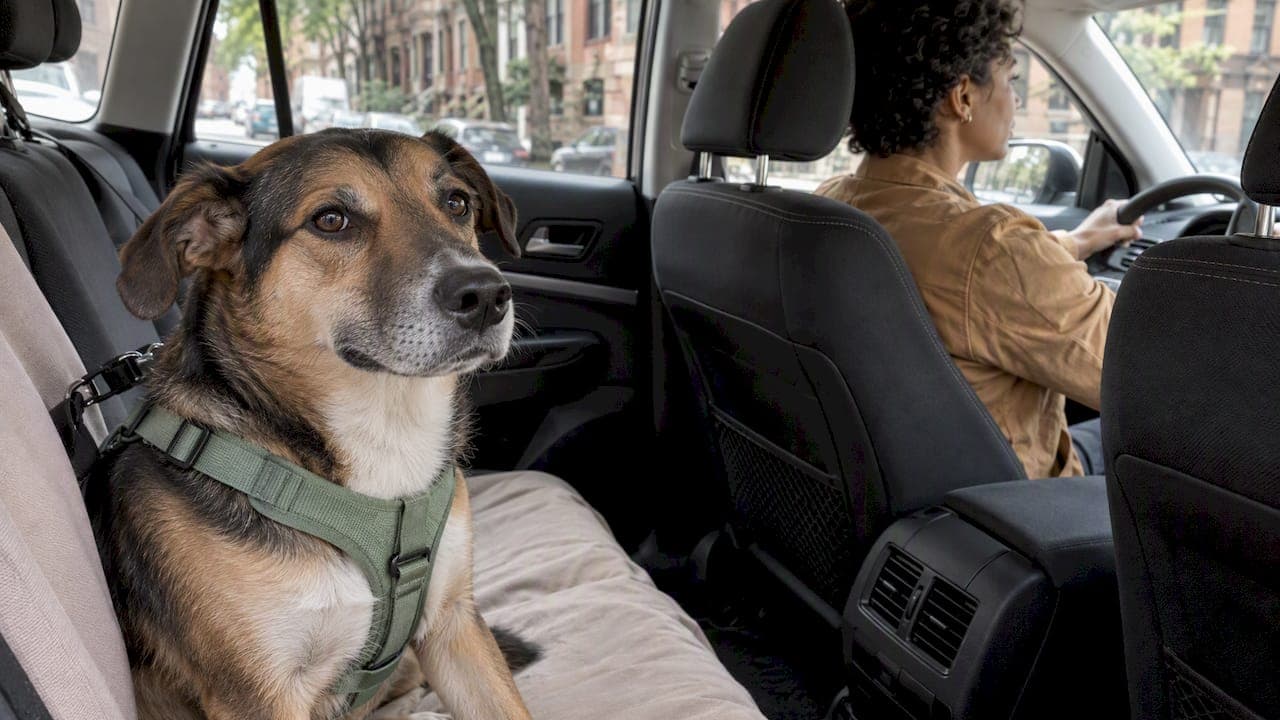
If your dog drools, paces, whines or shakes the moment the car door opens, the ride itself is the problem, not your dog's character. Car travel stress is common, it is usually treatable, and it rarely fixes itself. The reliable path is a mix of safe setup, slow retraining in small steps, and, for dogs with severe fear, a conversation with your veterinarian about short-term medication.
This guide covers how to tell fear from motion sickness, what to change in the car today, a week-by-week desensitization plan, and when it is time to bring in a vet.
TL;DR
- Stress in the car can be fear, motion sickness, overexcitement, or a mix. The signs overlap, so watch what happens before the engine even starts.
- Dogs show minimal habituation to car travel on their own. Repeating the same dreaded trip usually does not cure it. Gradual, rewarded exposure does.
- Secure your dog in the back seat with a crash-tested harness or a ventilated, anchored crate, and never leave a dog in a parked car.
- Severe cases may need veterinary-prescribed medication, timed in advance of the trip, alongside behavior work.
- Call your vet if your dog vomits repeatedly, struggles to breathe, collapses or seems disoriented.
Table of Contents
- What car travel stress looks like in dogs
- Why short, repeated trips do not always help
- Set up the car for safety and calm
- A gradual plan: desensitization and counterconditioning
- Motion sickness or anxiety? Ask your vet
- When medication belongs in the plan
- Planning a longer trip
- Our perspective: make the trip the smallest part of the visit
- When we come to you
- Signs that need a vet right away
- FAQ
- Sources
What car travel stress looks like in dogs
Some signs are obvious: whining, barking, trembling, heavy panting, drooling, trying to escape the seat or hide on the floor. Others are quieter and easy to miss: lip licking, yawning, a stiff body, ears pinned back, a dog who goes still and refuses to look at you.
The Merck Veterinary Manual groups problems rooted in fear, anxiety and overarousal together as behavior problems that can become serious for both dog and owner. In the car, that spectrum includes three common patterns:
| Pattern | What you often see | Typical clue |
|---|---|---|
| Fear or anxiety | Trembling, hiding, panting, refusing to enter the car | Distress starts before the car moves, sometimes at the sight of the keys or the leash |
| Motion sickness | Drooling, lip smacking, vomiting, lethargy | Symptoms build as the car moves and ease soon after you stop |
| Overexcitement | Barking, lunging, spinning, nonstop movement | Dog is eager rather than frightened, but cannot settle safely |
Many dogs show more than one pattern. A dog who has been sick in the car a few times may learn to dread it, so what began as nausea becomes fear. That is why sorting out the cause matters before you pick a fix.
Quick self-check before you start
Try this on a calm day:
- Ask your dog to approach the parked car with the engine off. Do they walk up willingly?
- Open the door and toss a treat inside. Do they take it?
- Sit in the car together for a minute with the engine off. Do they stay loose or turn rigid?
- Start the engine without moving. Do the signs return?
Wherever the stress first appears is where your training begins. A dog who panics at step 1 is a different case from one who only struggles once the car is moving.
Why short, repeated trips do not always help
A common piece of advice is "just take them more often and they will get used to it." The research is less encouraging. A study of Beagles not previously transported measured cortisol, heart rate and behavior across repeated short road trips, and found little sign of habituation on its own. Stress markers stayed elevated even after repeated exposure.
The practical lesson: if every ride ends at a place your dog dislikes, or the ride itself is unpleasant, repetition can reinforce the fear instead of weakening it. Your dog needs rides that predict good things, introduced at a pace they can handle.
Set up the car for safety and calm
Safety and comfort are linked. A dog who is bouncing around the cabin is more stressed and more at risk, and a driver who is distracted is more stressed too.
Restraint
The AVMA's guidance on pets in vehicles recommends securing dogs in the back seat, using either a crash-tested harness or a well-ventilated crate of appropriate size that is anchored so it cannot shift. Riding with the head out of the window or in a front seat with airbags exposes dogs to serious injury.
Not every product marketed as a car harness has been properly tested. The nonprofit Center for Pet Safety has warned that extension tethers and zipline-style products increase the risk of injury. Look for a harness with independent crash-test results, and fit it so your dog can sit or lie down comfortably.

For anxious dogs, a snug, secured crate with a familiar blanket can feel like a den. Others do better on a back seat with a harness, where they can see you. Let your dog's response guide the choice, and introduce either one at home first so it is not new on travel day.
Comfort
- Temperature: keep the cabin cool and the air moving. Heat makes both nausea and panic worse.
- Timing: for dogs prone to motion sickness, ask your vet about feeding schedules before trips. Do not skip water entirely.
- Familiar scents: a worn T-shirt or a blanket from your dog's bed adds something known to an unfamiliar space.
- Lavender: in a clinical trial of 32 dogs with a history of travel-induced excitement, the ambient odor of lavender was evaluated as a treatment. Dogs spent more time resting and less time moving and barking. It is a low-effort addition, though not a stand-alone cure for true fear.
- Pheromone products: many owners use them as part of a plan. Treat them as support for training, not a substitute.
Never leave your dog in a parked car
This is the rule that does not bend. The ASPCA warns that parked cars become very hot even with windows open, and the AVMA notes a vehicle can reach a dangerous temperature quickly, even on a day that does not feel hot. If your dog is already stressed and panting, heat can turn a rough trip into an emergency. Plan stops so someone can stay with your dog, or bring them home.
A gradual plan: desensitization and counterconditioning
The Merck Veterinary Manual describes treatment that pairs environmental management with behavior modification, starting with gradual steps such as feeding meals in a parked car and then moving to short drives. It also notes that behavior protocols can take months to complete. Plan on patience.

The idea is simple. Desensitization exposes your dog to the trigger at a level so low they stay relaxed. Counterconditioning pairs that trigger with something your dog loves, so the feeling changes over time. We explain how the two fit together in our 4-week desensitization and counterconditioning plan.
The ladder
Move to the next rung only when your dog is loose, curious and taking treats at the current one. If the signs of stress return, go back a step. Keep sessions to a few minutes.
- Near the car. Stand by the parked car with the doors open. Reward any calm look or step toward it.
- Into the car. Let your dog hop in on their own, eat a treat or a favorite chew, and hop out. No engine, no pressure.
- Meals in the car. Feed a meal on the back seat, doors open, then closed.
- Door closed, engine off. Sit together for a minute or two, then end the session before your dog asks to leave.
- Engine on, no movement. Reward steady calm. Turn it off and end on a good note.
- Roll to the end of the driveway. Stop, reward, go home.
- Around the block. Keep trips short and boring, and end at home or somewhere your dog loves.
- Fun destinations. Build to a park, a trail, a friend's yard. Mix in plenty of rides that end with nothing at all, so the car does not only predict the vet or the groomer.
Reading your dog during training
Pay attention to the small signals. A dog who stops taking treats, pants hard, or looks away repeatedly is telling you the step is too big. Do not push through. Pushing through teaches your dog that quiet signals are ignored and that louder ones are needed.
Your own mood matters too. Experts note that owner anxiety often mirrors pet anxiety, and the effect runs both ways: a calmer dog tends to make for a calmer driver. Speak in a normal voice, skip the over-soothing baby talk and keep your body language relaxed.
Use distance, not force
If your dog freezes at the car door, do not lift them in. Try a ramp or a lower surface, move the car so the doorway is easy to enter, or start with a crate placed at home that later moves into the car. If your dog is large or senior, joint pain can make jumping in uncomfortable, and that discomfort can feed car dread. If your older dog seems stiff, ask us about pain management.
Motion sickness or anxiety? Ask your vet
Drooling, lip licking and vomiting do not always mean fear. Motion sickness is a physical problem that can look like panic, and the two often feed each other. The AVMA travel brochure advises telling your veterinarian about carsickness, because, depending on your pet's health, medication may help your pet feel more comfortable on long trips.
A vet visit can also rule out other contributors, such as an ear problem that makes movement feel awful, pain, or gastrointestinal disease. Lab work in the clinic helps when the picture is unclear. Our in-house laboratory means a lot of that can be checked during one visit.
When medication belongs in the plan
For some dogs, fear is intense enough that training cannot begin because the dog is too distressed to learn. That is when veterinary-prescribed medication can help. The Merck Veterinary Manual lists drugs such as gabapentin, trazodone and alprazolam as options for situational relief, and notes that some need roughly 90 minutes of lead time before the stressor to take effect.
Some important points:
- Only your veterinarian should choose and dose these drugs. The right choice depends on your dog's age, weight, other medications and health conditions. Never give a human prescription or a leftover pill without a vet's instruction.
- Timing matters. If a drug needs time to work, give it when your vet says, not when your dog is already panicking in the car.
- Medication is a bridge, not the whole plan. It lowers fear enough for your dog to learn. Keep working the ladder above.
- Do a test run. Ask your vet whether to try a dose at home on a quiet day before a big trip, so you know how your dog responds.
If you want to know more about one commonly prescribed option, read our guide to trazodone for dogs. Diet can also influence how settled a dog feels, and this overview of dog anxiety and diet is worth reading when you plan around a dog with severe car anxiety. Bring any diet questions to your vet, especially before changing food ahead of a trip.
Planning a longer trip
Once short rides go well, a road trip becomes realistic. A few rules help:
- Pack for comfort: water, a collapsible bowl, waste bags, a familiar blanket, chews, your dog's usual food and any medication.
- Stop often. Offer water and a short, calm walk on a secure leash. Do not let a stressed dog bolt out of an open door.
- Check ID. A microchip with current contact information plus a tag with your phone number is a smart safeguard if a frightened dog slips out of a harness during a stop.
- Review travel rules. The CDC's pet travel page notes that traveling can be stressful for both you and your pets and that preparation helps. If you are crossing state lines or leaving the country, check requirements well ahead, as health certificates may be needed.
City driving specifics
In Brooklyn, many dogs are not regular car riders. A first car ride may be to the vet, the groomer or a weekend away, which can build a negative link. Rideshare and borrowed cars add more unknowns. If you rent or borrow a car, practice with it a few times first, and use a harness or crate that travels with you so the smell and feel are familiar.
If you do not own a car, consider making short "fun only" rides part of the plan, with a friend or family member driving. A trip to a quiet park with no vet in the equation can start repairing the association.
Our perspective: make the trip the smallest part of the visit
We see anxious dogs every week, and many arrive already stressed from the ride. By the time they reach the front door, they are panting, trembling or unwilling to walk in. That affects the exam, the lab draws and how your dog feels about the next visit.
Our practice is Fear Free certified, so we focus on lowering stress at every step: slow introductions, treats, gentle handling and a pace that suits your dog. That begins at home. When we talk to owners, we often suggest three changes:
- Fix the ride before you fix the visit. Even a few weeks of car-as-good-place practice changes the arrival.
- Plan ahead for medication. If your dog's fear is severe, call before the appointment so we can discuss a pre-visit plan and the right timing.
- Consider skipping the car. For dogs who cannot manage it, or owners who struggle to transport them, a house call keeps everything familiar.
We would rather you contact us early than wait for the dog to melt down in the back seat. Our guide to dog vet anxiety goes deeper on calmer clinic visits, and our behavior management services help owners build a plan for fear that goes beyond the car.
— CAVC
When we come to you
If the car is the biggest barrier to your dog's care, our home visit and house call service is built for that. Wellness checks, follow-ups and many other needs can be handled where your dog feels safest. It also suits busy owners, senior dogs, dogs with mobility problems and households with several pets.
If you are new to us, start at our new clients page to see how to get set up. For a dog whose fear is so intense that even starting the training ladder is hard, a wellness exam is a good place to build a plan with our team, including whether medication belongs in it.
Signs that need a vet right away
Most car stress is uncomfortable but not dangerous. Some situations are not. Contact a veterinarian immediately if your dog:
- collapses, or seems weak or disoriented
- has trouble breathing or very heavy panting that does not ease when you stop and cool the car
- vomits repeatedly or cannot keep water down
- has gums that look pale or blue
- seems injured after braking hard, a fender bender or a fall from the seat
If your dog may be overheating, move them to shade and cool air and head for care. Our urgent care team can help when something seems off. If a crash has happened, even a minor one, have your dog checked. The AVMA reports that typical injuries to animals in vehicle crashes range from minor abrasions to fractures and internal bleeding, and some may not be obvious right away.
FAQ
How do I calm my dog down in the car?
Start before the ride: secure your dog in the back seat with a crash-tested harness or an anchored crate, keep the cabin cool, and bring a familiar blanket. Then work slowly on the car itself, rewarding calm behavior in a parked car before any driving. If the fear is severe, ask your vet about medication that can be timed ahead of trips.
Will my dog grow out of car anxiety?
Usually not on their own. Research on dogs transported repeatedly found little habituation, with stress markers staying high. Dogs tend to improve when owners use gradual desensitization and counterconditioning, and some need veterinary support while they learn.
Is it motion sickness or anxiety?
Drooling, lip smacking and vomiting that build as the car moves point toward motion sickness. Trembling, hiding or refusing to get in before the car moves points toward fear. Many dogs have both, so your veterinarian can help sort it out and rule out other causes.
Can I give my dog a calming supplement or human medication before a trip?
Do not give human medication or leftover prescriptions. Dosing and safety depend on your dog's weight, age and health. Ask your veterinarian which option, if any, fits your dog, and when to give it before the drive.
Sources
- Pet safety in vehicles, AVMA
- Data, safety regulations lacking when it comes to pets and vehicles, AVMA
- Travel with your pet brochure, AVMA
- Behavior Problems of Dogs, Merck Veterinary Manual
- Aromatherapy for travel-induced excitement in dogs, JAVMA
- Stress Response of Beagle Dogs to Repeated Short-Distance Road Transport, Animals (MDPI)
- ASPCA Cautions Pet Owners About Summer Safety
- Pet Travel Safety, CDC
- 2013 Harness Study Results, Center for Pet Safety