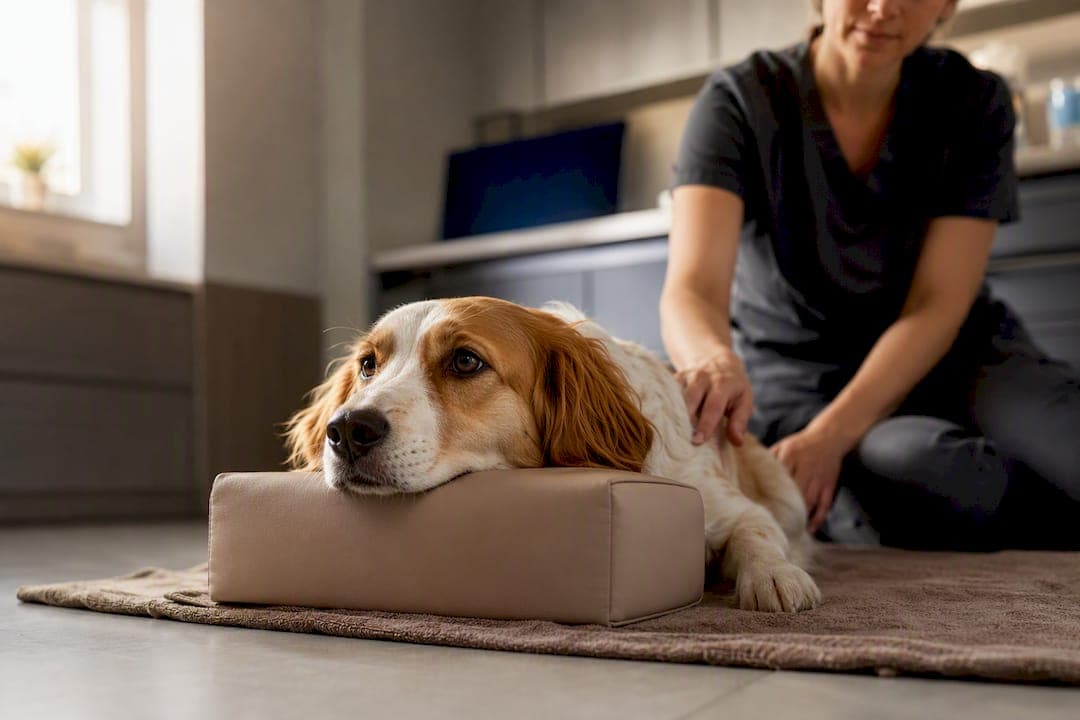
Cooperative care training teaches a dog to voluntarily participate in handling and medical procedures instead of being physically restrained through them, using reward-based methods and clear consent signals like a chin rest. The result: calmer exams, easier nail trims, and far less need for restraint or sedation. The approach is grounded in guidance from the American Veterinary Society of Animal Behavior, the IAABC Foundation, and the clinical experience of teams like City Animal Veterinary Center.
TL;DR:
- Most dogs can learn cooperative care within two to four weeks of consistent, short sessions, but severely anxious or previously forced-handling dogs may need additional veterinary support.
- Training involves breaking down handling tasks into micro-steps, gradually increasing duration and invasiveness while monitoring stress signals and staying below the threshold.
- Using reward-based methods and consent signals like a chin rest promotes trust, reduces fear, and minimizes the need for restraint or sedation during vet visits and grooming.
- Progress levels are organized along axes of tolerance, duration, and intensity, requiring careful tracking, patience, and avoiding pushing a dog past stress signals.
- If sudden aggression, physical pain, or fear responses occur despite training, a veterinary assessment is necessary before continuing cooperative care efforts.
Table of Contents
- What Is Cooperative Care Training for Dogs?
- Why Cooperative Care Matters for Vet Visits and Grooming
- The Behavior Science Behind Cooperative Care
- Step-by-Step Cooperative Care Protocol
- Building a Level-Based Cooperative Care Progression
- Reading Stress Signals and Managing Threshold Safely
- When to Bring in Your Veterinarian or a Behavior Specialist
- A Practitioner's View on Cooperative Care Training
- Get Vet-Backed Support for Cooperative Care Training
- Sources
- FAQ
What Is Cooperative Care Training for Dogs?
Cooperative care flips the old model of veterinary handling on its head. Instead of a dog being pinned, muzzled, or scruffed through a nail trim, the dog offers a specific behavior, usually resting its chin on a target, that signals "I'm ready." As long as that chin stays put, the handling continues. The moment the dog lifts its head, everything stops.
That chin rest is not a cute trick. It functions as a consent behavior, a built-in start and stop button that the dog controls. The IAABC Foundation Journal describes cooperative care as an approach where animals actively volunteer for grooming and veterinary procedures rather than simply enduring them. That distinction changes everything about how a dog experiences the vet's office.
Picture two nail trim scenarios. In the first, a dog is held down by two people while a third clips as fast as possible before the dog can react. In the second, the dog walks up to a mat, rests its chin on a raised platform, and holds still while one nail is clipped, then gets a piece of chicken and a release cue. The paw handling, the clipper, and the actual cut all get introduced separately, at a pace the dog is comfortable with.
Everyday applications include:
- Nail trims and paw handling, broken into touch, hold, and clip stages
- Ear cleaning, starting with just touching the outer ear flap
- Teeth brushing or oral exams, built from lip lifts to brief mouth holds
- Standing still on an exam table or grooming platform for a set duration
- Accepting a thermometer, injection site touch, or stethoscope contact
The welfare gap between these two models is not subtle. Restraint-based handling can produce a dog that goes still because it has learned struggling doesn't work, a state some behaviorists call "learned helplessness," not calm compliance. Cooperative care aims for the opposite: a dog that stays because it trusts the process and can leave whenever it wants.
Why Cooperative Care Matters for Vet Visits and Grooming
Fear at the vet is not a minor inconvenience. It is one of the most common reasons owners delay care, and it directly shapes how procedures get performed. A dog that fights a blood draw needs more hands, more time, and sometimes sedation to complete something that should take thirty seconds.
Cooperative care changes the calculation on both sides of the exam table.
For dogs, the welfare gains are real. Reducing fear during handling lowers overall stress hormone exposure and avoids the fallout of forced restraint, which the AVSAB links to a higher risk of fear, avoidance, and even aggression developing over repeated visits. A dog trained to tolerate handling through consent doesn't just survive the exam. It walks in without the full-body flinch.
For clinics, cooperative care means:
- Fewer procedures requiring sedation for routine handling
- Faster exams because the dog isn't fighting the process
- Safer handling for staff, since a relaxed dog is far less likely to bite out of panic
- Better diagnostic accuracy, since a calm dog's vitals reflect their actual baseline instead of a stress spike
Pro Tip: A dog's heart rate and blood pressure at the vet can be misleadingly high simply from fear, not underlying illness. Cooperative care training makes those readings more trustworthy over time.
For owners, the payoff shows up at home. Ear cleaning, brushing, and nail maintenance stop being wrestling matches. That matters most for owners of double coated breeds or dogs prone to ear infections, who need to do this kind of handling weekly, not once a year at a checkup.
The Behavior Science Behind Cooperative Care
Cooperative care isn't a collection of clever tricks. It rests on decades of established behavior science, mostly borrowed from operant and classical conditioning.
Operant conditioning is learning through consequences: a dog that gets a treat for holding still is more likely to hold still again. Classical conditioning is learning through association: a dog that repeatedly gets chicken the moment clippers appear starts to feel good about clippers, regardless of what happens next. Cooperative care leans on both, but the AVSAB's position on humane training is explicit that reward-based methods outperform aversive ones on welfare and long-term obedience alike. That's why cooperative care never uses corrections, scruffing, or forced exposure to speed things up.
Shaping is the mechanism that makes complex behaviors possible. Instead of expecting a dog to tolerate a full ear exam on day one, shaping breaks the skill into small approximations, rewarding each step before asking for the next. A dog learns to accept a cotton ball near its ear before it ever accepts a cleaning solution touching the ear canal. The Merck Veterinary Manual lists shaping alongside desensitization and counterconditioning as core, evidence-supported behavior modification techniques, while flagging punishment and flooding, forcing a dog to endure a feared stimulus until it stops reacting, as approaches to avoid.
Threshold is the concept that separates a good cooperative care session from a bad one. A dog "under threshold" can still think, eat treats, and learn. A dog pushed "over threshold" is in a stress response and isn't absorbing anything useful, no matter how many cookies you offer. The AKC's guidance on desensitization and counterconditioning stresses keeping the dog below that line throughout training.
Watch for these signs the dog is approaching or past threshold:
- Lip licking or repeated swallowing with no food present
- Yawning outside of tiredness
- Freezing or going unusually still
- Turning the head or whole body away from the handler
- Refusing treats the dog would normally take eagerly
Any of these signals means it's time to back up a step, not push through.
Step-by-Step Cooperative Care Protocol
Cooperative care training works best as a series of small, repeatable sessions rather than one long effort to "get through" a procedure. Here's a structure that works for most healthy adult dogs and adapts easily for puppies or seniors.
1. Set up the environment. Pick a quiet, low-traffic space with good footing, a mat or towel the dog associates with training, and high-value rewards cut small enough for rapid delivery, think pea-sized pieces of chicken, cheese, or a training-specific treat. Sessions should run three to five minutes, once or twice a day. Short and frequent beats long and rare every time.
2. Teach the chin rest first. Before touching a single body part, teach the dog to rest its chin on your open palm or a raised platform and hold that position. This becomes the on/off switch for every exercise that follows. Reward generously for even a one-second chin rest, then build duration gradually.
3. Follow the micro-step progression template. For any husbandry task, break it into this sequence:
- Touch the body part briefly with a bare hand
- Hold the touch for a slightly longer count
- Introduce duration targets, working up from one second to ten or more
- Bring the tool near without contact (clippers near the paw, cotton ball near the ear)
- Make brief tool contact without performing the actual procedure
- Perform the procedure itself, starting with the smallest possible version
Each step gets its own separate training session, not a rushed sequence in one sitting. That pacing is the single most common thing owners skip, and it's the reason so many "cooperative care attempts" stall out.
4. Apply the template to specific tasks.
For nail trims: touch the paw, then hold the paw, then introduce the clipper near the paw with no contact, then rest the clipper against one nail without cutting, then clip a single nail and stop.
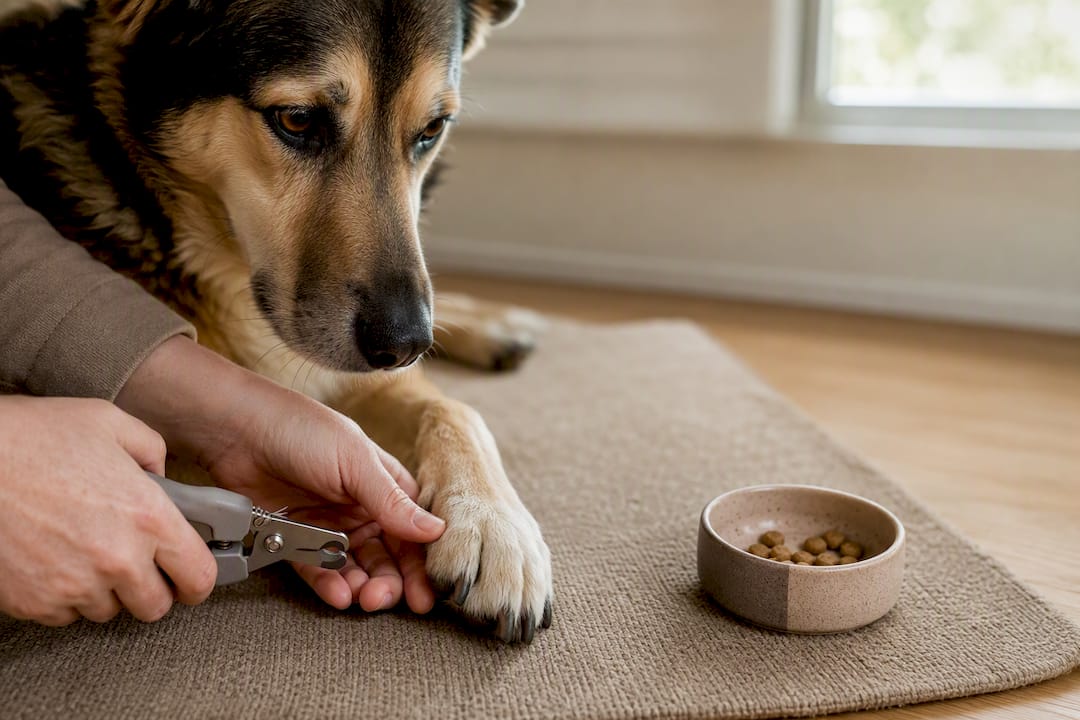
For ear cleaning: touch the outer ear flap, then lift the flap gently, then introduce a cotton ball near the ear, then dampen the cotton ball and touch the inner flap, then clean a small area and release.
For grooming and vet table handling: build comfort standing on the table itself before adding brushing, and separately build tolerance for a hand hovering near sensitive areas like the belly or tail base before any actual handling begins.
For mouth and dental exams: start with a hand near the muzzle, progress to gently lifting the lip, then touching a single tooth, well before a full oral exam is attempted.
5. Record progress and adjust. Keep a simple log: date, exercise, the highest step reached comfortably, any stress signs observed, and the plan for next time. This kind of tracking, similar to what the Cooperative Care Certificate program recommends, keeps owners from accidentally rushing a dog past what it's ready for. If a dog that handled a ten-second paw hold yesterday flinches at five seconds today, that's the log telling you to back up a step, not push forward.
Pro Tip: If a dog struggles with a step it mastered last week, don't assume regression means failure. Context changes everything for dogs. New environment, different lighting, or the smell of a previous vet visit on your clothes can all lower a dog's tolerance temporarily.
6. Practice consistently. Three to five short sessions a week outperforms one long weekend cram session. Consistency is what turns a rehearsed behavior into a dog's default response under real conditions.
Building a Level-Based Cooperative Care Progression
A useful way to measure progress is to think in levels, similar to the structure used by the Cooperative Care Certificate program, which organizes exercises by tolerance, duration, and intensity.
Each level increases difficulty along three axes:
- Tolerance: how much handling the dog accepts without stress signals
- Duration: how long the dog holds a position or accepts contact
- Intensity: how invasive or uncomfortable the handling becomes
A sample progression might look like this:
- Level 1: Dog offers a chin rest for one to two seconds and holds still for a light touch on the shoulder or paw.
- Level 2: Dog holds a chin rest for five to ten seconds while a tool (brush, stethoscope, cotton ball) is brought near without contact.
- Level 3: Dog accepts brief tool contact, such as a stethoscope touching the chest or a nail clipper resting on one nail, while maintaining the chin rest.
- Level 4: Dog tolerates a full brief procedure, one nail clipped, one ear briefly cleaned, or a short table stand for a visual exam, without breaking position.
- Level 5: Dog generalizes the behavior across new environments, handlers, and mild distractions, such as a vet tech performing the same procedure a familiar owner has practiced.
Before moving a dog up a level, test readiness by repeating the current level's exercise in a slightly new context, a different room, a different person handling, background noise. If the dog holds steady, it's likely ready to progress. If stress signals appear, stay at the current level longer rather than forcing advancement on a schedule.
Document each level's success with the same simple log described earlier. Owners who track this tend to notice patterns, like a dog that breezes through paw handling but needs far more repetitions for ear work, faster than owners going by memory alone.
Reading Stress Signals and Managing Threshold Safely
Every cooperative care session should be run with one eye on the dog's body language. The behaviors listed earlier, lip licking, yawning, freezing, turning away, are the clearest early warnings that a dog is nearing its limit.
When you see any of these signals, the response is always the same: stop the current step, lower the intensity, and let the dog take a break or disengage entirely. Pushing through a stress signal to "just finish" the nail trim undoes trust that took weeks to build.
Practical adjustments when signals appear:
- Shorten the duration target back to the last comfortable level
- Increase the distance between the dog and the tool or body part being handled
- Switch to a higher-value reward to rebuild positive association
- End the session early rather than trying to salvage it
Muzzle training deserves a specific mention. A muzzle conditioned as a voluntary, rewarded behavior, the dog choosing to push its nose into it for treats, is a legitimate management tool, not a punishment. The Merck Veterinary Manual treats this kind of conditioning as consistent with sound behavior modification practice, distinct from forcing a muzzle onto a resistant, unconditioned dog.
Pro Tip: A dog that repeatedly hits the same stress signal at the same step, session after session, usually needs a smaller step, not more repetitions of the one that isn't working.
Red flags for professional help include sudden aggression during handling, a dog that won't take treats at all even in a calm setting, or stress responses that intensify rather than fade with repeated, well-paced training.
When to Bring in Your Veterinarian or a Behavior Specialist
Cooperative care training solves a lot of problems, but not every fearful reaction to handling is purely behavioral. Pain is one of the most overlooked causes of sudden handling resistance, a dog that once tolerated ear cleaning and now snaps at the approach of a hand may have an ear infection, not a training gap.
Situations that warrant a vet visit before continuing training on your own:
- Any sudden change in tolerance for handling that was previously fine
- Aggression that escalates despite careful, below-threshold training
- Signs the dog can't calm down even in a low-stimulation setting, which the MSD Veterinary Manual notes can indicate a dog is too aroused to learn effectively until that base arousal comes down
- Visible pain responses, limping, flinching, or vocalizing during specific handling
This approach recognizes that a dog's fear response often has a physical root that training alone won't fix. For owners whose dogs struggle to travel to a clinic at all, home visit services can let a vet assess and support cooperative care progress without adding a stressful car ride and waiting room to the mix. Owners looking for more structured, clinic-backed reading can also review resources on reducing anxiety before vet visits or on fear and aggression management.
A Practitioner's View on Cooperative Care Training
Cooperative care works, but it rewards patience over speed. Most dogs show visible improvement within two to four weeks of consistent, short sessions, though dogs with a history of forced handling often need longer before they fully trust the process. The biggest mistake we see isn't lack of effort, it's owners advancing steps faster than the dog's body language says it's ready. If progress stalls for more than a couple of weeks despite consistent practice, that's the signal to loop in a veterinarian rather than push harder alone.
— CAVC
Get Vet-Backed Support for Cooperative Care Training
Some veterinary clinics offer Fear Free clinical teams that reinforce the same reward-based approach owners build at home. These appointments can be structured around consent-based handling.

Our services include Fear Free appointments designed to minimize stress during routine and diagnostic visits, house call veterinary care for dogs who do better without the car ride and waiting room, and behavior consultations for owners whose cooperative care progress has stalled. For owners tackling specific husbandry challenges, our team also supports dogs through ultrasound and diagnostic imaging prep using the same low-stress handling principles. If you're building cooperative care skills at home and want extra structure, Happy Dog Training's cooperative care post offers quick-start exercises that pair well with in-clinic reinforcement. When you're ready to bring your dog in for a Fear Free exam or want to schedule a home visit, visit City Animal Veterinary Center to book an appointment.
Sources
- Cooperative care - IAABC Foundation Journal
- Why You Need To Reward Your Dog in Training, According to the Experts - AVSAB
- Behavior modification in dogs - Merck Veterinary Manual
- Changing your dog's behavior with desensitization and counterconditioning - AKC
- Behavior problems of dogs - MSD Veterinary Manual
FAQ
What Is Cooperative Care With Dogs?
Cooperative care is a reward-based training method where dogs actively volunteer for handling and medical procedures using consent signals like a chin rest, rather than being physically restrained through them, as described by the IAABC Foundation.
What Is the 3-3-3 Rule for Dog Training?
The 3-3-3 rule is a general guideline for new dogs adjusting to a home, roughly 3 days to decompress, 3 weeks to settle into routine, and 3 months to feel fully at home, and it isn't specific to cooperative care training itself, though a settled dog generally learns handling exercises more readily.
What Is the Hardest Command or Behavior to Teach a Dog?
Within cooperative care, sustained duration behaviors near sensitive body areas, like holding still for an ear cleaning or a nail trim on a reactive paw, tend to take the longest because they require the dog to tolerate both physical contact and a mildly uncomfortable tool at the same time.
How Long Does Cooperative Care Training Take to Work?
Many dogs show noticeable comfort improvements within two to four weeks of short, consistent sessions, though dogs with a history of forced handling or high anxiety may need longer and can benefit from a veterinary behavior evaluation alongside training.
Can Any Dog Learn Cooperative Care, Even an Anxious One?
Most dogs can learn cooperative care with patient, below-threshold training, but severely anxious dogs sometimes need veterinary support first since a dog in a high-arousal state cannot learn effectively, according to the MSD Veterinary Manual.