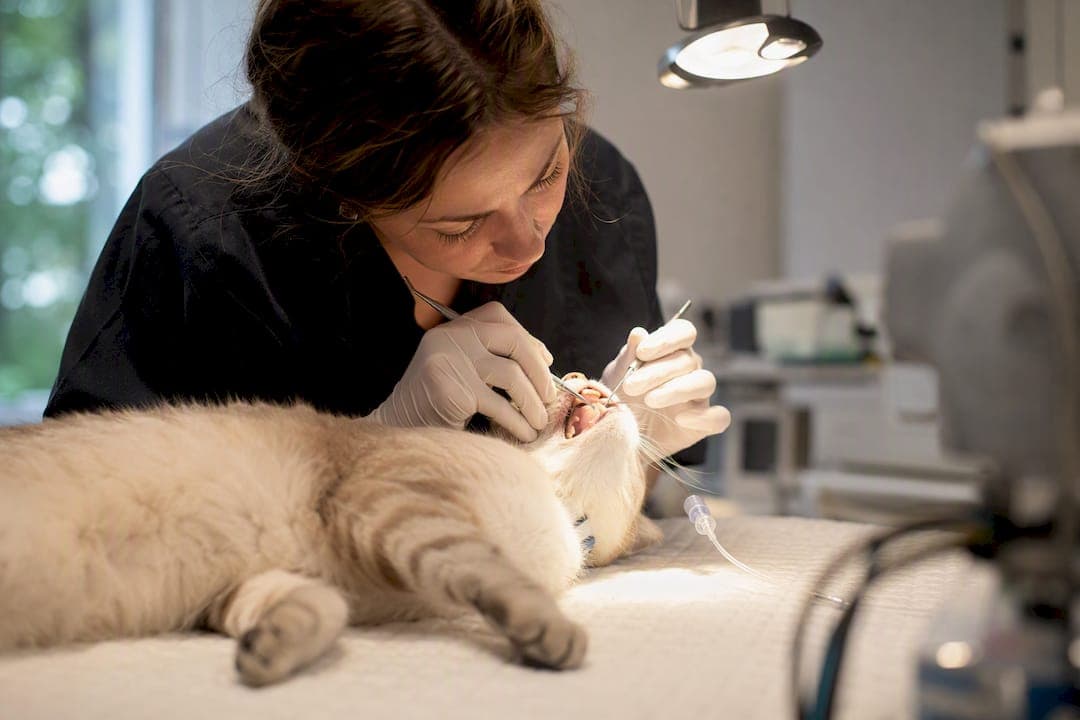
A professional cat dental cleaning, known clinically as a COHAT (comprehensive oral health assessment and treatment), is the only reliable way to remove disease hiding below the gumline and catch problems an awake exam simply cannot find. It requires anesthesia, full-mouth X-rays, and careful scaling above and below the gum. Home brushing helps slow plaque between visits, but it cannot replace what a COHAT does. Cornell University's veterinary school, the 2025 FelineVMA guidelines, and clinics like City Animal Veterinary Center all treat this as the standard of care, not an optional upgrade.
TL;DR:
- Full-mouth radiographs during a cat dental cleaning are essential for detecting subgingival disease and root issues that are not visible during an awake exam.
- Anesthesia is critical for scaling below the gumline, taking X-rays, probing pockets, and performing extractions, with modern protocols making it low risk for healthy cats.
- Daily brushing with enzymatic toothpaste and VOHC-approved dental products significantly slow plaque buildup, but cannot replace professional cleaning procedures.
- Most feline dental disease is manageable within general veterinary practice, with complex cases needing referral only if advanced surgical or diagnostic procedures are required.
- The cost of a professional COHAT varies depending on X-rays, extractions, and pre-anesthetic testing, while anesthesia-free cleanings are primarily cosmetic and not substitutes for proper care.
Table of Contents
- Why Dental Care Matters: How Common Is Feline Dental Disease?
- What Happens During a Professional Cat Dental Cleaning?
- Is Anesthesia Safe for Cat Dental Cleaning?
- Home Dental Care: Brushing and Daily Habits That Help
- Signs Your Cat Needs a Dental Exam
- What Recovery Looks Like After a Dental Procedure
- How City Animal Veterinary Center Approaches Feline Dental Care
- What Determines the Cost of a Cat Dental Cleaning?
- Nutrition and Diet Choices That Support Healthy Teeth
- When Does a Cat Need a Veterinary Dental Specialist?
- The Real Gap Between Dental Guidelines and What Cats Actually Get
- Book Fear Free Dental Care at City Animal Veterinary Center
- Sources
Why Dental Care Matters: How Common Is Feline Dental Disease?
Somewhere between 50% and 90% of cats over four years old have some form of dental disease, according to Cornell University College of Veterinary Medicine. That range is wide because dental disease shows up on a spectrum, from mild gum inflammation to bone loss severe enough to loosen teeth. Most cats never announce that pain out loud. They eat around it, chew on one side, or just get quieter about food.
A few conditions show up again and again in feline mouths:
- Gingivitis — inflamed, often bleeding gums, usually the earliest and most reversible stage.
- Periodontitis — infection that has moved into the bone and ligaments holding teeth in place, which is not reversible.
- Tooth resorption — a uniquely feline process where the tooth's own structure breaks down, often starting below the gumline where owners can't see it.
- Feline chronic gingivostomatitis (FCGS) — a severe, painful inflammatory condition affecting the whole mouth, sometimes requiring extraction of most or all teeth to resolve.
Left untreated, any of these can make eating painful enough that cats lose weight, and chronic oral infection has been linked to broader inflammatory strain on the body.
What Happens During a Professional Cat Dental Cleaning?
A COHAT is not a quick scrub and polish. It's a structured medical procedure with distinct stages, and skipping any one of them defeats the point.
- Pre-op exam and bloodwork. The vet checks organ function and overall health to tailor the anesthesia plan to that specific cat.
- Anesthesia induction and monitoring. The cat is intubated, placed on IV fluids, and monitored continuously for heart rate, blood pressure, oxygen levels, and temperature throughout.
- Full-mouth radiographs. X-rays capture what's happening at the root and below the gumline, where most disease actually lives.
- Dental charting. Every tooth gets probed and recorded, pocket depths measured, mobility checked.
- Scaling and polishing. Tartar is removed above and below the gumline, then the tooth surface is polished smooth to slow future buildup.
- Extractions, if needed. Teeth with resorption, deep pockets, or root disease visible on X-ray are removed in the same session.
The 2025 FelineVMA guidelines are explicit that anesthetized exams with full-mouth radiography are the standard for accurate diagnosis, not an extra step for complicated cases. The reasoning holds up: a cat can look fine on a conscious exam and still be hiding a resorptive lesion that only shows up on film. Anesthesia-free "cleanings" that skip X-rays and only polish visible crown surfaces are cosmetic at best. They cannot touch subgingival tartar, and they leave whatever is happening at the root completely undiagnosed.
Is Anesthesia Safe for Cat Dental Cleaning?
Anesthesia is not a formality bolted onto a cleaning. It's the mechanism that makes the whole procedure possible. Scaling below the gumline, taking diagnostic X-rays, probing periodontal pockets, and extracting a diseased tooth all require a cat to be completely still and pain-free. Cornell's dentistry service notes that modern monitoring protocols make anesthesia low risk when the plan is tailored to the individual patient's age, organ function, and health status.
The FelineVMA guidelines call for multimodal analgesia, meaning pain is managed through more than one drug class or technique working together, both during the procedure and in recovery. That's a deliberate safety standard, not a nice extra.
What should you expect a clinic to have in place before your cat goes under? Pre-anesthetic bloodwork, continuous vital sign monitoring, IV fluid support, and a protocol that flexes based on your cat's specific risk factors rather than a one-size-fits-all approach.
Pro Tip: Ask your vet directly what monitoring equipment they use during dental anesthesia. A clinic that hesitates to answer specifically is a red flag; one that walks you through pulse oximetry, blood pressure checks, and capnography without missing a beat has done this a lot.
Home Dental Care: Brushing and Daily Habits That Help
Daily brushing with an enzymatic cat toothpaste and a cat-specific toothbrush is the single most effective thing you can do at home to slow plaque buildup. Never use human toothpaste. It's not formulated for cats and can upset their stomach.
Beyond brushing, a few things genuinely move the needle:
- VOHC-approved dental products — diets, treats, and water additives carrying the Veterinary Oral Health Council seal have evidence behind their plaque-reduction claims.
- Dental-specific diets designed with a kibble texture that scrapes the tooth surface as your cat chews.
- Oral rinses or gels as a low-effort adjunct on days brushing isn't possible.
None of these replace brushing, and none of them replace a COHAT. Think of them as supporting players, not the main event.
Cooperative care training makes the difference between a cat who tolerates brushing and one who fights it every time. Start by simply touching your cat's lips for a few seconds, rewarding calmly, and building up over days or weeks to actual brushing motions. The FelineVMA guidelines specifically recommend this kind of stepwise, positive-reinforcement training, and clinics that provide video demonstrations tend to see owners actually stick with it.
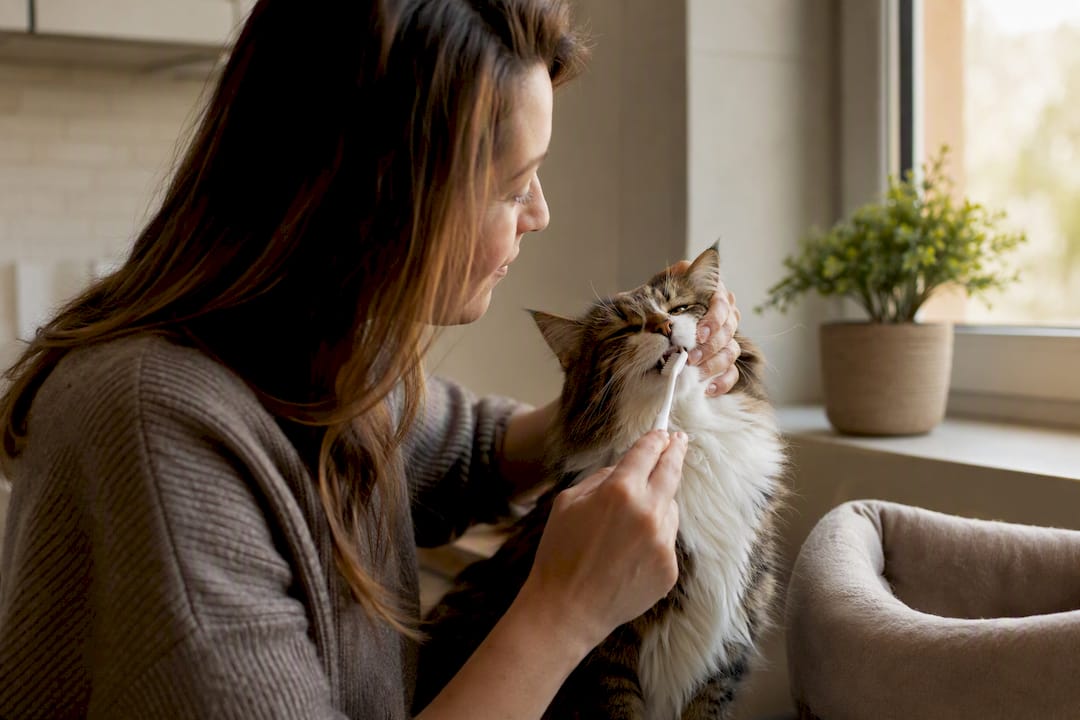
Pro Tip: If your cat's mouth is already painful, forcing a toothbrush in will backfire and teach them to associate your hands with pain. Get a vet exam first, then start training once the underlying disease is treated.
Signs Your Cat Needs a Dental Exam
Cats are experts at masking pain, so the signs are often quieter than owners expect. Watch for:
- Bad breath that's noticeably worse than usual
- Drooling or pawing at the mouth
- Dropping food, chewing on one side, or favoring soft food
- Visible tartar or red, swollen gums
- Reduced grooming, which shows up as a scruffier coat
A single one of these signs is reason enough to book an exam; you don't need to see multiple symptoms stack up first. As for how often cats need professional dental assessments, there's no universal age-based schedule that fits every cat. Your vet sets the interval based on what they find at each annual oral exam, since some cats develop disease fast and others stay stable for years.
What Recovery Looks Like After a Dental Procedure
Most cats bounce back within 24 to 72 hours, though extractions can extend that window slightly.
- Watch eating and activity closely. A cat who won't touch food after 24 hours, or seems unusually lethargic, needs a call to the clinic.
- Give pain medication as prescribed, even if your cat seems fine. Cats hide discomfort well, and skipping doses early can undo the benefit of the procedure.
- Antibiotics are used selectively, typically only when there's active infection or significant extraction sites, not as a routine add-on.
- Offer softened food for a few days if extractions were performed, then transition back to normal food as the gums heal.
- Attend the follow-up recheck and wait for your vet's go-ahead before reintroducing brushing at the extraction site.
How City Animal Veterinary Center Approaches Feline Dental Care
City Animal Veterinary Center builds dental visits around a Fear Free framework, which means handling techniques, sedation choices, and even exam room pacing are all designed to lower a cat's stress response before anesthesia even starts. For cats who panic at carriers or car rides, the clinic's house-call service brings pre-op exams and consultations to the cat's own home, which matters more than it sounds for owners managing an especially anxious or medically fragile animal.
A calm cat under anesthesia is a safer cat under anesthesia. Lowering stress before the procedure isn't a comfort add-on. It changes the actual physiology the anesthesia team is working with.
In-clinic capabilities include dental radiography, continuous anesthesia monitoring, and surgical extraction when full-mouth X-rays show disease that scaling alone can't fix. That combination, imaging plus monitoring plus the surgical skill to act on what the X-rays show, is what separates a real COHAT from a surface-level cleaning.
What Determines the Cost of a Cat Dental Cleaning?
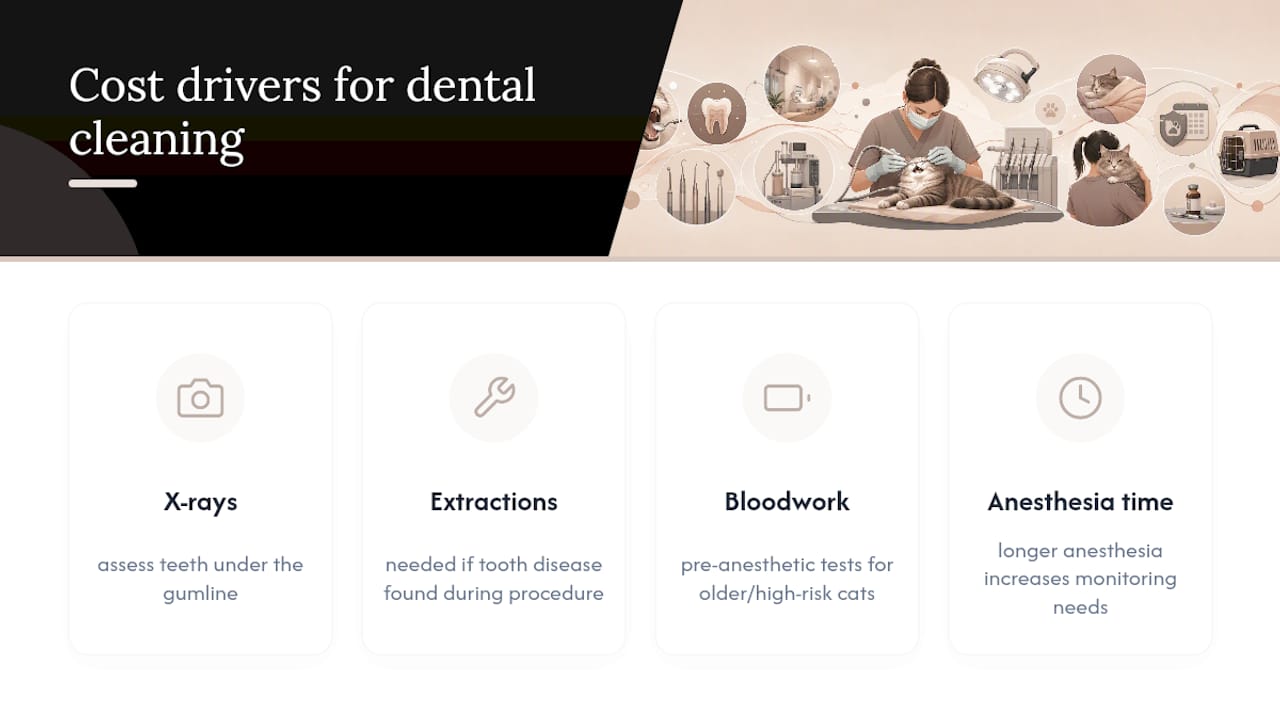
Every professional cleaning is priced around what that specific cat actually needs, not a flat fee for a generic procedure. A handful of variables drive that variation more than anything else: how many X-rays are needed, whether extractions turn out to be necessary once the vet sees under the gumline, how much pre-anesthetic bloodwork is required for an older or higher-risk cat, and how long the anesthesia and monitoring take.
That's part of why anesthesia-free "cleanings" advertised at a flat, low rate should raise questions rather than seem like a bargain. They skip the radiographs and subgingival work entirely, so the price reflects a much smaller, mostly cosmetic service, not a comparable alternative to a COHAT.
The most useful thing you can do as an owner is ask your vet for a written estimate before the day of the procedure, one that accounts for the likely range based on your cat's pre-op exam findings. A cat with visible tartar and stable bloodwork is a very different case from a senior cat with suspected resorption on multiple teeth, and the estimate should reflect that difference honestly rather than quoting a number that assumes the best-case scenario.
Nutrition and Diet Choices That Support Healthy Teeth
What goes in your cat's bowl daily shapes how fast plaque and tartar build back up after a cleaning. Dry kibble formulated specifically for dental health uses a larger, fibrous texture designed to scrape the tooth surface as your cat bites down, rather than shattering instantly like standard kibble does. Look for the VOHC seal specifically. Not every product marketed as "dental" has been tested to back that claim.
Wet food isn't off the table for dental health, but it does less mechanical scraping work, so cats eating primarily wet diets often benefit more from daily brushing or dental treats to compensate. Water additives with enzymatic ingredients can help between meals, though they work best as a supplement to brushing rather than a stand-in for it.
Diet won't undo periodontitis or resolve tooth resorption once it's underway. What it does well is slow the rate at which plaque mineralizes into tartar between professional cleanings, stretching the interval before the next buildup becomes a problem. Talk to your vet about whether a prescription dental diet makes sense for your specific cat, especially if they've already had one or more cleanings and tend to build tartar back quickly.
When Does a Cat Need a Veterinary Dental Specialist?
Most feline dental disease, including routine COHATs, gingivitis management, and straightforward extractions, is well within the scope of a general veterinarian trained in dental radiography and anesthesia. You don't need a specialist referral for a standard cleaning.
A board-certified veterinary dentist becomes worth seeking out for specific, harder cases: complex jaw fractures, oral tumors, cats with FCGS that hasn't responded to full-mouth extraction, or resorption patterns severe enough to need advanced surgical planning. Your general vet is the right person to make that call. If full-mouth X-rays reveal something beyond routine periodontal disease, whether it's a mass, an unusual root pattern, or bone involvement, that's when a referral to a specialist actually changes the outcome.
The practical question to ask isn't "should I see a specialist," it's "does my vet have the imaging and anesthesia monitoring to properly diagnose what's going on first." A general practice with strong dental radiography capability, like the kind City Animal Veterinary Center offers, can usually determine on the spot whether a case needs to go further or can be handled that same day.
The Real Gap Between Dental Guidelines and What Cats Actually Get
The guidelines are clear and have been for years: anesthetized exams, full-mouth X-rays, multimodal pain control. What's not clear is why so many cats still go their entire lives without ever getting one. Part of it is cost anxiety, part of it is anesthesia fear, and part of it is that cats are simply better than dogs at hiding how much their mouths hurt.
Here's what the evidence actually supports prioritizing, in order: get the baseline X-rays before disease is obvious, not after. The FelineVMA guidance on imaging cats as young as two years old exists precisely because resorption starts silently. Waiting for bad breath or drooling means you're already behind. Second, don't let anesthesia-free cleaning services talk you out of the real procedure. They treat a symptom you can see and leave the disease you can't see completely untouched.
Where conventional advice falls short is treating home brushing as a substitute for professional care rather than a complement to it. Brushing is genuinely worth doing every day. It's also never going to reach what's happening below the gumline.
— CAVC
Book Fear Free Dental Care at City Animal Veterinary Center
City Animal Veterinary Center offers full COHAT services built around the Fear Free approach, which means your cat's exam, imaging, and anesthesia are all handled with stress-reduction techniques from the moment you walk in, or from the moment the vet walks into your home. That house-call option matters most for cats who shut down at the sight of a carrier or owners who simply can't manage a car ride with a stressed animal.
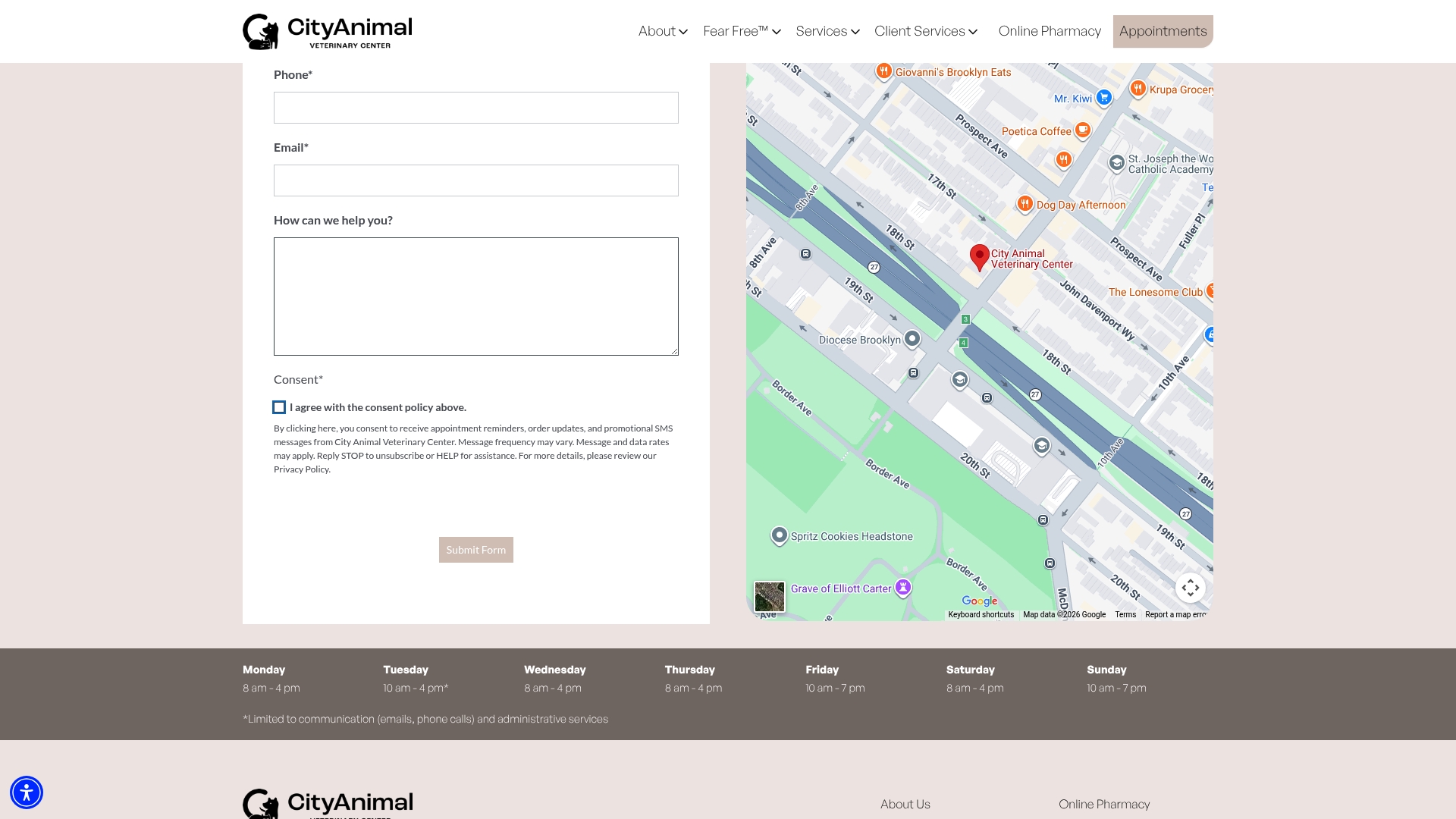
The clinic's in-house capabilities cover the full range a proper dental cleaning requires: digital dental radiography, continuous anesthesia monitoring, and surgical extraction when X-rays show disease scaling alone won't resolve. If your cat has any of the warning signs covered above, bad breath, drooling, reduced appetite, tartar buildup, the next step is straightforward. Schedule a dental exam with City Animal Veterinary Center and get a clear picture of what your cat's mouth actually needs before disease progresses further.
This article is general information, not a substitute for advice from a qualified doctor. Consult a qualified healthcare professional about your own circumstances before acting on anything here.
Sources
- Feline dental disease | Cornell University College of Veterinary Medicine
- 2025 FelineVMA feline oral health and dental care guidelines - PMC