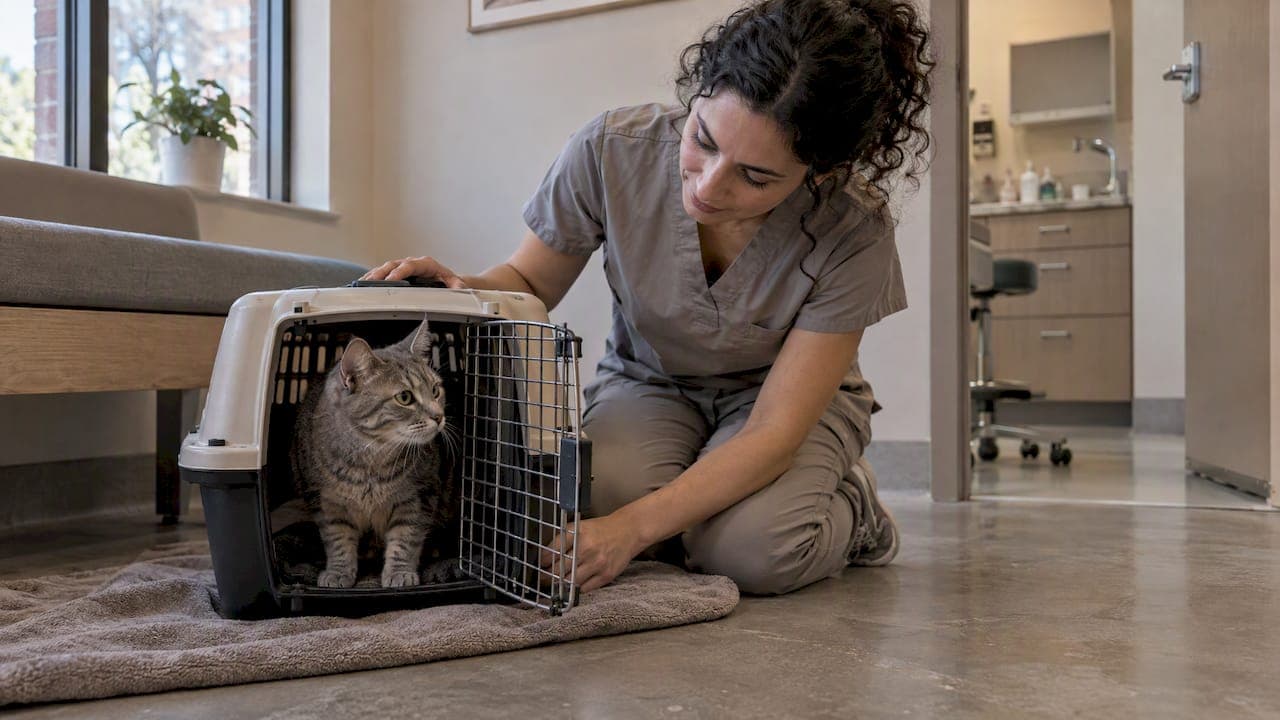
The fastest way to cut cat vet anxiety is a package approach: carrier training, travel practice, and Cat Friendly exam tactics, with prescribed pre-visit medication when needed. Guidelines from AAFP/ISFM back this combination, and the FDA approval of pregabalin (sold as Bonqat) gives owners a new prescription option. We follow this same Fear Free framework in our own exam rooms.
TL;DR:
- Carrier shape and training are crucial, with a hard-sided, top-removable model that is always lifted from underneath to reduce stress.
- Short, gentle car trips with a secured carrier, pheromone sprays, and steady temperatures help alleviate travel anxiety in cats.
- Behavior modification combined with prescribed medication like pregabalin or gabapentin significantly improves cooperation and reduces fear during vet visits.
- Using a carrier in a familiar space and covering the cat with a pheromone-sprayed towel can ease exam room anxiety and minimize handling stress.
- Early carrier training and clinic familiarity lower the need for medication, making exams quicker and less traumatic for cats.
Table of Contents
- Choose the right carrier and train your cat to like it
- Practice travel: how to make short car trips calm and safe
- What to expect and ask for at the clinic: Cat Friendly exam-room tactics
- When medication helps: evidence, timing, and safety for pre-visit meds
- Bringing the cat home: managing post-visit reactions and reintroductions
- City Animal Veterinary Center's Fear Free workflow: what we offer and how we help
- A short clinic perspective on preventing and treating vet anxiety
- How City Animal Veterinary Center can help: services and next steps
- FAQ
- Sources
Choose the right carrier and train your cat to like it
A carrier is the first stressor most cats encounter on vet day, so the shape and feel of it matter. FelineVMA guidance recommends a hard-sided carrier with a removable top, which lets a cat stay in the bottom half during the exam instead of being pulled out through a small door. Always lift a carrier from underneath rather than by the handle alone, since swinging motion adds to the fear.
Training turns the carrier from a trap into a safe spot; our partners offer helpful tips on how to spot Maine Coon kitten scams and better understand feline behavior for safer handling through every stage of life (How to Spot Maine Coon Kitten Scams: A Breeder’s Guide). A simple progression works for most cats:
- Leave the carrier out in a regular living space for several days with the door open.
- Feed meals or treats near, then inside, the carrier.
- Toss a few favorite treats in daily so your cat enters on its own.
- Close the door for a few seconds, then release, building up the duration gradually.
- Practice carrying your cat around the house in the closed carrier before the actual trip.
Some cats resist every step of this. If a cat still panics after a few weeks of patient repetition, cooperative care techniques or a session with a credentialed feline behavior professional can help before you push forward with travel.
Pro Tip: Keep the carrier out year-round instead of pulling it from a closet only on vet days: a carrier that only appears before stressful trips becomes a predictor of bad news.
Practice travel: how to make short car trips calm and safe

Once the carrier itself feels safe, the car is the next hurdle. Zoetis survey data found that roughly 59% of cats show visible distress during car travel, with freezing, hiding, and escape attempts among the most common signs.
Placement and setup inside the car matter more than most owners expect:
- Secure the carrier on the floor behind a seat or buckled by its own strap, never loose on a seat where it can slide.
- Avoid using a seatbelt around a carrier that is not crash-tested, since the belt can crush rather than protect it.
- Drape a light towel over part of the carrier so your cat can hide while still getting airflow.
- Keep the car at a steady, moderate temperature and skip the radio or loud conversation.
- Spray a synthetic feline pheromone product on the towel about 15 minutes before the ride.
Start with trips around the block before attempting the full drive to the clinic. If a cat drools, vomits, or panics on even short rides, ask your vet about motion-sickness medication alongside the anxiety plan.
What to expect and ask for at the clinic: Cat Friendly exam-room tactics
A Cat Friendly clinic visit starts before you walk through the door. Many practices let you wait in the car with your cat until an exam room is ready, which avoids the lobby entirely and skips exposure to barking dogs.
Once inside, a few adaptations make a real difference, drawn from AAFP/ISFM interaction guidelines and Fear Free exam-room recommendations:
- Keep your cat inside the carrier's bottom half, with the top lid removed, rather than extracting it by hand.
- Cover your cat with a warmed towel, ideally pre-sprayed with a calming pheromone.
- Use non-slip surfaces on exam tables, since cats tense up on cold, slick metal.
- Approach from the side rather than head-on, and pause for breaks if your cat freezes or flattens its ears.
- Keep the room quiet, with no barking, clattering equipment, or overhead paging if it can be avoided.
Tell the front desk and the technician about specific triggers before the appointment starts, not after your cat is already upset. A quick note like "she hides at the first touch of a stethoscope" lets the team adjust pacing in advance.
Pro Tip: Ask directly whether the practice follows Cat Friendly or Fear Free handling protocols; a clinic that trains staff in passive handling will say so without hesitation.
When medication helps: evidence, timing, and safety for pre-visit meds
Behavioral prep alone does not resolve every case, and that is where prescription options come in. The FDA approved pregabalin oral solution, marketed as Bonqat, specifically to ease anxiety tied to transportation and vet visits, with field studies showing a notably higher proportion of treated cats improved compared with placebo. FDA approval details confirm it is given as a single dose before travel. Trade coverage from AVMA notes it is prescription-only and requires veterinary monitoring.

Gabapentin remains a widely used alternative with its own evidence base. A JAVMA clinical study found that a single oral dose given prior to an appointment reduced fear-based aggressive behaviors and improved cooperation during exams. Adverse effects were generally transient, mainly drowsiness and some wobbliness in gait.
Before relying on either drug for an actual appointment, keep these safety steps in mind:
- Trial the prescribed dose at home first so you can watch for ataxia or excessive sedation in a familiar setting.
- Discuss kidney function with your vet, since many anxiolytics are cleared through the kidneys.
- Never give a dose that was not specifically prescribed and sized for your cat.
- Follow the exact timing your vet recommends rather than guessing.
Bringing the cat home: managing post-visit reactions and reintroductions
A cat often comes home smelling like the clinic, which can trigger hissing or avoidance from other cats in the household who no longer recognize that scent. A slow reintroduction helps:
- Keep the returning cat in a separate room for a few hours before letting it rejoin shared spaces.
- Swap bedding between cats so scents blend gradually.
- Watch for appetite loss, hiding, or limping beyond a day or two, and call your vet if any persist.
- Offer treats and normal play to reestablish routine rather than hovering anxiously.
City Animal Veterinary Center's Fear Free workflow: what we offer and how we help
We built our exam process around Fear Free principles, including pre-visit sedation protocols that incorporate medication when a vet determines it is appropriate. For cats who struggle with transport altogether, we also offer the option of exams in a familiar space. When pre-visit planning is useful, we talk owners through a home trial dose first, then walk through what a Fear Free exam looks like step by step: carrier-based handling, minimal restraint, and quiet pacing throughout.
A short clinic perspective on preventing and treating vet anxiety
Prevention beats damage control every time. Cats that start carrier and handling work months before they need it arrive calmer, and the exams go faster because nobody is fighting fear in the moment. We would rather build that plan with you early than manage a crisis visit later, so reach out before the anxiety becomes the whole appointment.
— CAVC
How City Animal Veterinary Center can help: services and next steps
We offer a direct path for owners who want professional support rather than figuring out carrier training and medication timing alone. Our Fear Free exams build in the hiding options, passive handling, and quiet pacing described above, and our pre-visit sedation protocols cover Bonqat dosing and home trials when a vet recommends it.
What we offer for anxious cats includes:
- Fear Free certified exam-room handling for cats who tense up at clinics.
- Pre-visit sedation planning, including Bonqat protocols where appropriate.
- Home visits for cats who cannot tolerate car travel at all.
- Behavior consults and in-house diagnostics to rule out pain-driven fear.
Start with a wellness exam where we can also map out a pre-visit plan, or look into our home visit services if travel itself is the main obstacle.
FAQ
What can the vet give my cat for anxiety?
Vets commonly prescribe pregabalin (Bonqat), which the FDA approved specifically for transportation and vet-visit anxiety, or gabapentin, which a JAVMA clinical study found reduces fear-based aggressive behaviors and improves cooperation during exams when given before an appointment. The right choice and dose depend on your cat's health history, so this always requires a prescription and a vet conversation first.
What is the 3-3-3 rule for cats?
This rule is commonly used for newly adopted cats adjusting to a new home: roughly 3 days to begin decompressing, 3 weeks to start settling into routines, and 3 months to feel fully at home. It is not a formally published veterinary guideline, so treat it as a general rule of thumb rather than a fixed schedule.
How long does two weeks feel to a cat?
There is no established scientific measure for how cats perceive elapsed time, so any specific comparison to human time is speculation. What is observable is that consistent routines and repeated positive exposure, such as carrier training over two weeks, tend to produce visible comfort gains in that window.
How do I take an extremely anxious cat to the vet?
Start with carrier training well before the appointment, use a towel-covered, pheromone-sprayed carrier for the drive, and ask the clinic about waiting in the car until the exam room is ready. For cats whose anxiety is severe, ask your vet about a trial dose of pregabalin or gabapentin at home first, as recommended in FelineVMA guidance, so you know how your cat responds before the real visit.
Can I trial anxiety medication at home before a vet visit?
Yes, and it is recommended. FelineVMA guidance advises trialing a prescribed dose at home first to watch for side effects like drowsiness or unsteady movement, and to discuss kidney function with your vet beforehand since many anxiolytics are cleared through the kidneys.
Sources
- FDA: FDA approves pregabalin oral solution alleviating anxiety associated with transportation and veterinary visits
- JAVMA: Clinical evaluation of a single oral dose of gabapentin on fear-based aggressive behaviors in cats
- AAFP/ISFM Cat friendly veterinary interaction guidelines and supportive literature (PMC article)
- AVMA: New drug calms cats during transportation, veterinary visits
- FelineVMA: Purrfect Journey / caregiver carrier guidance and transport recommendations