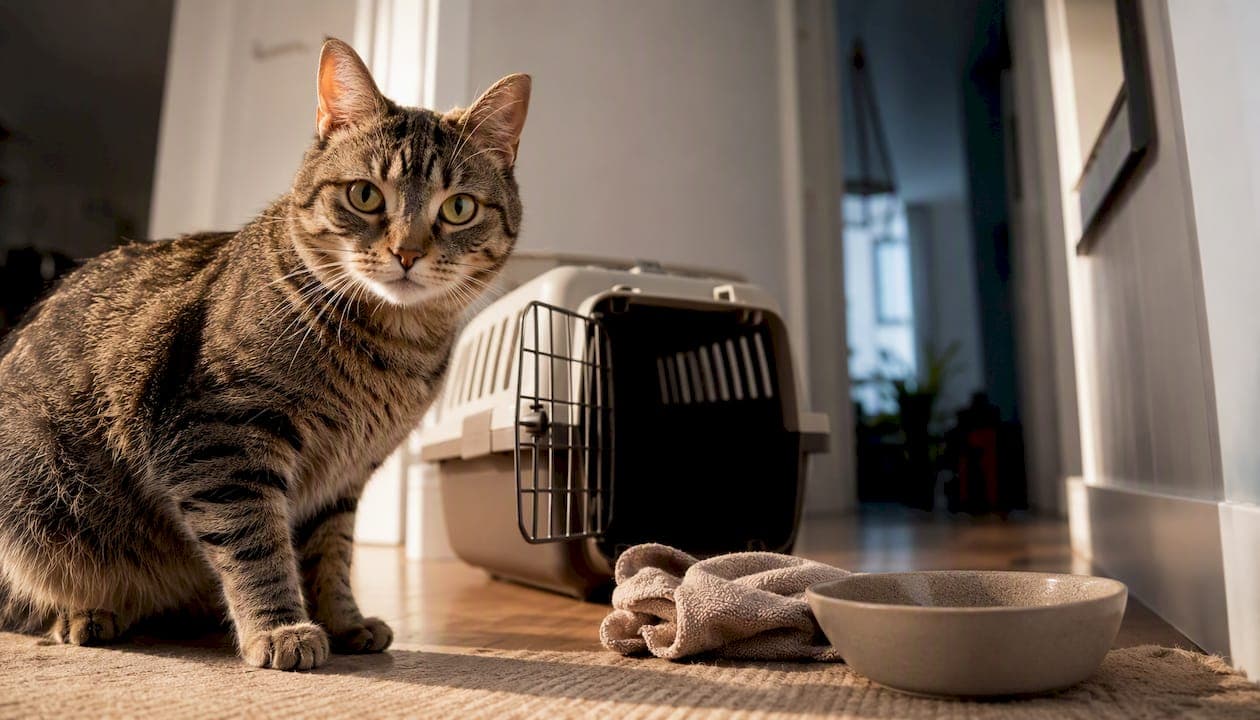
Yes, pre-visit sedation for cats can be both safe and effective, but only when a veterinarian selects and tailors the medication to your cat. The most common options are pregabalin (sold as Bonqat), gabapentin, and trazodone, with benzodiazepines like alprazolam or acepromazine used more selectively. Every protocol should start with a supervised test dose at home and a real conversation with your vet before travel day.
TL;DR:
- Pregabalin is the only FDA-approved pre-visit sedative for cats, offering a higher success rate in calming transportation and exams with minimal side effects.
- Gabapentin is the most commonly used option and is effective when administered 90 to 180 minutes before the appointment, but dosage must be adjusted for kidney health.
- Trazodone provides moderate sedation and anxiety relief, with onset around 60 to 120 minutes, though it may cause gastrointestinal upset in some cats.
- Sedatives like acepromazine and benzodiazepines carry higher risks and should only be used under veterinary supervision, especially in cats with heart or respiratory issues.
- Testing the medication at home before the actual vet visit is crucial to ensure safety and effectiveness, particularly in cats with underlying health conditions.
Table of Contents
- What Are the Safest Pre-Visit Sedation Options for Cats?
- Pregabalin (Bonqat): The Only FDA-Approved Option for Feline Anxiety
- Gabapentin: The First-Line Workhorse Most Vets Reach For First
- Trazodone and Other Sedation Options Worth Knowing About
- When Pre-Visit Sedation Is Not the Right Call
- How to Test and Prepare a Sedation Plan at Home
- Recovery: How Long Sedation Lasts and What to Watch For
- What Your Vet Considers Before Choosing a Protocol
- A Clinic Perspective on Multimodal, Fear Free Sedation Planning
- Ready for a Calmer Vet Visit? Here's the Next Step
- Primary Sources for Pre-Visit Sedation Guidance
- Sources
- FAQ
What Are the Safest Pre-Visit Sedation Options for Cats?
Cat owners searching for pre visit sedation for cats usually want a quick comparison before they call the vet. Here's how the main players stack up against each other, starting with potency and moving to practical timing.
- Pregabalin (Bonqat): FDA-approved specifically for feline transport and vet-visit anxiety. Dosed at 5 mg/kg, given about 90 minutes before you need to leave the house. Strong anxiolytic effect with mild to moderate sedation.
- Gabapentin: Not FDA-approved for this use but widely prescribed off-label. Typical doses run 50 to 150 mg per cat, given 90 to 180 minutes before transport. Effects range from mild calm to noticeable wobbliness depending on dose.
- Trazodone: Commonly dosed around 50 mg per cat, with onset around 60 to 120 minutes. Tends to produce more physical sedation than pure anxiety relief.
- Benzodiazepines (e.g., alprazolam): Used selectively, often for cats with severe carrier aversion or aggression, because a subset of cats develops paradoxical excitement instead of calm.
- Acepromazine: A reliable sedative but a poor anxiolytic. It quiets the body without touching the fear response, and its cardiovascular effects make many vets hesitant to use it alone.
None of these drugs are interchangeable, and combining two without veterinary guidance raises the risk of oversedation or dangerous drug interactions. A cat with kidney disease metabolizes gabapentin differently than a healthy five-year-old, and a cat with a heart murmur reacts to acepromazine in ways that matter far more than convenience.
Pregabalin (Bonqat): The Only FDA-Approved Option for Feline Anxiety
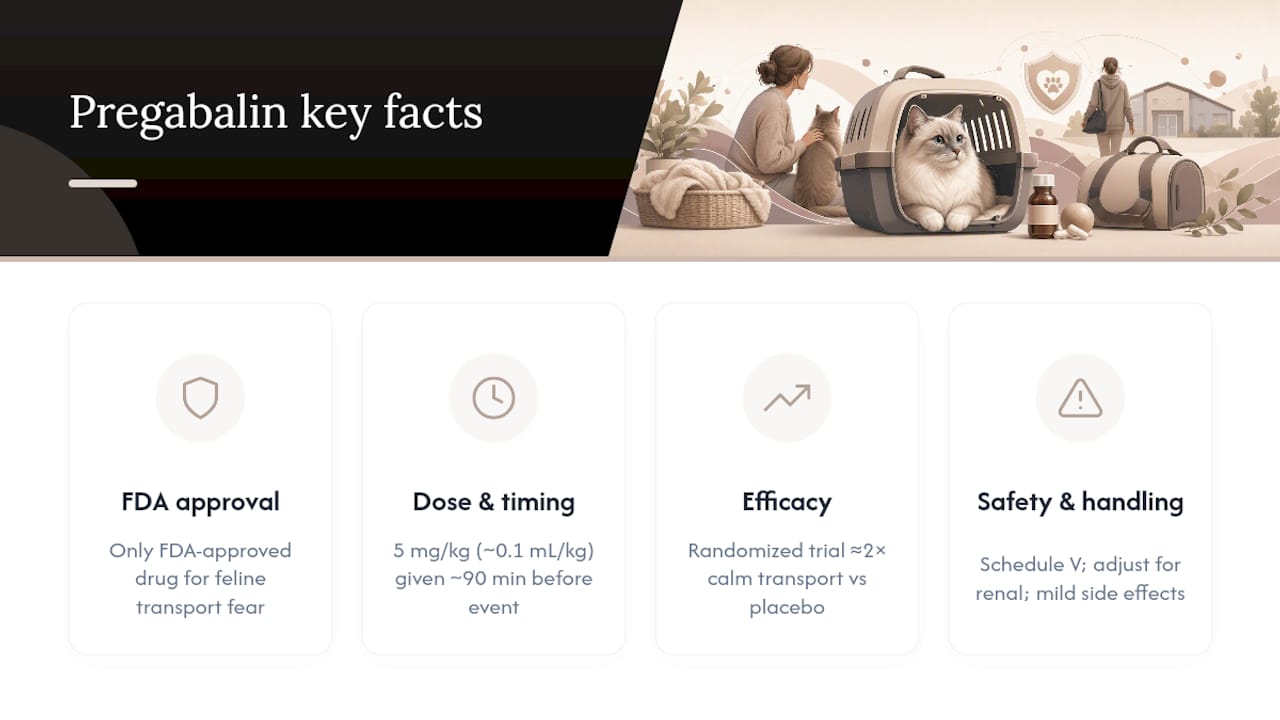
Pregabalin stands apart from the rest of this list for one simple reason: it's the only medication on it that the FDA has approved specifically for reducing acute feline fear tied to transportation and veterinary visits. The label dose is 5 mg/kg, roughly 0.1 mL/kg of the oral solution, given about 90 minutes before the stressful event. It's classified as a Schedule V controlled substance, which means your veterinarian handles prescribing and refill logistics a bit differently than with an over-the-counter supplement.
The evidence: A randomized, placebo-controlled study found that pregabalin produced notably better transport and examination behavior scores than placebo, according to Today's Veterinary Practice.
That's nearly double the success rate for calm transport, which is a meaningful gap when the alternative is a cat screaming in a carrier for forty minutes.
Adverse events in the margin-of-safety studies were uncommon and mostly self-limiting, including mild ataxia, lethargy, and occasional vomiting.
Pregabalin isn't automatically the right call for every cat. Vets typically reduce the dose or avoid it in cats with significant renal impairment, since the drug clears through the kidneys, and they proceed cautiously with breeding or very young cats where safety data is thinner. It also tends to produce less outright sedation than gabapentin at anxiolytic doses, which some owners actually prefer because the cat stays more like herself, just calmer.
Gabapentin: The First-Line Workhorse Most Vets Reach For First
Gabapentin has been used in feline medicine far longer than pregabalin, and that history shows in how confidently most clinics prescribe it. Typical protocols land in the 50 to 150 mg per cat range, with many veterinarians defaulting to 100 mg given roughly 90 to 180 minutes before you need to load the carrier.
For cats with severe carrier aversion, some clinicians add a smaller dose the night before, followed by the full dose the morning of the appointment. This two-dose strategy tends to produce a steadier calm than a single dose alone, particularly in cats who work themselves into a panic the moment they see the carrier come out of the closet.
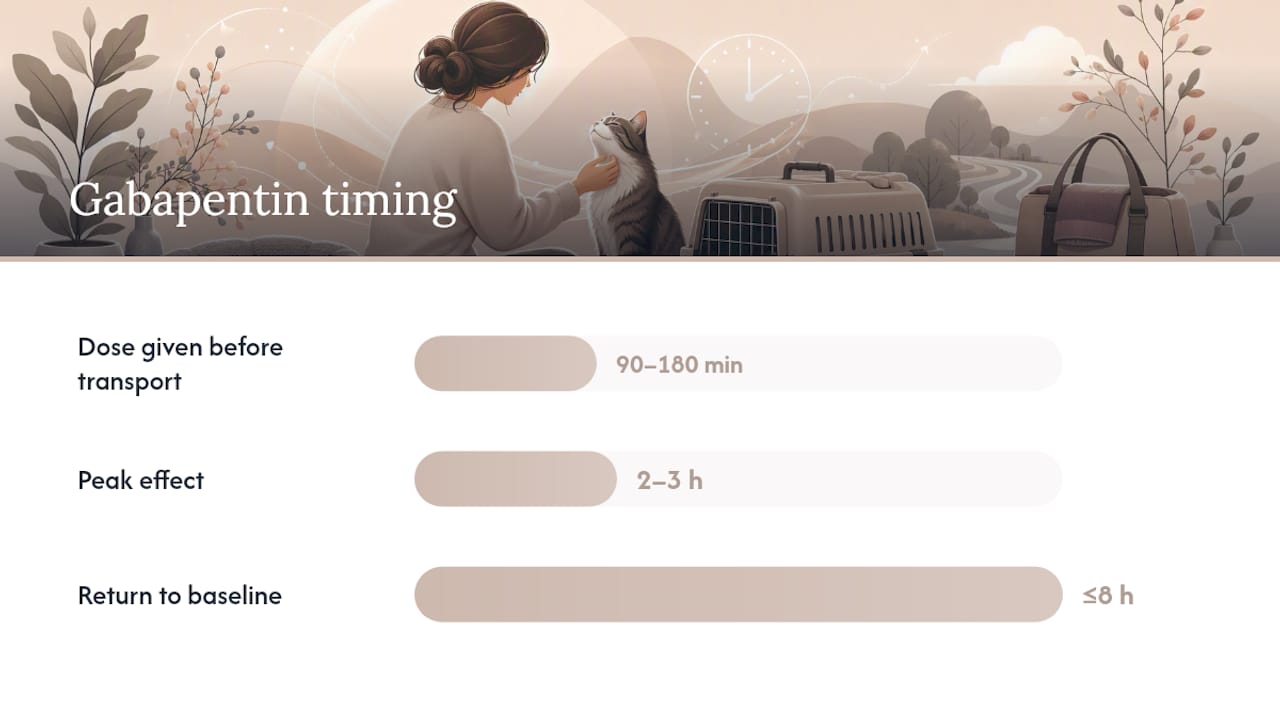
The evidence backs gabapentin's reputation. Reviews of pre-appointment feline medications report that 100 mg per cat given about 90 minutes pre-transport meaningfully reduced distress and improved handling compliance during exams. Peak effect generally hits around two to three hours after dosing, and most cats are back to baseline within eight hours.
Side effects to watch for including mild ataxia, drowsiness, and occasional vomiting, especially at the higher end of the dosing range. Older cats and those with reduced kidney function may need a lower dose since gabapentin is cleared renally, and it's worth flagging directly with your vet if your cat has any history of kidney values trending up.
- Only use veterinary-formulated gabapentin capsules or compounded feline liquids.
- Avoid human liquid gabapentin products, as they may contain toxic sweeteners to cats such as xylitol.
- Store capsules away from curious cats. A dropped capsule chewed and swallowed whole is a very different exposure than a measured dose.
Pro Tip: If your cat has never taken gabapentin before, do a trial run on a calm weekend, not the morning of a real appointment. You want to see how she reacts when nothing else is riding on it.
Trazodone and Other Sedation Options Worth Knowing About
Trazodone occupies a middle ground between the anxiolytics and the pure sedatives. In clinical use, a 50 mg dose per cat given about 90 minutes before travel has been shown to improve both transport and in-clinic tractability scores compared to no medication at all. Onset typically runs 60 to 120 minutes, with peak sedation around the two to three hour mark, which lines up well with a typical drive to the clinic followed by waiting room time.
The tradeoff with trazodone is palatability and gut tolerance. Owners frequently report their cat resisting the medication because of its bitter taste, and some cats experience mild gastrointestinal upset, particularly on an empty stomach. Giving it with a small amount of food often solves both problems.
Two other categories come up in conversations about cat sedation, and both deserve a caution flag rather than a recommendation for routine use.
- Acepromazine reliably sedates but does not reduce fear; its cardiovascular effects limit its solo use, especially in cats with possible heart disease.
- Benzodiazepines like alprazolam may be useful for fearful or aggressive cats but can cause paradoxical excitation in some; they are typically reserved for special cases under veterinary supervision and not for routine pre-visit use.
When Pre-Visit Sedation Is Not the Right Call
Every sedative on this list carries real contraindications, and skipping the pre-visit health check is the single most common mistake owners make when trying to manage their own cat's anxiety medication.
Before giving anything, your vet should know about:
- Known cardiac disease. A heart murmur or diagnosed hypertrophic cardiomyopathy changes which drugs are safe. Acepromazine's blood pressure effects and any drug that alters heart rate deserve extra scrutiny here.
- Respiratory compromise. Cats with asthma, upper airway issues, or brachycephalic-adjacent anatomy face higher risk from anything that depresses the central nervous system.
- Renal or hepatic dysfunction. Gabapentin and pregabalin both clear primarily through the kidneys, so reduced kidney function usually means a reduced dose, not a skipped one, but that adjustment has to come from your vet.
- Pregnancy or lactation. Safety data for most of these drugs in pregnant or nursing cats is limited to nonexistent, so vets generally avoid them outside of clear necessity.
- Pediatric patients. Very young kittens process drugs differently than adult cats, and dosing that's safe at six months may not translate to a ten-week-old kitten.
- Critical illness or recent surgery. A cat already stressed by an underlying medical crisis is not a good candidate for adding a sedative on top without direct clinical oversight.
Guidance from MSPCA-Angell specifically flags that acepromazine can produce irreversible cardiovascular effects and should be used cautiously, if at all, in cats with undiagnosed heart murmurs, which describes a surprising number of outwardly healthy cats who've simply never had one caught on exam.
Watch for these signs after dosing: prolonged ataxia that doesn't improve within a few hours, labored or shallow breathing, unresponsiveness, or full collapse. Any of these warrants an immediate call to your veterinarian or an emergency clinic, not a wait-and-see approach.
Drug interactions matter just as much as the underlying health conditions. Never combine two CNS depressants, say, gabapentin and trazodone, without your vet explicitly building that combination into the plan. If your cat has already received an oral sedative at home, tell the clinic before they administer anything else.
How to Test and Prepare a Sedation Plan at Home
Testing a dose before the actual appointment isn't optional if you're using anything stronger than a pheromone spray. The FDA's own guidance on pregabalin specifically recommends a supervised home test to catch unusual reactions before they happen during actual transport.
- Pick a low-stakes day. Give the prescribed dose on a weekend or evening when you have hours free to watch your cat, not the morning of a real appointment.
- Time it and write it down. Note when you gave the dose, when you first noticed a change (onset), when the effect peaked, and how long it lasted before wearing off.
- Watch for specific reactions. Mild wobbliness is expected with most of these drugs. Vomiting, excessive drooling, agitation instead of calm, or extreme lethargy are not, and should be reported before the real appointment.
- Get the administration method right. Liquid formulations mix easily into a small amount of tuna juice or wet food; capsules can sometimes be opened and sprinkled onto a favorite treat, but check with your vet first since not every drug tolerates that.
- Acclimate the carrier separately from the medication. Leave the carrier out for days before the visit, with bedding and treats inside, so it stops being a signal that something scary is about to happen. Pairing carrier training with a pheromone spray inside the carrier reinforces the calm association. A few cooperative care training exercises, just two to five minutes a day, adapted from dog training, can also help cats tolerate handling with less panic.
- Decide your timing strategy. Single-dose protocols work for many cats; a night-before dose plus a morning dose tends to work better for cats who spiral the moment they sense a trip coming.
Pro Tip: Take a short video during the home test. If your vet needs to adjust the dose later, showing them exactly what "mild ataxia" looked like on your specific cat is more useful than trying to describe it over the phone.
If the test dose produces anything alarming, or if you're simply not confident in what you're seeing, call your vet before the appointment rather than pushing through it. For cats whose anxiety is severe enough that even a tested, well-tolerated sedative doesn't make transport tolerable, City Animal Veterinary Center's house-call service removes the transport step entirely by bringing the exam to your home.
Recovery: How Long Sedation Lasts and What to Watch For
Most pre-visit medications wear off within four to eight hours, though pregabalin and gabapentin can linger a bit longer in some cats, particularly seniors or those with reduced kidney clearance. Expect your cat to seem "off" for the rest of the day rather than snap back to normal the moment you're home.
Practical recovery care matters more than owners often expect:
- Block access to stairs, cat trees, and countertops until the wobbliness fully resolves. A sedated cat misjudging a jump is a real injury risk.
- Set up a quiet, low-traffic room away from other pets or noisy household activity.
- Keep fresh water within easy reach. Some cats drink less than usual while sedated and can use the encouragement.
- Offer a small, easily digestible meal once your cat seems alert and interested in food, especially if trazodone or gabapentin caused any GI upset.
If your cat received additional sedation in the clinic on top of a pre-visit oral medication, recovery may run longer, and staff typically monitor vital signs closely during that window precisely because the combined effect is harder to predict than either drug alone. If ataxia, vomiting, or unusual lethargy persists well past the eight-hour mark, that's worth a call back to your vet rather than assuming it will resolve on its own.
What Your Vet Considers Before Choosing a Protocol
Veterinarians don't pick a sedative off a chart. They weigh your cat's overall health status, any medications already on board, what procedures are planned for the visit, how long the car ride will actually be, and how that same cat responded to sedatives in the past, if there's any history to go on.
Walking into that conversation with the right questions gets you a better protocol, faster:
- "Is this medication safe for my cat's heart and kidneys specifically?"
- "How many minutes before we leave should I give this?"
- "What side effects should I expect, and who do I call if something looks wrong?"
- "Should we test this dose at home first before the actual appointment?"
Pro Tip: Always tell the front desk if you've given your cat anything at home, even something as mild as a pheromone-soaked bandana. Vets adjust in-clinic sedation plans based on what's already in your cat's system, and leaving that detail out isn't a small omission.
A Clinic Perspective on Multimodal, Fear Free Sedation Planning
Some veterinary centers treat pre-visit medication as one piece of a larger plan, not a shortcut around it. Pairing a well-chosen drug with Fear Free handling consistently produces calmer exams than either approach alone. A cat who's had a tested dose of gabapentin and walks into a room where staff move slowly, use low voices, and skip unnecessary restraint tends to tolerate the full exam rather than fighting through parts of it.
That's the real value of combining pharmaceuticals with behavior-conscious handling: it doesn't just mask the fear response, it lets the veterinarian actually complete a thorough physical exam. For cats whose transport anxiety is the main barrier, a house-call option can sidestep the carrier and car ride altogether. Either way, the goal is the same: a protocol built around your specific cat, tested in advance, not guessed at in the parking lot.
— CAVC
Ready for a Calmer Vet Visit? Here's the Next Step
Some veterinary centers build pre-visit sedation plans around your cat specifically, not a generic dosing chart, because a cat with health changes needs a different conversation than a healthy cat who just hates the car. A Fear Free approach means the exam itself is designed to keep stress low once your cat arrives, and for cats whose anxiety centers on transport more than the exam itself, a house-call service can bring the visit to your living room instead.
If your cat panics at the sight of the carrier or turns every appointment into an ordeal for everyone involved, the fix usually isn't a stronger drug, it's the right plan, tested and tailored before appointment day. Schedule a consultation with City Animal Veterinary Center to talk through a sedation protocol built specifically for your cat's health history and temperament.
Primary Sources for Pre-Visit Sedation Guidance
- FDA approval notice for pregabalin oral solution (Bonqat) — regulatory status and label dosing
- Review of pre-appointment medications for dogs and cats — dosing evidence for gabapentin and trazodone
- MSPCA-Angell pre-hospital sedation guidance — contraindications and safety flags
- Today's Veterinary Practice on feline previsit pharmaceuticals — pregabalin clinical trial results
- dvm360 on sedation considerations for feline visits — multimodal, Fear Free framing
This article is general information, not a substitute for advice from a qualified doctor. Consult a qualified healthcare professional about your own circumstances before acting on anything here.
Sources
- FDA: CVM updates — FDA approves pregabalin oral solution for cats
- Today's Veterinary Practice — What's New With Feline-Friendly Previsit Pharmaceuticals
- A review of pre-appointment medications to reduce fear and anxiety in dogs and cats at veterinary visits — PMC
- Considerations for the use of sedation for feline veterinary visits — dvm360
FAQ
Can I sedate my cat before a vet visit?
Yes, but only with a medication your veterinarian has prescribed and dosed specifically for your cat. Options like pregabalin, gabapentin, and trazodone are commonly used, though the right choice depends on your cat's health history and any existing conditions.
What is the 3-3-3 rule for cats?
The 3-3-3 rule refers to adjustment timelines for newly adopted cats (roughly 3 days to decompress, 3 weeks to settle in, and 3 months to feel fully at home), not a sedation protocol, so it doesn't directly apply to pre-visit medication timing.
How long will a cat be out of it after sedation?
Most pre-visit sedatives wear off within four to eight hours, though pregabalin and gabapentin can linger a bit longer in senior cats or those with reduced kidney function. Restrict jumping and provide a quiet space until your cat is fully back to normal.
How risky is it to sedate a cat?
When a veterinarian selects and doses the medication appropriately, the risk is generally low. Margin-of-safety studies on pregabalin, for example, found self-limiting side effects like mild ataxia in under 5% of cats, but risk rises significantly in cats with undiagnosed heart, kidney, or respiratory conditions, which is why a pre-visit health check matters.