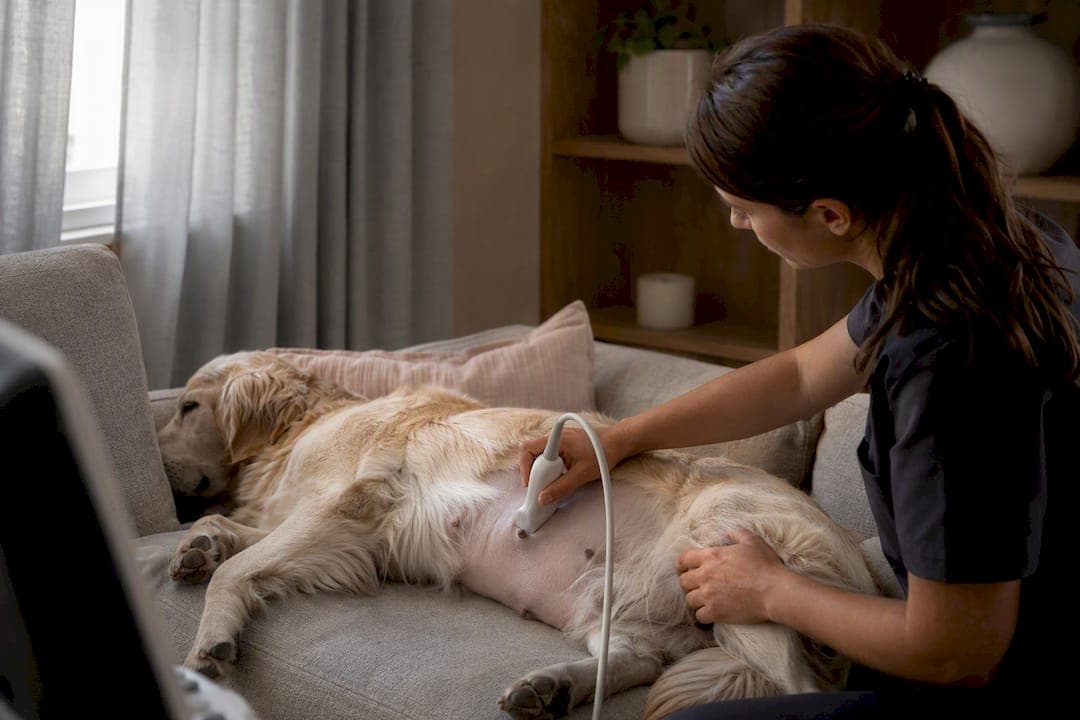
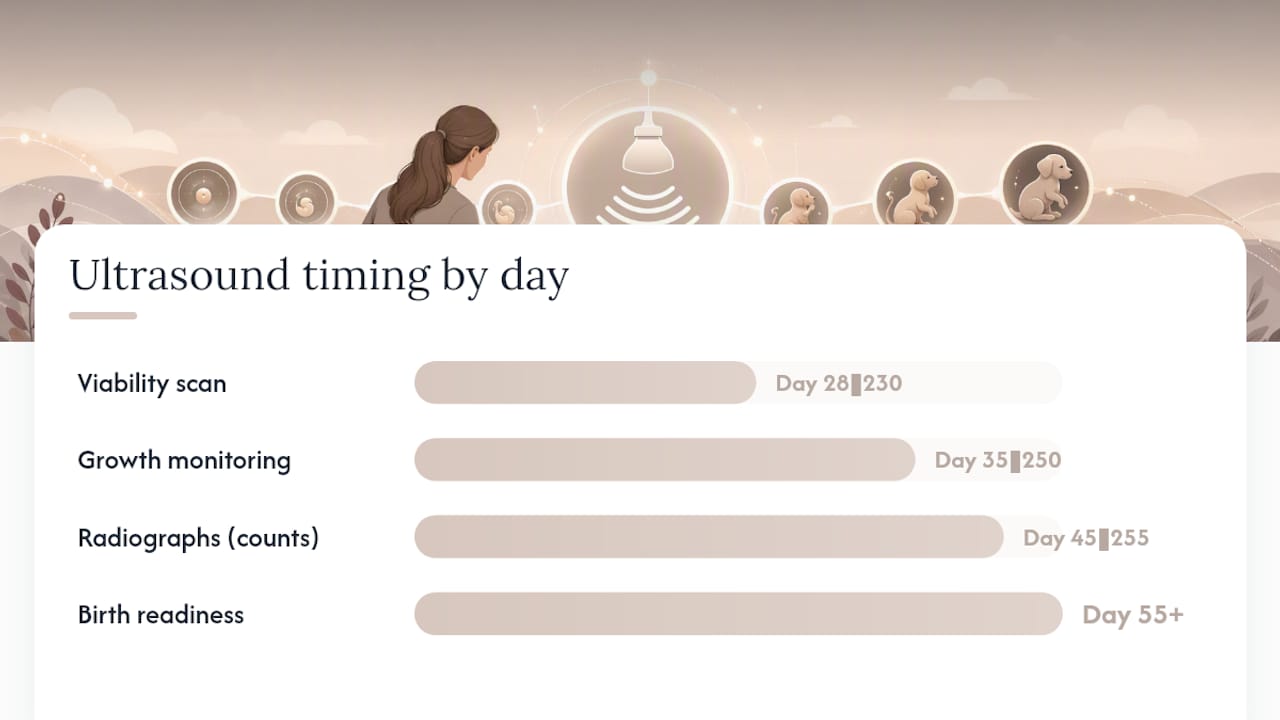
If you know or suspect your dog was bred, the ultrasound schedule that actually works looks like this: an early scan around day 25 to 30 to confirm pregnancy and find a heartbeat, a mid-pregnancy scan around day 35 to 50 to check on growth and rule out problems, and a late scan from day 55 onward to watch for signs that labor is close. Dog pregnancy ultrasound timing isn't a single appointment. It's a sequence, and each visit answers a different question.
- Day 25 to 30: confirm pregnancy and locate a fetal heartbeat, the primary marker of viability.
- Day 35 to 50: track fetal growth, organ development, and movement.
- Day 55 and beyond: check fetal maturity, heart rate trends, and readiness for whelping.
If you know the breeding date or have an ovulation timing estimate from your veterinarian, call to schedule that first scan now rather than waiting for visible signs of pregnancy. Waiting too long past day 30 to book means you lose the best window for a clean, reliable viability check. A visible, beating fetal heart is what your veterinarian is actually looking for at that first visit, not just a gestational sac.
Key Takeaways
Accurate dog pregnancy ultrasound timing depends on scanning at day 28 to 30 for viability, day 35 to 50 for growth monitoring, and day 55 onward for birth readiness, with radiographs reserved for exact counts after day 45.
| Point | Details |
|---|---|
| Book the first scan at day 28 to 30 | This window gives the most reliable heartbeat detection and viability read. |
| Heartbeat is the viability benchmark | A visible fetal heartbeat, not just a gestational sac, confirms an ongoing pregnancy. |
| Use radiographs for exact counts | Fetal skeletons calcify enough for accurate counting after day 45 to 55. |
| Late scans guide birth planning | Fetal heart rate trends and intestinal peristalsis signal when labor is approaching. |
| City Animal Veterinary Center offers Fear Free scans | Early, mid, and late ultrasounds are available in-clinic or via house call for anxious dogs. |
Table of Contents
- Key Gestational Facts Every Owner Should Know
- When Should You Get the First Ultrasound After Breeding?
- What Shows Up on a Mid-Pregnancy Ultrasound?
- What Does a Late-Term Ultrasound Reveal Before Whelping?
- Should You Use an Ultrasound or an X-ray to Count Puppies?
- How Do You Prepare Your Dog for a Pregnancy Ultrasound?
- Why Might Your Ultrasound Results Be Inconclusive?
- When Do Vets Recommend Repeat or Serial Ultrasounds?
- Your Quick-Reference Scan Timeline
- How City Animal Veterinary Center Handles Pregnancy Ultrasounds
- A Straightforward Recommendation on Timing
- Ready to Schedule Your Dog's Pregnancy Ultrasound?
- Frequently Asked Questions
- Sources
Key Gestational Facts Every Owner Should Know
Vets don't count "days pregnant" the way you might expect. Gestational age is usually calculated from the LH (luteinizing hormone) surge or from ovulation, not from the day of mating, because sperm can survive in the reproductive tract for several days. That's why two dogs bred on the same calendar day can be at slightly different points in gestation, and why the exact scanning window matters more than a mating date scribbled on a calendar.
Veterinary reproduction literature, including guidance summarized by the Merck Veterinary Manual and reproductive research reviewed on VIN, lays out a fairly consistent set of landmarks:
- Gestational sac first becomes visible on ultrasound around the third week of pregnancy.
- Embryo typically becomes distinguishable within the gestational sac around the end of the third week or start of the fourth week.
- Fetal heartbeat can often be detected from the start of the fourth week of pregnancy onward.
- The fetal skeleton calcifies sufficiently for radiographs sometime during the later half of pregnancy, generally after the sixth week.
- Whelping most commonly occurs about nine weeks after the LH surge, though timing varies.
Those ranges are averages, not guarantees. Litter size, breed, and individual variation shift things by a few days in either direction.
When Should You Get the First Ultrasound After Breeding?
The earliest reliable window for confirming pregnancy sits between day 25 and 35 after breeding, according to the Merck Veterinary Manual, with day 28 to 30 widely considered the sweet spot for a dependable read. Scan too early, before day 21, and you risk a false negative simply because structures haven't developed enough to show up on the screen yet.
Here's what actually shows up, and when, based on a serial ultrasound study of Miniature Schnauzer bitches:
- Day 17 to 19: the gestational sac appears as a small fluid-filled circle. It confirms something happened, not that it's viable.
- Day 22 to 23: the embryo itself becomes visible inside that sac.
- Day 23 to 24: a heartbeat can often be detected at this point, though many clinics wait until day 25 to 28 for a more reliable read.
- Day 28 to 30: this is when a fetal health assessment becomes genuinely dependable, according to UC Davis, and when ultrasound can reliably distinguish true pregnancy from a false pregnancy or pyometra.
The goal at this stage isn't a puppy count. It's answering three questions: is she pregnant, is at least one heartbeat visible, and is there anything abnormal, like fluid patterns suggesting uterine infection, that needs immediate attention.
If the scan comes back empty or inconclusive, don't panic and don't assume the worst. An empty-looking uterus at day 21 might just mean you scanned a few days too early. Most veterinarians will recommend rescanning 7 to 10 days later, sometimes alongside relaxin testing, which is a hormone specific to pregnancy that won't show a false positive from a phantom pregnancy the way progesterone can.

Pro Tip: Ask your clinic what frequency transducer they use for reproductive scans. Higher-frequency probes, in the 7 to 10 MHz range, can pick up gestational structures a few days earlier than older equipment, which matters if you're trying to confirm pregnancy on the early edge of the window.
What Shows Up on a Mid-Pregnancy Ultrasound?
By day 35 to 50, the ultrasound conversation shifts from "is she pregnant" to "how is this pregnancy progressing." Fetuses are large enough now to show real anatomical detail, and that detail tells your vet a lot about whether things are on track.
Expect your veterinarian to look for and describe:
- Fetal movement, which by itself is a strong sign of ongoing viability.
- Organ visibility, including early looks at the stomach and bladder as they fill.
- Overall growth trends compared to expected size for the gestational day.
- Placental appearance, checking for fluid buildup or abnormalities that might signal trouble.
This is also the stage where accurate puppy counting starts getting harder, not easier. Fetuses grow closer together, curl into each other, and overlap in the uterine horns, so a headcount done at day 40 is a rough estimate at best. Vets use mid-pregnancy scans less for a final number and more to catch a nonviable fetus early or spot high-risk signs like abnormal fluid accumulation.
Some clinics pair these scans with progesterone monitoring, particularly for breeders tracking a planned whelping date closely, since progesterone levels dropping ahead of schedule can flag an issue worth watching. If a mid-pregnancy scan turns up something ambiguous, such as a fetus that looks smaller than its littermates or shows no movement during the exam, the standard response is a recheck within a few days rather than an immediate worst-case conclusion. Growth and movement can look different scan to scan depending on fetal position and how active the puppy happens to be at that exact moment.
What Does a Late-Term Ultrasound Reveal Before Whelping?
From around day 55 to whelping, the ultrasound's job changes again. This is no longer about confirming a pregnancy exists. It's about figuring out whether these puppies are ready to be born and whether the delivery is likely to go smoothly.
Veterinarians watch for specific maturity signals during this window:
- Intestinal peristalsis, meaning visible movement within the fetal gut, which tends to appear as puppies approach full term.
- Lung and liver echogenicity changes, subtle shifts in tissue appearance on the screen that suggest organ maturation.
- Fetal heart rate trends, since a normal rate averages around 230 beats per minute, and a sustained drop can signal fetal distress or that labor is close.
A declining fetal heart rate in the final days often precedes labor by 12 to 36 hours, which is genuinely useful information if you're trying to plan around a whelping date or decide whether a scheduled cesarean makes sense for a high-risk dog. If a scan shows a heart rate dropping well outside normal range, or shows signs of fetal distress rather than the expected pre-labor pattern, that's when a vet moves from "let's watch and wait" to "let's talk about intervening now." For dogs with a history of difficult births, breeds prone to dystocia, or pregnancies already flagged as high-risk, this late scan often gets paired with a concrete birth plan, including hospitalization timing or cesarean prep, well before the first contraction shows up.
Should You Use an Ultrasound or an X-ray to Count Puppies?
Ultrasound and radiographs are good at different jobs, and using the wrong one for the question you're asking is a common mistake. Ultrasound wins early. Radiographs win for the final count.
Here's how the two compare:
- Ultrasound (day 25 to 40): best for confirming viability, checking fetal heartbeats, and catching early red flags. Weak for exact puppy counts because fetuses aren't distinct enough yet.
- Radiographs (day 45 to 55 and later): best for an accurate final litter count, since fetal skeletons have calcified enough to appear as clear, countable structures on X-ray.
If a breeder needs to know exactly how many puppies to expect, for whelping prep or simply peace of mind, the practical move is an early ultrasound for viability followed by a radiograph after day 45. Trying to get a firm number from ultrasound alone, especially past day 35, usually leads to an estimate that's off by one or two either way. Fetuses overlap, curl behind each other, and shift position depending on how the dam is lying during the scan, all of which throws off a headcount even for an experienced operator. A radiograph doesn't have that problem once bones have calcified. It gives you a still, clear skeletal picture that's far easier to count accurately.
How Do You Prepare Your Dog for a Pregnancy Ultrasound?
Getting ready for the appointment is simpler than most first-time breeders expect, and there's very little your dog needs to do differently beforehand.
Before you go:
- Bring the estimated breeding date or LH/ovulation testing results if you have them.
- Skip fasting. It isn't typically required for an abdominal ultrasound.
- Avoid strenuous exercise right before the visit, since a calm dog scans more easily.
- Note any unusual symptoms (discharge, lethargy, appetite changes) to mention to your vet.
During the exam, your dog will usually lie on her back or side while a small area of fur gets clipped and ultrasound gel is applied so the probe makes clean contact with the skin. Most dogs tolerate this without any sedation at all. Only extremely anxious animals need light calming support, and that decision is made case by case with the dog's comfort as the priority.
Pro Tip: If your dog gets visibly stressed at the vet, ask about a Fear Free exam approach or a house-call ultrasound. A calm dog holds still better, which usually means a faster, clearer scan and less time spent trying to get a usable image.

Why Might Your Ultrasound Results Be Inconclusive?
Ultrasound is a genuinely useful tool, but it has real limits worth knowing about before you walk in expecting a perfect readout every time.
Accuracy depends on a handful of factors:
- Machine and transducer quality, since older or lower-frequency equipment detects structures later than modern high-frequency units.
- Operator experience, which affects both detection timing and interpretation of what's on screen.
- Patient factors, including body size, excess body condition, thick coat, or intestinal gas, all of which can obscure the image.
- Breed differences, since very small or very large dogs image differently.
- Timing of the exam, since scanning too early misses structures and scanning too late makes counting harder due to overlap.
There's a real tradeoff built into this timing. Earlier scans give a better shot at counting individual fetuses because they're still spaced apart, but they risk missing a nonviable embryo that hasn't shown clear signs yet. Later scans catch developmental problems more reliably but make an exact count nearly impossible. If a scan comes back unclear either way, the standard next step is simply repeating it in a week, or moving to a radiograph if an accurate count is what actually matters clinically.
When Do Vets Recommend Repeat or Serial Ultrasounds?
Not every pregnancy needs more than two or three scans. But certain situations call for closer, more frequent monitoring, and knowing when you're in that category matters.
Vets typically escalate to serial scanning for:
- A history of previous pregnancy loss or embryonic resorption in that dog.
- An abnormal or irregular fetal heartbeat pattern spotted on an earlier scan.
- Suspected uterine disease, including pyometra, which needs to be distinguished from pregnancy quickly.
- High-value breeding litters where the cost of missing an early warning sign is simply too high.
What changes with serial monitoring isn't just how often you show up. It changes clinical decisions directly. Tracking fetal heart rate and intestinal maturity over several scans, combined with progesterone monitoring, can help a vet time a planned cesarean precisely, including scheduling steroid administration in advance to support fetal lung maturity when a C-section is planned.
Cadence depends on the concern. An unclear early scan usually gets rechecked every 7 to 10 days. A near-term dog with a concerning heart rate trend might get scanned every 24 to 48 hours until the picture is clear.
Your Quick-Reference Scan Timeline
Here's the whole schedule condensed into one checklist you can screenshot and reference as your dog's pregnancy progresses.
- Day 25 to 30: confirm pregnancy, locate a heartbeat. Bring your breeding date estimate.
- Day 35 to 50: monitor growth, organ development, and catch early warning signs.
- Day 45 to 55: consider a radiograph if you need an accurate puppy count.
- Day 55 onward: assess fetal maturity and heart rate trends ahead of whelping.
- Anytime: call promptly if you notice discharge, lethargy, or reduced appetite.
How City Animal Veterinary Center Handles Pregnancy Ultrasounds
Scheduling starts with your estimated breeding or LH date, which determines when we book that first scan. Our early-pregnancy protocol targets the day 28 to 30 window using clinical-grade equipment, since that timing gives the most dependable read on viability. When an exact litter count matters for whelping prep, we schedule a follow-up radiograph after day 45.
Appointments typically run as a straightforward visit: gentle positioning, a Fear Free approach throughout, and a clear conversation about findings before you leave. For dogs who find clinic visits stressful, our house-call service brings the same ultrasound capability to your home, so getting an accurate scan doesn't mean putting an anxious dog through a car ride and waiting room first.
A Straightforward Recommendation on Timing
Get that first ultrasound at day 28 to 30, not sooner. Scanning earlier out of impatience risks a false negative and an unnecessary scare. If you're unsure about your dog's breeding date or want a scan tailored to her specific situation, call and talk it through with us before booking.
Ready to Schedule Your Dog's Pregnancy Ultrasound?
City Animal Veterinary Center gives Brooklyn breeders and owners something a lot of clinics can't: a Fear Free ultrasound visit timed precisely to your dog's breeding date, plus the option to skip the stressful car ride entirely with a house call for anxious dogs.

Our diagnostic imaging covers the full pregnancy timeline, early ultrasound for viability, radiographs after day 45 for an accurate litter count, and follow-up scans as whelping approaches. If your dog also struggles with clinic anxiety, that's exactly what our Fear Free house-call service was built to solve, and it pairs naturally with the same prep steps used for senior wellness exams where reducing stress matters just as much.
When you call to book, have your estimated breeding or LH date ready, along with any progesterone or relaxin test results you've already had done. From there, we'll map out the right scan schedule for your dog's specific pregnancy. Schedule your appointment with City Animal Veterinary Center today and get that first scan on the calendar.
Frequently Asked Questions
What is the best time for a dog pregnancy ultrasound? Day 28 to 30 after breeding is the most reliable window, since it consistently shows a detectable fetal heartbeat and allows a dependable viability read.
Can an ultrasound tell you how many puppies a dog is having? Early ultrasound gives a rough estimate, but accuracy drops as puppies grow and overlap. A radiograph after day 45 gives a far more accurate count.
How early can a vet detect a dog pregnancy on ultrasound? Some structures appear as early as day 17 to 19, but scanning before day 21 risks a false negative since embryos may not yet be visible.
Does a dog need to be sedated for a pregnancy ultrasound? No, most dogs tolerate the exam without sedation. Only unusually anxious dogs may need light calming support, decided case by case.
What if the first ultrasound doesn't show a heartbeat? A rescan 7 to 10 days later is standard, since scanning too early is a more common explanation than an actual failed pregnancy.
This article is general information, not a substitute for advice from a qualified doctor. Consult a qualified healthcare professional about your own circumstances before acting on anything here.
Sources
- Pregnancy Determination in Bitches and Queens - Merck Veterinary Manual
- Pregnancy Diagnosis in the Bitch — UC Davis HealthTopics
- Time of initial detection of fetal and extra-fetal structures by ultrasonographic examination in Miniature Schnauzer bitches — PMC
- Ultrasonography for the evaluation of pregnancy in the female canine — RDA (review article)