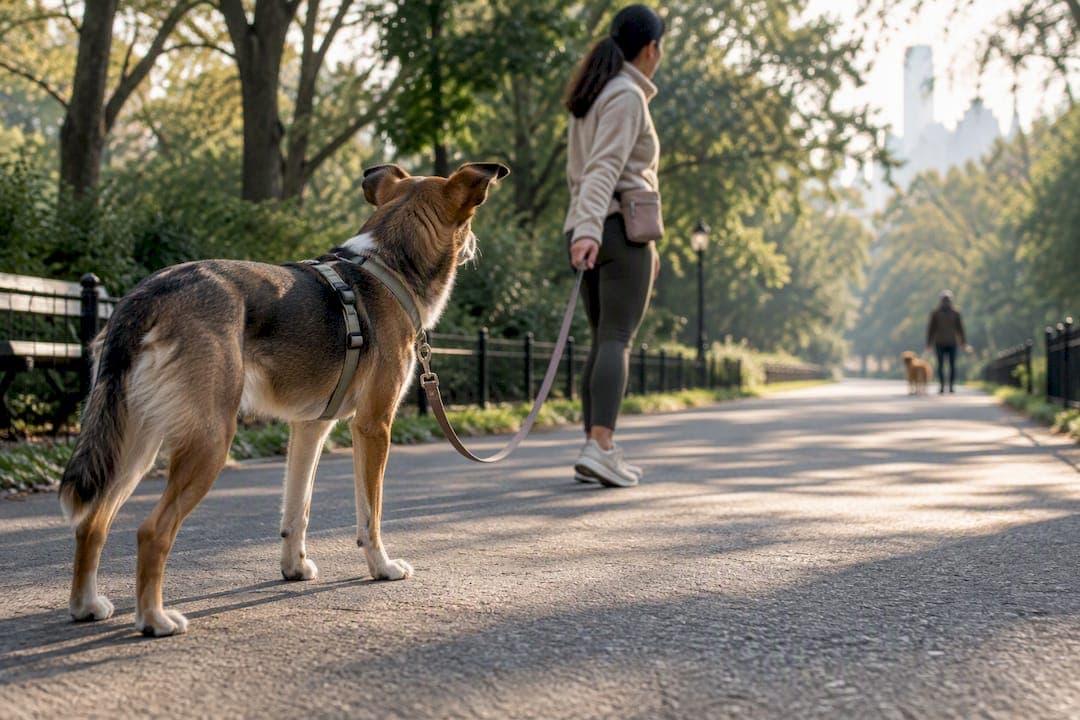
Leash reactivity is an exaggerated response, like barking, lunging, or freezing, that happens specifically because your dog is restrained. It does not mean your dog is aggressive. The fix works in two stages: manage distance and triggers now to stop the behavior from repeating, then retrain the underlying emotion with desensitization and counterconditioning over time.
TL;DR:
- Managing distance and triggers is essential for immediate reduction of reactive behaviors, requiring quieter routes, visual barriers, and early reaction cues.
- Equipment choices like front-clip harnesses, head halters, and muzzles help control reactivity without causing pain, while avoid using shock collars, prong collars, or physical punishment.
- Conducting veterinary exams is crucial when sudden or severe reactivity occurs, as medical issues like pain or sensory decline can be underlying causes.
- Consistent, gradual exposure starting in low-stress environments and accurate stress signal reading prevent escalation and improve long-term reactivity management.
Table of Contents
- What Does Leash Reactivity Look Like in Dogs?
- Why Is My Dog Reactive: Fear or Frustration?
- How Do You Stop a Dog From Reacting on Walks Right Now?
- How Do I Actually Train a Reactive Dog?
- Which Leash Reactivity Tools Actually Help?
- When Should You Call in a Professional?
- How City Animal Veterinary Center Supports Reactive Dogs
- Building Focus Before You Ever Face a Trigger
- Reading Stress Signals Before They Become a Blowup
- Tracking Whether Your Training Plan Is Actually Working
- Can You Prevent Leash Reactivity Before It Starts?
- The Advice That Gets Skipped, and What Actually Moves the Needle
- Sources
- FAQ
What Does Leash Reactivity Look Like in Dogs?
Reactive behavior on leash shows up in a handful of recognizable ways, and most owners have seen at least three of them on the same walk. Your dog might bark, lunge toward the trigger, pull hard against the leash, freeze in place, bounce frantically, or grab and chew the leash itself. According to Cornell University's College of Veterinary Medicine, a dog can be perfectly relaxed off leash and still react hard on leash, because restraint removes the option to approach or retreat freely.
Common triggers include:
- Other dogs, whether leashed or off-leash
- Unfamiliar people, especially those approaching directly
- Bikes, skateboards, and scooters
- Loud or fast-moving objects like delivery trucks
- Specific locations tied to a past bad experience
Trigger stacking happens when several stressors pile up in a short window, a jogger, then a dog, then a slammed car door. Your dog's stress crosses a line trainers call "threshold." Below threshold, your dog notices the trigger but can still take treats and think. Above it, you get the meltdown.
Why Is My Dog Reactive: Fear or Frustration?
Not all reactivity looks the same under the surface, and figuring out which type you're dealing with changes how you respond. A fear-based reactive dog wants distance. Watch for a lowered body, tucked tail, or a sideways retreat before the barking starts. This dog is trying to increase the space between itself and the trigger, and the leash is blocking that option.
A frustrated greeter is the opposite. This dog pulls toward the trigger, tail up, body loose, practically screaming to say hello. Cornell's research notes that the diagnostic question is simple: is your dog trying to create distance or close it? That single observation shapes your entire training plan.
The leash itself is part of the problem in both cases. It removes your dog's ability to choose distance, and that loss of control tends to raise arousal even in dogs that would handle the same encounter calmly off leash. There's also a physical layer worth ruling out. Pain from arthritis, dental disease, or an ear infection can lower a dog's tolerance for stress and make reactivity appear suddenly or worsen without warning. If your dog's reactivity came on fast or doesn't match their usual temperament, a veterinary exam belongs at the top of your list before you start any training plan.
How Do You Stop a Dog From Reacting on Walks Right Now?
Before you train anything, you manage the environment so your dog stops rehearsing the reactive behavior. Every repetition of lunging and barking reinforces the pattern, so your first job is prevention, not correction.
- Find your dog's threshold distance. This is the closest a trigger can get before your dog stops taking treats and starts reacting. Everything else depends on knowing this number.
- Choose quieter routes and off-peak times. A 6 a.m. walk in a side street beats a 5 p.m. loop past the dog park.
- Use visual barriers. Stepping behind a parked car, a hedge, or a building corner can drop your dog below threshold instantly.
- Turn early, not late. The moment you spot a trigger, cross the street, do a U-turn, or back up. Waiting until your dog notices is too late.
- Reward the retreat. Feed treats generously as you move away. You're not rewarding the reaction, you're rewarding calm movement in response to a trigger.
The AVSAB's guidance on managing fearful dogs is direct on this point: management protects the training process, but avoidance alone doesn't change how your dog feels about the trigger. You still need the next step.
Pro Tip: Carry treats your dog only gets on walks, something like boiled chicken or squeeze cheese. If your dog won't eat it near a trigger, you're too close. Back up until they will.
How Do I Actually Train a Reactive Dog?
Once management is solid, the real work is changing your dog's emotional response, not just controlling their body. This is where desensitization and counterconditioning come in, backed by AVSAB's protocol for leash reactivity.
- Build a rock-solid name response first, away from triggers. Practice in your living room and backyard until your dog spins toward you instantly, nine times out of ten, before you ever try it near a distraction.
- Introduce the trigger at a distance your dog tolerates. The instant your dog notices it, start feeding high-value treats continuously. The trigger predicts food, that's the whole mechanism.
- Stop before escalation. If your dog barks or lunges, you've moved too close. Increase distance immediately rather than pushing through.
- Layer in "Look at That" (LAT). Mark the moment your dog glances at the trigger calmly, then reward. This teaches your dog that noticing the trigger, not reacting to it, earns reinforcement.
- Add response substitution. Teach your dog to look at you, sit, and walk away as a single practiced sequence, so they have something else to do besides react.
- Track your success rate. Only move closer to a trigger once your dog gives eight out of ten calm, low-arousal responses at the current distance. That's the benchmark trainers use to avoid pushing too fast.
Keep sessions short, five to ten minutes, several times a week beats one long Saturday session. According to AVSAB's counterconditioning guidance, the food is delivered because the trigger appeared, not as a reward for a specific behavior. If your dog is already barking, you're already too close for the exercise to work.
Which Leash Reactivity Tools Actually Help?
Equipment choice matters more in leash reactivity work than in ordinary walking, because the wrong gear can add pain or pressure right at the moment your dog is already stressed. A front-clip harness gives you steering control without pressure on the throat. A head halter, introduced gradually, lets you redirect your dog's gaze away from a trigger. A properly fitted basket muzzle, used for safety during active behavior work, lets your dog pant, drink, and take treats while protecting everyone involved. Merck Veterinary Manual notes that muzzles and secure equipment reduce risk during training without signaling that the dog is a lost cause.
What to avoid entirely:
- Choke chains and prong collars
- Shock or e-collars
- Sharp leash jerks or "corrections"
- Shouting or physical punishment
- Flooding your dog with the trigger and hoping they "get over it"
According to the AVSAB's position statement on humane training, reward-based methods offer the most behavioral benefit with the least risk of harm, while aversive techniques are not recommended for behavior modification.
Keep the leash itself loose whenever possible. Tension travels down the line straight into your dog's body, and a tight leash can signal alarm even before a trigger appears. The Merck Veterinary Manual points out that confrontational handling tends to increase fear and aggression rather than reduce it.
When Should You Call in a Professional?
Some situations call for more than a training plan you run yourself. Watch for a sudden change in behavior, escalation toward biting or snapping, any sign your dog is in pain, or a lack of progress even when sessions stay well under threshold. Any of these deserves a veterinary visit before you continue training.
A vet exam rules out medical contributors, arthritis, thyroid imbalance, sensory decline, and can determine whether medication belongs in the plan. The Merck Veterinary Manual notes that medication doesn't replace training, but it can lower arousal enough that learning becomes possible again in dogs that are otherwise stuck.
For behavior work beyond what a general practice offers, look for a board-certified veterinary behaviorist (DACVB), a Certified Applied Animal Behaviorist (CAAB), or an experienced Certified Professional Dog Trainer (CPDT) with real reactive-dog casework. A solid professional plan typically includes a written trigger and threshold assessment, a desensitization schedule, and regular check-ins to adjust as your dog improves. If your dog's reactivity is tangled up with fear that looks close to aggression, this guide on safety-first plans for fear aggression walks through what that evaluation process looks like.
How City Animal Veterinary Center Supports Reactive Dogs
Getting a reactive dog into a clinic can be its own battle, waiting rooms full of other pets, bright lights, unfamiliar hands. City Animal Veterinary Center built its Fear Free approach around reducing exactly that kind of stress, so a behavior evaluation doesn't become another trigger event for your dog.
- Exam practices designed to lower stress from the moment you walk in
- Home visit options for dogs that struggle with car rides or clinic environments
- Behavior consultation support as part of a veterinary evaluation
- Clinic guides on muzzle training for calmer vet visits and cooperative care training you can start at home
If your dog's reactivity has a physical component or you're not sure where to start, scheduling a wellness exam is a reasonable first move, and it's one City Animal Veterinary Center makes as low stress as the visit allows.
Building Focus Before You Ever Face a Trigger
Skipping foundational work is the single most common reason leash reactivity training stalls. Your dog needs a handful of rock-solid behaviors built in a boring, trigger-free environment before those skills mean anything on a real walk.
Start with name response. Say your dog's name once in your kitchen and reward any head turn, then build to full eye contact. Repeat until your dog checks in almost automatically, no trigger required. Next comes an emergency U-turn: say a cue word, spin 180 degrees, and reward your dog for matching your pace without being dragged. Practice this on ordinary walks with zero triggers present, so it's already fluent when you need it under pressure.
A settle or "place" cue matters too. Teaching your dog to lie down and relax on a mat, then generalizing that to a park bench or a quiet sidewalk, gives them an off switch besides constant scanning for threats. Loose-leash walking itself deserves separate practice, reward your dog for walking near you with slack in the leash, completely apart from any reactivity work.
Layer these together only once each one is solid on its own. A dog with a strong name response, a reliable U-turn, and a working settle cue has three tools available the moment a trigger appears, instead of zero. Skipping this stage and jumping straight to trigger exposure is why so many owners feel stuck after weeks of effort.

Reading Stress Signals Before They Become a Blowup
Reactive episodes rarely come out of nowhere. Dogs telegraph rising stress well before they bark or lunge, and learning to read those signals lets you back off before a rehearsal happens instead of after.
Early stress signs include lip licking with no food around, yawning when your dog isn't tired, a tucked or low tail, whale eye (where the whites of the eyes show), and a body that stiffens or leans away. Panting that doesn't match the temperature or exertion level is another common tell. Catch any of these and you still have room to increase distance, redirect attention, or simply end the session.
Overload looks different and more urgent: your dog stops taking treats entirely, can't respond to a name they know cold, or shuts down and refuses to move. Some dogs get frantic instead, pulling in circles or redirecting onto the leash or even your hand. Any of these means the session is over for the day. Pushing through overload doesn't build resilience, it usually sets training back by teaching your dog that these walks are unpredictable and scary.
Video is genuinely useful here. Recording a few sessions on your phone lets you spot subtle stress signals in slow motion that you missed in real time, especially lip licks and body stiffening that happen in under a second.
Tracking Whether Your Training Plan Is Actually Working
Vague impressions like "he seems a little better" aren't enough to know if your plan is working or just coasting. Keep a simple log after every walk: the trigger type, the distance at first notice, and whether your dog stayed under threshold or reacted.
A basic notebook or phone note works fine. Record three things each session: distance to trigger, your dog's response (calm, alert, reactive), and how many reps you got in before ending. Over two to three weeks, patterns emerge. If your dog is holding steady at eight successful reps out of ten at a given distance, you've earned the right to close that distance slightly. If success rates are dropping, something changed, maybe a new environment, an off day, or a trigger stacking issue you hadn't noticed.
There's no fixed timeline that applies to every dog. According to the Merck Veterinary Manual, progress depends on the dog's history, health, and how consistently the plan gets followed, and improvement is typically gradual rather than sudden. A dog with years of rehearsed reactivity toward other dogs will likely need more time than a young dog reacting to bikes for the first time.
Adjust your plan when the data tells you to, not on a fixed schedule. If you're stuck at the same distance for three or four sessions in a row, that's a signal to either hold longer at the current level, break the environment down further, or bring in outside help rather than pushing forward and hoping for a breakthrough.

Can You Prevent Leash Reactivity Before It Starts?
Puppies and naturally sensitive dogs benefit enormously from early, deliberate exposure to the world, done right. The window for this kind of socialization is short, roughly the first three to four months of life, and how it's handled shapes a dog's baseline stress tolerance for years.
Expose puppies to a wide variety of sights, sounds, surfaces, and calm dogs and people, always at a pace the puppy can handle without shutting down or panicking. The goal is a puppy who notices something new and stays curious rather than scared, not one flooded with more than they can process. Pair every new experience with something good, treats, praise, play, so novelty starts to predict good things instead of uncertainty.
For naturally cautious or sensitive dogs, whether puppies or adults new to your home, keep early leash walks short and low pressure. Skip crowded parks and busy sidewalks for the first few weeks. Build loose-leash walking and name response in your yard or a quiet street before testing your dog in a busier environment. Reward calm observation of new things immediately, before any escalation, so your dog learns early that the leash is safe rather than restrictive.
Dogs with a history of poor early socialization, rescues with unknown backgrounds especially, benefit from treating every walk as gentle counterconditioning practice from day one rather than waiting for a reactive incident to start training.
The Advice That Gets Skipped, and What Actually Moves the Needle
Most articles on leash reactivity front load training technique and bury management, when it should be the other way around for a dog who's currently rehearsing the behavior daily. If your dog reacts on every walk, the fastest improvement usually comes from ruthless management first: shorter walks, quieter routes, more distance, fewer triggers. Training gains get erased fast if your dog is still practicing the old pattern five times a week.
The other place conventional advice falls short is treating reactivity as a training problem when it's sometimes a medical one. Pain and sensory decline get overlooked constantly, especially in older dogs whose reactivity gets chalked up to "just getting grumpier." A veterinary check costs you little time and can save months of training aimed at the wrong target.
If you take one thing from all of this, let it be sequencing: manage first, build foundational focus skills second, and only then work the trigger. Skipping straight to counterconditioning near a trigger without name response solid in a quiet room is the most common reason owners feel stuck after weeks of honest effort.
— CAVC
Sources
- Managing reactive behavior | Cornell University College of Veterinary Medicine
- Staying safe: management for fearful dogs — AVSAB
FAQ
How Do I Fix My Dog's Leash Reactivity?
Start by managing distance and triggers to stop the behavior from repeating, then use desensitization and counterconditioning to change how your dog feels about triggers. Pair the trigger, seen at a distance your dog tolerates, with high-value food, and increase closeness only as your dog's calm responses become reliable, per AVSAB's protocol.
How Do You Know if Your Dog Is Leash Reactive?
Look for barking, lunging, pulling, freezing, or frantic bouncing directed at specific triggers like other dogs, bikes, or strangers, specifically while your dog is on leash. Many reactive dogs are relaxed and social off leash, since restraint itself removes their ability to approach or retreat, which is often what triggers the reaction.
How Do I Get My Dog to Stop Reacting to Other Dogs on a Leash?
Keep your dog far enough from other dogs that they'll still take treats, that distance is their threshold, and reward calm attention at that range. Gradually close the distance only once your dog reliably responds calmly, and avoid corrections or leash jerks, which can worsen the fear or frustration driving the reaction.
Can Reactivity Be Trained Out of a Dog?
Reactivity typically improves with consistent management and reward-based training, but there's no guaranteed timeline or complete "cure" for every dog. Progress depends on the dog's history, health, and consistency of training, and some dogs benefit from a veterinary evaluation or a certified behavior professional alongside training at home.