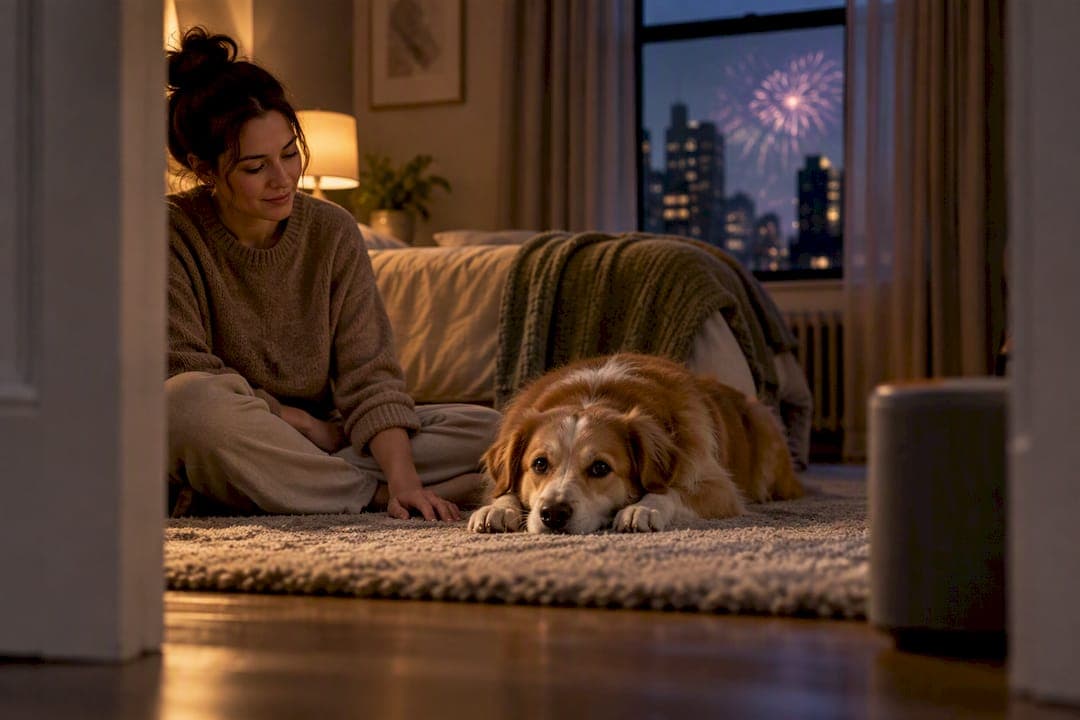
Noise phobia, sometimes called noise aversion, is a diagnosable anxiety disorder in dogs that responds best to counterconditioning paired with safety planning and, when necessary, medication prescribed by a veterinarian, such as the newly FDA-approved tasipimidine (brand name Tessie). Tessie requires a prescription and works best given about an hour before a predicted noise event. If your dog shows panic, self-injury, or destructive escape attempts during storms or fireworks, start behavior modification now and talk to your veterinarian, or a clinic like City Animal Veterinary Center, about whether medication belongs in the plan.
TL;DR:
- Medication like Tessie is most effective when given about an hour before a noise event and can be redosed up to three times within 24 hours.
- Dogs with severe or escalating panic behaviors such as self-injury or escape attempts require immediate veterinary attention and possible medication.
- Early behavior modification, including desensitization and environmental management, significantly improves long-term coping for noise-phobic dogs.
- Breed, limited early exposure to sounds, and traumatic experiences increase the likelihood of developing noise phobia, while underlying health issues may lower the threshold.
- Accurate diagnosis and treatment require veterinary assessment, documentation of episodes, and exclusion of medical conditions such as ear infections or pain.
Table of Contents
- What noise phobia (noise aversion) actually means
- Why some dogs develop noise phobia and others don't
- Recognizing mild worry versus dangerous panic
- When to involve your veterinarian or a behavior specialist
- Evidence-based treatments: behavior work, environment, and medication
- A step-by-step plan for storms, fireworks, and other noise events
- How City Animal Veterinary Center supports anxious dogs
- What a realistic long-term outlook looks like
- Getting help: services that support a noise phobia treatment plan
- Where to read the original research and guidance
- Sources
- FAQ
What noise phobia (noise aversion) actually means
Noise aversion describes a dog's fearful, avoidant, or panicked response to sounds that pose no real threat: thunder, fireworks, gunshots, vacuum cleaners, or even a slammed door. Veterinary behaviorists distinguish ordinary caution from true phobia by intensity, duration, and how much the reaction disrupts normal function. A dog with mild noise sensitivity might pace or seek a person during a storm, which can be distressing for children fearful of dogs and is addressed in detail in Why Is My Kid Scared of Dogs? A Parent's Guide. A dog with full-blown phobia may claw through drywall, break through a window screen, or shut down entirely.
- Common triggers include thunderstorms, fireworks, gunshots, construction noise, and household appliances.
- Reactions exist on a spectrum from mild wariness to panic-driven destructive or self-injurious behavior.
- Some dogs generalize fear to related cues, such as darkening skies or dropping barometric pressure before a storm.
Why some dogs develop noise phobia and others don't
Genetics plays a real role: herding breeds and certain working lines show higher rates of sound sensitivity, likely tied to heightened startle reflexes bred for alertness. Puppies that miss adequate exposure to varied sounds during their early socialization window often grow into adults who react fearfully to anything unfamiliar. A single traumatic event, being caught outside during a violent thunderstorm, for instance, can imprint a lasting fear after just one exposure. Repeated unpredictable exposure without any coping strategy compounds the problem over time.
- Breed tendencies and individual temperament shape baseline sound sensitivity.
- Limited exposure to diverse noises before about four months of age raises risk.
- A single frightening event can trigger lasting phobia, especially in sensitive dogs.
- Pain, hearing changes, or neurologic issues can lower a dog's threshold for fear responses.
Behavior modification and training plans for noise aversion are complicated by comorbid conditions and unpredictable stimuli, according to the IAABC Foundation Journal, which is why a veterinary checkup that rules out pain or ear disease matters before assuming a case is purely behavioral.
Recognizing mild worry versus dangerous panic
Reading your dog's body language early prevents a manageable fear from escalating into a crisis. Most owners can spot obvious trembling or hiding, but subtler signals often get missed until the dog is already in distress.
- Watch for panting, pacing, drooling, or lip licking that appears out of context with activity level.
- Note lowered body posture, tucked tail, flattened ears, or whale eye (showing the whites of the eyes).
- Look for clinginess or, conversely, attempts to hide in bathrooms, closets, or under furniture.
- Treat destructive scratching at doors and windows as a warning sign of escalating panic, not disobedience.
- Consider attempts to escape a yard or crate, drooling to the point of soaking fur, or self-inflicted injury as emergencies requiring same-day veterinary attention.
Many owners interpret early signs, a yawn, a paw lift, a sudden need to be near a person, as unrelated quirks rather than the first stage of fear. Video review with a veterinarian or behaviorist often reveals patterns owners missed in real time, which is part of why documenting episodes matters for accurate diagnosis.
When to involve your veterinarian or a behavior specialist
A veterinary visit for noise phobia typically starts with a detailed history: when the fear began, which sounds trigger it, and how the dog behaves during and after an episode. Bringing video of an actual episode gives the veterinarian far more useful information than a verbal description alone. Part of the workup includes ruling out physical contributors such as ear infections, arthritis pain, or age-related cognitive decline, since these can lower a dog's tolerance for stress generally.
- Share a timeline of triggers, frequency, and severity, ideally with dated notes or video.
- Expect your veterinarian to check for pain, hearing changes, or other medical contributors.
- Medication becomes appropriate when the dog risks self-injury, the fear is severe, or a behavior-only plan has already failed to help.
- For complex or treatment-resistant cases, your veterinarian may refer you to a board-certified veterinary behaviorist (ACVB diplomate) or a certified applied animal behaviorist (CAAB).
Pro Tip: Start a simple log now, noting the date, trigger, and what your dog did during each episode, so you walk into the appointment with real data instead of trying to recall details under stress.
Evidence-based treatments: behavior work, environment, and medication
Counterconditioning and desensitization (CC/DS) is the most effective long-term behavioral strategy for noise aversion, though it takes real time and consistency to work. The process pairs a very low-volume recording of the trigger sound with something the dog loves, gradually raising volume only as the dog stays relaxed. Most plans run over weeks to months, not days, and progress rarely moves in a straight line.

Environmental management supports the behavioral work. A safe room away from windows, white noise or music to mask outside sound, and removing access to windows or doors a panicked dog might damage all reduce the intensity of a bad episode. Predictable daily routines and mat relaxation exercises, teaching a dog to settle on a specific mat on cue, give dogs a sense of control that complements formal CC/DS work.
For dogs whose fear is severe or who cannot settle during a specific event, medication is a legitimate part of the plan rather than a last resort. Historic options include situational medications like trazodone, discussed in more detail in our guide to trazodone for dogs. The newer option is tasipimidine (Tessie), the first FDA-approved drug labeled specifically for noise aversion and separation anxiety in dogs.
- Tessie is typically given about one hour before a predicted noise event, on an empty stomach for reliable absorption.
- It can be redosed up to three times in 24 hours, with at least three hours between doses.
- Reported adverse effects include vomiting and lethargy, along with decreased alertness that owners should monitor.
Pivotal field studies supporting Tessie's approval showed a statistically significant improvement at the 30 mcg/kg dose compared to control, according to the FOI summary for NADA 141-627, which is the kind of controlled evidence that separates an approved medication from an unproven supplement.
A step-by-step plan for storms, fireworks, and other noise events
Preparation before a known event, and calm handling during one, both change the outcome.
- Weeks ahead: begin low-volume recordings of the trigger sound paired with treats or play, and reinforce mat relaxation daily.
- Days ahead: set up the safe room, test white noise or a fan, and confirm any prescribed medication is on hand.
- Night of the event: give medication like Tessie about one hour before the predicted noise if your veterinarian has prescribed it, then settle your dog in the prepared safe space.
- During the event: supervise quietly, offer calm reassurance or a chew if your dog will accept it, and never punish fear responses.
- If panic escalates: prioritize physical safety, block access to windows and exits, and call an emergency veterinary line if your dog shows signs of self-injury or cannot be calmed.
- After the event: log what happened, note what helped or didn't, and share that record at your next veterinary or behavior follow-up.
Pro Tip: Comforting a frightened dog does not reinforce the fear. Calm, measured attention can actually help lower a dog's sympathetic arousal during a panic episode, so don't withhold comfort out of concern you'll make things worse.
How City Animal Veterinary Center supports anxious dogs
Veterinary centers using a Fear Free approach aim to lower stress at every step of a visit, which matters for dogs whose noise phobia has made them generally more anxious around unfamiliar environments and handling. For dogs who find travel itself distressing, home visit and house call services can bring the exam, diagnostics, and medication discussion into a familiar space instead.
- Fear Free techniques include mat relaxation, gentle handling, and muzzle training done at the dog's pace, detailed further in our muzzle training guide.
- House calls remove the added stress of car rides and waiting rooms for dogs already prone to panic.
- Behavior management plans can be coordinated alongside pharmacy support to ensure prescriptions like event-dose medications are dispensed with clear instructions.
- Related reading on visit-specific anxiety is available in our guide to reducing vet visit stress.
What a realistic long-term outlook looks like
Full elimination of noise phobia is uncommon, and that's worth knowing going in so you don't measure success by the wrong standard. The realistic goal is a dog who copes better: shorter episodes, faster recovery, and less risk of injury or property damage. Dogs whose owners start behavior work early and stay consistent tend to do better than those who wait until the fear is severe. A veterinary and behavior team working together, rather than medication or training alone, gives most dogs the best shot at meaningful improvement.
— CAVC
Getting help: services that support a noise phobia treatment plan
You don't have to build a noise phobia plan alone. City Animal Veterinary Center offers behavior management consultations, wellness exams that rule out medical contributors, and a pharmacy that can dispense prescribed medications like event-dose options when appropriate for your dog. For dogs whose anxiety makes travel especially hard, our home visit and house call services bring the evaluation to your dog's own environment instead.
Before you book, put together a short video of a recent episode and a rough timeline of when the fear started and what triggers it, since that information speeds up diagnosis. From there, our team can talk through whether behavior modification alone fits your dog or whether medication should be part of the plan. You can also explore our full range of services, including behavior management, or schedule a wellness exam as a starting point. If home comfort matters more right now, learn about our house call services and how they work for anxious dogs.
Where to read the original research and guidance
For owners who want to go straight to the source material:
- The FDA's approval announcement for tasipimidine (Tessie) explains the drug's approved use and dosing limits.
- The FOI summary for NADA 141-627 details the pivotal field study results.
- The IAABC Foundation Journal and AAHA's noise aversion guidance cover behavior modification and practical owner steps in depth.
Sources
- FDA — FDA approves first drug to treat noise aversion and separation anxiety in dogs
- FOI summary — NADA 141-627 (Tessie) approval documentation
- PMC — review/discussion of counterconditioning and behavioral methods
- IAABC Foundation Journal — Bang! Boom! Developing training plans for dogs with noise aversion
FAQ
How do I help a dog with noise phobia?
Start with counterconditioning and desensitization, pairing low-volume recordings of the trigger sound with treats, while also setting up a safe room and predictable routine. For dogs with severe or worsening fear, ask your veterinarian about medications such as tasipimidine, which is given about an hour before a predicted event.
Is phonophobia in dogs a real, diagnosable condition?
Yes. Veterinary behaviorists and professional bodies including AAHA recognize noise aversion, sometimes described as phonophobia, as a legitimate anxiety disorder with identifiable signs, triggers, and treatment protocols rather than simple disobedience or quirky behavior.
What are the signs of extreme anxiety in dogs?
Extreme anxiety includes panting, drooling, pacing, hiding, and trembling that escalates into destructive scratching, attempts to escape confinement, or self-inflicted injury. Any dog showing escape attempts or self-injury during a noise event needs same-day veterinary attention.
Why do loud noises startle some dogs so much more than others?
Genetics, limited exposure to varied sounds as a puppy, past traumatic experiences, and underlying pain or hearing changes all lower a dog's threshold for a startle response. A veterinary exam helps rule out medical contributors before assuming the reaction is purely behavioral.
What should I know about giving Tessie (tasipimidine) to my dog?
Tessie is a prescription oral solution typically given about one hour before a predicted noise event, and it can be redosed up to three times in 24 hours with at least three hours between doses. Common side effects include vomiting and lethargy, so your veterinarian will walk you through dosing and monitoring before you use it.