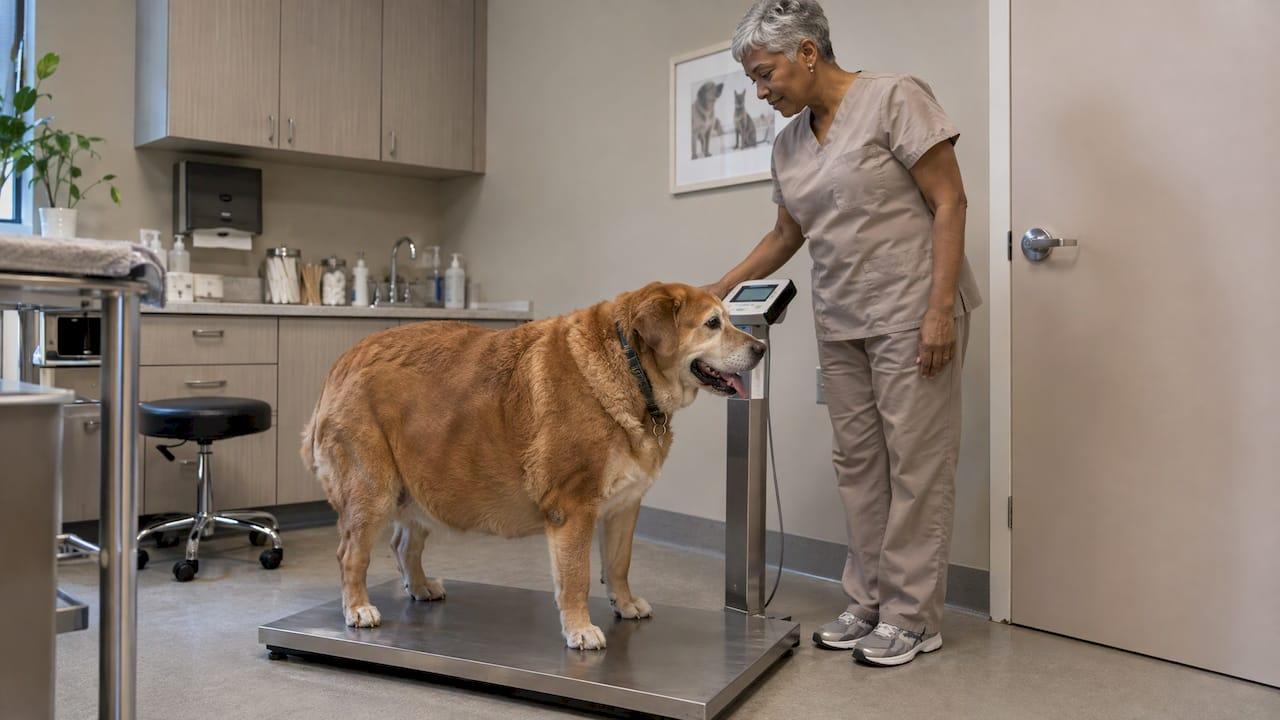
Extra weight is one of the most common and most preventable health problems in pets. In dogs and cats it is linked to diabetes, arthritis and joint pain, breathing and heart strain, skin disease, kidney problems, some cancers and a shorter life. The good news is that a few pounds are easier to deal with early, and a veterinarian can build a plan that fits your pet. This guide explains each risk, how to tell whether your dog or cat is carrying too much, and what to do next.
TL;DR
- Overweight pets face a higher risk of diabetes, osteoarthritis, respiratory and heart strain, skin disease, kidney disease and some cancers.
- In a large study of neutered dogs, overweight dogs had a higher risk of death at every age studied, and a shorter median lifespan in every breed examined.
- Overweight cats are about five times as likely as lean cats to develop lameness that needs veterinary attention, and obese cats are 2 to 4 times more likely to develop diabetes.
- A 9-point body condition score, checked at every visit, is the most reliable way to catch weight gain early.
- Weight loss should be gradual and directed by your veterinarian. Crash diets can seriously harm cats.
Table of Contents
- How common is pet obesity?
- The main health risks of an overweight pet
- Overweight cat health risks in practice
- What obesity does to dogs' lifespan
- How to tell if your pet is overweight
- Why pets gain weight
- Preventing obesity and losing weight safely
- Help with your pet's weight in Brooklyn
- FAQ
- Sources
How common is pet obesity?
More common than most owners expect. In 2022, 59% of dogs and 61% of cats evaluated by U.S. veterinary professionals were classified as overweight or obese. That means a pet at a healthy weight is now the minority in many exam rooms.
Cats are a good example of how early it starts. A 2025 U.S. study of roughly 4.9 million dogs and 1.3 million cats found that overweight prevalence was 47.2% in adult cats and 44.8% in mature cats, and 21.7% of mature cats were obese. Because the condition is so widespread, owners often stop noticing it. A round dog or cat starts to look normal, especially when the neighbors' pets look the same.
The main health risks of an overweight pet
U.S. veterinary guidelines link excess weight with reduced longevity and quality of life, chronic inflammation, skin and respiratory disorders, renal dysfunction, metabolic and endocrine disorders such as diabetes, orthopedic disease and some types of cancer. Here is how those risks show up at home.
| Risk | What you may notice at home |
|---|---|
| Diabetes | More drinking and urinating, weight changes despite a good appetite, lethargy |
| Osteoarthritis and joint pain | Stiffness after rest, reluctance to jump or climb stairs, slower walks |
| Breathing and heart strain | Panting after mild activity, noisy breathing, tiring quickly |
| Skin disease | Itching, skin folds that stay irritated, trouble grooming |
| Kidney and urinary problems | Changes in urination, straining, accidents |
| Reduced lifespan | Often no single sign, which is why routine weight checks matter |
These signs can have many causes. If you notice any of them, book an exam rather than assuming it is weight alone.
Diabetes and insulin resistance
Extra body fat makes the body respond less well to insulin. A 2024 review reports that obese cats are 2 to 4 times more likely to develop diabetes, and that in one cited study each extra kilogram was associated with a 30% drop in insulin sensitivity. In another study of 16 cats, controlled weight gain was associated with a 52% decrease in insulin sensitivity.
Obesity can also make diabetes harder to control. According to Tufts veterinary guidance, weight loss may sometimes produce diabetes remission and reduce insulin dependence in cats. That is a strong reason to act before a diagnosis, and a reason to stay hopeful after one.
Joint disease and mobility
Every extra pound is carried by the joints on every step. In dogs, obesity is associated with osteoarthritis, renal disease, skin disease, insulin resistance and neoplasia, while in cats it is associated with dermatological disease, diabetes mellitus, neoplasia and urolithiasis (urinary stones).

The mobility effect is easy to see in cats. Tufts reports that overweight cats are almost five times as likely as lean cats to develop lameness requiring veterinary attention, and that weight loss reduces joint stress in overweight cats with osteoarthritis. Many cats hide pain well, so "he just sleeps more now" is worth raising with your vet.
Breathing, heart and surgical risk
Fat around the chest and abdomen makes breathing harder, and the heart works harder to supply a larger body. Weight loss in obese dogs with osteoarthritis has been reported to improve respiratory function, insulin sensitivity, metabolic abnormalities and mobility. Extra weight also complicates anesthesia and surgery, which matters for dental procedures, spays and neuters and later-life care. If your pet is older, our guide to senior pet anesthesia explains what a careful plan looks like.
Overweight cat health risks in practice
Cats deserve their own section because their risks differ from dogs' in two ways. First, diabetes is a major concern, as covered above. Second, cats can become seriously ill when they lose weight the wrong way.
Cornell's feline health center notes that in cats, excess weight can impair activity and quality of life and aggravate osteoarthritis, hip dysplasia, diabetes mellitus and cardiovascular strain. The same source warns that sudden starvation diets risk hepatic lipidosis, a dangerous liver condition, and that weight loss should be veterinarian-directed and gradual. Never cut a cat's food sharply on your own.
An overweight cat may also struggle to groom, especially along the back and base of the tail. You may see matting, dandruff or irritated skin in places the cat can no longer reach.

What obesity does to dogs' lifespan
The strongest evidence on longevity comes from dogs. A peer-reviewed study of neutered client-owned dogs found a higher mortality risk at every studied age in overweight dogs, with hazard ratios ranging from 1.35 in German Shepherds to 2.86 in Yorkshire Terriers. Median lifespan was shorter in every breed examined.
Honest framing matters here. The same body of research shows that weight loss improves mobility, breathing and insulin sensitivity, though no published studies had yet shown that weight loss prevents disease or lengthens life. What we can say with confidence is that a leaner pet moves more easily and feels better, and those are reasons enough to start.
How to tell if your pet is overweight
The scale helps, but body shape tells you more. Veterinarians use a 9-point body condition score, where 4 or 5 is ideal. AAHA recommends using this validated scale, and notes that each point above 5 corresponds to roughly 10% overweight, with each step representing about a 5% increase in body fat. For cats, Cornell states that a score above 6.5 to 7 indicates overweight and 8 or higher indicates severe overweight or obesity.
A quick check you can do at home:
- Feel the ribs. Run your hands along the sides of the chest. You should feel ribs under a thin layer of padding without pressing hard.
- Look from above. A healthy pet has a visible waist behind the ribs. A straight or bulging outline suggests extra weight.
- Look from the side. The belly should tuck up toward the hind legs. A hanging belly pad in a cat is not always fat, but a sagging, swinging one deserves a vet's opinion.
- Watch behavior. Less play, more napping, panting on short walks or hesitating at stairs can all point to weight or to pain.
Because the score also looks at muscle, a vet can tell whether a pet is truly heavy or simply big-boned and muscular. That is the reason to have it checked in the exam room rather than guessing.
Why pets gain weight
Weight gain rarely has one cause. Research on cats lists breed, sex, age, neutering, genetics, diet type and amount, feeding frequency, sedentary indoor living and limited environmental enrichment as factors. Neutering may raise appetite and lower energy needs, so portions often need adjusting after surgery.
Food type matters too. The same review summarizes research finding that predominantly dry-fed cats had up to 2.4 times the risk of overweight compared with predominantly wet-fed cats. For city pets, there is also the lifestyle piece: apartment living, shorter walks on busy days and a lot of treats given out of love or guilt. None of that is a failing. It is simply how modern pets live, and it can be adjusted.
Medical causes exist as well. Some endocrine conditions and medications can change weight, which is another reason a veterinary exam comes before any diet change.
Our perspective at City Animal
We see weight creeping up in the exam room every week, and the conversation is almost always the same. Owners feel guilty, and pets feel the effects. Our approach is to take the guilt out of it and put a plan in.
A weight discussion works best when the pet is relaxed. A frightened dog or cat is hard to examine, hard to weigh and hard to read. That is why we practice Fear Free care: calmer visits mean more accurate body condition scoring, better conversations with you and a pet who does not dread coming back for weigh-ins.
Weight also rarely travels alone. A stiff hip, a skin problem or a change in thirst can be both a cause and a consequence, so we look at the whole animal. Our in-house laboratory and diagnostic imaging let us check for underlying conditions during the same visit, and our holistic options, including acupuncture and pain management, can help a pet who hurts move enough to lose weight comfortably.
For owners who find travel stressful for the pet or difficult for themselves, our home visits let us see the real feeding setup: the bowls, the treat jar, the couch. That context shapes a plan that works in your home, not just on paper.
CAVC
Preventing obesity and losing weight safely
Start with screening at every visit
AAHA guidance calls for a veterinarian to screen nutritional history, environment, activity, body weight, body condition score and muscle condition score at every visit, followed by a physical exam. Regular wellness exams are where small changes get caught, and our preventative care program is built around that routine.
Begin early
Prevention starts in kittenhood and puppyhood. In that 2025 U.S. study, cats recorded as overweight or obese during growth had 1.52 times the odds of being overweight or obese in adulthood. Measuring meals from the first month and keeping treats small sets the pattern for life.
Rule out medical causes first
Before a diet plan, your vet may recommend bloodwork or imaging to check for thyroid, kidney, joint or other problems that affect how much exercise and which diet is safe. Our in-house laboratory and diagnostic imaging make that part quick. If imaging is on the list, our pet X-ray safety guide explains how images are taken without owners having to hold their pets.
Follow a structured plan
Structure works. A 2017 PLOS One study found that 896 of 926 overweight dogs, or 97%, lost weight under a structured weight-loss plan, with a mean loss of 11.4%. Activity and quality-of-life scores improved while food-seeking behavior declined. In other words, dogs on a plan were not only lighter but happier.
A good plan usually includes:
- A target weight set by your veterinarian.
- Measured portions, using a scale or measuring cup rather than eyeballing.
- A diet chosen for your pet's needs, with treats counted as part of the daily allowance.
- Safe, gradual increases in activity: short extra walks for dogs, play sessions and puzzle feeders for cats.
- Rechecks every few weeks so the plan can be adjusted.
For dogs, our guide to vet-backed dog weight management walks through a checklist you can use at home.
Do not wait for severe obesity
A 2023 peer-reviewed study found worse outcomes in pets with class II obesity, defined as more than 40% overweight: fewer dogs completed programs, dogs lost weight more slowly and lost more lean tissue, and cats took longer and also lost more lean tissue. The takeaway is encouraging rather than scary: the earlier you begin, the smoother the process tends to be.
Keep older pets in the plan
Senior pets often gain weight as activity falls, and arthritis can make exercise uncomfortable. Our senior dog wellness exam guide covers what to expect, and pain management can open the door to the gentle movement that helps weight come off.
Help with your pet's weight in Brooklyn
At City Animal Veterinary Center, we offer nutritional counseling, wellness exams, in-house lab work, diagnostic imaging, pain management, acupuncture and dermatology under one roof, all delivered with Fear Free techniques designed to keep pets calm. If your dog or cat is anxious in the car or at the clinic, or if your schedule is tight, we also offer home visits in Brooklyn and the surrounding area.

To start, book a wellness exam and ask us for a body condition score. We will explain what it means for your pet and map out the next steps together.
FAQ
Is my pet's weight a real health risk or just cosmetic?
It is a real health issue. Excess weight is associated with diabetes, osteoarthritis, respiratory and heart strain, skin and kidney disease, some cancers and reduced longevity. Even modest extra weight puts steady stress on joints, so it is worth addressing early.
How do I know if my cat is overweight?
Ask your vet for a 9-point body condition score. For cats, a score above about 6.5 to 7 indicates overweight, and 8 or higher indicates obesity. At home, you should be able to feel the ribs easily and see a waist from above.
Can I put my overweight cat on a strict diet?
Not without veterinary guidance. Sudden, sharp food restriction can cause hepatic lipidosis, a serious liver condition in cats. Your veterinarian will set a gradual, monitored plan with a target weight and regular rechecks.
Can weight loss help a pet that already has diabetes or arthritis?
It can help. Weight loss has been reported to improve mobility and insulin sensitivity, and in some cats diabetes may go into remission. Your vet will tailor the plan to your pet's condition and medications.
Can a vet help if my pet hates coming to the clinic?
Yes. Fear Free techniques make exams and weigh-ins calmer for anxious pets, and in-home visits let us assess your pet in a familiar space. Contact us to see which option suits your pet.
Sources
- 2022 U.S. State of Pet Obesity Report, Association for Pet Obesity Prevention
- Overweight and obese body condition in about 4.9 million dogs and 1.3 million cats (2025 U.S. study)
- 2014 AAHA Weight Management Guidelines for Dogs and Cats
- Overweight and obesity in domestic cats: epidemiological features
- How does being overweight affect my cat? Cummings School, Tufts
- Canine and feline obesity: a review of pathophysiology
- Obesity, Cornell Feline Health Center
- Association between life span and body condition in neutered client-owned dogs
- Weight management in obese pets: the tailoring concept
- Screening Evaluation, 2021 AAHA Nutrition and Weight Management Guidelines
- Success of a weight loss plan for overweight dogs, PLOS One
- Weight loss outcomes are generally worse for dogs and cats with class II obesity