
Yes, ticks live in New York City, and locally acquired tick-borne disease cases happen here every year, not just somewhere upstate. Most infected New Yorkers picked up their tick during travel outside the five boroughs, but NYC DOH confirms local transmission does occur, concentrated on Staten Island and, less commonly, in parts of the North Bronx.
The city logged roughly 2,928 Lyme disease cases in 2025, along with 107 anaplasmosis cases and 98 babesiosis cases. That's not a reason to avoid Prospect Park or Pelham Bay. It's a reason to build a five-minute habit into your outdoor routine.
Here's what to do the moment you come inside from a park, garden, or trail:
- Check your body, especially warm, hidden spots like the scalp, behind the ears, armpits, groin, and behind the knees.
- Check your dog or cat too, running your fingers slowly through fur along the back, ears, and belly.
- Remove any attached tick immediately with fine-tipped tweezers. Don't wait until morning.
- Shower within two hours. It physically washes off ticks that haven't attached yet.
- Watch for fever, fatigue, or a spreading rash over the following days, and call a clinician if anything shows up.
Staten Island carries most of the city's documented local tick activity, largely because of its wooded parkland and deer population, with smaller pockets of concern in the northern Bronx near Pelham Bay Park and Van Cortlandt Park. For deeper guidance, both NYC DOH's tick resources and the CDC's prevention page are worth bookmarking before your next hike or dog walk.
Key Takeaways
Ticks are established in New York City, with locally acquired disease cases concentrated on Staten Island and parts of the North Bronx, making prompt checks and removal the single most effective defense.
| Point | Details |
|---|---|
| Ticks are present citywide | Locally acquired cases cluster on Staten Island and in parts of the North Bronx, though most cases involve travel outside NYC. |
| Check and remove fast | Full-body checks, prompt tweezer removal, and a shower within two hours cut disease risk substantially. |
| Layer your prevention | EPA-registered repellents on skin plus permethrin-treated clothing outperform either measure used alone. |
| Protect pets with vet guidance | Monthly spot-ons, oral preventatives, or vet-recommended collars work better than home remedies. |
| Know the warning signs | Fever, rash, or flu-like symptoms after a bite warrant a call to a clinician, not a wait-and-see approach. |
| Get a pet-specific plan | City Animal Veterinary Center offers house calls and Fear Free consultations to build a tick-prevention plan around your pet. |
Table of Contents
- Which Tick Species Live in NYC and What They Carry
- When Are Ticks Active in NYC, and Is the Season Getting Longer?
- Where in the City You're Actually Likely to Pick Up a Tick
- How to Actually Prevent Tick Bites in NYC
- How to Check for Ticks and What to Do With Your Clothes
- How to Remove a Tick Safely
- Can You Get a Tick Tested or Report a Bite in NYC?
- Protecting Your Pets from Ticks in NYC
- Reducing Ticks Around Your Home or Yard
- When a Tick Bite Should Send You to a Doctor
- What This City Actually Gets Wrong About Tick Risk
- How City Animal Veterinary Center Supports Tick Prevention for NYC Pets
- Where to Go for More Official Guidance
- Frequently Asked Questions
- Sources
Which Tick Species Live in NYC and What They Carry
Five tick species show up in and around New York City, and they don't carry the same risks. Knowing which one bit you (or which ones live near your usual dog-walking route) changes what symptoms to watch for.
The blacklegged tick (commonly called the deer tick) is the one to worry about most. It transmits Lyme disease, anaplasmosis, and babesiosis, and it's the species NYC DOH has documented most consistently on Staten Island and in pockets of the Bronx. The lone star tick, easy to spot by the white dot on the female's back, spreads ehrlichiosis and has also been linked to alpha-gal syndrome, a red meat allergy that develops after repeated bites. The American dog tick carries Rocky Mountain spotted fever, though cases tied to NYC exposure are rare. The Gulf Coast tick and the more recently arrived Asian longhorned tick round out the list, the latter notable mainly because it reproduces without mating, allowing populations to explode quickly once established.
| Species | Primary diseases | NYC borough presence |
|---|---|---|
| Blacklegged (deer) tick | Lyme, anaplasmosis, babesiosis | Staten Island, parts of the Bronx |
| Lone star tick | Ehrlichiosis, alpha-gal syndrome | Staten Island, Bronx, Queens |
| American dog tick | Rocky Mountain spotted fever | Citywide, low density |
| Gulf Coast tick | Rickettsial spotted fever | Staten Island (limited) |
| Asian longhorned tick | Still under study in the U.S. | Staten Island, expanding |
That range of species is exactly why NYC DOH recommends EPA-registered repellents and routine checks regardless of which park or trail you're on. You won't identify the species before it bites.
When Are Ticks Active in NYC, and Is the Season Getting Longer?
Ticks are most active from spring through fall in New York City, but the window keeps stretching. Nymphal ticks, the immature stage about the size of a poppy seed, peak from May through July and cause a disproportionate share of Lyme infections because they're nearly impossible to spot before they've been attached for hours. Adult ticks become active again in October and can stay out questing on any day the temperature climbs above freezing.
Warmer winters mean fewer hard freezes to knock back tick populations, and research on tick seasonality shows activity periods lengthening across the Northeast as a result. Mice and white-tailed deer, both common in Staten Island's wooded parks, act as the reservoir hosts that keep the tick life cycle going year after year. More green space use, more dog walking near brush, more community gardening: all of it adds contact points between people and ticks in a city that often gets underestimated as a tick habitat.
The 2,928 Lyme cases reported in 2025 reflect that longer exposure window as much as anything else.
Pro Tip: Late May through July is when nymphal ticks peak, and they're the hardest stage to see. That's the stretch to be strictest about checks, even if the weather doesn't feel like "tick season" yet.
Where in the City You're Actually Likely to Pick Up a Tick
Ticks don't wait in open lawns. They cling to grass blades and leaf edges in shady, humid microhabitats: leaf litter, tall grass, brushy borders, and the transition zones where a mowed lawn meets untended woods. In New York City, that means the edges of wooded sections in larger parks, community garden borders, and the overgrown margins along fences and tree lines in smaller neighborhood parks.
A dog walk that skirts the tree line at Pelham Bay Park, an afternoon pulling weeds at a community garden plot, or letting kids play near a shrub border in a Staten Island backyard are all ordinary NYC moments that carry real tick exposure. You don't need a weekend camping trip to pick one up.
Certain activities should automatically trigger a body check afterward:
- Hiking or walking dog-friendly trails near wooded edges
- Gardening or yard work near brush or leaf piles
- Sitting or lying directly on grass or ground cover
- Walking a dog along overgrown park borders
Even a few minutes in the wrong patch of grass is enough. That's exactly why clothing choices and repellent use, covered next, matter more than most people assume.
How to Actually Prevent Tick Bites in NYC
Repellent, clothing, and trail behavior form the three-part defense that works, in that order of impact. Skip one and the other two carry more weight, but all three together cut your risk the most.
- Use an EPA-registered repellent on skin: DEET, picaridin, or IR3535 are the three NYC DOH and CDC recommend, and all three have solid safety records when used per label.
- Treat clothing and gear (not skin) with permethrin, or buy pre-treated clothing. Permethrin kills ticks on contact and remains effective through multiple washes.
- Wear light-colored clothing so ticks are easier to spot, with long sleeves and pants tucked into socks.
- Stay toward the center of trails and avoid pushing through tall grass or brush, even to shortcut a path.
- Supervise kids and pets closely near brushy edges. Ticks don't jump or fly. They wait on vegetation and grab on when something brushes past.
One safety note: permethrin is for fabric and gear only. It should never go directly on skin, and pet owners need to check that any tick product is species-appropriate. Permethrin-based treatments that are safe for dogs can be dangerous for cats, so confirm compatibility before treating a multi-pet household's gear or bedding.
How to Check for Ticks and What to Do With Your Clothes
The routine is simple: shower within two hours, do a full-body check, check your pets and gear, and tumble-dry clothes on high for 10 minutes. That single sequence, backed by CDC guidance, catches the majority of ticks before they've had a chance to attach or transmit anything.

For the body check itself, focus on the spots ticks prefer: the scalp and hairline, behind the ears, armpits, the groin, behind the knees, around the waistline, and between the toes. These are warm, moist, and easy to miss without deliberately looking, which is why a mirror or a second pair of hands helps.
Clothing needs heat, not just a wash cycle. A cold or warm wash won't reliably kill a tick riding in a fold of fabric, but 10 minutes in a hot dryer will. If clothes are already wet from rain or sweat, add extra drying time before assuming they're tick-free.
If you want a tick identified later, save it. Seal it in a small container or zip-top bag with a bit of rubbing alcohol, then label the container with the date and general location of the bite. That detail can matter if symptoms show up weeks later and your clinician wants to narrow down the possibilities.
How to Remove a Tick Safely
Grab fine-tipped tweezers, get as close to the skin as possible, and pull straight upward with slow, steady pressure. That's the entire method, and doing it correctly matters more than how fast you do it.
- Before removal: Wash your hands and gather tweezers. Don't use your fingers, which crush the tick and increase contact with its fluids.
- During removal: Grasp the tick as close to your skin's surface as you can, avoiding squeezing its body. Pull upward with even, steady pressure rather than twisting or jerking, which can leave mouthparts embedded.
- Immediately after: Clean the bite area and your hands with soap and water or rubbing alcohol.
- Disposal or preservation: Flush the tick, seal it in a bag or container, or drop it in alcohol if you want it available for identification later.
Skip the folk remedies. Petroleum jelly, a lit match, or nail polish applied to a still-attached tick doesn't make it let go faster. It can actually stress the tick into regurgitating its gut contents into the bite wound, which raises infection risk rather than lowering it, according to NYC DOH.
Testing the tick itself for pathogens is generally not useful for deciding on treatment. Clinical decisions get made based on your symptoms and exposure history, not a lab result on the bug.
Can You Get a Tick Tested or Report a Bite in NYC?
Testing is available through some university and private programs, but it has limited value for your own medical decisions. A positive result on the tick doesn't mean you're infected, and a negative result doesn't rule out disease if you develop symptoms. Clinical care in New York City is driven by symptoms and exposure history, not a lab report on the tick.
Certain tick-borne diseases, including Lyme disease, anaplasmosis, and babesiosis, are reportable conditions, meaning laboratories notify the health department when they confirm a case. That's part of how NYC DOH tracks borough-level trends and issues advisories to clinicians.
If you're simply curious what species bit you, the TickEncounter Resource Center accepts photos for identification, and Columbia University's NYC Ticks project collects local tick encounter data that helps map where ticks are actually showing up across the city. Neither replaces a medical evaluation. Save the tick, but prioritize watching for symptoms over getting the tick itself analyzed.
Protecting Your Pets from Ticks in NYC
The most reliable step is a veterinarian-prescribed preventative used consistently, whether that's year-round or on a seasonal schedule your vet recommends. Home remedies and essential-oil sprays don't have the track record that prescription options do, and using the wrong product on the wrong species can cause serious harm.
- Monthly spot-on treatments applied to the skin, typically between the shoulder blades, kill or repel ticks before they attach.
- Oral preventatives work systemically and are a good option for pets that swim often or get bathed frequently, since topical products can wash off.
- Tick collars provide longer-lasting, lower-maintenance protection but need to be fitted and monitored correctly.
- Combination products address fleas, heartworm, and ticks together, which a vet can help you match to your pet's actual risk and lifestyle.
Ticks often ride into your home on a dog after a park visit, which makes checking your pet just as important as checking yourself. Run your hands through fur along the back, ears, tail base, and belly after any outdoor activity, and don't ignore new scratching, licking, or lethargy in the days after. Bring anything unusual, including a tick you can't remove cleanly, to a vet promptly rather than waiting to see if it resolves. For a closer look at how routine wellness visits fit into a broader prevention plan, our guide on puppy vaccine schedules covers how preventative care typically gets layered in from an early age.
Reducing Ticks Around Your Home or Yard
Landscaping changes can meaningfully cut tick numbers close to where you and your pets actually spend time, even on a small NYC lot. Ticks need moisture and cover, so removing both makes your yard less hospitable.
- Clear leaf litter regularly, especially along fences and foundation edges.
- Cut back tall grass and brush, particularly where lawn meets any wooded or overgrown area.
- Create a buffer zone of wood chips or gravel between lawn and woods or brush piles, which ticks are reluctant to cross.
- Stack firewood neatly and off the ground, away from the house.
- Keep swing sets, sandboxes, and other play areas away from yard edges and shaded borders.
Pesticide applications can reduce tick numbers in a treated area, but they're not a standalone fix and require following label instructions carefully, plus checking in with your local health department about any restrictions. For more involved yard interventions, the Tick Management Handbook from the Connecticut Agricultural Experiment Station is the detailed technical resource public health agencies point to.
If you're in an apartment or a building with a shared, small outdoor space, full landscaping isn't realistic. Regular mowing of whatever grass exists, keeping container gardens tidy, and clearing fallen leaves promptly still make a real difference at that scale.
When a Tick Bite Should Send You to a Doctor
Fever, flu-like symptoms, or a spreading rash after any recognized or possible tick bite means it's time to call a clinician. Don't wait to see if it resolves on its own.
Watch for these warning signs in the days and weeks after exposure:
- Fever, chills, or unusual fatigue
- Headache and muscle or joint aches
- A rash, especially one that expands over several days (the classic Lyme "bullseye," or erythema migrans, appears in many but not all cases)
- New neurological symptoms like facial drooping or tingling
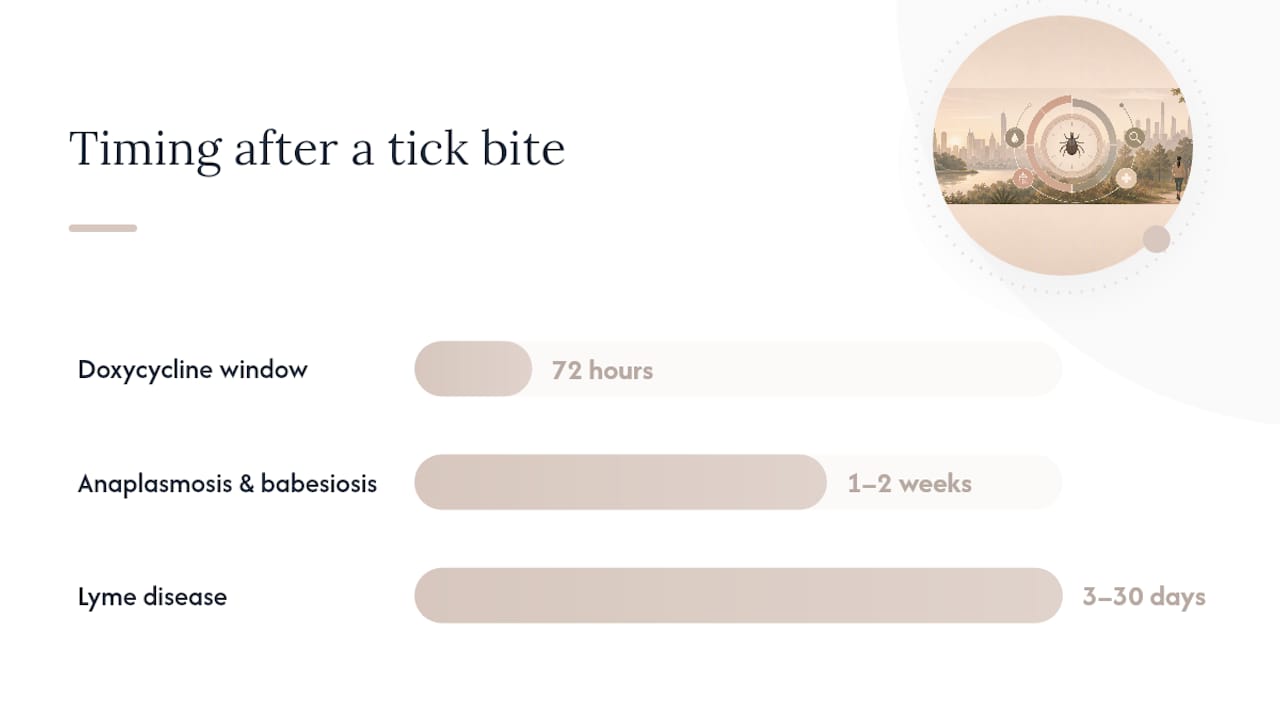
Symptoms from Lyme disease typically appear within 3 to 30 days of a bite, while anaplasmosis and babesiosis can show up within one to two weeks. A tick bite isn't required to make a diagnosis. Some patients never noticed being bitten at all, which is part of why exposure history (where you were, roughly when, whether you spent time in a wooded or brushy area) matters so much to a clinician working through possible causes.
In specific high-risk situations, such as an engorged blacklegged tick removed within the prophylaxis window, NYC DOH's clinical advisory outlines criteria for a single preventive dose of doxycycline given within 72 hours of removal. That decision belongs to a clinician, not a self-diagnosis, so don't delay a call if you're unsure. If you saved the tick, bring it or a photo of it to the appointment. It can help narrow the picture even though it won't replace symptom-based evaluation. This is general information, not a substitute for individualized medical advice, so confirm current guidance with your own healthcare provider.
What This City Actually Gets Wrong About Tick Risk
Most tick advice aimed at New Yorkers treats the city like it's tick-free until proven otherwise, which gets the risk backward. The real story is narrower and more useful: locally acquired cases cluster hard around Staten Island's wooded parkland and a handful of North Bronx green spaces, while the rest of the city carries lower but not zero risk. Treating every neighborhood park the same, either with blanket fear or blanket dismissal, misses the point.
The bigger gap isn't awareness of ticks existing. It's the disconnect between how seriously people take their own tick checks and how casually they treat their pets' exposure. A dog running through brush at Pelham Bay Park is arguably a bigger tick risk vector for a household than the humans on that same walk, simply because fur hides ticks so well and dogs can't tell you they got bitten. Prevention conversations tend to focus on repellent for people and forget that a consistent, vet-guided preventative plan for pets closes a gap that a can of bug spray never will.
If there's one priority to take from all of this, it's sequencing: check pets and people the moment you're back inside, before you do anything else, then build the habit of showering and doing a proper body check within two hours. Everything else, from yard maintenance to permethrin-treated clothing, matters, but it's secondary to that immediate window right after you come indoors.
How City Animal Veterinary Center Supports Tick Prevention for NYC Pets
City Animal Veterinary Center helps Brooklyn pet owners build a tick-prevention plan that actually fits their pet, not a generic recommendation off a package label. Our veterinary team can walk you through prescription preventatives, whether that's a monthly spot-on, an oral option, or a combination product, matched to your pet's health history and lifestyle.

For pets who get anxious at the vet, our Fear Free approach is built specifically to lower stress during exams, so a tick check or preventative discussion doesn't turn into a fight. And if getting to a clinic is the barrier, our house call service brings that same consultation to your home, which matters for pet owners managing mobility issues, multiple pets, or a packed schedule. If you're ready to put a real prevention plan in place before your dog's next park visit, reach out to City Animal Veterinary Center to schedule a consultation.
Where to Go for More Official Guidance
- NYC DOH's tick health topics page covers local prevention guidance, species information, and borough-level surveillance.
- NYC DOH's 2026 Health Advisory on tick-borne diseases is the technical resource clinicians use for diagnostic and prophylaxis criteria.
- The NYC DOH press release on tick prevention breaks down the latest citywide case counts in plain language.
- The CDC's tick prevention page offers national guidance on repellents, clothing treatment, and laundry decontamination.
- Columbia University's NYC Ticks project tracks local tick sightings and adds neighborhood-level detail to citywide surveillance.
- The TickEncounter Resource Center helps identify tick species from photos and offers detailed removal and prevention guides.
Use NYC DOH and the Columbia project for anything specific to your borough or neighborhood, and lean on the CDC and TickEncounter when you want broader prevention detail or species identification help.
Frequently Asked Questions
Are there ticks in NYC parks like Central Park? Yes, though risk in Manhattan parks like Central Park is lower than in Staten Island's wooded areas. Ticks favor shady, brushy edges over open lawns, so sticking to mowed paths reduces exposure even in city parks.
What's the best tick repellent for NYC residents? EPA-registered repellents containing DEET, picaridin, or IR3535 are the options NYC DOH and the CDC recommend for skin, while permethrin is for treating clothing and gear rather than skin directly.
How do I remove a tick in NYC safely at home? Use fine-tipped tweezers, grasp the tick close to the skin, and pull straight up with steady pressure. Clean the area afterward with soap and water, and skip folk remedies like petroleum jelly or heat.
Should I get a tick tested after a bite in NYC? Testing has limited value for clinical decisions since treatment is based on symptoms and exposure history, not lab results on the tick itself. Save the tick in alcohol if you want it identified, but focus on watching for symptoms.
How can I protect my dog or cat from ticks in NYC? Use a veterinarian-prescribed preventative, whether a monthly spot-on, oral medication, or tick collar, and check your pet's fur after every outdoor outing, especially around the ears, belly, and tail base.
Sources
- Ticks - NYC Health (press release)
- Ticks - NYC DOH: Health topics - Ticks
- 2026 Health Advisory #14: Tick-borne Diseases in New York City
- Preventing tick bites | Ticks | CDC
- NYC Ticks (Columbia University)