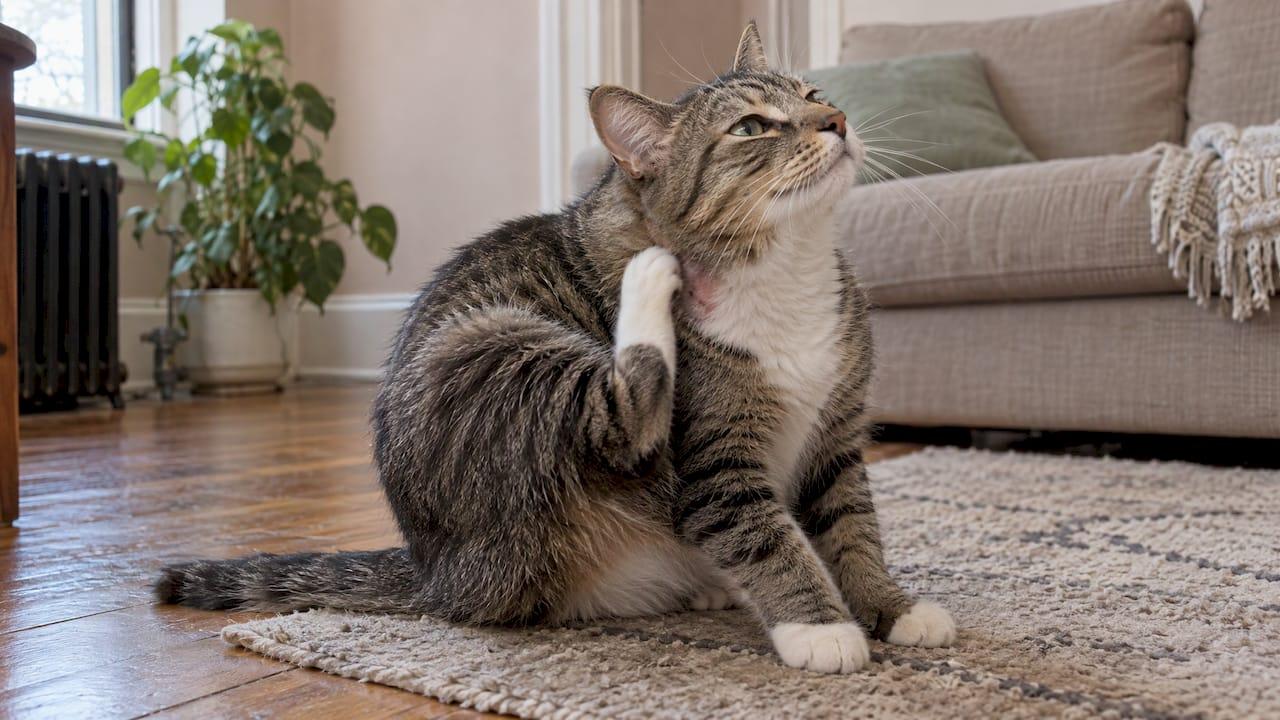
Cat dermatitis has a short list of usual causes: flea allergy, food allergy, environmental allergy, other parasites such as mites, and infections such as ringworm or bacteria. The crusts, scabs and bumps you see are a skin reaction, not a diagnosis, and the same-looking rash can come from any of these causes. That is why the fastest way to relief is an exam that rules causes out in order. At City Animal Veterinary Center in Brooklyn, we do that with Fear Free™ visits in the clinic or at home, so an itchy, anxious cat is handled gently while we find the cause.
TL;DR
- Flea allergy is the most common allergic skin disease in cats worldwide, and it can happen in indoor-only cats with no fleas in sight.
- Other common causes are food allergy, environmental allergy (atopic skin syndrome), mites, ringworm and bacterial or yeast infections.
- Scabby, pinpoint bumps (miliary dermatitis) are a reaction pattern, not a disease. Many causes produce them.
- Vets rule out parasites and infection first, then use a strict diet trial and, if needed, allergy testing to guide treatment.
- Book an exam if the itch lasts more than a few days, the skin is broken, or your cat is losing hair, scratching its face raw or seems uncomfortable.
Table of Contents
- What "dermatitis" means in a cat
- The most common causes of cat dermatitis
- Miliary dermatitis: the scabby-bumps pattern
- Why is my cat itchy when there are no fleas?
- How vets find the cause
- When to book a visit
- How we approach itchy cats at City Animal
- Ready to get your cat's itch checked?
- FAQ
- Sources
What "dermatitis" means in a cat
Dermatitis simply means inflamed skin. In cats it usually shows up as itching (the vet term is pruritus), over-grooming, scabs, small crusted bumps, hair loss, or sores on the head and neck. Cats are discreet about discomfort, so many owners first notice a symptom of the itch: a bald belly, clumps of fur in the lint trap, or a cat that grooms constantly.
The American Animal Hospital Association (AAHA) describes four typical feline reaction patterns: miliary dermatitis, head-and-neck itch, self-induced hair loss, and the eosinophilic granuloma complex (raised, often ulcerated skin lesions). None of these patterns points to one cause. Two cats with identical scabs can have completely different problems, and that single fact explains most of the confusion owners run into online.

The most common causes of cat dermatitis
The veterinary references agree on the main groups. The Merck Veterinary Manual lists parasites, infections, allergic skin diseases (atopic dermatitis, food allergy, contact allergy and insect-bite hypersensitivity) and less common causes such as skin tumors. Cornell's Feline Health Center names a similar set: food hypersensitivity or nutritional problems, parasites, fungal, viral and bacterial infections, and environmental allergens.
| Cause | What it looks like | Key clue |
|---|---|---|
| Flea allergy | Scabby bumps along the back, base of the tail, belly, neck | A reaction to flea saliva, so a few bites can cause weeks of itch |
| Food allergy | Itchy face, ears and neck, sometimes with ear problems | Often year-round and not seasonal |
| Environmental allergy (atopic skin syndrome) | Face and neck scratching, over-grooming, belly hair loss | May flare with seasons or indoor dust and mold |
| Mites and other parasites | Ear debris, crusting on ears and face, dandruff-like scale | Can spread between pets |
| Ringworm (a fungal infection, not a worm) | Circular patches of hair loss, scale, broken hairs | Contagious to other pets and people |
| Bacterial or yeast infection | Pustules, crusts, greasy or smelly skin | Often follows another cause and keeps the itch going |
| Contact irritation | Rash where skin touched a product or surface | Starts after a new product, litter or cleaner |
Flea allergy: the first suspect
AAHA calls flea allergy dermatitis the most common allergic skin disease in cats worldwide and says it must be considered even in indoor-only cats. The reason is the allergy itself. A flea-allergic cat reacts to proteins in flea saliva, so one bite can set off a long flare, and the flea may be gone before you ever see it. Cats are also excellent groomers and often swallow the evidence.
We cover the full checklist for this in our guide to flea allergy dermatitis.
Food allergy
Food allergy is a reaction to a protein in the diet, most often something the cat has eaten for a long time. It cannot be diagnosed by a blood test or by guessing. The accepted method is a strict diet trial, which AAHA's diagnostic guidance says lasts 4 to 12 weeks and should be followed by a food challenge to confirm the culprit. Treats, flavored medications and table scraps can ruin a trial, which is why a vet-guided plan matters.
Environmental allergy
Pollen, dust mites, mold and similar triggers cause what vets call feline atopic skin syndrome. It is typically diagnosed after fleas, other parasites, infection and food have been dealt with. A 2013 peer-reviewed review describes this as a diagnosis of exclusion, meaning the vet reaches it by eliminating look-alikes and by seeing how the cat responds to treatment.
Infections and parasites
Ringworm is a fungal infection of the skin and hair. The UK charity Cats Protection notes that ringworm is the most common fungal cause of skin disease in cats. It matters because it spreads to other pets and to people, and it is treated very differently from an allergy. Bacterial and yeast infections often arrive second: Merck notes that secondary infections can make an otherwise non-itchy skin problem itchy, which keeps the cycle going.
Miliary dermatitis: the scabby-bumps pattern
Miliary dermatitis is one of the top searches in this area, and the name causes a lot of misunderstanding. It describes tiny, pinpoint, red, crusted bumps that are often easier to feel than to see. Run your fingers through your cat's coat and you may find them along the back, neck or around the base of the tail.
According to AAHA, it commonly occurs in flea-allergic cats, but other causes should be considered, and lesions that do not respond to treatment call for further workup, including conditions like mastocytosis (a mast-cell disorder) or a skin cancer in situ. In practice that means:
- Treating it as a flea allergy and nothing else is a common mistake.
- Bumps that persist after proper flea control need a vet's exam, not another product.
- Crusting that spreads, bleeds or is accompanied by hair loss should be seen promptly.
Why is my cat itchy when there are no fleas?
This is the question we hear most from owners of indoor cats. The honest answer is that absence of visible fleas does not rule out flea allergy, and it also does not mean fleas are the cause. Several explanations fit an itchy cat with a clean flea comb:
- Flea allergy with very few fleas. One bite is enough in a sensitized cat, and fleas can come in on your clothes, on a visiting pet, or through a shared hallway or an open window.
- Food allergy. Itching that does not follow the seasons and affects the face and ears raises this possibility.
- Environmental allergy. Dust, pollen and mold are present indoors too.
- Mites and ringworm. Both can be hard to spot at home and are confirmed by tests, not by looking.
- Infection on top of another problem. Bacteria or yeast overgrowth can cause itch by themselves.
- Stress and boredom grooming. Some cats over-groom when anxious. Our guide to cat overgrooming explains how a vet separates a skin cause from a behavioral one.
Because these overlap, a vet works through them in a logical sequence rather than all at once.
How vets find the cause
AAHA's diagnostic approach is a good picture of what a thorough visit involves. The vet takes a history and examines the skin, then uses tools as indicated: flea combing, skin cytology, scrapings, ear cytology and dermatophyte (ringworm) testing. Biopsy may be recommended for unusual lesions. Cytology means looking at cells from the skin surface under a microscope to see whether bacteria, yeast or inflammatory cells are present.
The order matters. The AAHA framework says parasites and infection should be identified and treated before a cat is labeled allergic. Comfort comes first too: the same guidance prioritizes relief for a cat that is suffering while the workup continues, rather than making the cat wait.

Allergy testing: what it can and cannot do
Blood and intradermal skin tests are often misunderstood. AAHA's guideline states that serum and intradermal tests help formulate allergy immunotherapy but do not independently diagnose allergy. In other words, they come later, once the vet has established that an environmental allergy is likely and you want to pursue desensitization. Read more in our guide to allergy testing for cats.
Treatment options your vet may discuss
Treatment depends on the cause: flea control for flea allergy, a prescription diet for food allergy, antifungal therapy for ringworm, antibiotics for bacterial infection. For the itch itself, AAHA reports that glucocorticoids often give rapid, reliable relief in moderate-to-severe feline itch, antihistamines are less reliable, and cyclosporine can work long term but is not immediate. AAHA also recommends long-term, FDA-approved feline flea prevention, year-round in flea-endemic areas.
Give your cat only medicines a veterinarian has prescribed for that cat. Many human and dog products, including some flea treatments and pain relievers, are dangerous to cats.
When to book a visit
See a veterinarian if you notice any of the following:
- Itching or over-grooming that lasts more than a few days
- Scabs, open sores, bleeding or pus
- Patches of hair loss, especially circular ones
- Head shaking, ear debris or a bad smell
- A cat that is hiding, not eating or clearly uncomfortable
If your cat is in distress, or the skin is raw and infected, ask for an urgent visit rather than waiting. Ringworm is a particular reason to act: it can spread to people, so mention any rash on a family member to your own doctor as well.
How we approach itchy cats at City Animal
Most cats dislike carriers, car rides and waiting rooms, and a stressed cat is harder to examine and to sample. Our team uses a Fear Free™ approach designed to lower stress during exams. For cats that do not travel well, or for owners with a busy schedule, we offer home visits, so the exam happens in a familiar room.
Our dermatology service covers the workup described above, and we have an in-house laboratory and a pharmacy. For prevention, our preventative care service covers the year-round parasite control that keeps flea allergy from returning. If long-standing discomfort or pain is part of your cat's picture, we also offer acupuncture and pain management alongside conventional care. Acupuncture is a question people search alongside dermatitis, but it is a separate topic: for arthritis or other pain, ask us whether it fits your cat as one part of a wider plan.
What we think
An itchy cat is rarely a one-product problem. The most useful thing we can do is slow the guessing down: examine the skin, check for parasites and infection, and then move step by step toward the cause. That is how a cat gets relief that lasts.
We built our practice around making that process easier on the cat. A calm, Fear Free™ exam gives us a better look at the skin and a cleaner sample, and when a cat cannot comfortably travel, a home visit brings the exam to the living room. We also pair conventional dermatology with holistic options such as acupuncture and pain management, because the comfort of the whole cat matters, not only the skin.
If your cat has been scratching for more than a few days, do not wait for it to become a sore. Early answers are kinder to your cat and to you.
CAVC
Ready to get your cat's itch checked?
Book a dermatology exam at City Animal Veterinary Center in Brooklyn, in the clinic or as a home visit. We will look at the skin, check for the usual causes in order and give you a plan you can follow at home.

Start on our home visits page or contact us through cityanimalvet.com.
FAQ
Can cat dermatitis be caused by food?
Yes. Food hypersensitivity is one of the recognized causes of feline skin disease, and it often shows as an itchy face, ears and neck. It is confirmed with a vet-guided diet trial of 4 to 12 weeks, followed by a food challenge, not by a blood test alone.
Do indoor cats get flea allergy?
Yes. AAHA says flea allergy dermatitis must be considered even in indoor-only cats. Fleas can enter on people, other pets or through shared spaces, and a single bite can trigger a flare in an allergic cat. Year-round flea prevention prescribed by your vet is the standard recommendation.
What are the scabby bumps on my cat's back?
They are most likely miliary dermatitis, a reaction pattern that commonly accompanies flea allergy but can have other causes, including food allergy, mites and infections. Because the pattern does not identify the cause, an exam is the way to find out what is behind it.
Can I give my cat Benadryl for itching?
Do not start any medication without your veterinarian's guidance. AAHA notes that antihistamines are less reliable than other options for feline itch, and doses and products that are safe for people can be unsafe for cats. Your vet can prescribe something suited to your cat's cause and health.
Is skin allergy in cats curable?
Flea allergy is controlled by keeping fleas away, and food allergy by avoiding the trigger. Environmental allergies are usually managed over the long term rather than cured, using the options your vet recommends. Either way, an accurate diagnosis is what makes control possible.
Sources
- Dermatological Problems in Animals, Merck Veterinary Manual
- The Challenge of Skin Disorders, Cornell Feline Health Center
- 2023 AAHA Management of Allergic Skin Diseases in Dogs and Cats (guidelines)
- 2023 AAHA Management of Allergic Skin Diseases (full guideline PDF)
- Skin Diseases in Cats, AAHA
- Figure 6: Diagnosing Allergic Skin Disease in the Feline Patient, AAHA
- Feline Non-Flea Induced Hypersensitivity Dermatitis
- Itchy cats and skin disorders, Cats Protection veterinary guide