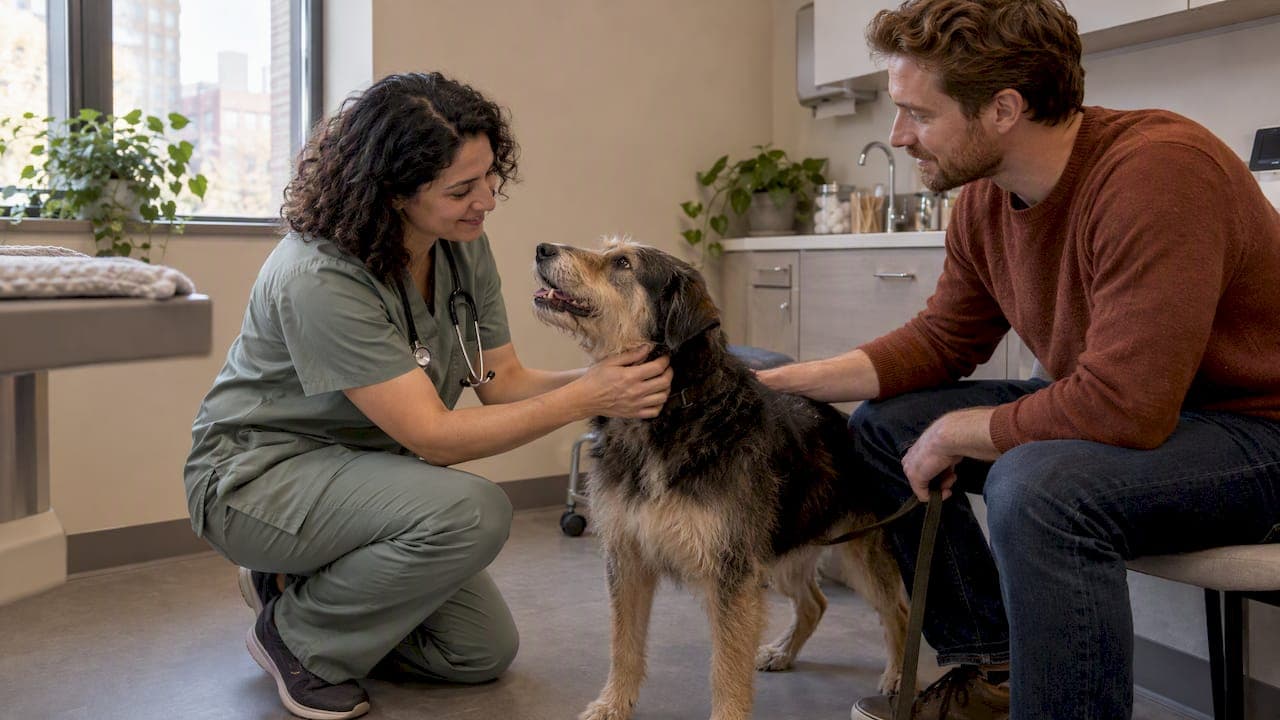
The right veterinarian is the one you can reach, trust and keep for the long haul, not simply the closest clinic or the one with the most stars. Check the license, confirm how the practice handles emergencies and your pet's stress, then book a first visit and see how the team treats you both. This guide walks through each step, with the questions worth asking and the signs that tell you a clinic is a good fit.
TL;DR
- Start with the basics: a valid state license, hours that fit your life, and a clear answer on after-hours emergencies.
- Match the practice to your pet: age, temperament, species and any special needs such as dental, skin or mobility problems.
- If your pet is anxious, ask directly whether the clinic is Fear Free certified and what that looks like in the exam room.
- Book a low-stakes first visit before you need help. A new clinic has to examine your pet in person anyway.
- Judge the visit by how well the team listens and explains, not only by how the building looks.
Table of Contents
- Why this choice matters more than it seems
- Step 1: Confirm the basics
- Step 2: Match the practice to your pet
- Step 3: If your pet is anxious, ask about Fear Free
- Step 4: Questions to ask a new vet
- Step 5: Read the signals, not just the reviews
- What we believe at City Animal
- Start with a get-to-know-you visit
- FAQ
- Sources
Why this choice matters more than it seems
Your vet is not someone you call only when something goes wrong. The American Veterinary Medical Association suggests using the same care you would use in selecting your own physician or dentist. That is the right mindset: this person will see your pet through vaccines, weight changes, a first limp, maybe a scary diagnosis.
There is also a legal reason to choose early. In the US, a vet generally needs a veterinarian-client-patient relationship (VCPR) before diagnosing or prescribing. The AVMA explains that in most states it is established through an in-person physical examination and kept current through timely follow-up exams, typically at least annually. Some states are adding limited telehealth options, and the details vary by state, so ask any clinic how it handles this.
The practical upshot: records alone do not transfer the relationship. If you switch, the new vet will want to examine your pet. So if you are new to Brooklyn, or unhappy with your current clinic, do not wait for an emergency to start.

Step 1: Confirm the basics
License and credentials
Any use of the title veterinarian, or the practice of veterinary medicine, in New York State requires a license, with limited exemptions. A reputable clinic will tell you who its veterinarians are and will not be bothered if you ask about their training. If you want to confirm a license, the state's Office of the Professions is where that verification runs.
Beyond the license, look at what extra training the team has. Certifications for low-stress handling, a particular medical interest such as dermatology or pain management, or dentistry are all worth asking about, because they tell you where the practice puts its energy.
Location, hours and access
A clinic that is excellent but impossible to reach will not be used. Think through your real week:
- How far is the clinic, and can you get there by subway, bus or car with a carrier or a large dog?
- Do the hours work around your job? Early mornings, evenings and weekends matter to many Brooklyn households.
- Is there a way to get care at home if travel is hard, for example for a senior pet, a very large dog, a pet with mobility problems, or an owner without a car?
Home visits are not a gimmick for some households. A cat that panics in a carrier or an older dog with sore joints may do better in a familiar living room. We cover that further down.
Emergencies and after-hours care
No clinic is open around the clock, so the question is what happens when yours is closed. Some practices cover emergencies themselves, while others refer you to a specific nearby emergency hospital. Either can be fine. What is not fine is not knowing. Ask for the name and address of the place you would go, and save it in your phone today.
It also helps to know the difference between urgent care and a true emergency, so you do not waste critical time. Our guide on five red flags that need an emergency vet lays out the signs.
Step 2: Match the practice to your pet
A good clinic for a healthy adult dog may not be the best clinic for a nervous rescue cat or a ten-year-old Labrador. Think about the stage and needs of your animal.
| Your situation | What to look for |
|---|---|
| New puppy or kitten | Vaccination schedules, parasite prevention, microchipping, early socialization and "happy visits" |
| Healthy adult | Annual wellness exams, preventive care plans, in-house lab for quick answers |
| Anxious or reactive pet | Fear Free certification, quiet rooms, cooperative care, a plan for pre-visit medication when appropriate |
| Senior pet | More frequent exams, mobility and pain assessment, bloodwork, nutrition guidance |
| Skin, dental or chronic issues | Dermatology, dental care, diagnostic imaging, holistic options such as acupuncture |
| Hard to transport | House call service |
Puppies, kittens and the early months
The first year sets habits for life. Young animals need a vaccine series, parasite control and a chance to learn that the clinic is a friendly place. The AAHA's new dog checklist points out that AAHA-accredited practices follow Canine Life Stage Guidelines to build individualized preventive plans, and that Fear Free certified veterinarians have specialized training to build trust with anxious dogs. Both are good questions to bring to a first call.

Senior pets
Older animals change quietly. Osteoarthritis, for example, is often hard to spot early, and owners tend to notice only once the limp is obvious. The AVMA's preventive care material notes that preventive healthcare combines a veterinary evaluation of overall health and risk of disease. In practice, that means asking about mobility, weight and nutrition well before your pet looks old. If you want to see what a senior visit looks like, read our walk-through of the senior dog wellness exam. For a broader take on life-stage routines, this pet health maintenance guide covers early screening for chronic conditions.
Step 3: If your pet is anxious, ask about Fear Free
A pet that shakes, hides, growls or refuses treats at the vet is not being bad. It is frightened, and that fear can make exams harder, shorter and less accurate. Practices that take this seriously build the visit around lowering stress.
The AAHA's guidance for owners says to look for Fear Free or cat-friendly environments and to ask specifically whether a clinic is Fear Free certified and how it handles a pet that becomes distressed during an exam. Typical elements include:
- Minimal waiting. Some practices let you wait in the car or go straight to an exam room so your pet avoids a crowded lobby.
- Positive reinforcement. Treats, toys and a calm pace instead of restraint.
- Cooperative care. According to AAHA, this positive-reinforcement approach lets animals take part voluntarily in their own treatment, which reduces stress and fear.
- Happy visits. Short stops with no procedure, just treats and attention, so the building is linked with good things. AAHA's look at Fear Free practices describes these visits as especially useful for puppies and rescues.
- A plan for reactive pets. For some animals, vets prescribe anti-anxiety medication to give before the visit. That is a decision for your veterinarian after an exam, never something to try with leftover or borrowed medication.
You can prepare at home, too. Our posts on dog vet anxiety, muzzle training for vet visits and cat vet anxiety give practical steps. If your cat is the nervous one, it is also worth learning how to verify a cat-friendly practice.
Step 4: Questions to ask a new vet
A phone call or a first visit is your interview. Bring a short list and notice whether the answers are clear and unhurried.
About access
- Are you accepting new patients, and how soon can we be seen?
- What are your hours, and how do I reach you with a question between visits?
- Who handles emergencies when you are closed?
- Do you offer house calls, and for which kinds of visits?
About care
- Which services do you do in-house, such as lab work, X-rays, ultrasound, dental care and surgery? Which do you refer out?
- How do you keep fearful animals calm? Are you Fear Free certified?
- Do you offer options beyond conventional medicine, such as acupuncture or pain management, when they suit my pet?
- How do you approach preventive care for my pet's age and breed?
- Will I usually see the same veterinarian?
About communication
- How do you explain a diagnosis and the treatment options?
- If there is more than one reasonable path, will you lay out the choices and let me decide?
- How will I get test results and records?
The AVMA frames the relationship as a partnership: you ask questions, follow instructions and report how your pet is doing so the vet can adjust the plan. A clinic that welcomes that is a good sign.
Step 5: Read the signals, not just the reviews
Online reviews help, but they are a noisy guide. A few things make them more useful:
- Look for patterns across many reviews, not a single glowing or furious one.
- Pay attention to what people praise: patience, clear explanations and gentle handling say more than a pretty lobby.
- Notice how the clinic replies to criticism.
- Ask neighbors and other owners on your block. A friend who also has an anxious cat is worth ten anonymous strangers.
Then go and see for yourself. During a first visit, watch for:
- A clean, calm space where animals are not stacked up in a noisy waiting area.
- Staff who speak to your pet as well as to you.
- A vet who examines your pet thoroughly and explains what they are doing.
- Time for your questions without a feeling of being rushed.
- Written follow-up: notes, instructions and a clear next step.
If something feels off, trust that. You are not locked in. Just remember that a new practice will need its own exam to start a fresh VCPR.
What we believe at City Animal
We are a Brooklyn practice, and we have strong opinions on this subject. We think the best vet visit is one your pet barely minds. That is why our team is Fear Free certified and builds visits around low stress, and why we offer home visits for clients who find travel hard with a pet.
We also think a good clinic treats the whole animal. Alongside conventional medicine, we offer holistic options such as acupuncture and pain management, and we put as much weight on how a pet feels as on what the lab shows. We would rather meet a healthy pet for a friendly first appointment than a sick one in a crisis, because a relationship built in calm is far easier to rely on later.
Our advice for any owner, whichever clinic you pick: ask the questions in this guide, watch how your pet responds, and choose the team that makes both of you feel at ease.
— CAVC
Start with a get-to-know-you visit
If you live in Brooklyn or nearby and are looking for a new vet, we would be glad to meet you. Our team covers wellness exams, vaccinations, dental care, surgery, urgent care, diagnostic imaging and an in-house lab. New to us? The new clients page explains how to get started, and you can learn more about our Fear Free approach before you come.
FAQ
How do I know if a vet is licensed?
In New York, practicing veterinary medicine or using the title veterinarian requires a state license, with limited exemptions. Ask the clinic who its veterinarians are, and verify the license through the state's Office of the Professions. Other states have their own boards, so check where you live.
Can I establish a vet relationship online?
For most situations, no. The AVMA says that in most states a VCPR starts with an in-person physical exam, although some states allow limited telehealth in specific circumstances. Ask any clinic how it handles this, and expect your new vet to want to see your pet in person.
When should I pick a vet for a new pet or after moving?
Before you need one. Many clinics take new clients by appointment, and a first visit gives you a baseline and a relationship ready for any urgent problem. For a new puppy or kitten, book soon after you bring them home.
What should I ask about an anxious pet?
Ask whether the clinic is Fear Free certified, whether it offers happy visits, and what it does when a pet becomes distressed. Also ask whether a pre-visit plan is appropriate for your pet. Your vet decides on any medication after examining your animal.
Is a vet who makes house calls a good option?
It can be, especially for senior pets, anxious animals or owners who cannot travel easily. Keep in mind that some diagnostics and procedures still need clinic equipment, so ask which visits can be handled at home.
Sources
- Finding a veterinarian, AVMA
- The veterinarian-client-patient relationship (VCPR), AVMA
- Preventive pet healthcare, AVMA
- How to choose a veterinarian, AAHA
- A look inside Fear Free practices, AAHA
- Less stress and better outcomes with cooperative care, AAHA
- New dog checklist, AAHA
- NYS veterinarian license requirements, Office of the Professions