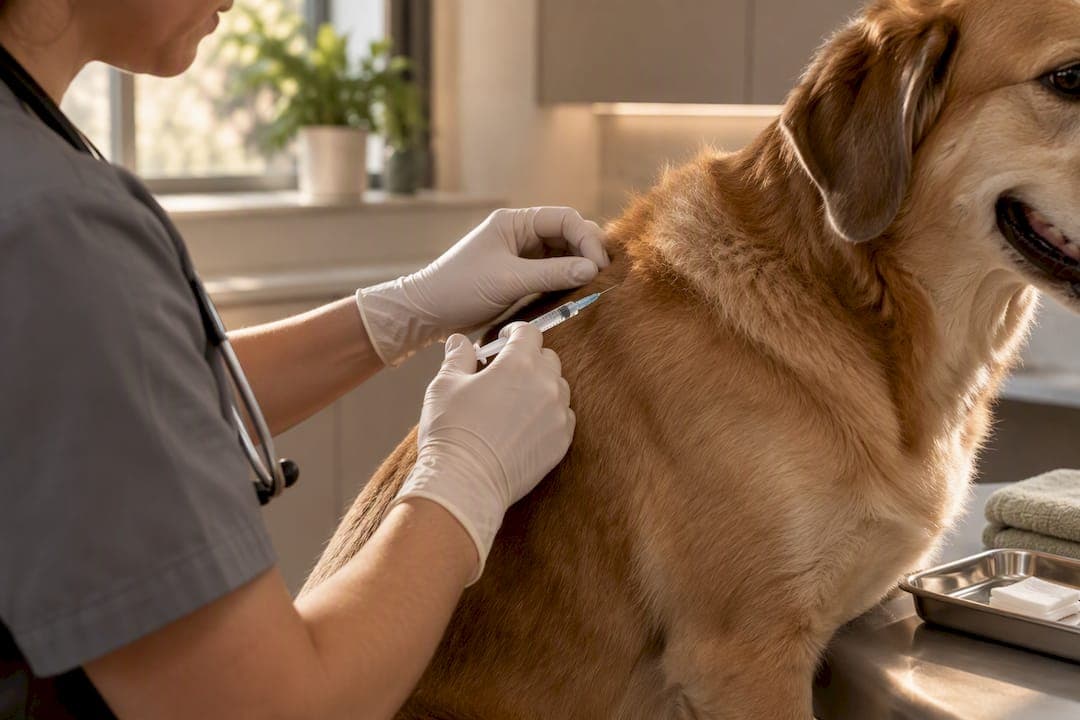
Core vaccines for dogs protect against canine distemper, adenovirus, parvovirus, rabies, and leptospirosis, and most healthy dogs need every one of them unless a veterinarian advises otherwise. The American Animal Hospital Association (AAHA) and the World Small Animal Veterinary Association (WSAVA) set the schedule most clinics follow: a puppy series, a six-month booster, then adult revaccination on a schedule that varies by vaccine. These guidelines are commonly applied at wellness visits.
TL;DR:
- Most dogs should receive all core vaccines, including distemper, parvovirus, adenovirus, rabies, and leptospirosis, unless advised otherwise by a veterinarian.
- Puppies require their first vaccine series starting at 6 to 8 weeks, with boosters every 2 to 4 weeks until at least 16 weeks, followed by adult boosters every 3 years or annually.
- Vaccine reactions are rare and usually mild, but small breeds and dogs receiving multiple vaccines at once need closer monitoring for adverse events.
- Non-core vaccines like Bordetella, Lyme, and canine influenza depend on a dog’s lifestyle, exposure risks, and environment, with leptospirosis increasingly considered essential.
- Regular titer testing may replace unnecessary boosters for distemper and parvovirus, especially for dogs with previous reactions or specific health considerations.
Table of Contents
- What each core vaccine protects against
- Puppy vaccine timing and adult booster schedules
- Vaccine safety and how veterinarians manage adverse events
- Core versus non-core vaccines and when lifestyle changes the plan
- How City Animal Veterinary Center delivers guideline-based vaccination
- Vaccine types and how the shot is actually given
- When to delay or skip a scheduled vaccine
- Reading vaccine titers instead of automatic boosters
- Why guideline-aligned, individualized care matters
- Book a vaccination visit that fits your dog's needs
- Where to read the original vaccine guidelines
- Sources
- FAQ
What each core vaccine protects against
Each core vaccine targets a disease that is either common, severe, or dangerous to people as well as dogs. That combination of risk and consequence is what earns a vaccine "core" status rather than an optional one.
Canine distemper virus attacks the nervous system, respiratory tract, and gastrointestinal tract at once, and dogs that survive the initial illness can develop lasting neurologic damage. Canine parvovirus type 2 causes severe intestinal bleeding and dehydration in puppies and unvaccinated dogs, and it spreads easily through contaminated ground, bowls, and hands. Canine adenovirus type 2 protects against infectious canine hepatitis, a liver disease caused by the related adenovirus type 1, so vaccinating against CAV-2 cross-protects against both.
Rabies is fatal once symptoms appear and it is zoonotic, meaning it spreads to people, which is why most places treat it as a legal requirement rather than a suggestion. Duration of immunity depends on the specific product used, some are labeled for one year and others for three, so the label and local law both determine when a booster is due, according to the CDC's rabies compendium.
Leptospirosis is a bacterial infection carried in wildlife urine and contaminated water, and it can cause kidney or liver failure in dogs while also posing a zoonotic risk to owners. AAHA and WSAVA both list it among core-adjacent recommendations because exposure is harder to predict than it once was.
- Distemper (CDV): attacks multiple organ systems and carries a high mortality rate in unvaccinated dogs.
- Parvovirus (CPV-2): causes severe enteritis, especially in puppies, with high morbidity if untreated.
- Adenovirus type 2 (CAV-2): prevents infectious hepatitis and cross-protects against CAV-1.
- Rabies: fatal and zoonotic, with legal vaccination requirements in most areas.
- Leptospirosis: zoonotic bacterial disease increasingly recommended for dogs of all lifestyles.
Puppy vaccine timing and adult booster schedules
Puppies need a series of shots rather than a single dose because maternal antibodies inherited from their mother can neutralize a vaccine before it has a chance to build the puppy's own immunity. Starting too early and stopping too soon are the two most common scheduling mistakes owners make.
- Puppy series: begin at 6 to 8 weeks old, then repeat every 2 to 4 weeks until at least 16 weeks of age.
- Six-month booster: many veterinarians recommend an additional booster around 6 months to close any remaining gaps in protection.
- Adult dogs: most core modified-live vaccines are boosted every 3 years after the initial series; leptospirosis is typically given annually; rabies follows the product label and local requirements.
- Unknown vaccine history: adult dogs with no verified records usually get a two-dose series 2 to 4 weeks apart, then follow the standard adult schedule.
Adverse events after canine vaccination occur at a low rate, indicating that most vaccine visits pass without incident, according to a large-practice analysis published in JAVMA, which means the vast majority of vaccine visits pass without incident.
The final puppy dose matters more than owners often realize. If it is given before 16 weeks, residual maternal antibodies can still block it, leaving a dog with a false sense of protection. That is why AAHA and WSAVA both anchor their schedules to a minimum age at the last dose rather than a fixed number of shots, and why a clinic-backed puppy vaccine timeline can help new owners track exactly which visit closes that window.

Vaccine safety and how veterinarians manage adverse events
Vaccine reactions are uncommon, and most that do occur are mild. Understanding what is normal and what is not helps owners react appropriately instead of panicking over routine soreness or skipping vaccines out of unnecessary fear.
The same JAVMA analysis found that adverse events were more likely after rabies and DA2PP vaccines, and in small-breed dogs, a pattern also noted in a peer-reviewed risk-factor study. Giving multiple vaccines at a single visit modestly raises the odds of a reaction, which is one reason some veterinarians stagger non-core vaccines across separate appointments for higher-risk dogs.
- Normal after a shot: mild soreness at the injection site, slight lethargy, or a brief decrease in appetite for a day.
- Seek immediate care for: facial swelling, hives, vomiting, difficulty breathing, or collapse.
- Higher-risk dogs: small breeds and dogs receiving several vaccines in one visit warrant closer monitoring.
Pro Tip: If your dog has reacted to a vaccine before, tell your vet before the next visit. They can space out non-core vaccines, consider titers instead of automatic revaccination, or schedule a short follow-up check to watch for delayed reactions.
Core versus non-core vaccines and when lifestyle changes the plan
Core vaccines are recommended for every dog regardless of where they live or how they spend their time. Non-core vaccines are recommended only when a dog's environment or habits create real exposure risk, which means the "non-core" label describes how common the risk is, not how serious the disease can be for an individual dog.
Common non-core vaccines include Bordetella (kennel cough), Lyme disease, and canine influenza. A dog that boards frequently or visits dog parks benefits from Bordetella. A dog hiking through tick-heavy woods benefits from a Lyme vaccine. A dog in a high-density shelter or boarding environment may need influenza coverage.
- Bordetella: recommended for dogs in boarding, daycare, or grooming settings.
- Lyme disease: recommended in regions with heavy tick exposure.
- Canine influenza: recommended for dogs in shelters, boarding facilities, or dog shows.
Leptospirosis sits in a gray area. It was historically treated as non-core, but because wildlife carriers exist even in urban and suburban settings, AVMA guidance now reflects a broader understanding of the disease, and many veterinarians recommend it for dogs of essentially any lifestyle rather than reserving it for rural or outdoor dogs.
How City Animal Veterinary Center delivers guideline-based vaccination
Some veterinary clinics follow AAHA and WSAVA schedules while adapting the experience to each dog's temperament. A Fear Free approach uses low-stress handling, minimal restraint, and rewards during the appointment itself, so a vaccine visit does not become a dog's most dreaded day.
- Fear Free handling: gentle restraint, treats, and pacing designed to reduce anxiety during injections.
- Home visits: available for dogs that struggle with travel or clinic environments, keeping the same vaccine protocol in a familiar setting.
- Bring records: prior vaccine certificates and any history of reactions help the team personalize the visit.
Owners preparing for a first visit can review practical steps for calmer vet visits beforehand, and those considering muzzle use for handling can look at Fear Free muzzle training techniques ahead of time.
Vaccine types and how the shot is actually given
Core vaccines come in a few different forms, and the type affects how the body responds. Modified-live vaccines (MLV) contain a weakened version of the live virus, prompting a strong and typically longer-lasting immune response, which is why most distemper, parvovirus, and adenovirus vaccines use this format. Killed (inactivated) vaccines contain a virus that cannot replicate, generally producing a shorter duration of immunity and sometimes requiring more frequent boosters, rabies vaccines are commonly formulated this way. Recombinant vaccines use a small, engineered piece of genetic material to trigger immunity without using the whole virus, offering another route to protection with a different safety profile.

Most core vaccines are given as a subcutaneous injection, typically between the shoulder blades or along the flank, using a small needle and a quick technique that Fear Free clinics pair with distraction and treats. Some non-core vaccines, like certain Bordetella formulations, are given intranasally or orally instead of by injection. The injection site itself is chosen partly for comfort and partly so any localized swelling is easy to monitor and unlikely to interfere with movement.
Regardless of type, a vaccine cannot instantly protect a dog. It takes days to weeks after each dose for the body to build a meaningful antibody response, which is one more reason the timing of the puppy series and any booster matters as much as the vaccine itself.
When to delay or skip a scheduled vaccine
Vaccination is not appropriate for every dog on every scheduled date. A dog running a fever, recovering from surgery, or showing signs of active illness should generally have vaccines postponed until they are stable, since an already-taxed immune system may not respond as intended and it becomes harder to tell a vaccine reaction apart from the underlying illness.
Dogs on immunosuppressive medication, undergoing chemotherapy, or living with certain chronic immune conditions often need an individualized plan rather than the standard schedule, sometimes favoring titers over automatic boosters or spacing vaccines further apart. Pregnant dogs are generally not vaccinated with modified-live vaccines, since the weakened virus can pose a risk to developing puppies. Dogs with a documented history of a serious vaccine reaction may need pre-treatment with antihistamines, a switch to a different product, or a revised schedule altogether.
None of these situations mean skipping core vaccines permanently. They mean adjusting timing and method with a veterinarian who knows the dog's full medical history, which is exactly why an unknown-history rescue or a dog with a complicated medical background benefits from a conversation before the needle comes out.
Reading vaccine titers instead of automatic boosters
A titer test measures the level of antibodies circulating in a dog's blood for a specific disease, offering a way to check whether existing immunity is still adequate before giving another dose. It is most commonly used for distemper and parvovirus, since both tend to produce long-lasting immunity in dogs that responded well to their original vaccines.
A titer result that comes back adequate suggests a booster may not be necessary yet, while a low or negative result suggests it is time to revaccinate. Titers are less useful for rabies in a legal sense, since most jurisdictions require a currently valid rabies vaccine on record regardless of antibody levels, so a titer cannot substitute for the legal requirement even when it shows strong immunity.
Titers are not free of nuance. A positive result reflects antibody presence, not a guaranteed level of real-world protection, and cost and lab turnaround time are practical considerations for owners weighing titers against a routine booster. Dogs with a history of vaccine reactions, older dogs, or dogs on long-term medication are often the best candidates for titer testing, since avoiding unnecessary vaccine exposure carries more value for them than it does for a healthy young dog.
Why guideline-aligned, individualized care matters
Vaccination guidelines exist because they work at a population level, but the best vaccine plan is still the one built around the dog in front of you. Two dogs of the same breed and age can have entirely different appropriate schedules once history, health status, and lifestyle enter the picture. We follow AAHA and WSAVA guidance as a starting point, then adjust it using Fear Free handling and a full review of each dog's medical history.
We would rather answer a question about a past reaction, a titer option, or a scheduling preference before a vaccine is given than after. That conversation costs a few extra minutes and prevents most of the problems owners worry about.
— CAVC
Book a vaccination visit that fits your dog's needs
City Animal Veterinary Center provides core vaccinations as part of routine wellness exams, so your dog's vaccine schedule, physical exam, and any needed bloodwork happen in one visit rather than several trips.

Dogs that find clinic visits stressful, or owners who cannot easily travel, can request home visit vaccination services instead, with the same guideline-based schedule delivered in a familiar setting. The team applies Fear Free handling at every appointment, whether in the clinic or at home, and welcomes questions about titers, prior reactions, or spacing out non-core vaccines for dogs with unique exposure risks, including guidance on environmental hazards covered in resources like what flowers are toxic to dogs.
- Vaccinations: full core vaccine series and boosters following AAHA/WSAVA schedules.
- Wellness exams: vaccines paired with a physical exam and health screening.
- Home visits: the same vaccination care delivered outside the clinic for dogs that need it.
Visit the vaccinations page to see what is offered or to request an appointment for your dog.
Where to read the original vaccine guidelines
- AAHA 2022 canine vaccination guidelines: core vaccine definitions and scheduling detail.
- WSAVA 2024 vaccination guidelines: global core vaccine framework and regional nuance.
- UC Davis VMTH vaccination guidance: plain-language summary of AAHA/WSAVA recommendations.
- CDC rabies compendium: rabies vaccine duration of immunity and legal considerations.
This article is general information, not a substitute for advice from a qualified doctor. Consult a qualified healthcare professional about your own circumstances before acting on anything here.
Sources
- 2022 AAHA canine vaccination guidelines
- WSAVA 2024 guidelines for the vaccination of dogs and cats
- Vaccination Guidelines for Dogs and Cats — UC Davis VMTH
- Compendium of Animal Rabies Prevention and Control — CDC
FAQ
Is Bordetella considered a core vaccine?
No, Bordetella is classified as a non-core vaccine and is recommended only for dogs with specific exposure risks, such as boarding, daycare, or grooming facilities. Core vaccines are recommended for all dogs regardless of lifestyle, while Bordetella depends on individual exposure.
What are the top three vaccines for dogs?
The three vaccines most consistently classified as core are distemper, parvovirus, and adenovirus, often combined into a single combination shot alongside additional core components. Rabies and leptospirosis round out the full core vaccine list recommended by AAHA.
Is leptospirosis a core vaccine now?
Leptospirosis is increasingly treated as core or near-core because wildlife carriers exist even in urban and suburban areas, and AVMA guidance reflects that broader understanding. Many veterinarians now recommend it for dogs of nearly any lifestyle rather than only rural or outdoor dogs.
What are the recommended core vaccines for dogs according to the AAHA?
AAHA lists canine distemper virus, canine adenovirus type 2, canine parvovirus type 2, leptospirosis, and rabies as core vaccines recommended for all dogs. These recommendations come from the 2022 AAHA canine vaccination guidelines and set the standard most veterinary clinics follow.