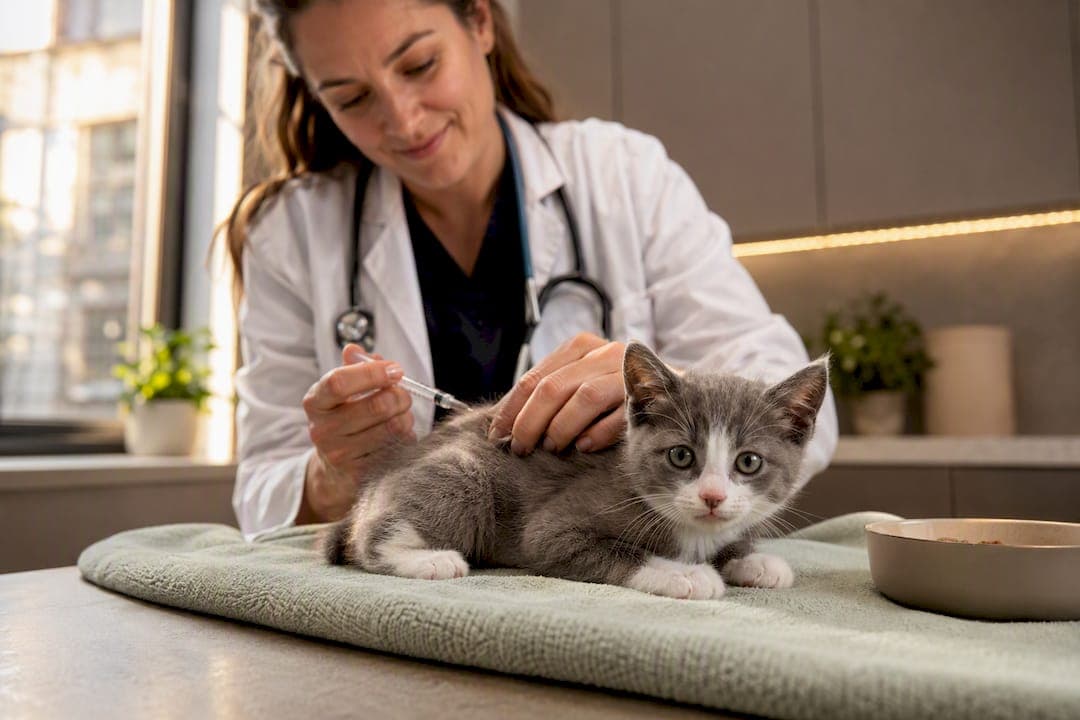
Start vaccines at 6 to 8 weeks old, then boost every 3 to 4 weeks until your kitten reaches roughly 16 to 20 weeks, following a detailed vet-approved puppy essentials checklist approach which can help cross-reference visit prep and what to bring. The core lineup is FVRCP, rabies, and FeLV (recommended for kittens under a year). Full protection doesn't kick in immediately, either. Your kitten needs about 7 to 10 days after that final dose before their immune system has caught up, so limiting contact with unfamiliar animals until then matters more than most owners realize.
TL;DR:
- Proper kitten vaccination involves multiple doses starting at 6 to 8 weeks, with the final FVRCP dose typically completed by 20 weeks to ensure maternal antibody clearance.
- FeLV testing must be performed before vaccination, as the vaccine is ineffective if the kitten is already infected, and it should be done at least once during the early visit window.
- The rabies vaccine is given between 12 and 16 weeks as a single dose, often required by law, with subsequent boosters based on state regulations and vaccine type.
- Non-core vaccines like Bordetella or FIV are only recommended if the kitten's environment poses specific risks, such as multi-cat households or outdoor exposure.
- Vaccine appointments should include a physical exam, careful handling, and documentation, while stress-reducing strategies and home visits can improve the experience for anxious kittens.
Table of Contents
- Kitten Vaccine Schedule: A Visit-by-Visit Timeline
- What Do FVRCP, Rabies, and FeLV Actually Protect Against?
- Does My Kitten Need Any Non-Core Vaccines?
- What Happens During a Kitten Vaccine Appointment?
- Is It Normal for My Kitten to Act Tired After Shots?
- Why Do Kittens Need So Many Vaccine Doses?
- How Does the Rabies Vaccine Requirement Actually Work?
- What Boosters Come After the Kitten Series?
- How Can I Make Vaccine Visits Less Stressful for My Kitten?
- Our Take on Getting the Kitten Series Right
- Book Your Kitten's Vaccine Series With City Animal Veterinary Center
- Where This Vaccine Schedule Information Comes From
- Sources
Kitten Vaccine Schedule: A Visit-by-Visit Timeline
Here's the practical breakdown veterinarians actually follow for a first-year kitten vaccine schedule, built around age windows rather than calendar months, since kittens rarely arrive at a clinic on a tidy monthly cycle.
| Age Window | Vaccines Given | Notes |
|---|---|---|
| 6–8 weeks | FVRCP (dose 1) | Start of the core kitten series; FeLV test recommended before any FeLV vaccine begins |
| 10–12 weeks | FVRCP (dose 2), FeLV (dose 1) | FeLV testing should happen first if not already done |
| 14–16 weeks | FVRCP (dose 3), FeLV (dose 2), Rabies | Rabies typically given once between 12 and 16 weeks depending on state law and vaccine label |
| 16–20 weeks | Final FVRCP dose | Closes the maternal antibody gap; some kittens need this last visit to finish the series |
| 6 months | Optional booster | Considered when maternal antibodies may have blocked earlier doses |
| 1 year | FVRCP, rabies, FeLV boosters | Marks the shift into adult booster intervals |
A few things don't show up neatly in a table. FeLV testing has to happen before that vaccine goes in the kitten's arm, not after, because vaccinating an already-infected kitten doesn't help and skews future health planning. The rabies dose is a single dose in this window, not a series, though your state may set its own exact age and follow-up rules. And that 6-month visit isn't automatic for every kitten. It's a judgment call your veterinarian makes based on how the earlier series went and how much residual risk from maternal antibodies is still plausible.
What Do FVRCP, Rabies, and FeLV Actually Protect Against?
These three vaccines earn the label "core" because the diseases behind them are common, serious, or both, and because PetMD identifies FVRCP, rabies, and FeLV as the central components of a proper kitten vaccine schedule.
FVRCP is a combination vaccine that isn't one disease but three:
- FHV-1 (feline herpesvirus) causes upper respiratory infection with sneezing, congestion, and eye discharge that can become chronic and flare up during stress for the cat's entire life.
- FCV (calicivirus) produces oral ulcers, respiratory symptoms, and in rare aggressive strains, a systemic illness that can be fatal even in adult cats.
- FPV (feline panleukopenia), sometimes called feline distemper, is the one that kills kittens fastest. It attacks rapidly dividing cells in the gut and bone marrow, and unvaccinated litters can lose most of their kittens to it within days.
Rabies is different from the other two because it's not primarily a cat-health issue. It's a fatal, zoonotic disease, meaning it spreads to people, and once symptoms appear in any mammal, there's no treatment. That's why rabies vaccination isn't just a medical recommendation. It's typically a legal requirement, and public health agencies track rabies cases as a reportable disease specifically because of the human risk.
FeLV (feline leukemia virus) is considered core specifically for kittens under a year old, even though it moves to a lifestyle-based decision in adulthood. Young kittens have less mature immune systems and higher susceptibility if exposed, which is part of why AAHA guidance places FeLV in the core category for kittens under one year regardless of whether that kitten will grow up strictly indoors. Testing has to come before vaccinating, since the vaccine doesn't help a kitten that's already infected and a false sense of protection could lead an owner to expose that cat to others. Once your cat is a confirmed indoor adult with no exposure to unknown cats, many vets will discuss dropping FeLV boosters, but that's a conversation to have at the one-year visit, not a decision to make on your own now.
Does My Kitten Need Any Non-Core Vaccines?
Not every kitten needs the same shots. Core vaccines apply to nearly all kittens regardless of circumstances, but a second tier of vaccines gets recommended only when a kitten's actual living situation calls for it.
Common non-core vaccines and the situations that make them worth discussing:
- Bordetella matters most for kittens heading into boarding facilities, shelters, or multi-cat households where respiratory pathogens spread quickly through shared air and surfaces.
- Chlamydia felis gets recommended in dense multi-cat environments like breeding catteries or rescue intake, where conjunctivitis outbreaks are more common.
- FIV (feline immunodeficiency virus) vaccination is rarely used today and only comes up for kittens with confirmed, ongoing outdoor exposure to unknown or aggressive cats, since testing complications make this a nuanced call.
Some of these come in different forms depending on how they're meant to work. Bordetella, for example, is sometimes given intranasally rather than by injection, which triggers a faster local immune response in the respiratory tract itself rather than a systemic one. That route also tends to cause fewer injection-related reactions, which matters if your kitten is already anxious about the visit.
None of this is something to decide from an article, including this one. A shelter kitten, a kitten in a household with five other cats, and a kitten who'll never leave a quiet apartment all carry different real-world risk, and that's exactly the kind of individualized read your veterinarian is positioned to make. Bring up your kitten's actual daily life, planned boarding, any outdoor access, and other pets in the home, and let that conversation shape which non-core vaccines actually make sense.
What Happens During a Kitten Vaccine Appointment?
A vaccine visit isn't just a quick jab. There's a sequence to it, and skipping steps is exactly how avoidable problems happen.
- Physical exam first. Your veterinarian checks for fever, parasites, respiratory symptoms, or anything else that would make vaccinating a bad idea that day. This isn't optional. UC Davis vaccination guidance is explicit that a pre-vaccine exam and professional handling are part of what makes vaccination safe, which is also why home self-administration of kitten vaccines isn't something a clinic will support.
- FeLV testing before the FeLV vaccine. If your kitten hasn't been tested yet, blood gets drawn and checked before that particular vaccine is given, not after.
- Injection at a specific site. Vaccines get placed as distally as possible on designated limbs, often following a right-side or left-side convention depending on which vaccine it is. This isn't arbitrary. Distal-limb placement means that in the rare event of an injection-site sarcoma, that limb can potentially be amputated to remove it entirely rather than requiring surgery closer to the body.
- Documentation. You leave with a written vaccine record showing exactly which vaccine, which lot number, which site, and which date. For rabies specifically, this record carries legal weight. Many municipalities require it for licensing, and it's the document animal control or a boarding facility will ask to see.
Keep that paperwork somewhere you can actually find it later. A missing rabies certificate has derailed more boarding reservations and travel plans than owners expect, and reconstructing vaccine history from memory rarely goes well.
Is It Normal for My Kitten to Act Tired After Shots?
Mild reactions are common and usually resolve on their own within a day. Soreness at the injection site, a little less energy than usual, or skipping part of a meal that evening all fall within the range of expected responses to a healthy immune system doing its job.
Watch for these instead, and treat them as reasons to call your clinic or an emergency vet immediately:
- Facial or muzzle swelling, especially around the eyes or mouth
- Labored or rapid breathing
- Vomiting or diarrhea that starts within hours of the vaccine
- Collapse, extreme weakness, or unresponsiveness
- Hives or widespread itching
These true emergencies are uncommon, but they can develop fast, usually within the first 30 to 60 minutes after the injection. That's part of why many clinics ask you to wait briefly in the parking lot or waiting room before heading home. Monitor your kitten closely for the rest of the day, and if anything seems off beyond mild sleepiness, don't wait it out.
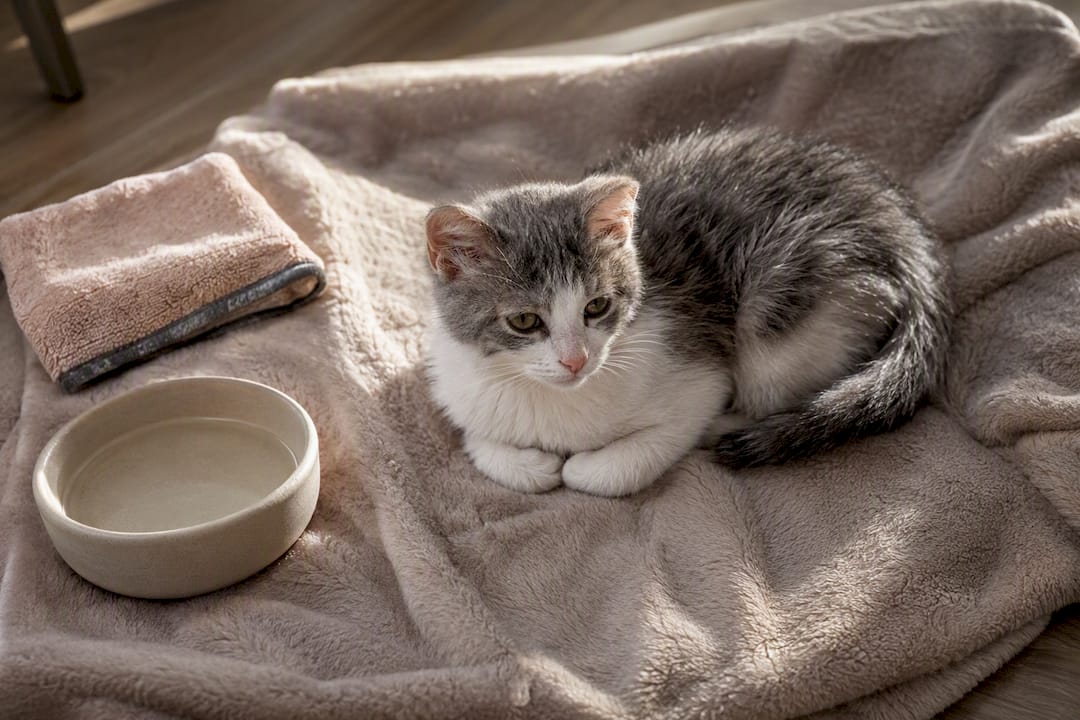
Pro Tip: Keep your kitten in a warm, quiet room for the rest of the day after vaccines, away from other pets and rough play. A calm nervous system handles the immune response better than one that's also managing stress from a chaotic household.
Why Do Kittens Need So Many Vaccine Doses?
This is the part most owners skip past, and it's the actual reason the schedule looks the way it does. Kittens are born with some protection already in their system, borrowed from their mother's antibodies through colostrum in the first day of nursing. Those maternally derived antibodies, or MDA, are genuinely useful. They shield newborn kittens during the weeks before their own immune system can respond to anything.
The problem is that MDA doesn't just protect against disease. It also blocks vaccines from working, because the maternal antibodies neutralize the vaccine's antigens before the kitten's own immune system gets a chance to respond and build lasting memory. And here's the frustrating part: MDA levels don't decline on a predictable, universal timeline. One kitten might lose maternal protection by 8 weeks. A littermate from the same mother might still have blocking levels at 14 weeks. There's no single age where you can say every kitten is now capable of responding to a vaccine, which is precisely why the series is spread across multiple doses instead of given once.
Because maternally derived antibodies vary so widely between individual kittens, a multi-dose vaccine series is the accepted approach for ensuring every kitten gets successfully immunized once MDA finally drops low enough to allow it. Guidelines note that up to a third of kittens may still carry enough residual maternal antibody at 16 to 20 weeks to blunt a vaccine response, which is the reasoning behind AAHA/AAFP's recommendation to consider a 6-month revaccination as a safety net.
That's also why titer testing, a blood test that measures existing antibody levels, isn't routinely used in kittens the way it sometimes is in adult cats. Titers are good at confirming whether an adult cat still has protective immunity from past vaccines. In a kitten mid-series, though, a titer result is hard to interpret cleanly, since you can't easily tell whether a positive reading reflects leftover maternal antibody or a genuine immune response the kitten built on their own. Finishing the recommended series on schedule is simply more reliable than trying to test your way around it.
How Does the Rabies Vaccine Requirement Actually Work?
Most kittens get their rabies vaccine as a single dose somewhere between 12 and 16 weeks, though the exact minimum age and the interval before the next booster depend on both your state's law and the specific vaccine label your clinic uses. UC Davis guidance places the initial rabies dose at 12 to 16 weeks, followed by a booster one year later, which then shifts to a multi-year interval depending on the vaccine product.
Rabies sits in a different legal category than the other core vaccines because it's a reportable zoonotic disease. Public health departments track confirmed and suspected rabies cases specifically because of the risk to people, and that oversight is why rabies vaccination carries legal weight that FVRCP and FeLV simply don't. Your municipality or state sets the actual minimum age, revaccination interval, and documentation requirements, and those rules genuinely vary. A kitten vaccinated in one county isn't necessarily compliant with a neighboring county's rules if you move.
The practical move here is simple: ask your clinic directly what your specific state and city require, and keep the paperwork they hand you. If your kitten will ever travel, board, or need a health certificate down the line, that record becomes essential, and understanding rabies titer testing matters even more if international travel is ever on the horizon. Don't assume the schedule from an article, a friend's cat, or even a different clinic automatically applies to your situation.
What Boosters Come After the Kitten Series?
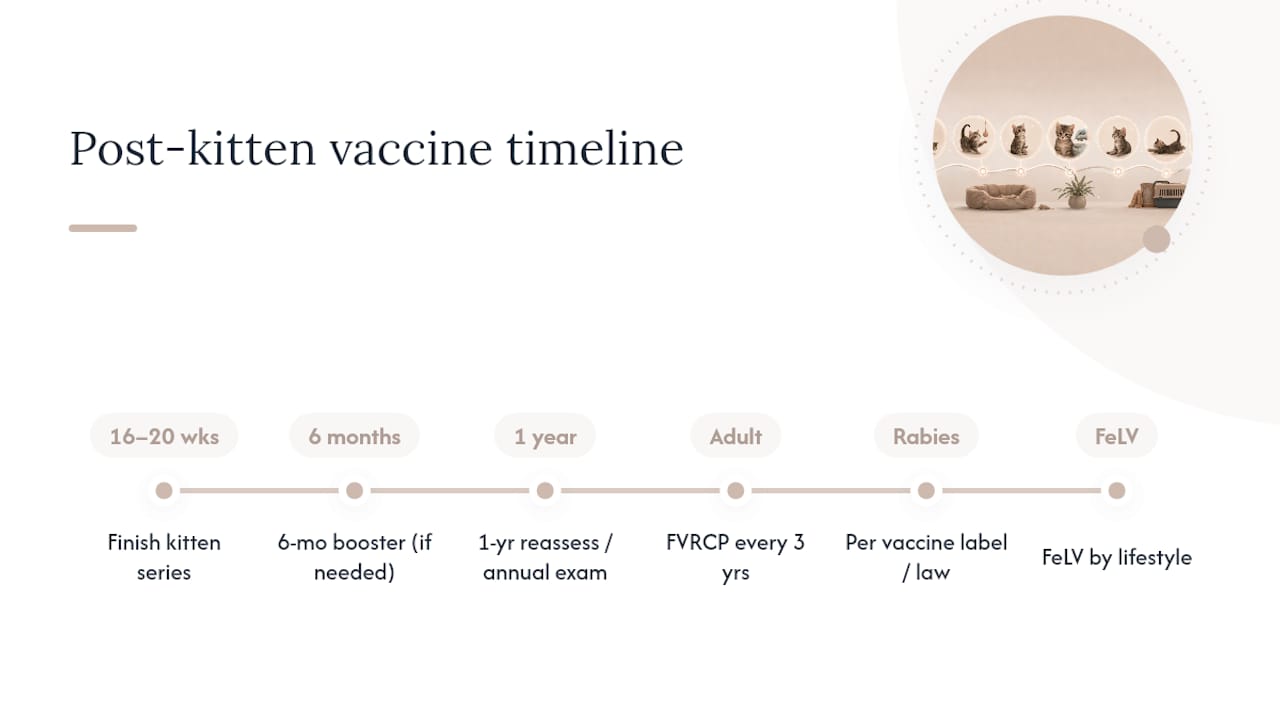
Finishing the kitten series around 16 to 20 weeks isn't the finish line. It's the point where the schedule shifts from frequent short-interval doses to a much slower, spaced-out rhythm.
The first checkpoint is either a 6-month or 1-year revisit, and which one your vet recommends often depends on how the kitten series went. If there was any concern that maternal antibodies interfered with an earlier dose, a 6-month booster helps close that gap for good. If the series went cleanly, many vets are comfortable waiting until the one-year visit to reassess.
From there, adult intervals stretch out considerably. Core FVRCP vaccines commonly move to a three-year interval in adult cats, based on duration-of-immunity studies that back that spacing. Rabies boosters follow whatever interval is printed on the specific vaccine label and required by your local law, which might be one year or three years depending on the product. FeLV becomes a lifestyle conversation at this point rather than an automatic core vaccine. An adult cat who's strictly indoor with no exposure to unknown cats has a very different risk profile than one who goes outside or lives with a cat that does.
None of this replaces the annual wellness exam, though. That yearly visit is where your vet reassesses whether your cat's living situation, health status, or environment has changed enough to adjust the plan, and it's worth treating as a checkpoint rather than a formality.
How Can I Make Vaccine Visits Less Stressful for My Kitten?
A kitten who has one terrifying vet visit often turns into an adult cat who fights the carrier for the next decade. Investing a little effort into low-stress visits early actually pays off for years.
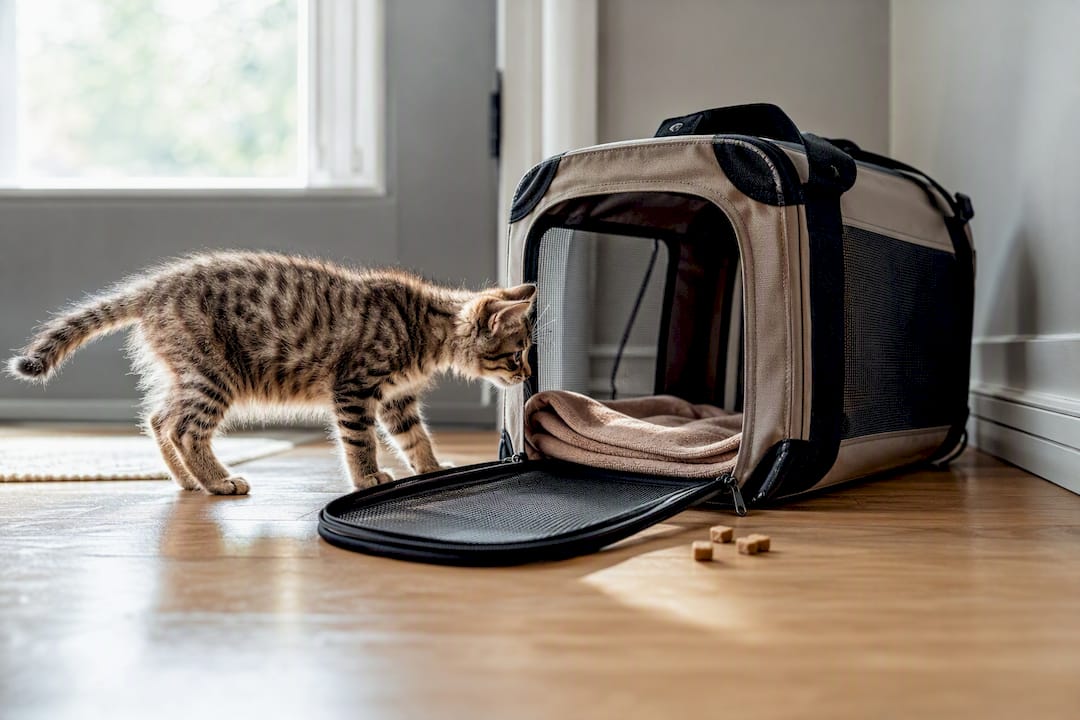
A few things help before you ever walk in the door. Leave the carrier out at home for a few days beforehand instead of pulling it out of a closet right before you leave, so it stops signaling "something bad is about to happen." A short practice car ride or two, with no destination other than driving around the block, can also take some of the novelty and fear out of the actual appointment.
Once you're at the clinic, you're allowed to ask for things. Request a cat-only exam room if the clinic offers one, since the smell and sound of dogs in a waiting room genuinely raises a kitten's stress level. Ask about pheromone diffusers or sprays in the exam room, and ask your vet team to use minimal restraint, working with the kitten's body language rather than forcing a hold. City Animal Veterinary Center's Fear Free approach builds around exactly this kind of handling, prioritizing a kitten's comfort at every step rather than treating the exam as something to push through quickly.
For kittens who genuinely can't tolerate a clinic environment, even a well-run one, a home visit for vaccinations is worth asking about. Getting the injection in a familiar space, without a car ride or waiting room at all, removes most of the stress triggers in one move. It's not the right fit for every kitten or every vaccine, since some visits benefit from clinic-based diagnostics, but for a kitten who spirals into panic at the sight of a carrier, it's a legitimate option to raise with your vet.
Pro Tip: Bring your kitten's favorite treats to the appointment and let the vet team hand-feed a few during the exam. Positive associations built during actual visits, not just at home, are what make the next appointment easier.
Our Take on Getting the Kitten Series Right
We see a version of the same mistake constantly: an owner treats the kitten vaccine schedule as a checklist to finish rather than a biological process to respect. The doses aren't spaced out because that's a convenient billing cadence. They're spaced out because a kitten's immune system, filtered through unpredictable maternal antibodies, needs repeated opportunities to actually respond. Skip a dose or stretch the interval too far, and you're not saving your kitten anything. You're just gambling with the exact window the schedule was built to close.
What we'd push back on is the instinct to treat every kitten identically once the core series is done. FeLV in particular gets treated as a lifelong obligation by some owners and dismissed too early by others, when the honest answer is that it depends entirely on how that specific cat will actually live. A shelter-adopted kitten heading into a multi-cat household needs a different conversation than a single kitten who'll never leave a fifth-floor apartment.
The other piece we'd stress: a kitten's very first vet experiences shape how they handle every visit for the next fifteen years. Vaccines matter, but so does whether that kitten leaves the clinic terrified or unbothered, and that outcome is largely in the hands of the people handling them. Our Fear Free approach exists because we've seen what the alternative costs owners down the line.
— CAVC
Book Your Kitten's Vaccine Series With City Animal Veterinary Center
City Animal Veterinary Center runs the full kitten vaccine series with Fear Free handling built into every appointment, so your kitten isn't just protected medically. They're also not left with a lasting fear of the vet.

Every visit starts with a real physical exam, includes FeLV testing before that vaccine goes anywhere near a needle, and ends with clear documentation you'll actually be able to find later, including the rabies paperwork your city or state requires. If your kitten struggles with car rides, carriers, or clinic environments in general, ask about our house call service. We bring the same series and the same careful handling directly to your home, which for a genuinely anxious kitten can be the difference between a manageable visit and a traumatic one. You can also read more about what to expect at that first appointment before you come in. When you're ready, book your kitten's next vaccine visit with our team in Brooklyn, and we'll walk you through exactly where your kitten stands in the series and what's due next.
Where This Vaccine Schedule Information Comes From
The timeline and recommendations here draw directly from the 2020 AAHA/AAFP Feline Vaccination Guidelines, the primary peer-reviewed standard veterinary clinics used to build kitten protocols. Additional guidance comes from UC Davis's veterinary health resources, which lay out specific MLV FVRCP intervals and rabies timing in detail.
Consumer-facing summaries from Chewy's kitten vaccine guide and PetMD's vaccination overview helped translate that clinical guidance into the practical, visit-by-visit format above. For readers who want a deeper look at your kitten's very first appointment specifically, our own first vet visit guide covers what to bring and what to expect beyond the vaccines themselves.
This article is general information, not a substitute for advice from a qualified doctor. Consult a qualified healthcare professional about your own circumstances before acting on anything here.
Sources
- 2020 AAHA/AAFP Feline Vaccination Guidelines
- Vaccination Guidelines for Dogs and Cats | UC Davis
- Kitten Vaccination Schedule and Costs | PetMD