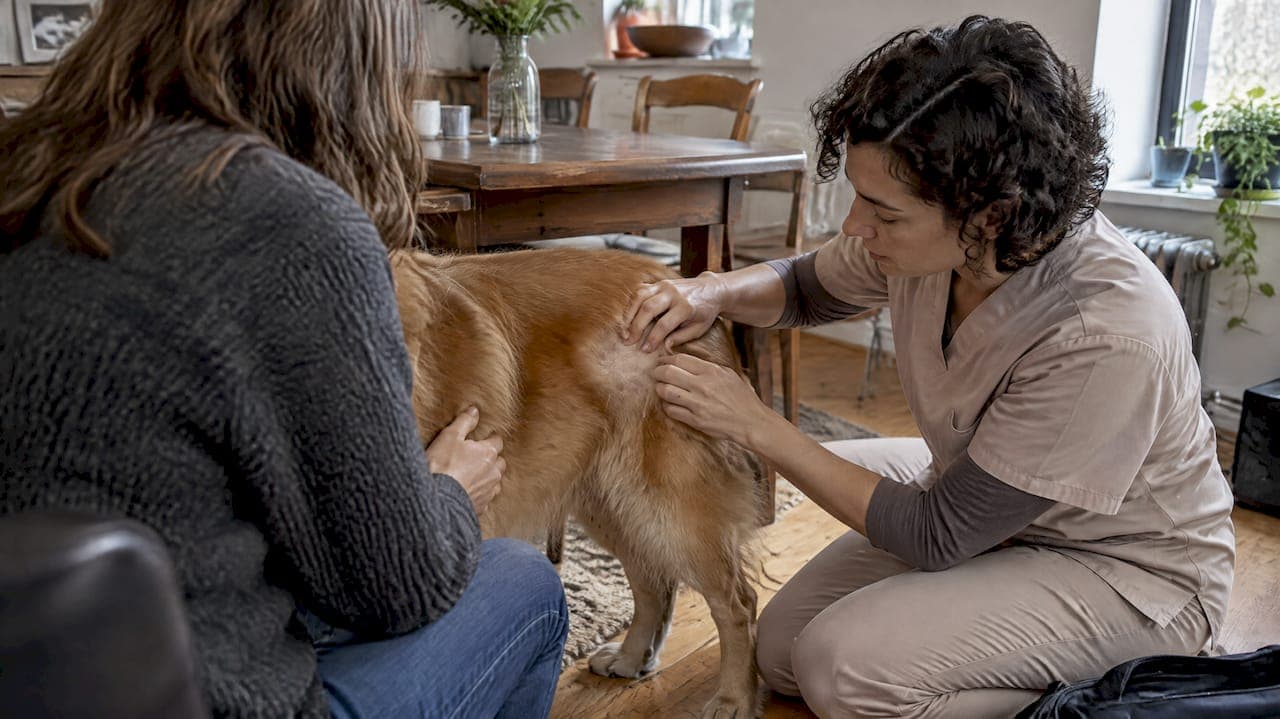
Most dogs who won't stop scratching are reacting to one of three overlapping problems: parasites, allergies, or a secondary skin infection. Mild cases sometimes settle with basic flea control, but open sores, rapid hair loss, or signs of illness call for a veterinary exam rather than home remedies. Because several causes often occur together, pinpointing the trigger usually takes a structured diagnostic process.
TL;DR:
- Tail base and rear end itching can signal flea allergy even when no fleas are visible; track scratching patterns and severity for your veterinarian.
- Food reactions require a strict novel protein or hydrolyzed diet for 8 to 12 weeks; blood and hair tests are unreliable for diagnosis.
- Veterinarians often treat bacterial or yeast infections first, and bacterial infections may require 21 to 30 days of antibiotics before reassessing the underlying itch.
- Seek prompt veterinary care for open sores, spreading hair loss, lethargy, fever, pain, facial swelling, or itching that disrupts sleep or normal behavior.
Table of Contents
- What Is Pruritus and How Do Dogs Show It?
- Common Causes: Parasites, Allergies, Infections, and More
- How Vets Diagnose the Cause of Itchy Skin
- Treatment and Management Options Owners Will Encounter
- When to See a Vet and What Timelines to Expect
- How We Help Itchy Dogs Get Answers Faster
- Managing Expectations: A Clinician's View on Long-Term Itch Care
- Book a Dermatology or Home Visit Consult With Us
- FAQ
- Sources
What Is Pruritus and How Do Dogs Show It?
Pruritus is the medical term for the itch sensation that drives dogs to scratch, lick, chew, rub, or shake their heads. These behaviors are the dog's way of relieving discomfort, and where the irritation shows up on the body often points toward a cause.
- Ears and paws: frequently linked to allergies, especially environmental or food-related reactions.
- Belly and armpits (ventrum): common with contact irritants or allergic flare-ups.
- Tail base and rear end: a classic sign of flea allergy dermatitis, even when no fleas are visible.
- Widespread, symmetrical itching: can suggest mites or a broader allergic process.
Veterinarians often track severity using a pruritus scale, a simple 1 to 10 rating that helps measure whether a dog is improving over time. A single flea bite can trigger intense itching in a flea-allergic dog, which is why "no fleas seen" never rules out fleas as the cause.
Common Causes: Parasites, Allergies, Infections, and More
Itchy skin almost always traces back to one or more of four categories, and figuring out which one (or combination) is at play shapes the entire treatment plan.
- Parasites. Fleas cause direct irritation and, in sensitized dogs, flea allergy dermatitis, where a single bite produces severe itching for days afterward. Sarcoptic mange causes intense, often contagious itching, while Demodex mites typically cause hair loss with less itch unless a secondary infection sets in. Ticks and lice are less common triggers but can contribute to skin irritation.
- Allergies. Canine atopic dermatitis, a reaction to environmental allergens like pollen or dust mites, is one of the most common causes of chronic itching in dogs, with symptoms usually starting between 6 months and 3 years of age (most frequently between 1 and 3 years). Food-related adverse reactions and flea-bite hypersensitivity are the other two major allergic categories. Seasonal flare-ups point toward pollen or outdoor allergens, while year-round itching suggests food, indoor allergens such as dust mites, or fleas.
- Infections. Bacterial pyoderma and Malassezia (yeast) overgrowth frequently complicate itchy skin, and according to the Merck Veterinary Manual, these secondary infections often need to be treated before the underlying cause can be accurately assessed.
- Other contributors. Contact dermatitis produces localized itching from substances like certain plants or cleaning products. Psychogenic licking and underlying endocrine or systemic disease are less common but worth ruling out in persistent cases.
Pro Tip: Keep a simple log of when and where your dog scratches most. That pattern often gives your vet the first clue toward the right diagnostic path.
For a deeper look at identifying flea-triggered itching specifically, our flea allergy dermatitis checklist walks through the signs owners notice first.

How Vets Diagnose the Cause of Itchy Skin
Diagnosing chronic itch is a process of elimination, and the order of testing matters because treating infections first clears the picture for everything else.
- History and physical exam: your vet asks about itch distribution, seasonality, other pets in the household, and any digestive symptoms.
- Skin scrapings and flea combing: check for mites and fleas directly on the skin and coat.
- Cytology: a quick slide test identifies bacterial or yeast overgrowth contributing to the itch; our skin cytology guide explains how this sample is collected and read.
- Wood's lamp or fungal culture: used when a fungal infection is suspected.
- Elimination diet trial: a strict novel-protein or hydrolyzed diet fed for 8 to 12 weeks remains the most reliable way to diagnose food-related reactions, since blood and hair tests are not considered reliable for this purpose according to ICADA's updated treatment guidelines.
- Allergy testing: intradermal or serum testing can identify specific environmental allergens once food and parasites are ruled out, and results can guide allergen immunotherapy.
Secondary bacterial infections often require 21 to 30 days of antibiotics before your vet can accurately judge how much itching remains from the underlying cause.
Treatment and Management Options Owners Will Encounter
Once a cause or combination of causes is identified, treatment usually combines several approaches rather than a single fix.
- Parasite prevention: year-round, veterinary-prescribed flea and mite prevention, paired with environmental control like vacuuming and washing bedding, breaks the flea-allergy cycle.
- Infection control: topical or oral antibiotics and antifungals clear bacterial or yeast overgrowth, typically over several weeks.
- Anti-itch medications: drugs such as oclacitinib, lokivetmab, ciclosporin, or short courses of glucocorticoids interrupt the itch-scratch cycle while the underlying cause is addressed.
- Elimination diet: a carefully managed trial identifies food triggers and can be paired with essential fatty acid supplementation to support the skin barrier.
- Long-term allergy management: allergen immunotherapy, proactive topical care, and scheduled follow-ups help manage atopic dermatitis over time.
Veterinary guidance notes that allergic skin disease is frequently a lifelong condition best handled through an ongoing partnership between owner and veterinarian rather than a single treatment. For a broader look at combining these strategies, see our post on multimodal allergy treatment.
When to See a Vet and What Timelines to Expect
Some signs mean a dog needs prompt veterinary attention rather than a wait-and-see approach.
- Open sores, raw patches, or rapidly spreading hair loss.
- Lethargy, fever, or signs of pain along with the itching.
- Eye involvement or swelling around the face.
- Itching severe enough to disrupt sleep or normal behavior, a pattern worth tracking the way the HAVEN Freedom guide to monitoring dog sleep describes for owners watching for disrupted rest.
Expect antibiotic courses of 21 to 30 days for infections, 8 to 12 weeks for a full elimination diet trial, and anywhere from days to a few weeks for anti-itch medications to show effect. Photo logs and pruritus scoring during follow-up visits help your vet judge progress accurately, a method supported by Vet Times' clinical guidance on pruritus management.
How We Help Itchy Dogs Get Answers Faster
Our dermatology approach uses Fear Free handling methods intended to keep anxious dogs calmer during skin scrapings, cytology, and exams, helping make results more reliable and the visit less stressful for everyone.
- Dermatology consults focused on identifying the cause behind chronic or recurring itch.
- In-house laboratory testing for faster cytology and parasite results.
- Elimination diet counseling to guide owners through an 8 to 12 week trial correctly.
- Home visit options for dogs who may do better outside a clinic setting or for owners with mobility limitations.
- Access to prescribed anti-itch medications and parasite prevention through a pharmacy.
These services connect directly to the same diagnostic steps outlined above, aiming to shorten the path from first scratch to an actual answer.
Managing Expectations: A Clinician's View on Long-Term Itch Care
Owners often want a single fix, but allergic skin disease is usually a condition to manage, not cure. Consistency, be it year-round parasite prevention, sticking to a diet trial without cheating, or keeping follow-up appointments, matters more than chasing a quick solution.
— CAVC
Book a Dermatology or Home Visit Consult With Us
If your dog's itching has gone on for weeks or keeps coming back, a thorough workup is the fastest way to actual relief. We offer in-house lab testing, dermatology consults, and Fear Free exams at our clinic, plus home visits for dogs who do better without the car ride or waiting room.

Browse our clinic services to see how dermatology, home visits, and lab work fit together, or check our new client information to get started. For background before your appointment, our blog post on running an elimination diet can help you prepare. Call us or schedule online whenever you're ready.
FAQ
My dog is on Apoquel but still itchy. What could be causing this?
Anti-itch medications like oclacitinib (Apoquel) control symptoms but don't address an underlying secondary infection, a new allergen exposure, or fleas, any of which can cause breakthrough itching. Persistent itching on medication is a reason to schedule a recheck so your vet can look for an additional or evolving cause.
Is coconut oil good for dog itching?
Coconut oil is not a substitute for identifying and treating the underlying cause of itchy skin, such as parasites, allergies, or infection. Some owners use it topically for mild dryness, but a dog with ongoing itching needs a veterinary exam rather than a home remedy alone.
What could be causing my dog's dry, flaky skin and scabs?
Dry, flaky skin with scabs commonly points to allergies, a secondary bacterial or yeast infection, or parasites like mites, since all three can damage the skin barrier. A veterinary exam with skin cytology can distinguish between these causes and guide the right treatment.
Why is my dog scratching its belly with its hind legs?
Belly scratching with the hind legs often signals contact irritation or an allergic reaction affecting the ventrum, an area with thinner, more exposed skin. If the itching is persistent or spreading, a vet visit can determine whether allergies, fleas, or another cause is responsible.
Sources
- Itching (pruritus) in dogs — Merck Veterinary Manual
- 2023 AAHA management of allergic skin diseases in dogs and cats guidelines
- Canine pruritus: diagnosis and management — Vet Times