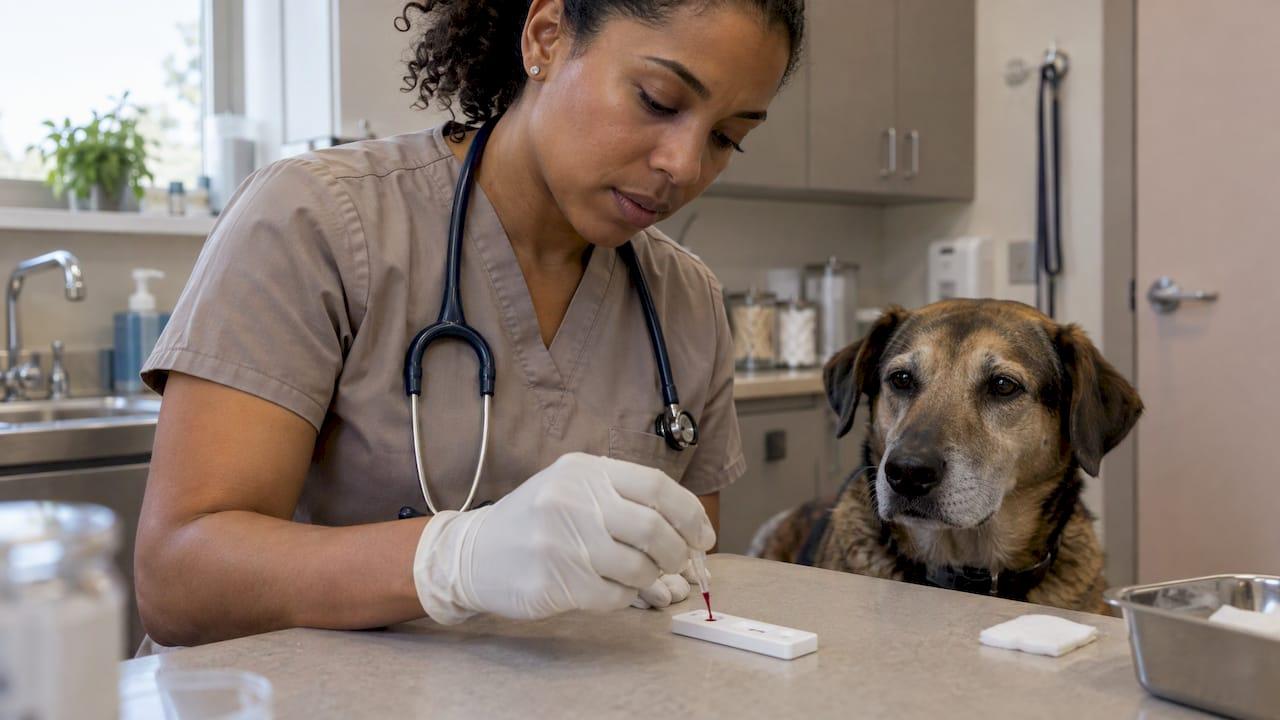
Test your dog for heartworm once a year, every year, and test before starting prevention in any dog 7 months or older. Puppies under 7 months can start prevention first and get tested later. Cats need annual screening too, though the tests are different. Below is the full timing, from a puppy's first visit to what to do after a missed dose.
TL;DR
- Adult dogs: test annually, and before starting prevention if the dog is 7 months or older and has not been on it.
- Puppies under 7 months: start prevention now, then test about 6 months later, again 6 months after that, then yearly.
- Missed two months or more of prevention: call your vet, restart right away, and retest 6 months later.
- Cats: annual testing is strongly recommended, ideally with both an antigen and an antibody test.
- The in-clinic test takes only minutes, so it fits into a normal wellness visit.
Table of Contents
- When to test an adult dog
- When to test a puppy
- Why the test can't catch a brand-new infection
- Testing after a missed or late dose
- Why you shouldn't start prevention without a test
- Cats and heartworm testing
- What the test involves
- A simple testing calendar
- Our perspective
- Book your pet's heartworm test
- FAQ
- Sources
When to test an adult dog
The American Heartworm Society (AHS) says all dogs should be tested every year. An adult dog over 7 months old that has never been on prevention should be tested before starting, then again 6 months and 12 months later, and annually after that.
The FDA gives the same guidance: test dogs 7 months and older before starting prevention, and test every year while the dog is on it.
The Companion Animal Parasite Council goes a step further. Its 2026 guidelines call for annual testing with both an antigen test and a microfilariae test, and note that some areas may warrant testing twice a year, especially for dogs exposed to many mosquitoes for long periods.

Why test if your dog is already on prevention?
The AHS points out that preventives are highly effective but not 100% effective. A yearly test confirms that the program is working. Dogs can also spit out or vomit a chewable, or a dose can slip by unnoticed. A test catches a problem while it is still easy to treat.
When to test a puppy
Puppies under 7 months can begin prevention without a test. The AHS then advises testing 6 months after the first visit, again 6 months later, and yearly after that.
AAHA's parasite control guidelines add that testing starting at 7 to 12 months of age allows early detection. It matters most for young adult dogs whose prevention started late and for newly adopted adults with an unknown history.
If you have a new puppy, our pediatric wellness exam guide walks through the first months, and our puppy deworming schedule covers the intestinal parasites that come up at the same visits.
Why the test can't catch a brand-new infection
This is the part that surprises owners. A heartworm test does not turn positive the day after a mosquito bite. According to the AHS canine guidelines, the earliest antigen can be detected is about 5 months after infection, and the earliest microfilariae about 6 months after. A reasonable pre-detection interval is 7 months.

The same guidelines note that in infected dogs on a macrocyclic lactone preventive, antigen may be suppressed until about 9 months after infection. In some cases, testing may need to wait even longer.
The CAPC explains why: antigen tests detect a protein from adult female worms. Mature infections with at least one female are usually found, while very low worm burdens or male-only infections may be missed.
What this means for you
- A negative test shows what was detectable when the sample was drawn, not what happened last week.
- If your vet suspects infection despite a negative antigen result, the CAPC recommends heat treatment of the serum to release antigen that antibodies may be masking.
- If a dog is likely infected but tests negative, the AHS recommends retesting in 6 months rather than waiting a full year.
Testing after a missed or late dose
Life gets busy. If your dog misses two months of prevention, the AHS says to consult your veterinarian, restart monthly prevention immediately, and retest 6 months later. The wait exists because heartworms need to be about 7 months old before an infection can be diagnosed.
The FDA lists other reasons your vet may adjust the schedule:
- Your dog's age when prevention began
- How long doses were missed
- A switch from one preventive to another
- Recent travel to an area where heartworm is more common
- The length of the heartworm season where you live
A Cornell veterinary resource lists similar triggers: dogs over 7 months, dogs on monthly preventives, 7 months after possible infection from missed doses, and annually or twice a year for higher-risk dogs.
Why you shouldn't start prevention without a test
It is tempting to skip the test and just give the pill. For dogs 7 months and older, the FDA warns that a preventive given to a dog with adult heartworms may be harmful or deadly. If microfilariae are circulating, the preventive can make them die suddenly and trigger a shock-like reaction.
Test first, then start. That one order protects your dog.
Cats and heartworm testing
Cats get heartworm too, and indoor cats are not exempt. The AHS feline guidelines strongly recommend annual testing, preferably with both a heat-treated antigen test and an antibody test. Testing before starting prevention is not required for cats but is highly recommended.
No single test finds every case in cats. Antibody tests can pick up an immune response as early as 2 months after infection, which is why the two tests are used together. Unlike dogs, cats do not need pre-testing for microfilariae before prevention, since the guidelines describe microfilaremia in cats as uncommon, transient and too low to trigger an adverse reaction.
What the test involves
The test starts with a small blood sample, usually from a front leg. An in-clinic antigen test needs only a few drops. According to Webvet, in-clinic results arrive in about 10 to 15 minutes, while samples sent to an outside lab usually take one to three business days.
Many clinics run the heartworm test as part of a combination screen that also checks for tick-borne diseases. Our guide to the SNAP 4Dx test for dogs explains what that visit looks like, and our tick disease testing guide covers how to avoid false negatives.
A simple testing calendar
| Situation | When to test |
|---|---|
| Puppy under 7 months | About 6 months after the first visit, 6 months later, then yearly |
| Dog 7 months or older, new to prevention | Before starting, then at 6 and 12 months, then yearly |
| Dog on prevention all year | Once a year |
| Two or more months of missed prevention | Restart now, retest 6 months later |
| Dog moved from another region or recently adopted | At the first visit, with follow-up as your vet advises |
| Cat | Yearly, antigen plus antibody if possible |
Our perspective
At City Animal, we treat the heartworm test as one of the most useful minutes of the wellness visit. It is quick, and it protects every other decision we make about prevention.
We build it into the annual exam so you don't need a separate trip. Our in-house laboratory means we can run tests on site, and our Fear Free approach keeps the blood draw calm for dogs and cats who dislike the clinic.
If your pet is anxious or hard to transport, a home visit can fit your life better. Tell us at booking and we will help you plan the visit around your pet.
CAVC
Book your pet's heartworm test
We offer wellness exams for dogs and cats in Brooklyn, with Fear Free handling and in-house lab work. Prefer to stay home? Ask about home visits. You can also read about our preventative care.

Call or book through our site to schedule your pet's next test.
FAQ
How long does a heartworm test take?
An in-clinic antigen test typically gives results in about 10 to 15 minutes, according to Webvet. If a sample goes to an outside lab, expect one to three business days.
Can I give heartworm medicine without testing first?
For dogs 7 months or older, no. The FDA says a preventive given to an infected dog may be harmful or deadly. Test first, then start prevention.
How soon after a mosquito bite will a test show infection?
About 5 months for antigen and about 6 months for microfilariae, per the AHS guidelines. A reasonable wait is 7 months, so a test right after a suspected exposure can't give a reliable answer.
Does my indoor cat need a heartworm test?
The AHS strongly recommends annual testing for cats. Ask your vet about pairing an antigen test with an antibody test, since no single test catches every case.
Sources
- Heartworm Basics, American Heartworm Society
- Keep the Worms Out of Your Pet's Heart, FDA
- AHS Canine Guidelines (2024)
- AHS Feline Guidelines
- Heartworm Diagnostics: Antigen Tests Alone Aren't Enough, AHS
- Companion Animal Parasite Council, Heartworm
- Parasite Control, AAHA
- Heartworm disease, Cornell University
- Heartworm Test for Dogs, Webvet