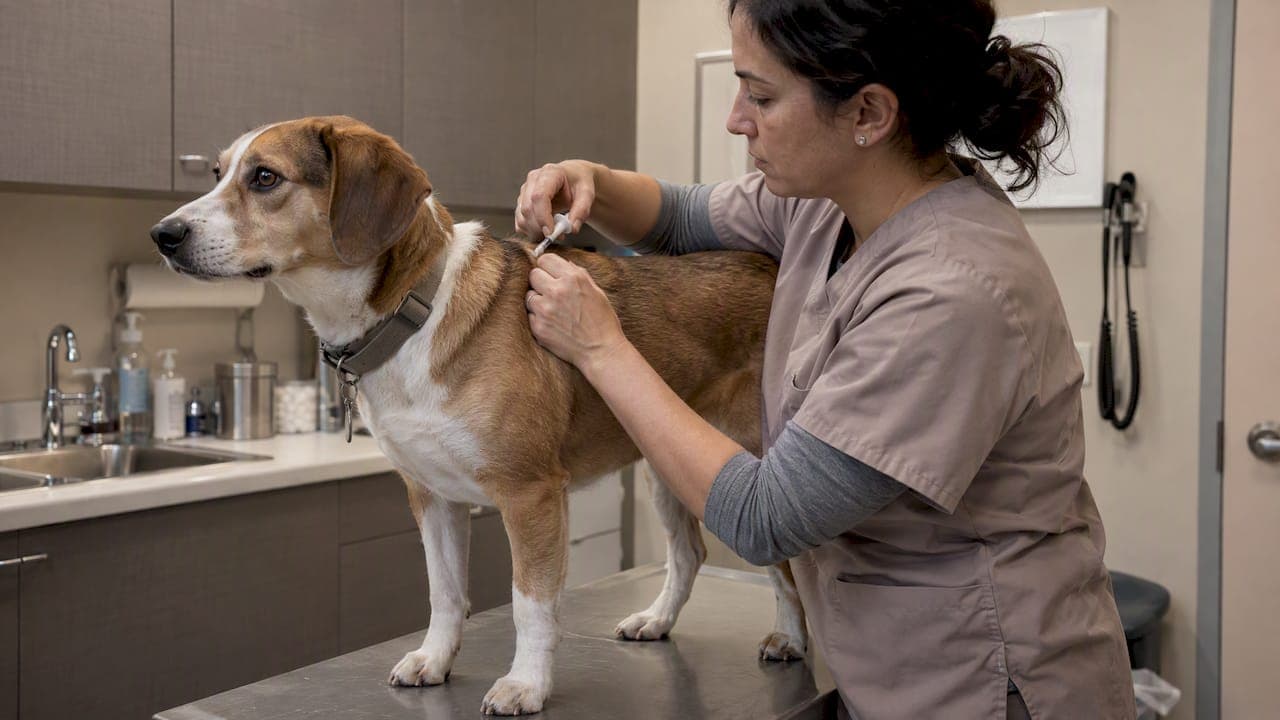
A microchip gives your dog permanent identification that a collar can't: it can't fall off, be removed or fade. In a large shelter study, microchipped stray dogs were returned to their owners 52.2% of the time, versus 21.9% for dogs without a chip. The chip also matters for travel, because the CDC now requires one for dogs entering the U.S. But the benefit depends on one thing owners often skip: keeping the registration current. Here is what a chip does, what it doesn't, and how to get the most from it.
TL;DR
- A microchip is permanent ID. Microchipped stray dogs in a study of more than 7,700 shelter animals were returned home at more than twice the rate of unchipped dogs.
- The chip is only a number. If the registry doesn't hold your current phone number and address, finders can't reach you.
- It is not a GPS tracker, and it doesn't replace a collar with ID and rabies tags.
- Travel rules often hinge on the chip: dogs entering the U.S. must be microchipped, and for the EU the chip must go in before the rabies vaccine.
- Ask your vet to scan the chip at every wellness visit to confirm it still reads.
Table of Contents
- What a microchip is (and what it isn't)
- The main benefits of microchipping your dog
- The step most owners skip: registration
- Microchipping and travel with your dog
- Is there a downside to microchipping?
- What to expect when your dog gets a chip
- Our perspective: chip it, register it, scan it
- Microchipping at City Animal Veterinary Center
- FAQ
- Sources
What a microchip is (and what it isn't)
A microchip is a tiny transponder, about the size of a grain of rice, placed under your dog's skin. It has no battery and no moving parts. According to the AVMA's microchipping FAQ, it is a passive RFID device: it only sends out its unique ID number when a scanner passes over it. That design is why it lasts a lifetime.
It also explains the limits:
- It doesn't track location. You can't open an app and see where your dog is. If your dog slips out of the yard, the chip does nothing until someone scans it.
- It doesn't contain your details. The chip holds a number. A registry database links that number to your name and phone.
- It needs a scanner. A shelter, rescue or vet clinic has to scan your dog first. A neighbor who finds your dog on the street can't read it.
That last point is why the AVMA's guidance is that a chip supplements a collar and tags, never replaces them. A collar with a current ID tag and rabies tag is the fastest way for a stranger to call you directly. The chip is the fail-safe for when the collar is gone.
The main benefits of microchipping your dog
Much better odds of getting home
This is the benefit that matters most. The study of 7,704 animals entering shelters found that stray dogs with microchips were returned at 52.2%, compared with 21.9% for those without. The AVMA's check-the-chip infographic summarizes it plainly: microchipped dogs are more than twice as likely to go home.
That is a shelter-based figure, and it covers strays who reached a facility that scans. It is not a promise about any single dog. But in a city like Brooklyn, where dogs can get out through an apartment door, a stairwell or a hallway in seconds, a permanent ID is an easy insurance policy.
Identification that can't be lost or removed
Collars slip off. Tags wear down, get chewed or are replaced and forgotten. A microchip stays in place for life, so identification is there after a harness is swapped, a collar is removed for grooming, or a frightened dog wriggles free. The AVMA's client brochure on microchipping notes that millions of animals have been chipped and reported problems are rare.
Proof and a path back when your dog is found far away
Dogs in a city travel. They get carried off in a stranger's arms, picked up by a rescue, or end up in another borough. When any clinic or shelter scans the chip, they get a number they can look up. If your registration is current, they can contact you the same day. If the dog is found with no collar at all, the chip is often the only thing they have to go on.
Requirements for travel
Microchips are no longer a nice-to-have for many trips. We cover this in detail below, because it's what many owners searching for "microchip for pet travel" need to know.
A one-time, quick procedure
The AVMA describes implantation as a quick, routine procedure, similar to a standard vaccination. There is no surgery and no recovery period for most dogs. The chip rarely needs replacing, and it has no battery to change.
The step most owners skip: registration
The chip alone doesn't bring your dog home. Registration does.
The AVMA explains that the main reason microchipped pets aren't reunited is missing or outdated contact information, not chip failure. Pets are found, scanned, and then staff hit a dead end: a disconnected phone number or an old address. The AVMA's check-the-chip materials point to the same problem, and cite figures suggesting a large share of chips are never properly registered.
A short checklist:
- Register the chip the day it's placed. Don't assume the clinic did it for you. Ask who registers it and get the confirmation in writing or by email.
- Use a phone number you will always answer. Add a second contact, such as a partner, family member or friend.
- Update after every move or number change. Put it on the same list as updating your driver's license or lease paperwork.
- Check your registration once a year. Log in, confirm the details, and confirm the chip number matches the one on your dog's records.
- Re-register after adoption. If you adopted your dog, the chip may still be registered to a shelter or the previous owner. Transfer it.
A useful side note: some owners also add a connected device to a collar for real-time communication and alerts. A microchip doesn't do that, and a device like that doesn't replace permanent ID either. One explainer on why chipping your pet matters covers the permanent-ID side of the picture for owners comparing options.
Microchipping and travel with your dog
Many of our clients first ask about chips because a trip is coming. Here is what the sources say, and where we'd tell you to check before you book anything.
Bringing a dog into the U.S.
As of August 1, 2024, the CDC requires dogs entering the United States to be microchipped, appear healthy, and be at least six months old. Dogs arriving from countries the CDC lists as high risk for dog rabies have to meet extra documentation requirements. If you are taking your dog abroad and coming back, this applies on the return leg.
Taking your dog to the EU
For EU destinations, order matters. USDA APHIS states that your pet must have a working microchip before its rabies vaccination for travel, and your veterinarian must scan the chip before giving the vaccine. A rabies vaccine given before the chip was placed generally doesn't count, which means repeating it and losing time. The same guidance points to checking that your chip meets the destination's standard (ISO 11784/11785) well ahead of time.
If your dog was chipped years ago with a non-standard chip, check this early. A scan at a wellness visit will tell us whether the chip reads properly.

Build the timeline backward
The chip is one piece of a paperwork chain: the chip, the rabies vaccine, sometimes a titer test, a health certificate within a set window, and USDA endorsement. Our guides walk through each piece:
- Pet health certificate travel: what U.S. pet owners must do
- The 10-day window: timeline to bring a dog to Europe from the U.S.
- Rabies titer FAVN: the complete pet travel guide
- APHIS 7001 form: what U.S. pet owners must know
- How to find a USDA accredited veterinarian
Requirements differ by country and change, so always confirm with the destination's official rules before you act. Our pet travel and international health certificate service is the place to start if you are planning a trip.
Is there a downside to microchipping?
Honest answer: the risks are small, and it helps to know what they are.
- Migration. The AVMA brochure names this as the most common problem: the chip moves from where it was placed. It can then be harder to find with a scanner.
- Rare reactions. Chip failure, hair loss, infection or swelling are described as rare.
- Privacy worries. The chip holds a number, not your address. Your details sit in a registry you control.
- False confidence. The real downside is assuming the chip works on its own. An unregistered chip or an outdated phone number can leave you no better off than before.
For nearly all dogs, the AVMA's view is that the protection outweighs these uncommon risks.
Why annual scans matter
At every wellness exam, ask your vet to scan the chip. We want to confirm it still reads and hasn't traveled far from the usual spot between the shoulder blades. A chip that has shifted can be missed by a rushed scan, which is how a found dog can end up treated as unchipped. A scan takes seconds and can be part of a routine visit.
What to expect when your dog gets a chip
The process is simple, and for an anxious dog the atmosphere matters more than the needle.
- Scan first. We check whether a chip is already there. Dogs adopted from shelters or rescues sometimes have one nobody remembers.
- Placement. The chip is placed under the skin with a needle, much like a vaccine.
- Verify. The chip is scanned again to confirm the number reads.
- Register. You record your contact details so the number leads to you.
Many owners have the chip placed during a puppy visit, a spay or neuter, or another procedure, so there is no extra trip. If you have a young dog, ask us how timing fits with their vaccine schedule and size. Don't guess at an age on your own: the right moment depends on your dog, and a vet can tell you.
Our perspective: chip it, register it, scan it
We see the same pattern in the exam room. Owners who chip their dogs are doing the right thing, but the chip is a three-part habit: place it, register it, check it. Most of the heartbreak in lost-pet stories comes from the second and third steps being forgotten, not from the chip itself.
We are also a Fear Free practice. Chip placement is quick, but a nervous dog can turn a two-second task into a bad memory. So we pair it with low-stress handling: calm approach, treats, and time for the dog to settle. If your dog hates the clinic, a house call may make sense. Our home visit service exists for owners who can't easily travel with their pets, and it's worth asking about when you book.
Our advice for a Brooklyn dog: wear a collar with a current ID tag and rabies tag, have a registered chip as backup, and have the chip scanned at every checkup. Do those three things and you have covered the realistic ways a dog gets separated from a family.
— CAVC
Microchipping at City Animal Veterinary Center
We offer microchipping at our Brooklyn practice, and we can scan your dog's existing chip during a wellness exam. If you are a new client, our new client page explains how to get started. Traveling soon? Tell us your destination and dates when you call, so we can check that the chip, the rabies vaccine and the health certificate fall in the right order.
FAQ
What is the best age to microchip a dog?
Many dogs are chipped as puppies, often at a routine visit. The right timing depends on your dog's size and health, so ask your vet at the first puppy exam. Adult dogs and rescues can be chipped at any age. If a trip is planned, remember that the CDC requires dogs entering the U.S. to be at least six months old and microchipped.
What happens if you don't chip your dog?
Your dog can still be found, but the odds shift. In the shelter study cited above, unchipped stray dogs were returned to owners 21.9% of the time, compared with 52.2% for chipped dogs. You may also hit roadblocks with international travel, where a chip is a standard requirement.
Does a microchip track my dog's location?
No. It is a passive RFID device with no battery and no GPS. It sends its ID number only when a scanner is held over it. Keep a collar and ID tag on your dog for immediate contact by finders.
Do I need to update anything after I chip my dog?
Yes. Register the chip, then update the registry whenever your phone number, address or emergency contact changes. The AVMA identifies outdated registration as the main reason chipped pets aren't reunited with their families. Check your details once a year.
Is microchipping painful or risky?
The AVMA describes it as a quick, routine procedure similar to a vaccination. Complications such as migration, infection or swelling are reported as rare. If your dog has a medical condition or you have concerns, talk to your vet before the appointment.
Sources
- Characterization of animals with microchips entering animal shelters, JAVMA
- Microchipping: FAQs for pet owners, AVMA
- Microchipping client brochure, AVMA
- Check the chip infographic, AVMA
- CDC Updates Dog Importation Regulation
- High-Risk Countries for Dog Rabies, CDC
- Pet travel microchip requirements, USDA APHIS