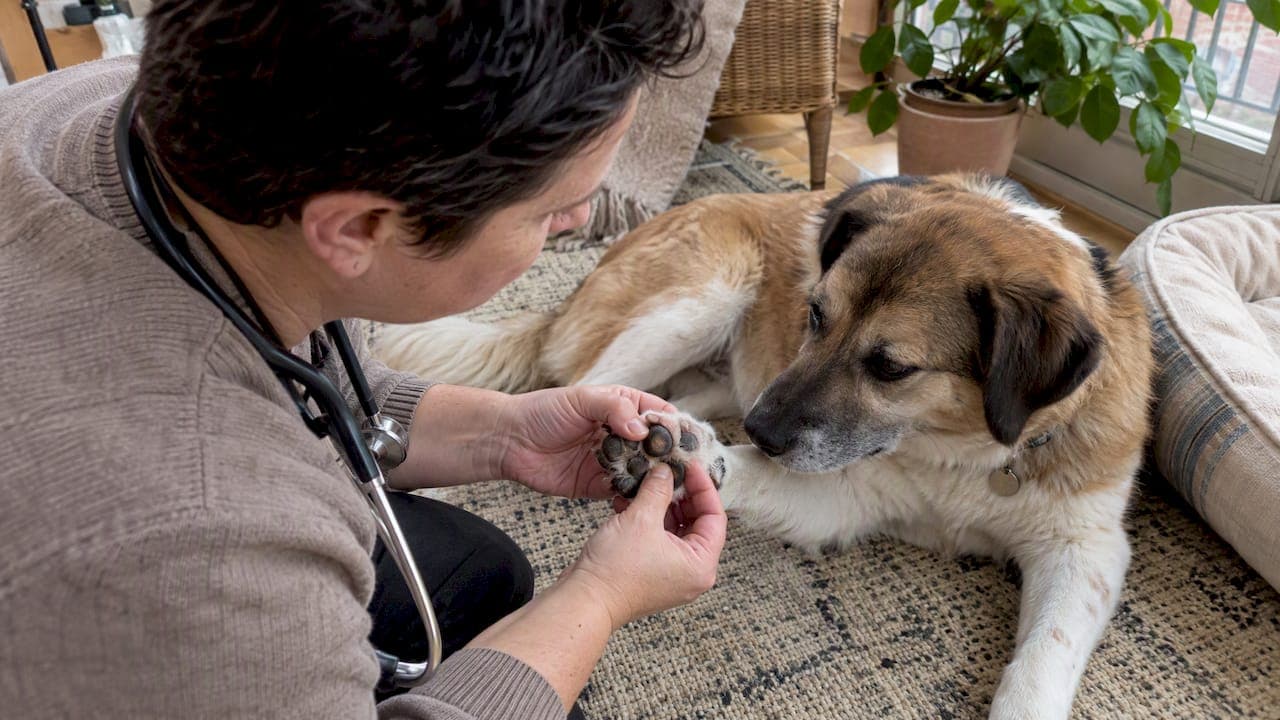
Red, smelly, constantly licked paws are a common sign of Malassezia overgrowth, a yeast that normally lives harmlessly on canine skin. When the signs match, the right next step is a veterinary exam with skin cytology, paired with vet-directed paw hygiene started right away. Severe pain, open sores, or signs of illness beyond the paws call for urgent veterinary contact rather than home treatment.
TL;DR:
- Veterinarians confirm suspected yeast overgrowth with skin cytology, which can identify yeast and accompanying bacteria during the appointment; visual signs alone cannot distinguish lookalikes.
- Topical treatment needs 10 minutes of skin contact, application every three to five days, and roughly one more week after symptoms clear.
- Recurring flares often return unless veterinarians address triggers such as allergies or endocrine disease; antifungal treatment alone may clear yeast temporarily without preventing another episode.
- Oral antifungals are reserved for widespread, deep, or resistant cases; veterinary supervision matters because courses often last three to four weeks or longer.
- Open sores, severe pain, lameness, or illness beyond the paws need prompt care; call a veterinarian if treatment shows no improvement after 7 to 10 days.
Table of Contents
- What a Paw Yeast Infection (Malassezia Dermatitis) Is
- How Dogs Get Yeast on Their Paws: Triggers and Mechanisms
- Which Dogs Are More Likely to Get Recurring Paw Yeast Infections
- Signs Owners Notice: A Practical Symptom Checklist
- How Vets Diagnose Paw Yeast Infections
- Treatment Roadmap: From Topical Care to Systemic Antifungals
- Managing Recurrence: Maintenance Hygiene and Prevention
- When to Seek Veterinary Care Urgently
- City Animal Veterinary Center: Clinic Tips and House-Call Notes
- Clinician Perspective: Realistic Expectations for Chronic Cases
- How We Can Help With Your Dog's Paw Yeast Infection
- FAQ
- Sources
What a Paw Yeast Infection (Malassezia Dermatitis) Is
Malassezia pachydermatis is a yeast that lives on normal dog skin without causing any trouble most of the time. It only becomes a problem when something shifts the balance of the skin's surface environment, allowing the yeast population to multiply far beyond its usual numbers. That shift from harmless resident to active irritant is what vets mean when they diagnose Malassezia dermatitis, and it's described in the WAVD consensus on Malassezia dermatitis as a disturbance of the host-yeast relationship rather than a new infection picked up from somewhere else.

Paws are one of the most common sites because the skin between the toes, called the interdigital space, traps moisture and warmth, both of which favor yeast growth. Other frequent locations include the ears, the skin folds, the groin, and the neck.
Paw inflammation isn't always yeast, though, and the symptoms can overlap with other skin problems:
- Dermatophytes (ringworm): tend to cause circular, scaly patches and are less commonly linked to the greasy, musty odor typical of yeast.
- Mites such as Demodex: cause hair loss and inflammation that can look similar on the surface; diagnostic skin scrapings are needed to rule this out.
- Bacterial infections: often cause more pus and crusting, and frequently occur alongside yeast rather than instead of it.
Because these conditions can look alike to the naked eye, a visual check at home is a starting point, not a diagnosis.
How Dogs Get Yeast on Their Paws: Triggers and Mechanisms
Yeast overgrowth doesn't appear out of nowhere. It develops when something disrupts the normal checks that keep Malassezia in check on the skin, whether that's a change in skin oil production, a weakened skin barrier, or a shift in moisture levels that gives the yeast a more favorable environment to multiply in.
Several common triggers set this imbalance in motion:
- Allergies (environmental or food-related): inflamed, itchy skin produces more oil and sheds its protective barrier faster, both of which feed yeast growth.
- Chronic moisture: frequent swimming, wet grass, rain, or paws that don't dry fully between walks keep the interdigital skin damp.
- Damaged skin barrier: cuts, abrasions, or chronic licking wear down the skin's natural defenses.
- Foreign material: grass awns, splinters, or debris lodged between the toes irritate the skin and create a moist pocket.
- Systemic disease: conditions like hypothyroidism or Cushing's disease alter skin oil production and immune function in ways that favor yeast.
Seasonality plays a role too. Humid summer months and regions with high rainfall tend to see more paw yeast cases, since warm, damp conditions are exactly what the yeast favors. Dogs that swim regularly or live in consistently humid climates often need more frequent paw drying and checks during these periods. Owners who notice a pattern of worsening symptoms after walks in wet grass or after swimming sessions are often looking at a moisture-driven trigger, which is useful information to share with a vet during an exam.
Which Dogs Are More Likely to Get Recurring Paw Yeast Infections
Some dogs deal with a single, resolved episode. Others face it again and again, and the pattern usually traces back to an underlying issue that keeps resetting the conditions yeast needs to thrive.
- Dogs with allergies (atopic or food-related) are the largest group at risk, since chronic itching leads to licking, licking damages the skin barrier, and the damaged barrier invites yeast overgrowth, a cycle that repeats unless the allergy itself is addressed.
- Breeds with skin folds or dense paw hair, including many terrier types and breeds with heavily furred feet, trap moisture more easily between the toes.
- Older dogs and those with endocrine disease, such as hypothyroidism or Cushing's disease, often have altered skin chemistry that favors yeast overgrowth.
- Dogs with a history of recurrent ear or skin yeast infections tend to have a general predisposition that shows up in multiple body sites, not just the paws.
Addressing the root cause rather than only the yeast itself is the difference between a one-time treatment and a cycle of relapses. A dog with undiagnosed allergies, for instance, can clear a yeast flare with antifungal treatment and see it return within weeks if the allergy driving it goes unmanaged. Our paw licking checklist walks through common allergy signs worth tracking at home.
Signs Owners Notice: A Practical Symptom Checklist
Most owners catch a paw yeast infection because of behavior changes before they notice the skin changes themselves. A dog suddenly obsessed with licking or chewing one or more paws, especially at night or during quiet moments, is often the first clue.
Watch for this combination of signs:
- Persistent licking or chewing focused on one or more paws, often worse in the evening.
- Redness or inflammation of the skin between the toes or on the top of the paw.
- Brownish or rust-colored staining on the fur, claws, or pads, caused by saliva from constant licking.
- Greasy texture or flaking of the skin surface.
- A musty, "corn chip" type odor, often the most distinctive clue that owners describe.
Clinical signs commonly include pruritus, redness, scaling, and malodor, and severe or long-standing cases can develop darkened, thickened skin. A dog that's limping, flinching when the paw is touched, or showing open sores has moved beyond a routine case and needs prompt veterinary attention rather than at-home management.
Pro Tip: Take a few close-up photos of the affected paw every few days and jot down when the licking started. That timeline helps a vet distinguish a fast-moving flare from a slow, chronic pattern, and it speeds up the diagnostic conversation at the first visit.
How Vets Diagnose Paw Yeast Infections
Skin cytology is the standard first step for diagnosing yeast overgrowth, and it's quick enough to run during a routine appointment. A vet presses clear tape against the affected skin or takes a direct impression smear from the interdigital area, stains the sample, and examines it under a microscope.
This approach works well because:
- Tape strip and impression smear techniques are described by the Royal Canin Academy's clinical overview as practical, clinic-ready tools that are often enough on their own to confirm yeast overgrowth.
- Staining and microscopy let the vet see the yeast's distinctive shape directly, along with any bacteria that may be present alongside it.
- Results are available the same visit in most general practice settings, with no need to send samples to an outside lab for routine cases.
Culture, biopsy, or bloodwork come into play when a case doesn't fit the usual pattern. The ESCCAP guideline on superficial mycoses notes that culture and biopsy are reserved for atypical presentations or infections that don't respond to standard therapy as expected. Bloodwork or endocrine testing is more often recommended for dogs with recurring infections in multiple sites, since that pattern can point to an underlying condition like hypothyroidism.
Clinical response to treatment is itself a diagnostic tool in some cases. According to the WAVD consensus on Malassezia dermatitis, a dog with a notably high yeast population on cytology that then improves with antifungal therapy has effectively confirmed the diagnosis through that response. Even dogs with relatively low yeast counts on the slide can be clinically sensitive to the yeast present, so a short therapeutic trial sometimes settles the question when cytology alone is ambiguous. Our guide to skin cytology in dogs covers what the sample collection and interpretation process typically involves.
Pro Tip: If your dog's paw symptoms affect more than one foot or come back repeatedly, mention that pattern specifically. It often shifts the diagnostic conversation toward checking for an underlying allergy or endocrine cause rather than treating the yeast alone.
Treatment Roadmap: From Topical Care to Systemic Antifungals
Most paw yeast infections respond to topical treatment alone, and that's where therapy almost always starts.
The ESCCAP guideline specifies that topical treatments need to stay in contact with the skin for at least 10 minutes to work effectively, applied every three to five days, or about twice weekly. Treatment duration varies with case severity, generally lasting several weeks and extending longer for more extensive or stubborn infections. The Royal Canin Academy notes that a twice-weekly regimen over three weeks is often sufficient as the sole therapy for localized cases.
Applying topical treatment correctly makes a real difference in outcomes:
- Focus on the interdigital spaces between each toe, not just the top or bottom of the paw, since that's where moisture and yeast concentrate most.
- Dry the paw thoroughly after each treatment, since leftover dampness undermines the whole point of the wash.
- Use an e-collar or a supervised distraction for the first several minutes after application, since dogs will lick off the product immediately given the chance, cutting the contact time well below what's needed.
- Keep a consistent schedule rather than treating only when symptoms flare, since gaps in the routine let the yeast population rebound between sessions.
Systemic antifungal medication becomes necessary when topical treatment isn't enough on its own, typically for infections that are widespread, deeply rooted, or not responding as expected. Oral options include itraconazole, ketoconazole, and terbinafine. The WAVD consensus reports that courses often run three to four weeks or longer for refractory cases, with visible improvement frequently appearing within about a week of starting treatment. Some azole drugs persist in skin tissue long enough that a pulsed schedule, such as two consecutive days a week, can be effective, though that kind of regimen requires veterinary oversight to monitor for side effects and confirm it's working as intended.
A few supporting details matter regardless of which treatment path a dog is on:
- Secondary bacterial infections are common alongside yeast and need their own treatment, usually determined by the same cytology sample.
- Anti-itch medication can break the itch-lick cycle while the antifungal treatment takes effect, reducing self-trauma in the meantime.
- Treatment should continue roughly one week past visible clinical cure. Stopping as soon as the skin looks normal is one of the most common reasons infections come right back, since a small residual yeast population can rebuild quickly once treatment stops.
Pro Tip: Mark treatment days on a calendar or phone reminder. Missed or inconsistent applications are one of the most frequent reasons topical therapy underperforms, not a failure of the product itself.
Managing Recurrence: Maintenance Hygiene and Prevention
Clearing an active infection is only half the job for dogs prone to repeat flares. The other half is building a maintenance routine that keeps the skin environment from tipping back toward overgrowth.
- Use antifungal or antiseptic wipes on a set schedule, not just when symptoms appear, particularly for dogs with a known history of recurrence.
- Dry paws thoroughly after swimming, bathing, or walks in wet conditions, since residual moisture is one of the most controllable triggers.
- Consider protective booties during consistently wet or muddy seasons to limit moisture exposure in the first place.
- Step up maintenance frequency during humid months or in climates with heavy seasonal rainfall, when yeast-friendly conditions are more persistent.
- Work with a vet on allergy diagnosis and management if yeast keeps recurring, since the WAVD consensus is clear that antifungal treatment alone rarely solves recurring cases without addressing the underlying trigger. Our overview of multimodal allergy treatment covers how that combined approach typically works.
Follow-up cytology is a useful checkpoint even once symptoms look resolved, since it confirms the yeast population has actually returned to normal rather than just looking calmer on the surface. For dogs with a documented history of relapse, some vets recommend low-frequency maintenance topical therapy, such as a wipe-down once or twice a week indefinitely, as a practical middle ground between full treatment courses and no intervention at all.
Pro Tip: If your dog's yeast flares follow a predictable seasonal pattern, start maintenance wipes two to three weeks before that season typically begins rather than waiting for symptoms to reappear.
When to Seek Veterinary Care Urgently
Most paw yeast cases are uncomfortable but not emergencies. A handful of signs change that.
Contact a vet promptly, rather than waiting, if you see:
- Open wounds, bleeding, or raw skin from aggressive licking or chewing.
- Severe pain or sudden lameness, especially if your dog won't bear weight on the paw.
- Fever, lethargy, or loss of appetite alongside the paw symptoms, which suggests the problem may extend beyond the skin.
- No improvement after 7 to 10 days of a treatment plan already started, which usually means the regimen needs adjusting rather than more time.
At a recheck, vets typically repeat cytology to confirm the yeast count has actually dropped, check for new or persisting bacterial infection, and ask about how consistently the treatment plan was followed at home. Bringing a simple symptom diary and a few dated photos to that visit makes the comparison faster and more accurate than relying on memory alone.
City Animal Veterinary Center: Clinic Tips and House-Call Notes
Paw handling can be stressful for dogs that are already sore or itchy, which is where a Fear Free approach makes a real difference during the exam itself. Lower stress during handling means a calmer cytology collection and a more accurate read on how uncomfortable the paw actually is.
A few practical notes for getting the most out of a visit:
- House calls work well for anxious or hard-to-transport dogs, as well as for straightforward follow-up checks once a treatment plan is already underway.
- Bring photos and a timeline of when symptoms started and whether they've changed, since that history shapes the diagnostic approach from the first minute.
- List any products already tried, including over-the-counter washes or wipes, so treatment isn't repeating something that already didn't work.
- In-house lab capability means cytology results are often available the same visit, without a wait for outside lab processing.
Clinician Perspective: Realistic Expectations for Chronic Cases
Some dogs clear a paw yeast infection in a few weeks and never deal with it again. Others, usually dogs with underlying allergies or endocrine conditions, face a pattern of flares that needs ongoing management rather than a single fix. That's not a treatment failure. It's the nature of a problem that's rooted in something beyond the yeast itself.
Most infections respond well once both the yeast and the underlying trigger are addressed together, and owners who stay consistent with maintenance routines tend to see fewer, milder flares over time. If symptoms aren't improving or seem to be getting worse, reaching out sooner rather than later keeps a manageable case from becoming a harder one to treat.
— CAVC
How We Can Help With Your Dog's Paw Yeast Infection
We offer dermatology consultations built around getting to an accurate diagnosis quickly, with in-house cytology that gives us same-visit answers on what's actually happening with your dog's skin. A calm exam approach helps reduce stress when a paw is already sore or sensitive to touch, and house calls can be beneficial for dogs that find clinic visits stressful or need a simple follow-up check without a full trip in.

A dermatology visit for a paw issue typically includes:
- A full skin and paw exam to check for patterns across multiple feet or body sites.
- Cytology sampling with results available during the appointment.
- A tailored treatment plan based on cytology findings.
- A maintenance plan for dogs with a history of recurrence or underlying allergies.
| What to expect | Details |
|---|---|
| Diagnostic approach | In-house cytology with same-visit results |
| Visit format | In-clinic Fear Free exam or house call |
| Follow-up | Recheck cytology and treatment adjustment as needed |
Reach out through our dermatology services page to set up a visit, or check our home visit options if your dog does better without the trip to the clinic.
FAQ
How do you cure a yeast infection in a dog's paws?
Most cases clear with a topical antifungal regimen, typically a 2% miconazole and 2% chlorhexidine shampoo or wipe left on the skin for about 10 minutes and applied every three to five days. Treatment continues for one to several weeks past when the skin looks normal, since stopping too early is a common cause of relapse.
What naturally kills yeast in dogs?
There's no proven natural substitute for veterinary-directed antifungal treatment, and relying on one can delay effective care. Keeping paws dry and clean supports treatment but doesn't replace the antifungal washes and, when needed, oral medication a vet prescribes based on cytology findings.
Can I put Monistat on my dog's paws?
Some human antifungal products share an active ingredient with veterinary formulas, but using them without guidance isn't recommended, since dosing and formulation differences can make them ineffective or inappropriate for a dog's skin. A vet exam confirms the diagnosis first and points to a product and schedule that actually matches the case.
Will a yeast infection go away on its own in a dog?
It's unlikely without addressing what triggered the overgrowth in the first place, since the underlying imbalance, whether it's allergies, moisture, or a skin barrier issue, tends to persist on its own. Infections left untreated often progress to more inflamed, thickened, or darkened skin over time rather than resolving.
Sources
- ESCCAP Guideline GL2: Superficial mycoses in companion animals
- Biology, diagnosis and treatment of Malassezia dermatitis in dogs and cats — WAVD consensus (Bond et al., 2020)
- Diagnosis and treatment of Malassezia dermatitis in dogs | Royal Canin Academy
- Atopic dermatitis in dogs — Merck Veterinary Manual