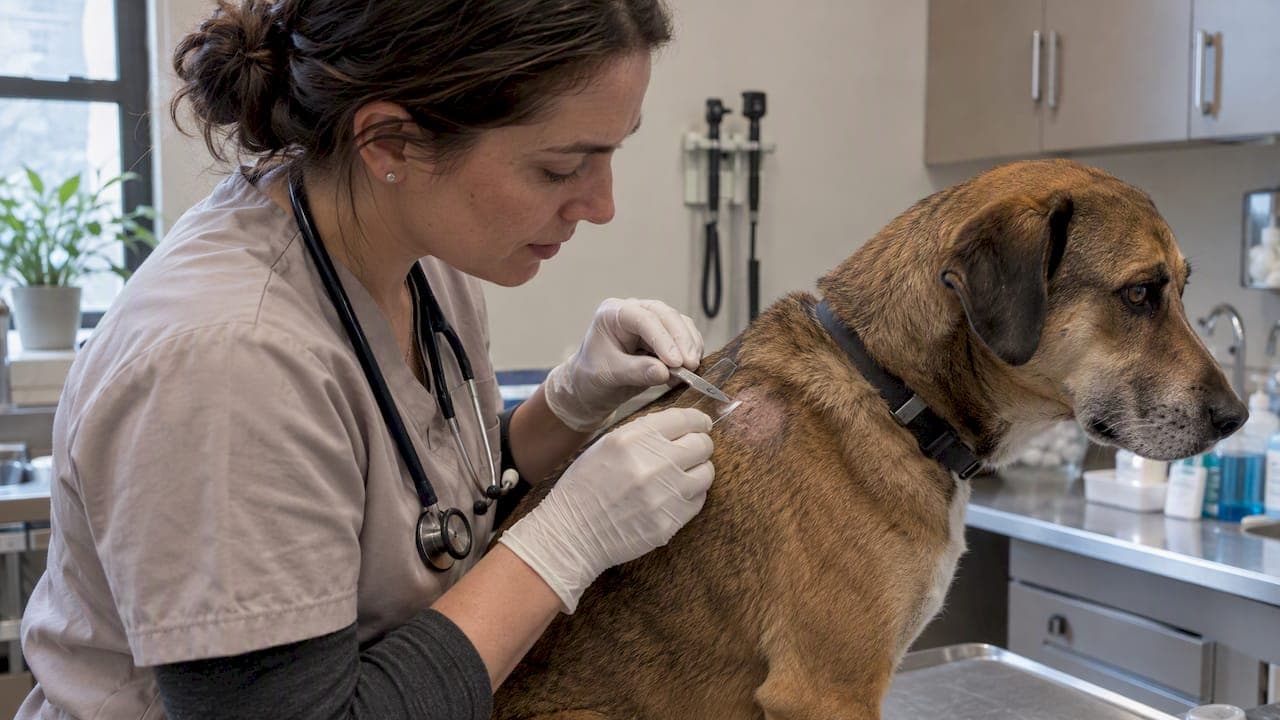
Demodex, or demodicosis, is mite overgrowth in hair follicles that causes patchy hair loss and skin irritation. Mild, localized cases often clear up on their own, but spreading or generalized lesions need a veterinary skin scraping to confirm the diagnosis and start treatment. Human transmission is rare, and many healthy puppies carry small numbers of mites without ever getting sick.
TL;DR:
- Localized demodicosis usually involves small patches on the face or front legs and often resolves without aggressive treatment.
- Generalized demodicosis affects multiple body areas or entire limbs and requires sustained veterinary treatment with drugs like isoxazolines or macrocyclic lactones.
- Deep skin scraping remains the gold standard for diagnosis, and multiple samples from affected sites improve detection accuracy.
- Treatment should continue for one to two months after two consecutive negative scrapings to prevent relapse, with recheck screens scheduled every four to eight weeks.
- Unlike some skin conditions, demodicosis typically does not cause severe itching, so spreading lesions or secondary infections are primary signs that require veterinary attention.
Table of Contents
- What demodex is and why the form matters
- Common signs to look for
- How veterinarians confirm demodex
- Treatment options and how vets choose one
- Monitoring, prognosis, and preventing relapse
- What to expect at the veterinary visit
- A veterinarian's perspective on demodex treatment
- How City Animal Veterinary Center can help
- Sources
- FAQ
What demodex is and why the form matters
Demodex mites live in the hair follicles of virtually every dog, and in small numbers they cause no harm at all. Problems start when the immune system fails to keep their population in check, allowing mites to multiply and trigger hair loss, inflammation, and sometimes secondary skin infection.
Veterinarians classify the disease by how widespread it is, since the distinction drives both prognosis and treatment decisions, according to the University of Minnesota Animal Dermatology program.
- Localized demodicosis typically involves a few small patches, often on the face or front legs, and frequently resolves without aggressive treatment.
- Generalized demodicosis affects several body regions or an entire limb and almost always requires sustained medical treatment.
- Juvenile-onset disease appears in puppies and young dogs and often has a better long-term outlook than cases that begin later in life.
- Adult-onset demodicosis raises concern for an underlying illness that may suppress the immune system.
Because generalized and adult-onset cases can reflect a deeper health issue, breeding considerations also come into play: dogs that develop generalized demodicosis are generally not recommended for breeding.
Common signs to look for
Demodicosis rarely looks dramatic at first. Owners typically notice patchy hair loss, sometimes with scaling, redness, or small bumps called comedones clustered around the face, eyes, or front legs, a pattern the University of Minnesota's dermatology reference describes as classic for localized disease.
- Patchy or moth-eaten hair loss, often starting around the eyes, muzzle, or front legs.
- Scaling, redness, or a greasy coat, the last of which can point to a related mite variant, Demodex injai.
- "Raccoon eyes", a darker ring of hair loss around the eyes seen in some puppies.
- Swollen, painful paws or draining tracts, which can signal a more serious secondary infection called furunculosis.
One notable pattern: demodex itself is often not very itchy, so intense scratching usually points to a secondary bacterial infection or another skin disease layered on top. If lesions are spreading, draining, or your dog seems generally unwell, that combination is a reason to see a veterinarian promptly rather than wait it out. Owners comparing itch-driven conditions may also find it useful to read about paw licking caused by allergies, which can look similar but behaves differently than demodex.
How veterinarians confirm demodex
Deep skin scraping remains the diagnostic gold standard for demodicosis, according to the World Association for Veterinary Dermatology consensus guidelines. A vet pinches the skin to push mites up from the follicles, then scrapes until capillary bleeding appears, since mites can hide deep in hair follicles and be missed by a shallow sample.
- Multiple deep scrapings from several affected sites improve detection, especially when mite numbers are low.
- Hair plucks, tape-squeeze preparations, or skin cytology can help in areas where scraping is difficult, such as around the eyes or on the paws.
- Fungal culture, PCR, or skin biopsy may be added when the presentation is unusual or scrapings do not match the clinical picture.
- Bloodwork or hormone testing is considered for adult-onset cases, since conditions like Cushing's disease, hypothyroidism, or cancer can suppress immunity and allow mites to flourish.
- MDR1 gene testing is sometimes recommended before starting macrocyclic lactone drugs in breeds known to carry the sensitivity mutation.
Finding a few mites on a scraping does not automatically confirm disease. A veterinarian weighs mite numbers, their life stages, and the pattern of skin lesions together, since low numbers of mites are a normal finding in many healthy dogs. For a closer look at how these samples are read in practice, see this guide to skin cytology in dogs.
Treatment options and how vets choose one
Treatment depends heavily on whether the disease is localized or generalized. Localized demodicosis is often managed with observation alone, sometimes paired with a topical antiseptic if the skin looks irritated, since many of these mild cases clear up as the dog's immune system matures.
Generalized demodicosis calls for sustained, vet-directed therapy. Several drug classes are commonly used, and the Merck Veterinary Manual notes that choice depends on the dog's age, breed, and neurologic history.
- Isoxazolines (afoxolaner, fluralaner, lotilaner, sarolaner), often dosed monthly or every 8 to 12 weeks for fluralaner, are widely used for generalized cases.
- Macrocyclic lactones, including milbemycin, moxidectin, and ivermectin, are effective options but require caution in breeds prone to the MDR1 mutation.
- Amitraz dips or collars remain an option in select cases where other treatments aren't suitable.
Safety matters here. The FDA has issued an advisory noting that isoxazoline-class products have been associated with neurologic events such as tremors, ataxia, and seizures in some animals, and recommends consulting a veterinarian before use, particularly in dogs with a seizure history. Macrocyclic lactones carry their own risk in MDR1-sensitive breeds, which is why genetic testing sometimes comes first.
Secondary bacterial infection, or pyoderma, is common in generalized demodicosis and needs its own treatment. The Companion Animal Parasite Council recommends topical chlorhexidine or benzoyl peroxide shampoos alongside culture-directed systemic antibiotics when infection is confirmed. Readers dealing with related skin infections may find this piece on hot spots in dogs useful for understanding topical antiseptic care.

Pro Tip: Never stop demodex treatment early just because the coat looks better, since visible improvement often happens before the mites are actually cleared, and stopping too soon is one of the most common causes of relapse.
Monitoring, prognosis, and preventing relapse
Generalized demodicosis requires a defined stopping point, not a guess. The University of Minnesota's guidance and the CAPC demodex guideline both recommend continuing treatment for one to two months after two consecutive negative skin scrapings taken four to eight weeks apart.
- Recheck scrapings are scheduled every 4 to 8 weeks until two in a row come back clear.
- Localized cases generally carry an excellent prognosis with minimal intervention.
- Juvenile-onset generalized cases tend to have a fair to good outlook with consistent treatment.
- Adult-onset cases are more variable and often require investigating an underlying illness before the skin will fully respond.
Since demodicosis can have a hereditary component, spaying affected intact females and avoiding breeding dogs that develop generalized disease are commonly recommended long-term measures.
What to expect at the veterinary visit
A typical demodex workup starts with a history and a focused skin exam, followed by deep skin scrapings from several sites and a cytology check for bacteria or yeast. Depending on the findings, a vet may add fungal testing or bloodwork, especially for adult-onset cases.
For dogs who find clinic visits stressful, Fear Free certified handling and home visit exams can make it easier to collect good samples without a fight, since a calmer patient means a more accurate scraping.
- Bring a medication history, including any recent flea or tick products and supplements.
- Mention any recent breeding activity or immunosuppressive drugs the dog has received.
- Ask about the recheck schedule and what a "clear" scraping actually looks like before treatment stops.
A veterinarian's perspective on demodex treatment
The mistake owners make most often is treating demodex as a one-size-fits-all skin problem. Breed, age, and neurologic history should drive drug choice, not habit, and follow-up scrapings matter as much as the first diagnosis. Skip the internet shortcuts and extra-label dosing: what's safe for one dog can be dangerous for another.
— CAVC
How City Animal Veterinary Center can help
If your dog has spreading lesions or signs that just will not clear, a proper diagnostic workup makes the difference between guessing and treating the actual problem. Veterinary centers offering dermatology evaluations and in-house laboratory testing may provide cytology and scrapings needed to confirm demodicosis, sometimes using Fear Free certified approaches to help anxious dogs stay calmer during sample collection.

- Dermatology evaluations to identify the cause of skin lesions and lay out a treatment plan.
- In-house laboratory and cytology for same-visit results on skin scrapings.
- Home visits may be available for dogs who struggle with clinic travel or handling.
- Handling techniques aimed at reducing stress throughout every step of the exam.
If your dog's skin issues are spreading or not improving, book a wellness exam to get a diagnostic workup started.
This article is general information, not a substitute for advice from a qualified doctor. Consult a qualified healthcare professional about your own circumstances before acting on anything here.
Sources
- Canine demodicosis — University of Minnesota Animal Dermatology (2025)
- Diagnosis and treatment of demodicosis in dogs and cats: Clinical consensus guidelines (WAVD)
- Mange in dogs and cats — Merck Veterinary Manual
- Companion Animal Parasite Council (CAPC) demodex guideline
- FDA fact sheet on isoxazoline adverse events
FAQ
How do you treat demodex in dogs?
Localized demodicosis often resolves with observation and sometimes a topical antiseptic, while generalized cases need sustained treatment with drugs like isoxazolines or macrocyclic lactones, chosen based on the dog's breed and health history. Treatment typically continues for one to two months past two consecutive negative skin scrapings.
Is dog demodex contagious to humans?
Demodex canis is considered specific to dogs and is not typically contagious to people. It's also not usually passed between unrelated dogs, since most cases start when puppies acquire the mites from their mother shortly after birth.
How to tell if a dog has demodex mites?
Watch for patchy hair loss, scaling, or small bumps, often starting around the face, eyes, or front legs, usually without intense itching unless a secondary infection has set in. A veterinarian confirms the diagnosis with a deep skin scraping examined under a microscope.
Where do dogs get demodex from?
Puppies typically pick up Demodex mites from their mother during the first few days of life, and most healthy dogs carry small numbers without ever developing disease. Clinical demodicosis develops when something, often an immature or suppressed immune system, allows the mite population to grow out of control.