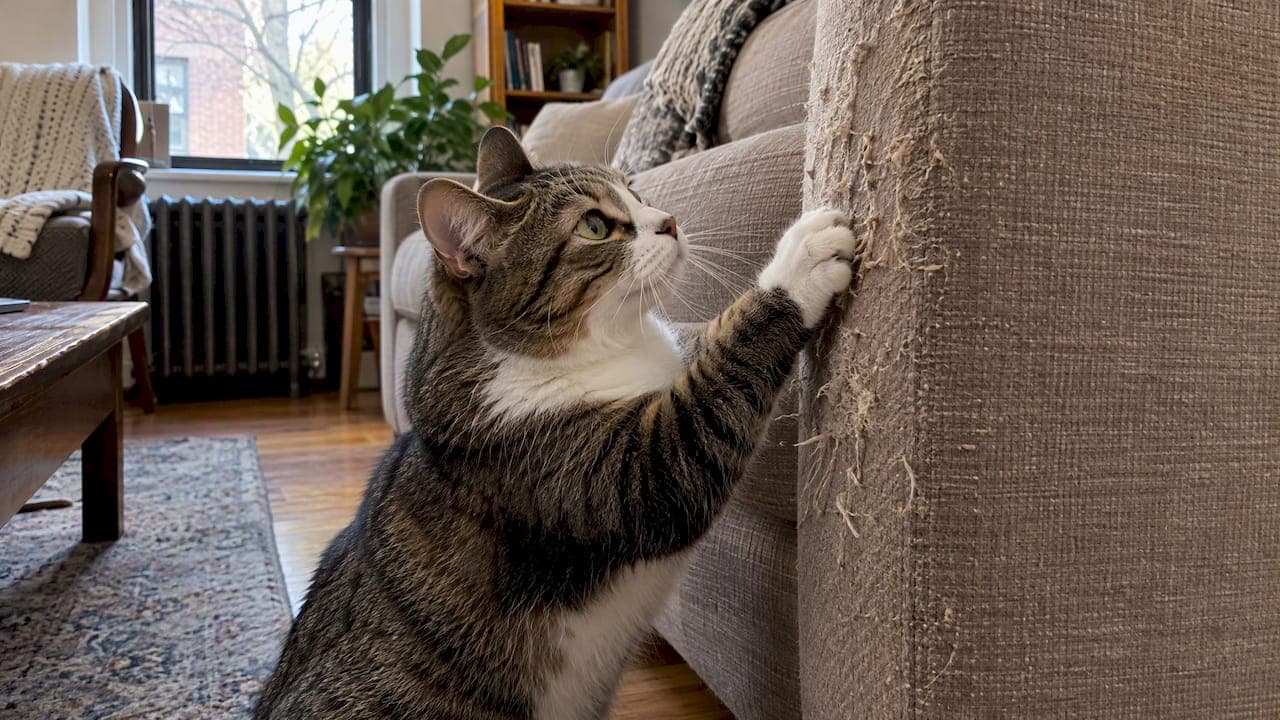
Your cat is not wrecking the couch out of spite. Scratching is an innate behavior, and the fix is to give your cat a better place to do it than your sofa, then make the sofa less appealing. That means a sturdy, tall post next to the spot your cat already targets, a reward every time it is used, temporary protection on the furniture, and regular nail care. Punishment does not work and can backfire.
Below you will find why cats scratch, how to choose and place a post, how to protect your furniture while the habit changes, and the signs that mean it is time to talk to a veterinarian.
TL;DR
- Cats scratch to mark territory, leave scent, and shed worn claw sheaths, so the urge cannot be removed, only redirected.
- Put a sturdy, tall scratching post right beside the furniture your cat targets, and reward every use.
- Cover the couch temporarily with a blanket, plastic sheet, or double-sided tape while the new habit forms.
- Never punish your cat or declaw it. Trim nails regularly and consider soft nail caps.
- If scratching is sudden, excessive, or paired with other changes, book a vet visit to rule out medical and stress causes.
Table of Contents
- Why cats scratch furniture
- Give your cat something better to scratch
- How to train your cat to use a scratching post
- Protect your furniture while the new habit forms
- Nail care: trims and soft caps
- When scratching is a sign of something else
- Our perspective
- Talk to us about your cat's scratching
- A simple two-week plan
- FAQ
- Sources
Why cats scratch furniture
Scratching looks like destruction to us, but to a cat it is communication and maintenance. Cornell's Feline Health Center explains that cats scratch to mark territory, to deposit scent from glands in their paws, to remove the outer sheaths of their claws, and to leave visible marks that may display confidence. It describes the behavior as innate.
A veterinary review of destructive scratching in a 2019 paper indexed on PubMed Central adds two points worth remembering. Scratching is a normal, beneficial behavior, and appropriate outlets should always be provided. When cats are deprived of suitable scratching opportunities, they may turn to household items instead. In other words, if your couch is shredded, the most likely missing piece is a better option, not a better-behaved cat.
The same review notes that scratching can reflect different levels of arousal or agitation, which suggests the motivation is not always the same. A cat scratching after a stressful visitor leaves may be doing something different from a cat stretching after a nap.
Why your cat picks the couch
Furniture is attractive for practical reasons. It is sturdy, it is textured, it is often in the middle of the household's activity, and it already smells like you. Once a cat has scratched a spot, scent and visual marks tell it to come back. Cats are drawn to areas where they have deposited scent from their paws, which is why a fabric corner that has been scratched once tends to be scratched again.
Household factors that matter
A 2024 study in Frontiers in Veterinary Science looked at undesired scratching in domestic cats. It found that the presence of a child in the home, play duration, playfulness, and nocturnal activity were associated with scratching levels. The practical takeaway is that a lively, energetic cat in a busy home has more to burn off and more reason to mark. Play and enrichment are part of the solution, not an afterthought.
Give your cat something better to scratch
The single most effective step is to provide an appealing alternative. Cornell advises making sure the post is sturdy and tall enough for your cat to stretch out fully. A wobbly or short post fails the first test, because a cat that cannot lean into a full stretch will go back to the sofa arm that does not move.
What a good scratching surface looks like
- Stable: It should not tip or slide when your cat pulls on it. Heavy bases or posts that can be anchored work best.
- Tall: Your cat should be able to extend its body and reach up without the post bending.
- Matched to your cat's habits: Watch how your cat scratches now. A cat that rakes the vertical side of the couch wants a vertical post. A cat that shreds the rug or the flat arm cushion may prefer a horizontal pad.
- Textured to grip: Many cats like material that lets claws sink in and pull. If your cat targets upholstery, try a different texture on the post and see which one wins.
PetMD recommends ensuring the post is in a social area and matches the orientation your cat already prefers. Observation beats guessing here. Spend a few days noticing whether your cat scratches up, across, or down, and buy or build accordingly.
If your cat's favorite target is the floor covering, the surface itself matters. Some rugs invite claws more than others, and a guide to pet-friendly rug materials can help you choose a surface that holds up while you offer a dedicated scratching option alongside it, along with the play your cat needs.
Placement is half the battle
Where you put the post can decide whether it gets used. The 2024 research highlighted in Frontiers in Veterinary Science indicates that placing a cat tree or scratching post in areas the cat frequents is a statistically significant factor in successful redirection. A post in a spare room might as well not exist.
PetMD notes that cats tend to prefer scratching posts placed somewhat close to household members rather than in secluded corners. Think living room, near the couch, near the spot where the family gathers, or beside the sleeping area, since many cats scratch when they wake up.

Cornell's advice is the simplest and the most useful: put the post right next to the area your cat likes to scratch. Once your cat is reliably using it, you can move it a few inches at a time toward a spot that works better for your space.
How to train your cat to use a scratching post
Training a cat is mostly about making the right choice easy and rewarding. Here is a simple routine.
- Set the post beside the target. Place it directly next to the couch corner or chair your cat is already scratching.
- Make it interesting. Cornell suggests enticing your cat with treats or catnip. Rub a little catnip on the post, or dangle a toy against it so your cat's paws land on the surface.
- Reward use immediately. Treats, strokes, or praise right after your cat scratches the post tell it exactly what you want. PetMD gives the same advice.
- Redirect calmly. If you see your cat heading for the couch, gently guide it to the post, or call it over with a toy. Do not scold.
- Repeat daily. New habits form through consistency. Reward every time in the first weeks, then taper to occasional treats.
- Keep the post where it is. Moving it around too early resets the learning.
Use play to build the habit
PetMD says sufficient enrichment, including more interactive playtime, may help decrease excessive scratching. A short play session with a wand toy before meals, finishing at the post, gives your cat a way to burn off energy and links the post with a good experience. Because the 2024 study connected play duration and nocturnal activity with scratching levels, evening play is a smart place to start.
Protect your furniture while the new habit forms
Redirecting takes time, so protect the furniture in the meantime. Cornell recommends covering furniture with blankets, plastic sheets, or double-sided tape to discourage scratching. PetMD adds that citrus scents and plastic covers can also make the furniture less appealing. Most cats dislike sticky surfaces under their paws, which is why tape works for many households.
A practical protection plan
| Problem | What to try | Why it helps |
|---|---|---|
| Cat scratches the couch arm | Double-sided tape or a fitted plastic cover on the arm, with a post right beside it | Makes the spot unpleasant while the post offers a better texture |
| Cat scratches the front of the sofa | A tall, sturdy vertical post pushed against that spot | Matches the cat's reach and scratching direction |
| Cat scratches the rug | A horizontal scratching pad placed on or beside the rug | Matches the flat orientation the cat prefers |
| Cat returns to marked spots | Clean with an enzymatic product, then cover or block the area | Removes scent that tells the cat to come back |
PetMD points out that enzymatic cleaning products can be used on furniture cats have scratched, because cats are drawn to places where they have left scent. It also mentions that a pheromone spray applied to targeted furniture can serve as a gentle deterrent. Test any spray or cleaner on a hidden patch of fabric first.
Why deterrents should not come from you
Cornell warns against punishing your cat, because punishment can teach a cat to fear you and may lead to aggression. It says consistent, immediate deterrents that do not involve you, such as a booby trap, are less likely to make a cat associate the unpleasant experience with its owner. Shouting, spraying with water, or chasing your cat only makes it do the scratching when you are not looking.
Nail care: trims and soft caps
The ASPCA advises regular nail clipping and says temporary adhesive plastic caps can help prevent damage if a cat scratches furniture. Trimming the sharp tips of the claws makes each scratch less destructive. Use a trimmer made for cats, trim just the tip, and pair the routine with treats so your cat learns to tolerate it.
If your cat resists nail trims, you do not have to struggle at home. Our team can show you the technique, and anxious cats often do better with a calm, low-stress approach. If handling stress is part of the problem, our guide on reducing cat vet anxiety explains how we plan visits around your cat's comfort, and the desensitization and counterconditioning plan walks through building tolerance step by step.
Why declawing is not the answer
The ASPCA opposes declawing and says it should never be used as a behavioral remedy or as a preventative measure. Between a post your cat loves, protected furniture, trimmed nails, and optional nail caps, you have far better tools than surgery.
When scratching is a sign of something else
Most furniture scratching is normal behavior in the wrong place. But sometimes a change in scratching comes with other changes, and that is a reason to call us rather than buy another post.
Book a visit if you notice:
- Scratching that starts suddenly in a cat that never did it before.
- Scratching alongside litter box changes, hiding, or aggression. Our guides on litter box problems in cats and inter-cat aggression cover how we approach these.
- Excessive licking, hair loss, or skin irritation. Our article on cat overgrooming explains why this should be checked, and our dermatology service can look into skin causes.
- Behavior changes in an older cat. Review senior cat behavior changes, and ask about pain management or geriatric care if your cat seems stiff or reluctant to jump.
- Scratching after a new pet, a move, or a new baby. Our guide on introducing a cat to a dog can help with household changes.
The 2019 review points out that scratching can show different levels of arousal or agitation. That is why the context matters: a cat scratching when you come home is not the same as a cat scratching nonstop at night.
If you want help with a stubborn case, the ASPCA recommends contacting a Certified Applied Animal Behaviorist or a board-certified veterinary behaviorist. Start with your own veterinarian, who can rule out medical causes and tell you whether a behavior referral makes sense.
Our perspective
We see scratching as a conversation your cat is having with its home, not a problem to be shut down. When a cat scratches the couch, it is telling you something: it needs an outlet, it feels the need to mark its territory, or something in its world has changed.
Our approach starts with comfort. As a Fear Free practice, we think a cat that feels safe is easier to read, easier to train, and easier to treat. Many of the cats we see for behavior concerns are not misbehaving at all. They are anxious, bored, or in discomfort, and the scratching is the part of the story that the owner can see.
That is why we combine behavioral advice with a full medical look. A wellness exam can catch dental pain, skin conditions, or joint discomfort that change how a cat moves and behaves. For cats that dread the carrier and the car, a home visit lets us examine your cat in the room where the scratching actually happens, so we can suggest where a post should go and how your cat uses the space.
We also value gentle, whole-pet care, including options such as acupuncture and pain management when they suit an individual cat. Our team's goal is simple: a calm cat, a home you still love, and no punishment, ever.
CAVC
Talk to us about your cat's scratching
If you have tried posts, tape, and trims and the couch is still losing, we can help. Our team can check for medical or stress-related causes and build a plan around your cat's personality. Cats that hate the carrier can be seen at home through our home visit service, and our behavior management support is available for ongoing concerns.

For a full check-up, including nail care guidance and a look at your cat's overall health, schedule a wellness exam at City Animal Veterinary Center in Brooklyn.
A simple two-week plan
If you want a starting point, try this sequence.
Days 1 to 2: Observe. Note which furniture your cat scratches, in which direction, and at what time of day. Clean those spots with an enzymatic cleaner.

Days 3 to 4: Set up. Place a sturdy, tall post or a flat pad right next to the main target. Cover the target with a blanket, plastic sheet, or double-sided tape.
Days 5 to 10: Reward. Use catnip or a toy to draw your cat to the post. Treat and praise each time your cat scratches it. Add a short play session each evening.
Days 11 to 14: Adjust. If the post is being used, keep it in place and add a second one in another favorite area. If it is ignored, change the texture, height, or orientation rather than giving up. Trim nails weekly or consider soft caps.
If the plan fails after a couple of weeks of consistent effort, that is a clue to look deeper, and a vet visit is the logical next step.
FAQ
How can I stop my cat from scratching the couch?
Place a sturdy, tall scratching post right beside the part of the couch your cat scratches, and reward every use with treats or praise. Make the couch less appealing with double-sided tape, a plastic cover, or a blanket until the new habit sticks. Avoid punishment, which can make a cat afraid of you.
Do all cats scratch furniture?
Scratching is innate to cats, so nearly all of them do it somewhere. Whether it lands on your furniture depends on the outlets available, the cat's energy and play levels, and the household. A 2024 study linked play duration, playfulness, nocturnal activity, and a child in the home with higher scratching levels.
Is it okay to declaw a cat to protect furniture?
No. The ASPCA opposes declawing and says it should never be used as a behavioral remedy or preventative measure. Regular nail trims, soft nail caps, and appropriate scratching posts protect furniture without surgery.
Where should I put a scratching post?
Put it next to the furniture your cat already scratches, in a spot where your family spends time. Research highlighted in 2024 found that placement in areas the cat frequents significantly affects whether redirection works. Cats generally avoid posts tucked away in secluded corners.
When should I see a vet about scratching?
See a vet if scratching starts suddenly, becomes excessive, or comes with litter box changes, hiding, aggression, or skin problems. Your vet can rule out medical causes and refer you to a Certified Applied Animal Behaviorist or a board-certified veterinary behaviorist if needed.
Sources
- Feline Behavior Problems: Destructive Behavior, Cornell Feline Health Center
- Evaluating undesired scratching in domestic cats, Frontiers in Veterinary Science
- Common feline problem behaviors: Destructive scratching, PubMed Central
- How to Stop Cats From Scratching the Furniture, PetMD
- Destructive Scratching, ASPCA