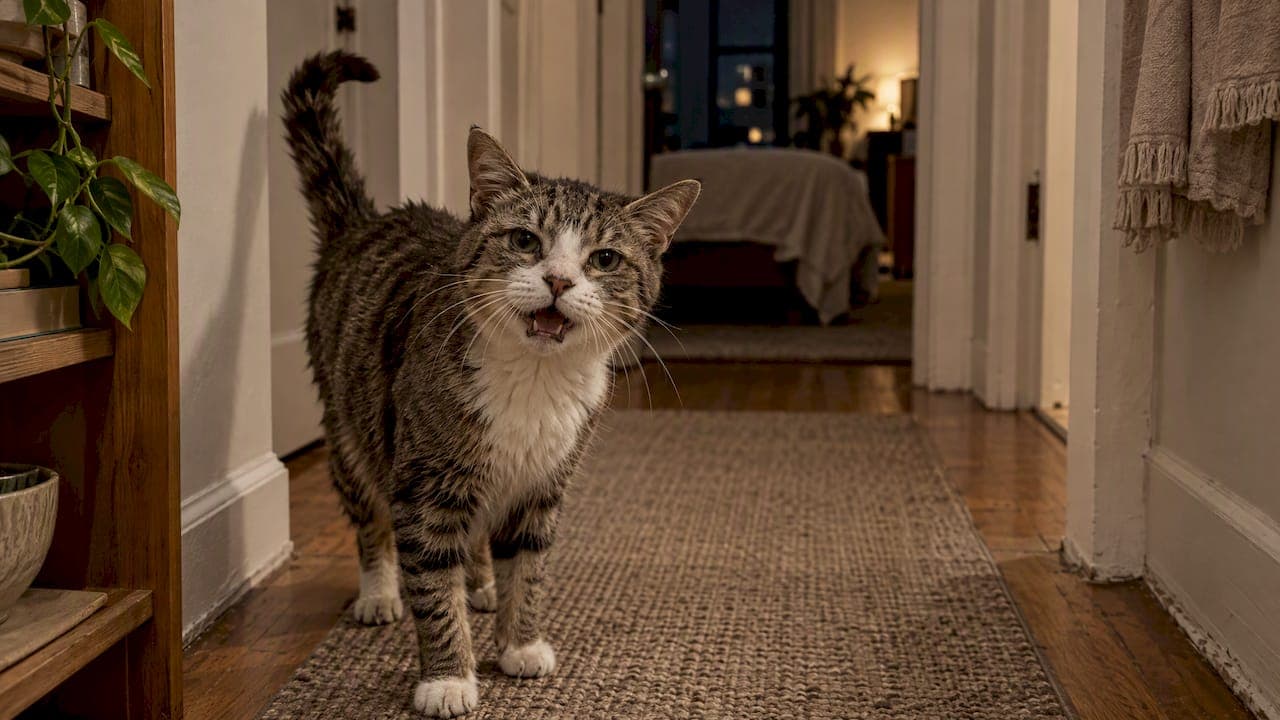
If your older cat is acting strange, the most useful rule is this: a new behavior is a symptom until a veterinarian says otherwise. Sleeping a bit more is common. Yowling at 3 a.m., missing the litter box, hiding, or suddenly avoiding the couch is not "just old age." It usually points to pain, an illness you can treat, or cognitive decline, and all three respond better when caught early.
This guide covers the changes worth noticing, what is usually behind them, how to document them, and what to do at home while you wait for your appointment.
TL;DR
- Behavior changes in senior cats are rarely normal aging. Pain, kidney disease, thyroid disease, high blood pressure and cognitive dysfunction are common causes.
- Litter box accidents, night yowling, confusion, hiding, less grooming and reduced jumping are the changes to report.
- Cognitive dysfunction is diagnosed only after a vet rules out other medical causes, so the first step is always an exam.
- Healthy cats aged 10 to 15 should be seen at least every 6 months, and over 15 every 4 months, per AAFP guidelines.
- Short phone videos and a few home tweaks (ramps, low-sided litter boxes, night lights) help both diagnosis and comfort.
Table of Contents
- Why "he's just old" is the wrong conclusion
- The changes to watch for
- Quieter signs people miss
- What is usually behind it
- Normal aging versus a red flag
- Build a record your vet can use
- Practical changes at home
- How cognitive dysfunction is managed
- Our perspective at City Animal
- Getting your senior cat seen
- How often should a senior cat see the vet?
- FAQ
- Sources
Why "he's just old" is the wrong conclusion
Cats hide discomfort well. Their signals are subtle, and owners often adapt without noticing: a litter box moved, a cat bed placed on the floor instead of the windowsill. The 2021 AAHA/AAFP senior care guidance urges owners and vets to resist writing behavior shifts off as "being an old cat," and asks vets to raise the question of behavior at every visit.
The numbers explain why. The Merck Veterinary Manual reports that at least one behavioral sign linked to cognitive decline appears in roughly 35% of cats aged 11 to 14 and more than 50% of cats 15 and older, as summarized in its section on cat behavior problems. Common does not mean harmless, and it does not mean untreatable.

The changes to watch for
Vets often sort these signs with the acronym VISHDAAL, which the Merck Veterinary Manual lays out. Here is how each one looks in a real living room.
Vocalization
Loud, drawn-out calling at night, often with no obvious reason, is one of the most common complaints. A cat who calls out in a hallway at 2 a.m. may be disoriented, in pain, hungry, or dealing with high blood pressure or an overactive thyroid. The sound itself does not tell you which.
Interaction
A cat who used to greet you at the door and now stays under the bed has changed socially. So has a formerly aloof cat who suddenly cannot let you out of sight. Either direction counts. Irritability when touched can mean a sore back or hips.
Sleep-wake cycle
More napping is expected. A flipped schedule, with restless nights and sleepy days, is not.
House soiling
Accidents outside the box are the change that most often sends owners to the vet. They have many causes, from arthritis to urinary tract disease to confusion. The AAHA behavior guidance for senior cats notes that litter box changes may indicate urinary tract disease and that any new or unusual behavior should prompt a medical evaluation. Our own post on the vet's first fix for litter box problems walks through a short testing sequence you can start at home.
Activity
Aimless wandering, pacing, staring at walls, or getting stuck in corners are classic signs of confusion. The opposite matters as well: a cat who stops playing, stops climbing, and stops visiting favorite perches.
Anxiety
New fearfulness, clinginess, or reactions to sounds and visitors that never bothered your cat before can come from declining senses, pain, or cognitive change.
Learning and memory
Forgetting where the litter box or food bowl is, or not recognizing familiar people, belongs here.
Quieter signs people miss
Not every sign is dramatic. The AAFP's owner pain handout calls behavior change the primary indicator of pain in cats. Look for:
- Less grooming. A scruffy, matted or greasy coat, especially along the back, often means grooming has become uncomfortable.
- Unusual resting spots. Hiding in closets or sleeping on the cold bathroom floor instead of the bed.
- Eating changes. Eating more, less, or dropping food from the mouth. Dental disease is a frequent culprit, which is why we cover what a professional cat dental cleaning involves.
- Hesitating before jumps. Stopping at the edge of the sofa, jumping up in two stages, or giving up on the windowsill.
- Different reactions to touch. Flinching when you pet near the spine or hips.
What is usually behind it
Pain, especially osteoarthritis
This is the leading suspect. A JAVMA review of osteoarthritis cites studies in which up to 92% of cats showed radiographic signs of degenerative joint disease, with related behavior changes including inactivity, altered social relationships and inappropriate elimination. Many of those cats never limp. They simply stop doing things that hurt.
A litter box with a tall side can become a barrier. The AAFP's pain materials describe how arthritis can make stepping over the edge or crossing slippery flooring to get there painful, which is why a house-soiling cat deserves a pain assessment, not a scolding.

Medical disease
Kidney disease, hyperthyroidism, high blood pressure, diabetes, urinary tract disease and dental pain can all change how a cat acts. The Cornell Feline Health Center makes the point that age alone is not a disease, and that many conditions of older cats can be controlled even when they cannot be cured. Bloodwork and urine testing often provide the first real answers. If you are curious what that involves, see our guide to urinalysis for cats.
Cognitive dysfunction syndrome
Feline cognitive dysfunction is sometimes called senility or dementia. It is an age-related neurodegenerative condition, and Cornell's overview notes that cats are living longer than they used to, which is one reason it is seen more often.
The key point for owners: it is a diagnosis of exclusion. Your vet must first rule out medical causes such as hypertension, kidney disease or hyperthyroidism, per the Merck Veterinary Manual. Self-diagnosing from an online checklist can mean a treatable problem goes unaddressed.
Sensory decline and stress
Reduced vision and hearing can make a cat startle easily or call out because they cannot find you. A new pet, a move or a changed routine can add stress. Our post on multi-cat tension and aggression is useful if a household dynamic has shifted.
Normal aging versus a red flag
| What you see | Usually fine | Call your vet |
|---|---|---|
| Sleep | A few more naps | Restless nights, pacing, daytime-only sleeping |
| Play | Shorter sessions | Stopped playing or climbing altogether |
| Litter box | Same habits | Accidents, straining, new location choices |
| Voice | Same as before | New or louder night calling |
| Grooming | Same routine | Matted, greasy or unkempt coat |
| Affection | Slightly more cuddly | Hiding, irritability, or new clinginess |
| Appetite | Stable | Any sudden change |
A useful test: if the change is new, persistent, and you noticed it, book an exam. Straining in the litter box without producing urine, vomiting repeatedly, labored breathing or refusing food entirely are emergencies, so go to an urgent care or emergency hospital right away.
Build a record your vet can use
The AAFP encourages owners to record short videos of routine behavior and review them over time, because gradual shifts are easy to miss when you see your cat daily. The senior care guidelines list patterns worth capturing: grooming, vocalizations, sleep locations, jumping and play.
Before the appointment:
- Film your cat walking, climbing onto a favorite spot and using the litter box (from a distance).
- Note when night vocalizing happens and how long it lasts.
- Write down appetite, water intake and any accidents, with dates.
- List any medications or supplements.
- Bring a fresh urine sample if your vet asks for one. Ask first how to collect it.
These details can shift an exam from guesswork to a clear picture.
Practical changes at home
None of these replace a diagnosis, but they can make life easier while you get one. The AVMA's coverage of senior pet behavior problems points to simple environmental changes such as ramps, steps and soft, warm bedding for cats with sore joints.
- Litter boxes: choose one with a low entry, keep one on every floor, and use non-slip flooring around it.
- Ramps and steps: give access to the bed, couch or window perch.
- Warm bedding: place it where your cat already likes to rest.
- Night lights: a small light in hallways can help a disoriented cat.
- Stable routine: keep food, water and boxes in the same spots, and avoid rearranging furniture.
- Gentle enrichment: short play sessions, food puzzles and window views keep the mind active.
Ask your vet before giving any medication or supplement. Many human pain relievers are dangerous to cats.
How cognitive dysfunction is managed
No single drug or diet cures it. According to the Merck Veterinary Manual, management is multifaceted: environmental enrichment, positive reinforcement, and in some cases extra-label use of medications such as selegiline, to be discussed thoroughly with your vet. The AAHA senior care guidance on cognitive dysfunction notes that the condition is less well described in cats than in dogs, which is another reason to work with a vet who follows the research.
The realistic goal is comfort and quality of life, and the earlier you start, the more there is to preserve.
Our perspective at City Animal
We see the same story often in Brooklyn apartments: an owner noticed something months ago, assumed it was age, and waited. By the time the cat arrives, a manageable arthritis problem has become a cat who no longer uses the box or the stairs.
Our view is simple. Treat a behavior change as medical until proven otherwise. Then look at the whole cat, not just one symptom: pain, teeth, kidneys, thyroid, blood pressure, senses, and home setup.
Stress matters as much as the diagnosis. A senior cat who panics in a carrier is harder to examine and harder to help, and the owner dreads the next visit. That is why we are Fear Free certified, and why we offer home visits for cats who struggle to travel. If the trip is the problem, read our post on lowering cat vet anxiety. For older pets we also pair traditional care with options such as pain management and acupuncture, tailored to each patient.
If you have a senior dog at home too, our senior dog wellness exam guide covers what to expect.
— CAVC
Getting your senior cat seen
We offer wellness exams with in-house laboratory testing, so many first answers come quickly. Cats who find the clinic stressful can be seen through our home visit service. Where discomfort is the cause, our pain management and acupuncture services are options your veterinarian can discuss with you. If something is urgent, urgent care is available. New to us? Start on our new clients page.
How often should a senior cat see the vet?
The AAFP guidelines recommend that cats aged 10 to 15 be examined at least every 6 months, and healthy cats over 15 every 4 months, with more frequent visits for chronic disease, per the 2021 AAFP Feline Senior Care Guidelines. Those visits are where small shifts get caught. Bring your videos and notes each time.
FAQ
Why is my old cat acting weird all of a sudden?
Sudden changes usually have a physical cause such as pain, urinary or kidney problems, thyroid disease or high blood pressure. Cognitive dysfunction is possible but is only diagnosed after other causes are excluded. Book an exam soon, and go to an emergency hospital if your cat is straining to urinate, breathing with effort or refusing all food.
Is night yowling in senior cats normal?
It is common, but it is not something to accept. Causes include confusion, pain, hunger, poor senses and medical conditions like hyperthyroidism. A vet visit can sort out which one applies, and night lights, a bedtime routine and a quiet sleeping spot may help.
Can cognitive dysfunction in cats be cured?
No, but it can be managed. Environmental enrichment, mental stimulation, a consistent routine and, in some cases, medication can help preserve quality of life. Your vet will first rule out other diseases that look similar.
Why is my senior cat peeing outside the litter box?
Common reasons include arthritis that makes entering the box painful, urinary tract disease, kidney disease and confusion. It is not spite. Have your cat examined, then try lower-sided boxes on every floor.
Sources
- Behavior Problems of Cats, Merck Veterinary Manual
- 2021 AAFP Feline Senior Care Guidelines (PDF)
- 2021 AAFP Feline Senior Care Guidelines, PubMed Central
- Behavior and Environmental Needs: Senior Cats, AAHA
- Managing Cognitive Dysfunction and Behavioral Anxiety, AAHA
- Pain management handout, AAFP (PDF)
- Osteoarthritis nutrition and nutraceuticals, JAVMA
- Setting the stage for owners when senior pets develop behavior problems, AVMA
- The Special Needs of the Senior Cat, Cornell Feline Health Center
- Cognitive Dysfunction, Cornell Feline Health Center