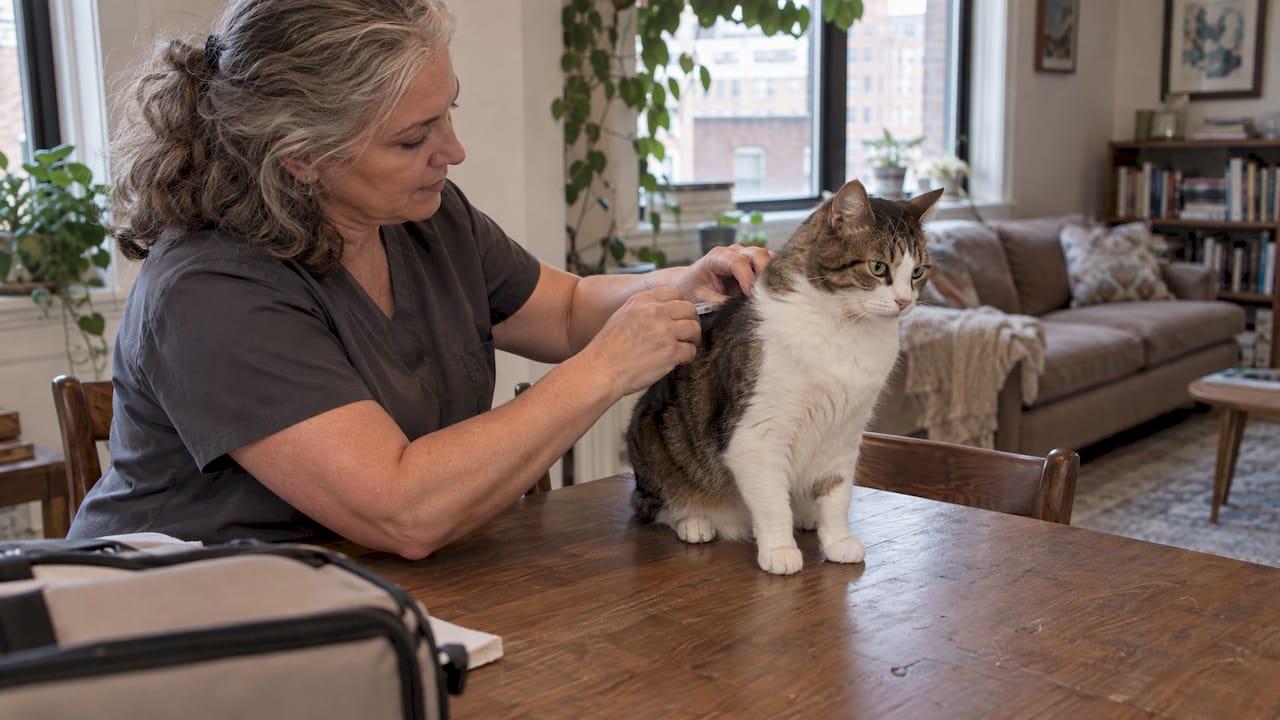
An indoor cat in New York City needs a rabies vaccine, because city rules require it, and it also needs the core feline vaccines your veterinarian recommends for protection against common, serious viruses. Living indoors lowers your cat's risk. It does not remove it. At City Animal Veterinary Center in Brooklyn, we plan vaccinations around your cat's age, history and temperament, with a Fear Free approach designed to keep the visit calm for cat and owner.
TL;DR
- NYC requires cats to have current rabies vaccination, indoor cats included. The first dose is due by 4 months of age, with a booster no later than one year after.
- Core vaccines for cats cover feline herpesvirus, calicivirus, panleukopenia (the FVRCP combination) and rabies. FeLV is also core for kittens and cats under one year.
- Other vaccines, such as adult FeLV, Bordetella and Chlamydia felis, depend on your cat's exposure risk, so they are a conversation with your vet.
- An overdue cat exposed to a possibly rabid animal faces far harsher consequences than a current one.
- A cat that dreads the carrier or the clinic can still stay protected: low-stress handling and home visits exist for exactly this reason.
Table of Contents
- Why an indoor cat still needs vaccines
- What NYC requires: rabies
- The core vaccines for indoor cats
- Kitten schedule versus adult schedule
- Making vaccine visits easier for an anxious cat
- Vaccine side effects: what is normal and what is not
- A simple vaccine checklist for NYC cat owners
- Our perspective
- Book your cat's vaccine visit
- FAQ
- Sources
Why an indoor cat still needs vaccines
Most owners of indoor cats ask the same thing: if my cat never goes out, what is it being protected from? Three realities of city life answer that.
Escape happens. An open door, a window with a loose screen, a hallway during a move or a delivery. In an apartment building, a cat that slips out meets stairwells, basements and neighbors' pets within seconds.
Wildlife comes in. NYC Health notes that rabies is a risk to indoor pets if they get outdoors or if a rabid bat enters the home. Bats find their way into apartments through small gaps, and a curious cat will chase one.
People carry things in. Viruses can travel on shoes, hands and clothing, and your cat may share space with other pets, a boarding facility, a groomer or a future roommate's cat.
The city's rabies activity is not hypothetical. NYC Health's annual summary for 2025 records 22 rabid animals, including 20 raccoons, one cat on Staten Island and one bat, with raccoon counts in Brooklyn and Queens higher than in the prior two years. A May 2026 advisory reported eight rabid animals detected in NYC so far that year and kept the public advice to keep cats' rabies vaccinations up to date. Raccoons are a Brooklyn backyard and park reality, and a cat on a ground-floor window sill or fire escape is closer to them than it looks.
Indoor life also changes how you think about the rest of your cat's health. Keeping a cat busy and well-exercised at home supports its overall wellbeing, and there are plenty of ways to keep indoor cats active and engaged. Vaccination is the other half of the picture: it covers the risks that enrichment cannot.

What NYC requires: rabies
Rabies is the one vaccine where the law, not just a recommendation, applies to your indoor cat.
The NYC Health Department states that cats must have up-to-date rabies vaccinations. The first shot is due by 4 months of age. The first revaccination is required no later than one year after the primary vaccination, and later boosters must keep the cat current. The city's 2025 veterinary summary adds that later revaccination follows the schedule of the USDA-approved vaccine manufacturer, which is why your vet checks the specific product used when it sets your cat's next due date.
New York State's Department of Health says the vaccination certificate is the proof of rabies vaccination and that the veterinarian must keep a copy. The state lists a few exceptions, including a veterinarian's determination that vaccination poses an adverse health risk. If you think your cat might be one of those cases, that decision belongs to your veterinarian after an exam, and it is worth raising at your next visit.
What happens if your indoor cat is not vaccinated
This is the part many owners never hear until it matters. According to NYC Health, an unvaccinated cat exposed to a possibly rabid animal may be required to be euthanized or isolated for up to six months in a facility under daily veterinary observation.
Cornell's Feline Health Center describes the same divide. An unvaccinated or overdue cat may face euthanasia under strict rules or a lengthy quarantine, while a cat that is up to date may instead receive a booster and be quarantined at home under set conditions. A bat in the bedroom at 2 a.m. is stressful enough. Knowing your cat's certificate is current turns it into a manageable event.
If you ever find a bat in your home, or your cat is bitten or scratched by a wild or unknown animal, call NYC's health authorities and your veterinarian right away. Do not handle the animal with bare hands.
The core vaccines for indoor cats
Beyond rabies, the veterinary profession has a shared baseline. The 2020 AAHA/AAFP feline vaccination guidelines, written by the American Animal Hospital Association and the American Association of Feline Practitioners, classify vaccines as core (recommended for essentially all cats) or non-core (recommended based on lifestyle and exposure).
Per those guidelines, feline herpesvirus (FHV-1), feline calicivirus (FCV), feline panleukopenia virus (FPV) and rabies are core for cats with unknown vaccination history. FeLV is also core for kittens and cats under one year.
| Vaccine | What it protects against | Category for indoor cats |
|---|---|---|
| Rabies | Fatal viral disease, also a human health risk | Core, and required in NYC |
| FVRCP (FHV-1, FCV, FPV) | Upper respiratory infections and panleukopenia, a severe, often deadly viral illness | Core |
| FeLV (feline leukemia virus) | A virus that weakens the immune system | Core for kittens and cats under one year; risk-based for adults |
| Bordetella bronchiseptica | A respiratory bacterium | Non-core, based on exposure risk |
| Chlamydia felis | Eye and respiratory infection | Non-core, based on exposure risk |
The same guidelines say FIP vaccination is not generally recommended, so you will not see it on a standard schedule.
Why FVRCP matters even in a studio apartment
The FVRCP combination covers the viruses that cause most feline upper respiratory illness, plus panleukopenia. These are hardy germs that spread through shared surfaces and objects, which is how they reach a cat that has never left the apartment. Kittens, adopted cats with unknown history and cats going to boarding are the groups where owners most often see the value of having these done on time.
FeLV: a test first
For feline leukemia, the guidelines call for vaccination to follow a negative FeLV antigen test. Kittens receive two doses 3 to 4 weeks apart, beginning as early as 8 weeks. For adults, whether to continue depends on exposure risk and the product's licensed duration. A cat that lives alone indoors and a cat that shares a home with a newly adopted rescue are very different cases, which is where an individual risk assessment earns its keep. Having an in-house laboratory means testing can be part of the same visit.
Kitten schedule versus adult schedule
Kittens need a series because the antibodies they receive from their mother can block a vaccine's effect for a while, and nobody can predict exactly when that protection fades in an individual kitten. The guidelines recommend starting the series no sooner than 4 weeks of age, repeating every 2 to 4 weeks through 16 to 18 weeks, and revaccinating FVRCP at 6 months.
In plain terms, a kitten you bring home at 8 weeks will make several visits over its first four months or so, and the rabies shot falls inside the NYC window of 4 months. Our guide to the kitten vaccination schedule walks through the visits in order, and what to expect at a kitten's first vet visit covers what happens at the first one.
For adult cats, the plan is simpler but not automatic:
- Bring any records you have. Adoption paperwork, a shelter record or a previous vet's certificate lets us avoid repeating shots or guessing.
- Confirm the rabies due date. Check the certificate for the date and the vaccine used, since that determines the next due date.
- Review lifestyle. Balcony access, a new pet, travel, boarding, a move or a rescue foster all change the risk picture.
- Decide on non-core vaccines together. Adult FeLV, Bordetella and Chlamydia felis are options to weigh against your cat's real exposure, not a default.
If your cat has an unknown history, say a rescue found in a Brooklyn courtyard, tell us so. The guidelines treat unknown history as the starting point for the core vaccines, and that is where we begin.
Making vaccine visits easier for an anxious cat
Many indoor cats go years without leaving the apartment, so the carrier, the elevator and the exam room can be a lot. Some owners put off visits because of that, and a late booster is exactly the gap that matters most for rabies.
This is where our Fear Free approach is useful. It is designed to reduce stress for pets during visits, so both the cat and the owner feel more comfortable. A few things that help, whichever clinic you choose to visit:
- Leave the carrier out at home for days beforehand, with a blanket inside, so it becomes furniture instead of a threat.
- Cover the carrier during the walk or ride, to cut visual stress.
- Skip the big meal before a visit if your vet suggests it, so treats work as a reward.
- Tell the team about past reactions to handling, noise or other animals, so the visit can be planned around them.
We go deeper on this in our piece on cutting cat vet anxiety with a Fear Free plan.
For owners who find travel with a pet hard, our home visit service is there for exactly that situation. It suits busy professionals, owners without a car, and households where getting a stressed cat out the door is itself the obstacle.
Vaccine side effects: what is normal and what is not
Most cats are a little quiet after vaccination. Mild tiredness, reduced appetite or a sore spot at the injection site for a day or so is common. Call your veterinarian promptly if your cat develops facial swelling, hives, repeated vomiting, difficulty breathing or collapse, or a lump at the injection site that persists or grows. Those signs need a vet's attention the same day. If it happens outside normal hours, our urgent care team can advise on next steps, and an emergency hospital is the right call when your cat is struggling to breathe.
Tell your vet about any previous vaccine reaction, any current illness and any medication before the visit. A sick cat may need to wait, and your vet can adjust the plan for cats with a reaction history.
A simple vaccine checklist for NYC cat owners
- Find your cat's rabies certificate and note the date and the product used.
- Add the next due date to your phone calendar, with a reminder a month ahead.
- Keep the certificate with your lease and pet documents, since boarding, grooming and travel often ask for it.
- If your cat is under one year, ask about FeLV and the full kitten series.
- If you plan to travel with your cat, ask early about health certificates and, for some destinations, rabies titer testing. Our rabies titer FAVN guide explains the process.
- If you spend time outdoors where your cat may pick up parasites on your clothing, ask about prevention too. Our note on ticks in NYC explains why it matters.
Our perspective
We hear the same sentence from many Brooklyn cat owners: she never goes out, so does she really need this? We understand the logic. What we explain is that a vaccine schedule for an indoor cat is not about the life you think your cat has. It is about the one slipped door, the one bat in the hallway, the one boarding stay you did not plan.
The other thing we hear is that the visit itself is the problem. A cat that hides under the bed when the carrier appears is a cat whose boosters get postponed. That is why we built our practice around Fear Free handling and offer home visits for clients who cannot easily travel. Protection that happens on time beats protection that is perfect on paper.
Our approach is team-centered and tailored to the emotional and physical needs of each pet. For vaccines, that means we look at your cat's age, history, household and temperament, and we recommend what fits that cat, not a one-size template.
CAVC
Book your cat's vaccine visit
If your cat's rabies certificate is close to due, or you are not sure what it says, we can review it and set up a plan. We offer vaccinations and wellness exams in Brooklyn using a Fear Free approach, and home visits for clients who find travel with a pet difficult.

A wellness exam is also the right moment to talk through nutrition, microchipping and any worries about your cat's behavior, so one visit covers more than one question.
FAQ
Does my indoor cat need a rabies vaccine in NYC?
Yes. NYC Health states that cats must have up-to-date rabies vaccinations, and the first dose is due by 4 months of age. Indoor status does not change that, because escapes and bats entering the home are both recognized risks. Ask your veterinarian for a certificate that shows the date and the vaccine used.
How often does an indoor cat need vaccines?
After the kitten series, rabies must be given again no later than one year after the first vaccination, and then on the manufacturer's schedule for the product used. Core vaccines such as FVRCP and the optional ones follow a schedule your vet sets based on your cat's age, history and risk. Your cat's certificate shows the due date.
Which vaccines are core for cats?
The 2020 AAHA/AAFP guidelines list rabies, feline herpesvirus, calicivirus and panleukopenia as core, plus FeLV for kittens and cats under one year. Adult FeLV, Bordetella and Chlamydia felis are non-core, chosen according to exposure risk.
What if my cat is overdue on rabies?
Book a visit as soon as you can so your vet can bring the vaccination current. This matters because an overdue cat exposed to a possibly rabid animal can face euthanasia or a long isolation period, while a current cat may receive a booster and home quarantine. If your cat has been exposed to a bat or wild animal, call your veterinarian and NYC health authorities right away.
My cat panics at the vet. Can she still be vaccinated?
Yes. Low-stress handling, preparation at home and a planned visit make a real difference, and our Fear Free approach is built around that. If travel is the obstacle, ask about our home visit service.
Sources
- Rabies - NYC Health
- 2026 Annual Rabies Summary 2025 - NYC Health
- NYC Health Department ORV program for raccoons in Brooklyn and Queens
- What Pet Owners Need to Know About Rabies - New York State Department of Health
- Need for Rabies Vaccination for Indoor Cats - Cornell Feline Health Center
- 2020 AAHA/AAFP Feline Vaccination Guidelines