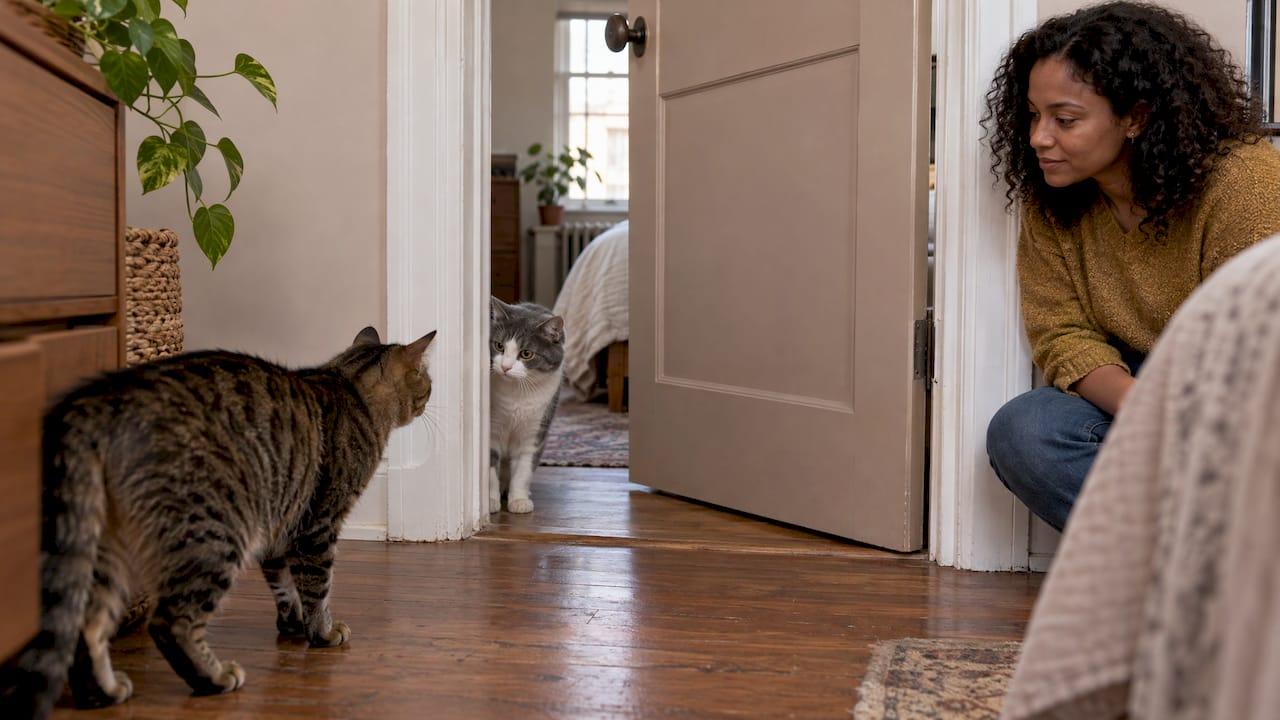
The safest way to introduce a new cat is slowly: a separate room first, scent swapping next, then visual contact through a barrier, then short supervised meetings. You move to each step only when both cats are relaxed at the current one. Start with a veterinary check-up for both cats, because a healthy, unstressed cat adapts far better. At City Animal Veterinary Center in Brooklyn, our Fear Free approach is built around keeping pets calm, and that mindset is exactly what a good introduction needs.
- ✓Wellness exams
- ✓Vaccinations
- ✓In-house laboratory diagnostics
- ✓Home visits
TL;DR
- Keep the new cat in its own room for at least a week. Seven to ten days is a common recommendation, and some cats need longer.
- Swap scents before the cats see each other: cloths, bedding, and a shared brush.
- Move through the steps by behavior, not by the calendar. The AAFP step-by-step guide says the process can take a few days to a few months.
- Hissing is normal. Fighting, hiding, or changes in eating and litter box habits mean you pause and back up a step.
- Book a vet visit for both cats before the introduction starts.
Table of Contents
- Before the new cat comes home
- Step 1: Arrival day and the first nights
- Step 2: Scent swapping
- Step 3: Visual contact
- Step 4: Supervised time together
- How long does it take?
- Hissing, stress, and when to pause
- Where a Fear Free vet fits in
- Our perspective
- FAQ
- Sources
Before the new cat comes home
Get both cats a health check
The AAFP guidelines recommend that all cats have a recent veterinary check-up and be in good health before any introduction, and that the new cat be tested by a veterinarian for common contagious diseases (AAFP). This protects your resident cat, and it removes a hidden variable. A cat in pain or fighting an infection may hiss, hide, or snap for reasons that have nothing to do with the newcomer.
Our team handles this through wellness exams and vaccinations, and we run diagnostics with our in-house laboratory. If your resident cat gets frantic in a carrier, a home visit lets us do the exam where your cat already feels safe. Bringing home a kitten? Our guide to the first kitten vet visit covers what to expect.
Set up the safe room
Pick a quiet room, such as a bedroom or bathroom, where the new cat can stay fully separated from your resident cat for the first days. American Humane suggests stocking it with food, water, litter, toys, and soft beds, and choosing a room with an inch or two of space under the door, which helps later with scent and sound exchange (American Humane).

A veterinarian writing for PetMD advises choosing a room the resident cat doesn't often use, and furnishing it a few days ahead with the newcomer's own things: bedding, cat trees, perches, toys, bowls, and a litter box. Ideally these are new items, so the resident cat's scent doesn't arrive too early (PetMD).
In a small Brooklyn apartment, the room might be the bathroom or a bedroom you close off. That's fine. What matters is a closed door, a litter box the new cat can reach without crossing your resident's territory, and a hiding spot. If the litter box will live in a cabinet-style cover, it helps to get that done early: here is a walkthrough on moving a cat to a litter box enclosure, so the new cat isn't learning two things at once.
Why separate resources matter
The AAFP describes five pillars of a healthy multi-cat home: safe places; multiple, separated key resources; chances to play and hunt; positive, predictable human interaction; and an environment that respects cats' senses (AAFP). In practice, that means each cat gets its own food bowls, water, litter box, and resting spots, not shared ones in one corner. Setting these up before the meeting prevents the competition that causes many failed introductions.
Step 1: Arrival day and the first nights
Where should the new cat sleep the first night? In its own room, with the door closed. The AAFP advises carrying the cat in a covered carrier straight to that room, opening the carrier door, and letting the cat choose when to come out. This can take a few days for some cats (AAFP). The San Francisco SPCA likewise says to let the cat decide whether to explore or stay in the carrier (SF SPCA).
Don't drag the cat out or carry it around the apartment to "meet" the household. Sit quietly in the room, speak softly, and let the cat approach you.
The SF SPCA recommends waiting seven to ten days before proceeding with the introduction (SF SPCA), and the San Diego Humane Society recommends keeping the cats completely separated for at least a week (San Diego Humane Society). Treat these as a minimum. A timid cat or a cat who is still hiding all day isn't ready.

Step 2: Scent swapping
Cats learn about each other through smell long before they care about sight. Scent swapping builds familiarity without a confrontation. There are three simple methods.
- Cloth swap. Seattle Humane describes rubbing a soft cloth against one cat's cheeks, giving it to the other cat, and doing the same in reverse (Seattle Humane).
- Bedding swap. Trade blankets or beds that smell like each cat, and keep moving them back and forth to build what Seattle Humane calls a "group scent."
- Shared brush. The San Diego Humane Society suggests brushing one cat, then the other with the same brush, repeating and switching the order so each receives the other's scent (San Diego Humane Society).
Watch how each cat reacts to the item. Sniffing, rubbing, or ignoring it is a good sign. Growling, hissing at the cloth, or leaving the area means slow down and keep swapping for longer.
You can also swap rooms. Once the new cat is settled, let it explore the rest of the home while the resident cat is shut in the safe room, then reverse. Each cat learns the other's trail without a face-to-face meeting.
Seattle Humane suggests roughly days 3 to 14 for separation and scent swapping (Seattle Humane). Some pairs need longer, and that's fine.
Step 3: Visual contact
When both cats seem relaxed around each other's scent, let them see each other without being able to touch. The Ohio State Indoor Pet Initiative describes opening the door a crack and securing it so the cats can look at each other but not pass through (OSU Indoor Pet Initiative). A baby gate or a stack of two gates also works.
Tips that help:
- Keep sessions short and end them while both cats are calm.
- Feed them on either side of the barrier, starting far back and moving the bowls a little closer each day. A slower pace of eating keeps attention on the food, and slow feeding for cats can make mealtimes last long enough to build a positive link.
- Use play. Dangle a wand toy so each cat focuses on the toy and not on the other cat.
Some hissing is normal. If either cat becomes aggressive or extremely hostile, the OSU team says to close the door, leave the cats alone for a few hours, then crack the door again (OSU Indoor Pet Initiative).
Step 4: Supervised time together
Once both cats look at each other calmly through the barrier, you can allow short meetings in a shared space. Feliway's guidance describes using a neutral space that neither cat has spent most of its time in, keeping meetings short, and stepping in to separate the cats and return to the visual phase if you see long staring, hissing, or fighting (Feliway). Seattle Humane places supervised interactions in a large room with hiding spots and escape routes, roughly days 15 to 21 for faster pairs (Seattle Humane).
How to run a good session:
- Tire them out first. The San Diego Humane Society recommends playing with and feeding both cats before the session, using the cat activity cycle of play, catch, eat, groom, sleep. Cats are calmer and sleepier afterward (San Diego Humane Society).
- Offer escape routes. Cat trees, shelves, and open doors give the nervous cat somewhere to go.
- Redirect early. Use toys, treats, or your voice if either cat becomes frustrated, frightened, over-excited, or fixated on the other.
- End on a good note. Separate the cats after each session, as the SF SPCA advises (SF SPCA).
- Lengthen gradually. Add a few minutes each day as long as both cats stay relaxed.
When cats tolerate, ignore, or interact calmly with each other, that is a positive sign.
How long does it take?
There is no fixed schedule. The AAFP guide says an introduction can take a few days to a few months, sometimes longer, and that you shouldn't move to the next step until each cat is comfortable with the current one (AAFP). The calendar ranges in the sections above are starting points. Your cats' body language is the clock.
| Stage | What you're looking for before moving on |
|---|---|
| Separate room | New cat eats, uses the litter box, and explores; resident cat eats normally |
| Scent swapping | Both cats sniff or ignore scented items without growling or hiding |
| Visual contact | Both cats eat or play near the barrier with loose, relaxed bodies |
| Supervised time | Cats ignore each other, groom, nap nearby, or play gently |
A good rule: if you have to wonder whether they're ready, wait another few days.
Hissing, stress, and when to pause
Why cats hiss
PetMD explains that hissing signals discomfort, fear, or stress and is more defensive than offensive. Often the cat wants to avoid a physical fight, and the cat who hisses most is usually the one being chased or antagonized. The advice is to back away, give the cat space and hiding places, and let it calm down (PetMD).
Never punish a cat for aggression toward the other cat. The SF SPCA notes this only raises stress and prolongs the conflict. Stay silent and calmly separate the cats, or speak softly (SF SPCA).
Signs to slow down
The SF SPCA says to pause the introduction if either cat shows intense hissing or growling, or signs such as not eating, avoiding the litter box, or overgrooming, and to extend separation for a week or more if needed (SF SPCA). Treats and toys can distract a stressed cat. Contact your veterinarian if your resident cat seems stressed.
Litter box changes deserve special attention, since they can point to stress or a medical problem. Our guide to litter box problems in cats explains the causes, and our vet-first fix for litter box problems shows how we sort them out.
If a fight happens
AAFP guidance states that if all steps have been followed and one cat is traumatized or injured in a fight, the match will likely not work out (American Humane). Separate the cats right away, don't reach in with bare hands, and have any wound checked by a veterinarian. For ongoing tension between cats who already share a home, see our plan for inter-cat aggression. If you're also thinking about a dog, read how to introduce a cat to a dog.
Where a Fear Free vet fits in
An introduction is a stress test for both cats, and a calm, healthy cat handles it better. We're a Fear Free practice in Brooklyn, and our approach is designed to reduce stress during visits. We offer behavior management consults for cats that struggle to settle, and urgent care if a scuffle leaves a scratch or bite. For cats that dread the carrier, our home visit service brings the exam to your living room. If vet trips themselves are the hard part, see how we cut cat vet anxiety.
Ready to get both cats checked before the new arrival? Book a wellness exam with our team.

Our perspective
Most failed introductions we hear about have the same root: the people were ready before the cats were. A new cat is a big change for a resident cat, who has spent years learning every sound and smell in your home.
We care about the whole experience. That's why we start with health: a cat who is sore, itchy, or unwell has less patience for a newcomer. Our team works the Fear Free way, using calm handling that keeps stress low, and the same thinking applies at home. Keep sessions short, reward calm behavior, and let the quieter cat set the pace.
If you have a cat who panics at the carrier, a house call can make the pre-introduction exam far easier. And if the introduction stalls, our behavior consults and holistic options are there to help your cats feel at ease.
CAVC
FAQ
Where should a new cat sleep the first night?
In its own closed room with food, water, a litter box, a bed, and a scratching post. The room should be one that won't disrupt your resident cat's routine. Open the carrier and let the new cat decide when to come out (SF SPCA).
How long should I keep a new cat separate?
At least a week. The SF SPCA suggests seven to ten days before starting introductions, and some cats need longer (SF SPCA). Wait until the new cat eats, uses the litter box, and moves around the room with confidence.
Is hissing a bad sign?
Not by itself. Hissing is usually a defensive signal that a cat wants space (PetMD). Back up a step if it escalates into growling, chasing, or fighting.
Does scent swapping really help?
It gives each cat a safe, low-pressure introduction to the other's smell before any meeting. Rub a cloth on one cat's cheeks and give it to the other, swap bedding, or brush both cats with the same brush (Seattle Humane).
When should I call a vet?
Call if either cat stops eating, avoids the litter box, overgrooms, or is hurt in a scuffle. Our team can see your cat at the clinic or at home.
Sources
- Introducing Cats to Cats, American Humane
- Step-by-step guide to introducing cats, AAFP
- How To Introduce Cats the Right Way, PetMD
- Why Do Cats Hiss?, PetMD
- Introducing Cats, Feliway
- New Pets, Indoor Pet Initiative, Ohio State
- Cat to Cat Introductions, Seattle Humane
- Introducing Cats, San Diego Humane Society
- How to Introduce Cats Step-by-Step, San Francisco SPCA
- Bringing Your New Cat Home, San Francisco SPCA