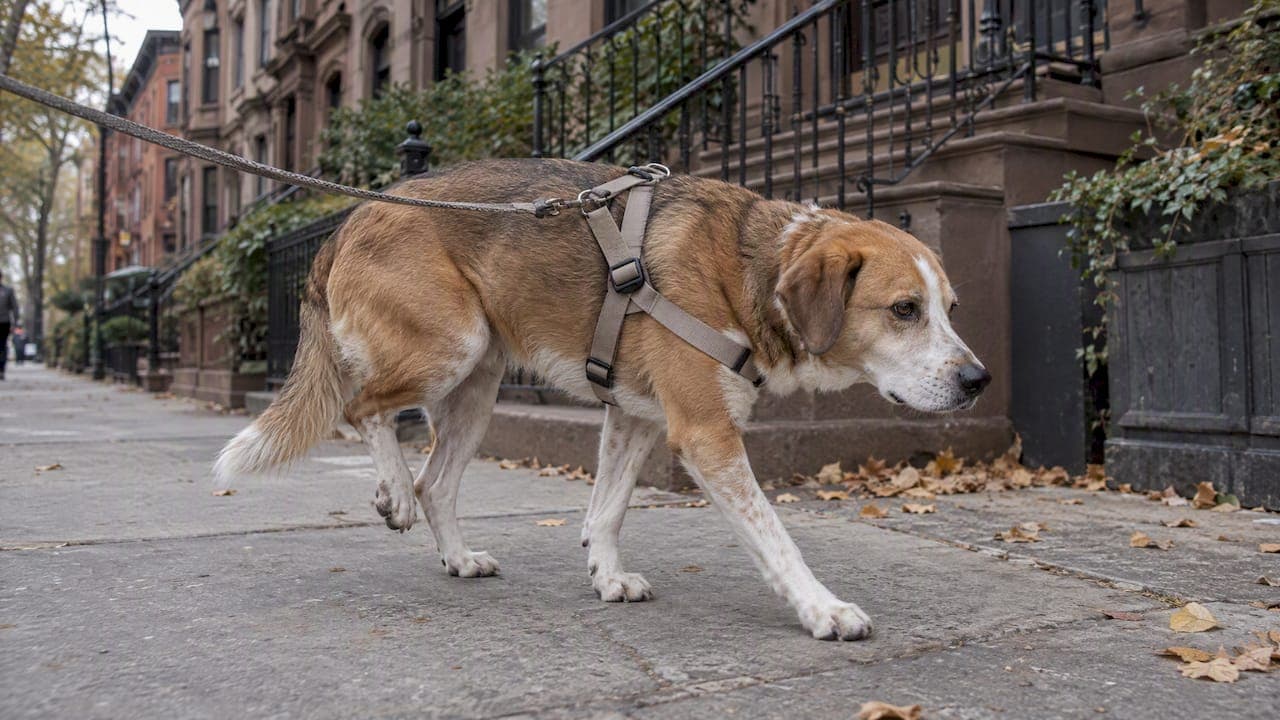
A limping dog is a dog in pain. The cause can be as simple as a thorn in a paw pad or as serious as a torn cruciate ligament, a fracture, or an illness that has nothing to do with the leg. Cornell's veterinary college describes limping as a sign that something painful is interfering with normal use of a limb, ranging from mild stiffness to a complete refusal to bear weight. This guide walks through the usual suspects, what you can safely check at home, and when to stop watching and start dialing.
TL;DR
- Limping always means pain or a mechanical problem. It is never normal, and a limp that fades can still leave pain and joint inflammation behind.
- Common causes include paw injuries, sprains and strains, cranial cruciate ligament disease, luxating kneecaps, hip and elbow problems, arthritis, and, less often, infection, spinal disease, or bone tumors.
- Go to a vet the same day if your dog won't put weight on the leg, the limb looks swollen or misshapen, or there is bleeding, fever, or sudden collapse.
- Never give human pain medication. Many of these drugs are dangerous for dogs and can hide the problem.
- Film your dog walking at home. It helps your vet see what a nervous dog may hide in the exam room.
Table of Contents
- First look: what you can safely check at home
- The most common causes of a limping dog
- Quick guide: what the pattern might suggest
- When a limp is an emergency
- What not to do
- Will a limp heal on its own?
- What happens at the vet visit
- Our perspective: calm dogs show us more
- Treatment: what comes after the diagnosis
- Book a limp exam with us
- FAQ
- Sources
First look: what you can safely check at home
Stay calm, and keep your dog quiet. Move them to a spot where they can lie down, and have a second person help if your dog is large or in pain. Even gentle dogs can snap when something hurts, so go slowly and watch their face and body.
Then check a few things:
- Which leg, and front or back? Watch your dog walk on a flat surface. A dog usually nods its head up when the sore front leg touches down. A hind leg limp tends to show as a shortened stride or a hip that drops or hikes.
- The paw. Spread the toes gently and look between them and under the pads for cuts, thorns, glass, a burr, a cracked or bleeding nail, or swelling.
- The leg itself. Run your hand down from shoulder or hip to toes. Note heat, swelling, an odd angle, or a spot your dog pulls away from.
- The whole dog. Is your dog eating, drinking, and alert? Is there a fever, vomiting, or a hunched posture? These matter because lameness can be a subtle sign of illness elsewhere in the body, not just a local injury.
If you find a small, obvious splinter or burr and your dog lets you remove it easily, that may be the end of it. If anything else turns up, or the limp continues, book an exam.
The most common causes of a limping dog
Veterinarians sort limping by body system: musculoskeletal (injury and developmental disease), neurological (spinal or nerve pain), and systemic (such as infectious or immune-mediated disease). Here is how that looks in everyday practice.

Paw and nail problems
The paw is the first place to look because it is the easiest thing to fix. Typical culprits:
- Torn or broken nails, often from catching on carpet, a grate, or a hard run
- Cuts and abrasions on pads, from hot pavement, glass, or ice-melting salt in a New York winter
- Foreign objects such as thorns, splinters, or grass seeds lodged between toes
- Insect stings, interdigital cysts, and infections between the toes
- Allergies that cause constant licking and sore, inflamed paws. Our post on why dogs lick their paws and what a vet checks goes through that pattern.
A dog that licks one paw obsessively and limps slightly is telling you where it hurts. Don't assume it is just boredom.
Sprains, strains, and soft tissue injuries
A sudden limp after a big run, a jump off the couch, or rough play at the dog run often points to a muscle strain or ligament sprain. These can improve with rest, but they can also look identical to more serious injuries early on. A dog that is only a little off after a day of rest should still be examined if the limp has not cleared in a day or two.
Cranial cruciate ligament disease
The cranial cruciate ligament stabilizes the knee. According to the Merck Veterinary Manual, cruciate disease is the leading cause of hindlimb lameness in dogs, and it can come from trauma or from gradual degeneration of the ligament. Signs include:
- Sudden hind-leg limping, or a limp that comes and goes and gets worse after exercise
- Sitting with one leg kicked out to the side
- Stiffness after rest
- Swelling around the knee
Some dogs partly tear the ligament and seem to recover, then tear it fully weeks later. A "better" knee is not proof of a healed knee.
Luxating patella
In this condition the kneecap slips out of its groove. Owners often describe a dog that skips a few steps on a hind leg, then kicks the leg out and goes back to normal. It is common in smaller breeds, but it can happen in any dog. Occasional skipping still deserves an exam, because repeated slipping can wear the joint.
Hip and elbow dysplasia
Hip dysplasia is a common inherited condition in which the joint forms loosely, and over time this laxity leads to arthritis and pain. Developmental conditions like these are most often seen in medium and large breeds. Signs include a bunny-hopping gait, trouble rising, reluctance to climb stairs, and a swaying rear end. Elbow dysplasia does the same in the front legs.
Arthritis and chronic joint pain
Osteoarthritis is the long-haul cause. Owners frequently chalk up slowing down, stiffness, or trouble getting up to age. A paper in the Journal of the American Veterinary Medical Association lists clinical signs that include pain, decreased range of motion, swelling, stiffness, and muscle loss, and notes that pain can change a dog's behavior. A dog that is grumpy about being touched may be hurting, not just getting older.
It is also manageable. Early attention gives you more options, and that is the whole reason not to wait.
Fractures, dislocations, and wounds
A fall, a car strike, or a tangle with another dog can cause fractures, dislocated joints, or deep punctures that hide under fur. A dog that holds a leg up, won't touch the foot down, or has visible deformity needs same-day care. Bite wounds are easy to miss and can become infected within days.
Growing pains and puppy problems
Limping in puppies can be misleading. Some conditions, like panosteitis, are temporary. Others, like hip dysplasia, need early diagnosis so that you can slow progression. Another is Legg-Calvé-Perthes disease, a deterioration of the femoral head that affects young dogs. The lesson: have a limping puppy looked at, rather than guessing it is a strain.
Bone disease, infection, and tumors
The Merck Manual notes that bone disorders can be developmental, infectious, nutritional, or caused by tumors, trauma, or unknown causes. Cornell's list of other causes for a limping dog also includes bone cancer, spinal disease, and foot injuries. A limp that gets steadily worse, with swelling over a bone, is a reason to move quickly, especially in a large or older dog.
Spinal and nerve causes
A disc problem or pinched nerve can make a dog drag a paw, knuckle over, or seem wobbly instead of truly limping. Crying out when picked up, a hunched back, or weakness in the hind legs are red flags that belong in an urgent appointment.
Tick-borne and immune-related illness
Systemic disease can show up as shifting limping, where the sore leg changes from day to day, often with fever, low energy, or poor appetite. Cornell lists infectious diseases such as Lyme disease and immune-mediated joint disease in this category. Blood work helps sort these out, which is one reason a vet looks at the whole dog and not just the leg.
Quick guide: what the pattern might suggest
| What you see | Possible causes | How soon to be seen |
|---|---|---|
| Sudden, no weight on the leg | Fracture, dislocation, ligament rupture, deep wound | Same day |
| Limp after exercise, then better | Strain, sprain, early cruciate disease, arthritis | Within a day or two |
| Skipping step, leg kicked out, then normal | Luxating patella | Book an exam soon |
| Limp plus licking one paw | Foreign object, torn nail, infection, allergy | Within a day or two |
| Stiff after rest, slow to rise | Arthritis, hip dysplasia | Book an exam |
| Limp that shifts legs, with fever or low energy | Tick-borne or immune-related illness | Same day or next day |
| Puppy limping | Growth conditions, dysplasia, injury | Book an exam |
This table can't diagnose your dog. It helps you describe what you are seeing and judge how urgent it is.
When a limp is an emergency
Go to an emergency or urgent-care vet right away if your dog:
- Cannot or will not put any weight on a leg
- Has a swollen, hot, or misshapen limb, or a bone you can see
- Is bleeding heavily or has a deep wound
- Cries out, snaps, or becomes limp, pale, or collapses
- Has a limp with fever, vomiting, or severe lethargy
- Drags the hind legs or suddenly can't stand
Not sure whether you need urgent or emergency care? Our post on five red flags that need an emergency vet lays out the difference. For same-day concerns during our hours, you can learn about our urgent care service. Outside those hours, 24-hour emergency hospitals operate in Brooklyn, so know where your nearest one is before you need it.
What not to do
Do not give human pain medication. Ibuprofen, naproxen, and acetaminophen can be dangerous to dogs. Veterinary NSAIDs exist, but they are prescribed after an exam. Cornell's NSAID guide for animals explains how these drugs are used under veterinary direction. Painkillers can also mask the problem. A dog that feels better may run on a damaged joint and make it worse.
A few other habits to avoid:
- Don't force your dog to "walk it off"
- Don't let them jump on and off furniture or climb stairs freely while they are limping
- Don't massage or manipulate a leg that might be broken
- Don't wait for weeks to see whether it "heals". Cornell's pain resources stress that signs of pain often develop gradually and are easy to miss, so a limp that stops can still leave pain behind.
Will a limp heal on its own?
Sometimes a mild strain does settle with a few days of restricted activity. But you can't tell a mild strain from a partial ligament tear by looking. If the limp lasts more than 24 to 48 hours, comes and goes, or returns after exercise, treat it as a medical problem. A limp that appears and disappears is the pattern owners most often dismiss, and it fits conditions like luxating patella, early cruciate disease, and arthritis.
What happens at the vet visit
A limp workup starts with a history and a hands-on exam, as Cornell's guide to the visit explains. Your vet will watch your dog move, feel each joint and bone, and check the paws, spine, and muscles. Depending on findings, the next steps can include:
- X-rays to look at bones and joints, and ultrasound for soft tissue
- Blood work to rule out systemic or infectious disease
- Joint fluid analysis in some cases
Help your vet by preparing:
- A short video of your dog walking, trotting, and climbing stairs at home
- A note of when the limp began, which leg, and what makes it better or worse
- Any recent injuries, new activities, or ticks you found
- A list of medications and supplements your dog gets
The video matters more than owners expect. Anxiety in the exam room can mask signs of pain, and a dog that limps all morning may walk normally on the clinic floor.
Our perspective: calm dogs show us more
At City Animal, we see the same pattern often: an owner arrives with a dog that limped for days, but in the exam room the dog trots out perfectly. A stressed dog tenses, pulls away, and hides pain. That is why we built our visits around the Fear Free approach, aiming to lower stress so we can feel and see what is really going on. A relaxed dog gives a more honest exam.

We also see a lot of owners who hold off because loading a large or painful dog into a car and traveling through Brooklyn feels like too much. If that is you, ask us about home visits. A dog that is examined on its own turf often moves more naturally, and you don't have to put a hurting animal through the trip.
Our view on limping is simple: take it seriously early. The cause is often fixable, and the sooner it is found, the more options you and your dog have. Those options go beyond surgery or medication. Our team also offers pain management, and for suitable dogs, holistic therapy alongside conventional care. You can read more in our guide to acupuncture for dogs. For older dogs, a senior wellness exam is a good time to bring up stiffness, slower rising, or reluctance on stairs, signs that are easy to write off as age.
— CAVC
Treatment: what comes after the diagnosis
What your dog needs depends entirely on the cause. In general terms:
- Paw and nail problems: cleaning, removal of a foreign object, bandaging, or treatment of infection
- Sprains and strains: controlled rest, activity restriction, and pain control prescribed by your vet
- Cruciate and other ligament injuries: often surgical stabilization, depending on the dog and the injury. Our surgery page covers what we offer.
- Arthritis: a long-term plan that may combine medication, weight management, nutrition, controlled exercise, and complementary therapies
- Infection or immune disease: targeted medication guided by lab work
If your dog needs sedation or anesthesia for X-rays or a procedure, our guide to anesthesia safety in senior pets explains what to ask any clinic.
Book a limp exam with us
If your dog is limping and you can't tell why, we can help find out. At City Animal Veterinary Center in Brooklyn we offer exams with digital X-rays, ultrasound, and in-house lab work, so many parts of a limp workup can happen under one roof. You can start with a wellness or sick-pet exam, or if you are new to us, visit our new client page. If your dog is hurting badly or won't bear weight, call us right away so we can advise you on the safest next step.
FAQ
When should I be concerned about my dog limping?
Be concerned right away if your dog won't use the leg at all, the limb is swollen or misshapen, or there is bleeding, fever, or collapse. Also act if a mild limp lasts more than a day or two, or keeps returning. Any limp deserves attention, because it signals pain.
What should I do if my dog is limping?
Restrict activity, keep your dog calm, and check the paw for cuts, thorns, or a torn nail. Do not give human pain relievers. If you can, record a short video of the limp, then call your vet to describe it and decide how soon to come in.
Why does my dog limp sometimes and not others?
An intermittent limp often points to a joint problem, such as a luxating patella, early cruciate disease, hip dysplasia, or arthritis, which flare with activity and settle with rest. The pain often returns even if the limp seems to disappear. A video of the limp is especially useful here.
Why is my puppy limping?
Puppies can limp from simple strains, but also from growth-related conditions such as panosteitis or hip dysplasia. Some pass on their own, while others need early treatment to protect the joint. Have your vet examine a limping puppy instead of waiting.
Sources
- What to expect when taking your limping dog to the veterinarian, Cornell University College of Veterinary Medicine
- Overview of Lameness in Small Animals, Merck Veterinary Manual
- Joint Trauma in Dogs and Cats, Merck Veterinary Manual
- Canine hip dysplasia, Cornell University College of Veterinary Medicine
- Nutrition and nutraceuticals in the management of osteoarthritis, JAVMA
- Aseptic Necrosis of the Femoral Head in Dogs, Merck Veterinary Manual
- Bone Disorders in Dogs, Merck Veterinary Manual
- NSAID medication guide for animals, Cornell University
- Recognizing pain in dogs, Cornell University College of Veterinary Medicine
- 24 Hour Emergency Vet in Brooklyn, NY