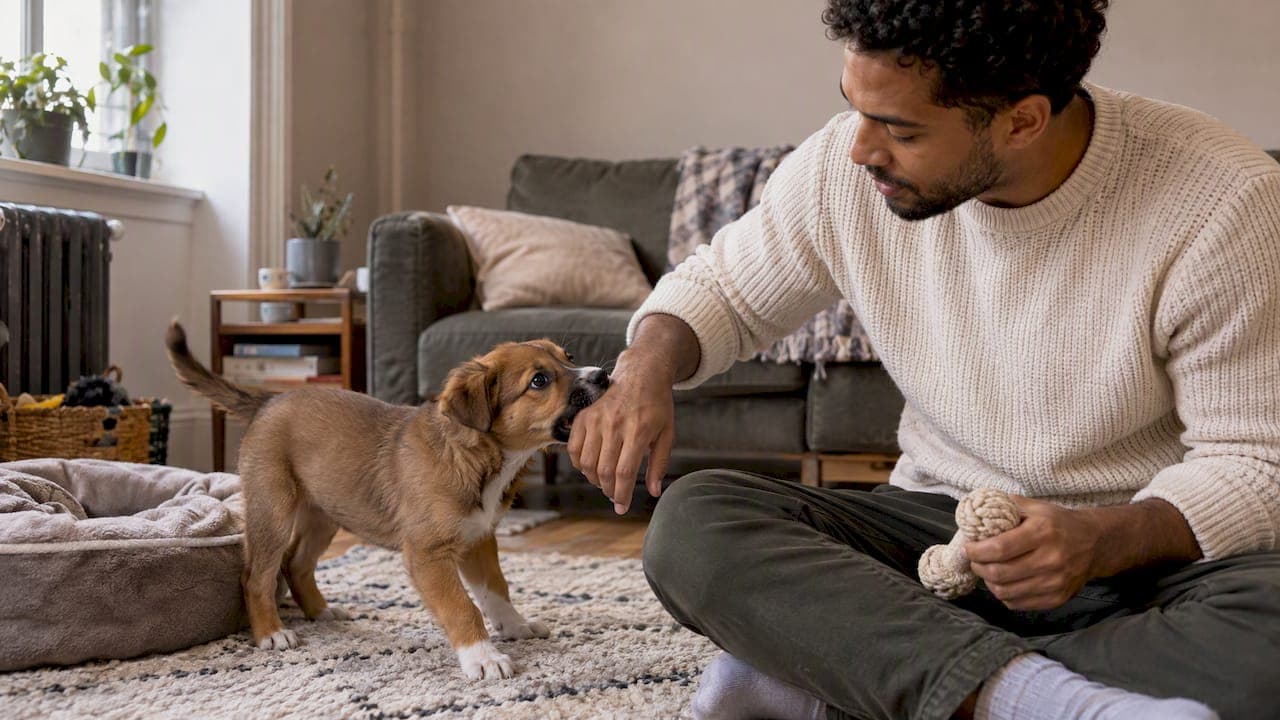
Puppy biting is normal, and it is fixable. You stop it by doing three things consistently: calmly ending the moment when teeth touch skin, redirecting your puppy's mouth to something legal to chew, and meeting the needs behind the biting, like sore gums, tiredness and too much excitement. Most puppies need weeks of repetition, not a single clever trick. This guide walks through what to do in the moment, how to teach a soft mouth, what to avoid, and the signs that mean it is time to bring in a professional.
TL;DR
- Puppies bite because they explore with their mouths, their gums hurt while teething, and they are often overtired or overexcited.
- When teeth touch skin, stop the fun, calmly remove yourself or your hand, then offer a toy and praise the switch.
- Teach bite inhibition by rewarding gentle mouths and keeping play short, so your puppy learns how much pressure is too much.
- Never use physical punishment. It can make a puppy fearful and can lead to harder biting or aggression.
- If biting involves pressure holding, stiff body language, deep growling or head-shaking, book a behavior consult.
Table of Contents
- Why puppies bite and nip
- What to do the moment your puppy bites
- Teaching bite inhibition
- Redirecting the bite to the right target
- Meeting the needs behind the biting
- Common mistakes that make biting last longer
- Perspective: why a calm puppy visit matters for biting
- When biting is more than normal puppy behavior
- Get support for your puppy in Brooklyn
- FAQ
- Sources
Why puppies bite and nip
A puppy's mouth is its hands. Everything new gets picked up, tasted and tested, and that includes your fingers, sleeves, shoelaces and pant legs. Biting during play is also how littermates learn manners: a bite that is too hard ends the game, and the puppy learns to dial it down. When your puppy joins your home, you take over that teaching job.
Several things sit behind the nipping:
- Teething. Teething can make a puppy's gums sore, which is why chewing and gnawing on hands feels like relief to them (PetMD).
- Play. Mouthing is a normal part of how puppies play with people and other dogs.
- Overtiredness and overstimulation. A puppy who has been awake too long often turns into a wild, biting, zoomy creature. It looks like naughtiness, but it is really a need for a nap.
- Attention. If biting reliably makes you squeal, chase or talk to your puppy, the puppy learns that teeth get a reaction.
- Excitement at greetings. Visitors, kids running around and the moment you walk in the door are classic trigger points.
Will my puppy grow out of it?
Mostly, with your help. Puppy biting tends to peak at about 13 weeks of age (PetMD), so if you are in the thick of it, it can feel endless and still be right on schedule. But time alone is not the teacher. If you do not teach bite inhibition and provide appropriate things to chew, a puppy can grow into an exuberant adolescent dog who is harder to manage (PetMD). The sharp little nips fade because you shape them out, not because they vanish on their own.
What to do the moment your puppy bites
Your response in that one second matters more than any long training session. Here is a simple sequence that works for most households. Everyone in the home should use the same one, because consistency is what makes puppies learn quickly.
- Go still and quiet. Skip the shrieking and the flailing. High-pitched squeals and jerking hands often excite a puppy further and turn a nip into a game.
- Pause the fun. Remove your hand, foot or clothing from your puppy's mouth and stop interacting for a few seconds. Looking away or standing up works well. The lesson is simple: teeth make the good stuff stop.
- Offer something legal. Hand over a chew toy or a tug toy, and let your puppy bite that instead.
- Praise the switch. The moment your puppy takes the toy and mouths it, say “good” and reward with calm praise. Your puppy needs to hear that the right choice pays off.
- Restart play if the puppy is calm. If the puppy dives back at your hands, repeat the pause. After a few rounds, give a longer break.
Some trainers use a short, soft “ouch” in a surprised tone when the pressure is too hard. The point is to mark the moment, not to scold. If your puppy gets more wound up when you say it, skip the word and just go quiet and still.
When your puppy keeps coming back
If your puppy latches on again and again despite these steps, that is usually a sign of fatigue or overstimulation, not defiance. Calmly guide your puppy to a quiet space, such as a crate or pen with a chew, or offer a potty break. Treat it as a reset, never as punishment. A puppy who naps for an hour or two often comes back as a much easier student.
Is it okay to push a puppy away?
Shoving, pinning or flicking a puppy usually backfires. Physical punishment can make a puppy fearful and can cause it to bite harder or become aggressive (American Kennel Club). Gentle removal of your hand and a calm break are safer and more effective. The same goes for “alpha” style tactics like holding a puppy's mouth shut. These tend to teach a puppy to distrust hands, which is the opposite of what you want from a dog you will be handling for the vet, the groomer and daily life.
Teaching bite inhibition
Bite inhibition is a dog's ability to control how hard it bites. The goal is not a puppy who never uses its mouth. The goal is a puppy who learns that human skin is extremely delicate, so that even if an adult dog someday mouths you in a stressful moment, the pressure is soft.
A practical way to build it:
Stage one: no painful pressure. In the first weeks, react to hard bites by pausing play. Gentle mouthing can be tolerated for the moment, while the hard ones end the game. Puppies learn what “too hard” is by contrast.

Stage two: less pressure becomes the rule. As your puppy gets better, raise your standard. Pauses now follow moderately firm mouthing too, then any teeth contact on skin. Move the bar slowly over days and weeks, not minutes.
Stage three: teeth on skin means a pause, every time. By this stage most puppies will check in with you before mouthing and often choose a toy instead.
Keep sessions short and end on a calm note. Five minutes of well-timed practice a few times a day beats a long, frantic hour that finishes with everyone frustrated.
Hand-feeding and gentle-mouth games
Mealtime is a free training opportunity. Offer a few kibbles from your open palm and reward your puppy for taking them softly. If your puppy grabs, close your hand briefly and offer again when the puppy backs off. Over time, the puppy learns that gentle manners open the hand. Handling practice, like touching paws, ears and the muzzle with treats, also builds trust and prepares your puppy for exams.

Redirecting the bite to the right target
Redirection is the engine of the whole plan. A puppy's need to chew does not go away, so you give it a better outlet.
- Keep toys within reach everywhere. Stash a rope, a rubber chew or a soft toy in every room, and in your pocket on walks and at the door.
- Rotate the selection. Offer a few at a time and swap them out so they stay interesting.
- Use different textures. Some puppies prefer firm rubber, others soft plush, and teething puppies often love something cool, like a chilled (not frozen solid) chew.
- Make yourself more interesting than your socks. Tug with a long toy so your hands stay far from the teeth, then pause the game when the puppy lunges for you.
- Do not make hands into toys. Never encourage nipping by enticing a puppy to chase your hands or toes. As your puppy grows, its teeth will be sharper and the nip may become a bite that is no longer fun (PetMD).
Also watch the tone of rough play. Wrestling with your hands, slapping at the puppy's face and games where you wave fingers all teach the puppy that your skin is part of the game. Use a toy as the go-between, and end play when your puppy gets too wound up.
Meeting the needs behind the biting
Behavior training works far better when the puppy's basic needs are covered. Consider the whole day, not just the bite.
Sleep
Puppies need a lot of rest, and many get cranky and mouthy when they do not get it. If your puppy turns into a land shark around the same time every evening, try a scheduled nap in a crate or pen before that window starts. A quiet, boring space helps your puppy actually settle.
Exercise and mental work
A short walk, sniffing in a safe yard or hallway, a snuffle mat or a food puzzle can use up energy in a calmer way than rough play. Sniffing and chewing are naturally soothing for dogs. Meals served from a puzzle toy give the mouth a job.
Teething comfort
If gums are sore, a puppy will chew harder and more often. Offer appropriate chew toys sized for your puppy so they cannot be swallowed. Supervise chewing, and remove any toy that is breaking into pieces.
Socialization
A puppy who meets calm people, dogs and new places at a gentle pace usually develops better manners and confidence. Our puppy socialization checklist covers a Fear Free approach to the early weeks, including how to keep exposures positive rather than overwhelming.
Common mistakes that make biting last longer
- Inconsistent rules. If one person lets the puppy chew fingers and another does not, the puppy cannot learn the rule.
- Yelling or scruff-shaking. Loud, aggressive corrections can scare a puppy, and fear can make biting worse.
- Rough, chaotic play with kids. Teach children to stay calm, stand still like a tree, and hand over a toy instead of running and squealing. Always supervise play between young children and puppies.
- Waiting too long to start. The earlier you begin, the less rehearsal your puppy gets of the habit.
- Expecting overnight results. Most puppies need weeks of repetition. A little progress each day is the normal pattern.
- Ignoring the tired puppy. Training a puppy who is already overstimulated rarely goes well. Give a break first.
Perspective: why a calm puppy visit matters for biting
At City Animal Veterinary Center, we see puppy biting from two angles: the training side at home and the health side in the exam room. Nipping is rarely a character flaw. It is a young animal learning how to use its mouth, often while its gums hurt and its world is changing every day.
We believe the way a puppy experiences its earliest vet visits shapes how it feels about being handled for life. That is why we practice Fear Free care, which is designed to lower stress for pets and for the people attached to them. A puppy who is relaxed, treated gently and rewarded for calm behavior has an easier time learning that hands are safe and that mouths can be soft.
We also think biting should be looked at as a whole-pet question. Pain, itchy skin, dental discomfort or fear can all show up as mouthiness. Our team can check the physical side, talk through your puppy's routine, and point you toward behavior support when training alone is not enough. For owners who cannot easily bring a nervous puppy across the borough, we offer home visits so the exam happens where your puppy feels most secure.
CAVC
When biting is more than normal puppy behavior
Most nipping is ordinary and improves with consistent training. But some patterns deserve professional eyes. If bites include holding with pressure, body tension, deep growling or head-shaking, contact a behavior professional (PetMD). Other reasons to ask for help include:
- Biting that is getting harder or more frequent despite several weeks of steady work.
- A puppy who bites when touched in a specific spot, which can point to pain and calls for a veterinary exam.
- Guarding of food, toys or resting places with stiffening, snapping or growling. Our guide to resource guarding in dogs lays out a safety-first plan.
- Fear-based biting around strangers, handling or the vet. See our article on fear aggression in dogs for how to approach it safely.
- Bites that break skin on a child or another vulnerable person. Separate the puppy and children during unsupervised moments and get advice promptly. If anyone is bitten and the skin is broken, wash the wound and speak to a doctor.
If you are unsure whether it is behavior, pain or both, start with a veterinary exam, then add a trainer or behaviorist as needed. Our dog aggression guide explains how to stop the practice of unwanted behaviors while you arrange support.
Get support for your puppy in Brooklyn
A puppy's first months are the best time to build good habits and catch small problems early. At City Animal Veterinary Center, our puppy and kitten care, vaccinations and exams are built around gentle, Fear Free handling, so your puppy associates the clinic with treats and calm rather than stress. You can learn more about wellness exams and puppy care on our site, or ask about a home visit if getting your puppy to us is hard.
If you want hands-on training help alongside veterinary care, our PumpkinPups dog training page explains what is available in Brooklyn. For behavior concerns that may have a medical component, ask us about behavior management at your next visit.
FAQ
Do puppies grow out of aggressive biting?
Normal puppy biting usually fades as teething ends and training takes hold, and it tends to peak at around 13 weeks according to PetMD. It does not simply disappear without guidance, though, so keep teaching and redirecting. If the biting looks serious, with stiff posture, deep growling or pressure holding, get a behavior professional involved early.
Is it okay to push a puppy away when it bites?
It is better not to. Shoving or physical punishment can make a puppy fearful and can cause harder biting or aggression, as the American Kennel Club advises. Instead, go still, calmly remove your hand, pause play and offer a toy.
How do you discipline a puppy for biting you?
Think teaching rather than discipline. Stop the interaction for a few seconds, redirect to a chew toy and praise your puppy for taking it. Give a nap or quiet time when your puppy is overtired. Avoid yelling, hitting or scruff-shaking, which can create fear and make biting worse.
Why does my puppy bite more in the evening?
Many puppies get overtired and overstimulated later in the day, which looks like a burst of biting and zoomies. Try a scheduled nap before that window, offer a chew or a food puzzle, and keep play calm. If the pattern stays intense, mention it at your next vet visit so we can rule out discomfort.
When should I talk to a vet or trainer about puppy biting?
Reach out if biting is getting harder, if it comes with pressure holding, body tension, deep growling or head-shaking, or if your puppy reacts when touched in a particular spot. A vet can check for pain or illness, and a qualified trainer or behaviorist can build a plan around your household.
Sources
- How To Stop a Puppy From Biting, PetMD
- How to Stop Puppy Biting and Train Bite Inhibition, American Kennel Club