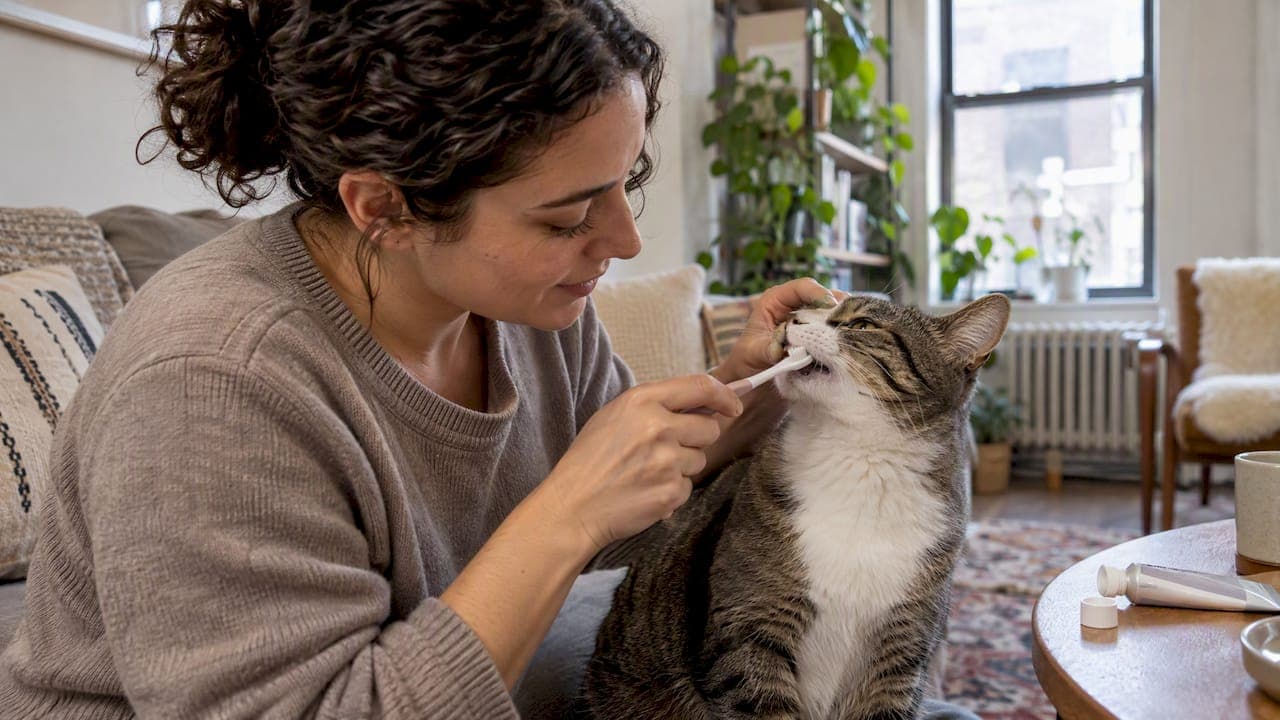
Brushing your cat's teeth works best as a slow training project, not a one-time wrestling match. Start with a taste of cat toothpaste, build up to touching the gums, then brush only the outer surfaces of the teeth, a few seconds at a time. Most cats need a couple of weeks of tiny, rewarded sessions before a brush ever goes in the mouth, and that patience is what makes the habit last.
This guide walks you through the whole process: what to buy, how to train, what to do with a cat who won't cooperate, and how brushing fits with professional care. We also cover the carrier, because a cat who has learned to trust handling at home usually does better in the exam room too.
TL;DR
- Periodontal disease affects nearly 70% of cats by age three, and brushing is the best thing you can do at home to slow it.
- Brush only the outside surfaces (the cheek side) of the teeth. A cat's rough tongue helps clean the inner surfaces.
- Go in stages: taste, touch, gums, then brush. Short, calm, rewarded sessions beat long ones.
- Brushing supplements professional exams and cleanings. It never replaces them.
- Look for the VOHC Seal of Acceptance when you choose products.
Table of Contents
- Why brushing matters more than it seems
- What you need before you start
- How to brush your cat's teeth, step by step
- How often to brush
- Start young, but older cats can learn too
- When your cat resists
- Keep the training space cat-safe
- Carrier training: the other half of a calm vet visit
- Our perspective: brushing is home care, and home care has limits
- Where professional care fits in
- When to call a vet instead of brushing
- Book a dental check with a Fear Free team
- FAQ
- Sources
Why brushing matters more than it seems
Plaque is a soft film of bacteria that forms on teeth constantly. If it stays, it hardens into tartar, and the gums underneath become inflamed. The trouble is that much of the damage happens where you can't see it. According to the AVMA, periodontal disease often develops below the gumline, where it can cause pain, tooth loss and inflammation that reaches beyond the mouth.
The same AVMA release notes that daily brushing is the gold standard of home care, yet only a small fraction of owners keep up a regular routine. If you have tried and given up, you are in the majority. The good news is that the reason is usually technique and pacing, not your cat.
Bad breath, red or swollen gums, drooling, dropping food or chewing on one side are all signs that the mouth needs a veterinarian, not just a brush. The AVMA's pet dental care page lists these warning signs and recommends that your veterinarian check your pet's teeth and gums at least once a year.

What you need before you start
Keep the kit small and cat-specific.
- A cat toothbrush or finger brush. Most standard human toothbrushes are too big for a cat's mouth. The Veterinary Oral Health Council (VOHC) notes that a brush made for cats works, and that small finger brushes that slip over your fingertip are an option too. A soft, small-headed brush is easier to angle along the gumline.
- Pet toothpaste. Never use human toothpaste. Fluoride and foaming agents are not meant to be swallowed, and cats can't spit. Poultry, seafood and malt flavors are common, and the flavor is part of the reward.
- A favorite treat. Something your cat truly loves, in tiny pieces.
- A calm spot. A bathroom or small room with the door closed, a towel on your lap or a counter, and no other pets wandering in.
Choosing products with the VOHC seal
Pet stores are full of dental products with big claims. The VOHC awards its Seal of Acceptance only to products that have met its standards for reducing plaque or tartar. The accepted list covers toothpastes, brushes, wipes, water additives, dental diets and treats, so you can match the product to your cat's temperament. A cat who will never tolerate a brush may still accept a wipe, a diet or an additive, and those are better than nothing. Ask us at your next visit if you aren't sure which product suits your cat.
How to brush your cat's teeth, step by step
The goal is for your cat to think of this as a game that ends in a treat. Expect each stage to take several days. Move on only when your cat is relaxed, not just tolerating it. A relaxed cat has loose shoulders, normal ears and will accept the treat afterward. If your cat flattens ears, swishes the tail or tries to leave, you went too fast: go back one step.
Step 1: Pick the moment
Choose a time when your cat is calm, often after a meal or play session. Do the training in the same place at the same time each day. Sessions should be a minute or two at most. Stop while your cat still wants more.
Step 2: Let your cat taste the toothpaste
Put a pea-sized dab of toothpaste on your finger and offer it. Many cats happily lick it. Do this for several days until your cat approaches the toothpaste with interest. Don't touch the mouth yet.
Step 3: Touch the lips and teeth
With toothpaste on your finger, gently lift one side of the lip and rub the outside of a single canine tooth, the long front-side fang. Count to three, then reward. Over the next days, add the teeth behind it, a few at a time.
Step 4: Add the gums
Rub along the gumline in small circles with your fingertip or a piece of gauze. Gums are where plaque causes inflammation, so this is the real target. If the gums look red or bleed easily, don't push harder: that is a reason to book an exam.
Step 5: Introduce the brush
Let your cat lick toothpaste off the brush first. Then touch the brush to the canines, reward, and gradually work toward the back teeth. Hold the brush at roughly a 45-degree angle to the gumline and use small circular or back-and-forth motions.
Step 6: Brush only the outside
You do not need to open your cat's mouth wide. Experts emphasize that the outer, cheek-facing surfaces matter most, since plaque and tartar build up fastest there, and the tongue handles much of the inner surface. Work from the back of one side to the front, and repeat on the other side. Aim to build up to about 30 seconds per side.
Step 7: End on a win
Always finish with a treat, play or praise, even if you only got two teeth done today. Tomorrow you do a little more.
How often to brush
Daily is ideal, because plaque begins hardening into tartar within days and tartar can't be brushed off. Many veterinary guides treat three times a week as a bare minimum, but results come from consistency, so choose a schedule you can truly keep. Tie it to something you already do, like dinner or your own evening routine.
If your cat only tolerates half the mouth one day, do the other half the next. Partial brushing beats a fight that ends the habit.
Start young, but older cats can learn too
Veterinary teams recommend beginning as early as the kitten stage because early handling makes lifelong acceptance more likely. The UC Davis teeth brushing guide is clear that older pets can still learn, though desensitization needs more patience and smaller steps. If your adult cat has never had anything in the mouth, spend longer at each stage. A week on toothpaste licking is not wasted time.
If you have a new kitten, bring up dental handling at the first wellness exam. Kitten visits are a good time to practice mouth handling, and your veterinarian can check how the adult teeth are coming in.
When your cat resists
Some cats will never accept a brush. That doesn't mean you have failed. Try these before giving up.
- Go back a stage. Most refusal comes from moving too fast.
- Shorten the session. Ten seconds of calm is worth more than a minute of struggle.
- Change the flavor or tool. A finger brush, gauze wrapped on a finger, or a dental wipe may be easier than a standard brush.
- Never scruff or restrain forcefully. Fear teaches your cat to avoid you at brushing time.
- Use alternatives. VOHC-accepted water additives, diets and treats can reduce plaque for cats who refuse brushing, though they work best alongside professional care.
- Rule out pain. If a cat who used to tolerate brushing suddenly refuses, a sore tooth may be the reason. Resorptive lesions, for example, can be painful and hidden; read our article on spotting tooth resorption early.
A cat with significant anxiety or a history of aggression around handling may need a behavior plan. Our team offers behavior management and other services that can help you shape a routine that works for your cat.
Keep the training space cat-safe
While you set up your brushing spot, take a look at the surroundings. Fresh flowers on a counter are a common hazard, since some popular blooms are toxic to cats. This guide to cat-safe flowers explains what to ask a florist before bringing a bouquet home.
Carrier training: the other half of a calm vet visit
Many readers who search for brushing tips also ask about getting a cat into a carrier, and the two skills work the same way. Both rely on short, rewarded sessions and on letting the cat choose to take part.
A study described by Fear Free Happy Homes found that cats taught to enter a carrier willingly showed less stress on the car ride and had shorter vet exams. The basics are simple:
- Leave the carrier out all the time. Put a soft blanket inside so it becomes furniture, not a signal that something bad is coming.
- Feed treats near it, then in it. Start at the door, then inside, then deeper over several days.
- Keep sessions to a minute or two. Cats fill up quickly on treats, so stop when the treats stop interesting them.
- Close the door briefly, reward, then open it. Slowly lengthen the time.
- Pick a carrier with a top opening or one that comes apart, so the cat can be lifted in or the exam can happen with the cat in the bottom half.
- Practice a short car trip before the real appointment.
If your cat still struggles, tell us before the visit. We have written about how a clinic-led Fear Free plan can cut vet anxiety and about pre-visit sedation options for cats who can't manage the trip calmly. For some households, a home visit removes the carrier problem entirely.
Our perspective: brushing is home care, and home care has limits
We see two mistakes with cat dental care. The first is skipping it because the idea of brushing feels impossible. The second is believing that brushing, a dental treat or a special diet can substitute for a professional exam.
What we tell owners in Brooklyn is simple. Brushing is worth the effort because it slows plaque. But it works on the visible crown of the tooth, and the diseases that cost cats the most happen under the gumline, where only an exam and dental radiographs can reveal them. The AVDC says that the only way to prevent or identify periodontal disease early is through regular veterinary cleanings under anesthesia, with the mouth evaluated and all teeth radiographed.

That is also why we caution owners about "anesthesia-free" dentals. The AVDC position is that scaling without anesthesia only addresses tartar on the visible crown, doesn't treat disease below the gumline, and can be unsafe for the cat and the person holding the instruments. It can also give a false sense of security. A white-looking tooth is not necessarily a healthy one.
Our approach is to make the whole process less frightening. As a Fear Free practice, we plan visits around your cat's comfort: low-stress handling, a calm room, and a team that goes at your cat's pace. We would rather see a cat for a gentle exam every year than for an emergency after months of hidden pain. We also want brushing to be something you and your cat can enjoy, so we are happy to demonstrate technique during an exam, show you where your cat's gums look healthy or inflamed, and adjust the plan if brushing isn't realistic.
— CAVC
Where professional care fits in
Home brushing and professional care do different jobs.
| Home brushing | Professional exam and cleaning | |
|---|---|---|
| What it reaches | Plaque on visible tooth surfaces | Full mouth, including below the gumline |
| Frequency | Daily is ideal | Exam at least annually, per the AVMA |
| Finds hidden disease | No | Yes, with charting and dental radiographs |
| Treats existing disease | No | Yes |
| Anesthesia | Not needed | Required for a safe, thorough cleaning |
If your cat already has gingivitis, a cleaning followed by good home care is often the most effective approach. Our article on reversing cat gingivitis with one cleaning and Fear Free home care explains how that works, and what a professional cleaning involves can help you feel prepared. If your cat has more serious mouth problems, such as persistent inflammation, see our piece on feline stomatitis treatment. And if you wonder about imaging, we explain X-ray safety for owners.
When to call a vet instead of brushing
Don't try to brush through any of these. Call your veterinarian:
- Your cat cries, paws at the mouth or pulls away when you touch one spot
- Blood on the brush, or gums that are bright red or swollen
- A strong, persistent odor
- Drooling, dropping food or chewing on only one side
- Loose, broken or discolored teeth
- Sudden loss of appetite
Any cat that stops eating for a day or more needs prompt attention, and our urgent care team can help.
Book a dental check with a Fear Free team
If you're starting a brushing routine, a baseline exam is the best first step. We can examine your cat's teeth and gums, tell you how much home care they need, and show you the technique in person. Learn more about our dental care services, or visit our page for new clients in Brooklyn to get started. If traveling with your cat is the hardest part, ask about home visits.
FAQ
Are you supposed to brush your cat's teeth?
Yes, if your cat will allow it. Brushing is the most effective home method for reducing plaque, and dental disease is very common in cats. If brushing isn't possible, ask your veterinarian about VOHC-accepted alternatives and keep up annual dental exams.
At what age should I start brushing my kitten's teeth?
As early as you can, ideally as a young kitten, so that mouth handling feels normal. Begin with gentle touching and toothpaste tasting rather than a brush. Your vet can also guide you when adult teeth come in.
Can I use human toothpaste on my cat?
No. Use toothpaste made for pets. Human toothpaste contains ingredients that are not meant to be swallowed, and cats can't rinse and spit.
Do I need to brush the inside of the teeth?
No. Focus on the outer, cheek-facing surfaces, where plaque builds fastest. The cat's tongue helps clean the inside surfaces, so you can skip them.
Is it too late to start brushing an older cat?
It isn't too late. Older cats can learn, but they usually need smaller steps and more time. Have your vet check for painful problems first, since mouth pain can make an older cat refuse brushing.
Sources
- AVMA: "Doggie breath" could be a sign of serious disease
- AVMA: Pet dental care
- VOHC: Toothbrushes or similar devices in cats
- VOHC: Accepted products
- UC Davis: Teeth brushing training guide
- AVDC: Periodontal disease factsheet
- AVDC: Companion animal dental scaling without anesthesia
- Fear Free Happy Homes: Teach your cat to go into a carrier