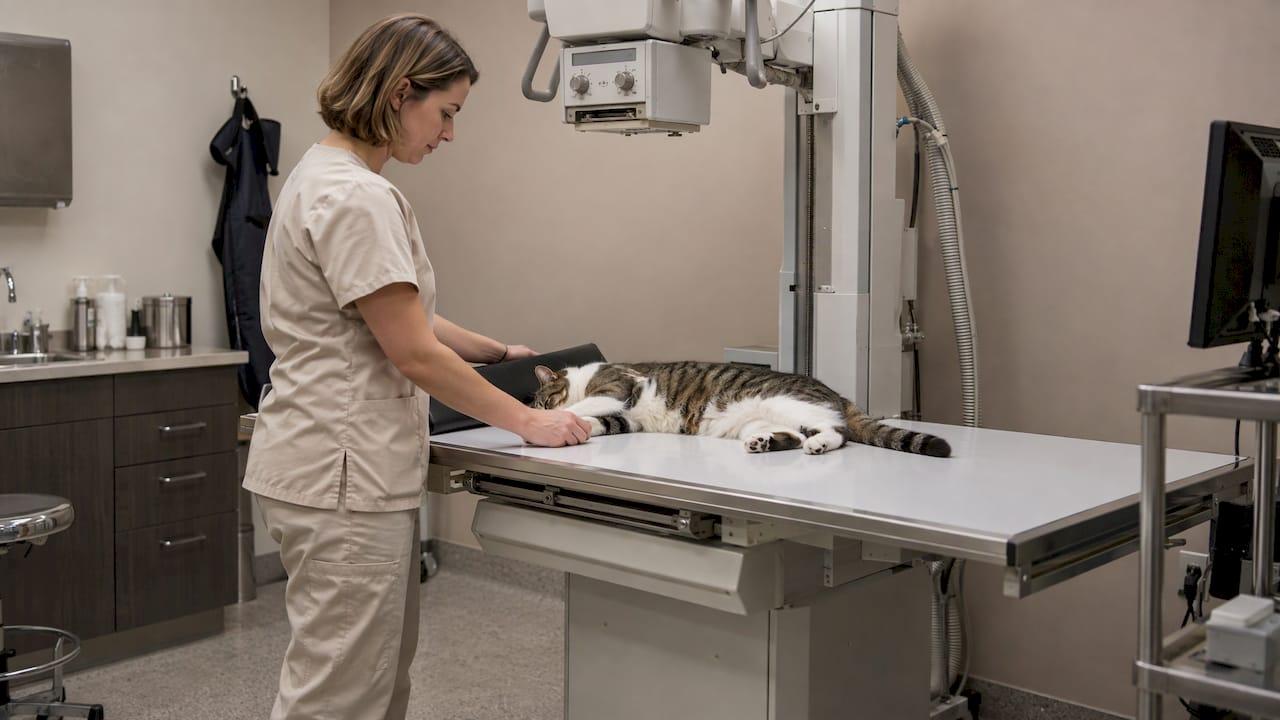
Many cats can have an X-ray with no sedation at all. Others do much better with it, especially cats in pain, cats who panic when handled, or cats who need exact positioning. Your veterinarian decides case by case. They weigh the body area being imaged, your cat's health, and how your cat copes with restraint. This guide explains how that decision is made, what happens if your cat is sedated, and how to get your cat ready and comfortable afterward.
TL;DR
- Most cats can have X-rays without sedation, but a veterinarian may recommend it for the safety of the cat and the team, per PetMD.
- Sedation helps most when a cat is painful, very stressed, or too wiggly to hold still. Movement blur can force repeat images.
- Follow your vet's fasting instructions exactly. They differ by sedation type and by clinic.
- Sedated cats should be monitored during the procedure and for hours afterward. Expect a sleepy, quiet cat for a day or so.
- A calm, low-stress visit starts before the car ride. Ask us about a Fear Free plan for your cat.
Table of Contents
- Do cats need sedation for an X-ray?
- Why a vet may recommend sedation
- When an awake X-ray may be the better plan
- Sedation versus anesthesia: what the words mean
- How cats are monitored during sedation
- How to prepare your cat
- What happens on the day
- Recovery: what to expect and what to watch
- Cat X-rays at City Animal Veterinary Center
- Questions to ask your vet before the X-ray
- FAQ
- Sources
Do cats need sedation for an X-ray?
Not always. The X-ray itself is painless and the exposure is very brief. The Merck Veterinary Manual notes that pets may be sedated to reduce stress and help them stay still, and that lead shields protect the rest of the pet's body and the people taking the images.
Whether a cat needs sedation comes down to three questions:
- Can your cat be positioned safely and calmly? A relaxed cat who tolerates gentle handling may need nothing more than a towel and a quiet room.
- Is your cat in pain? Lying on a side or being stretched out for a limb or spine image can hurt.
- Which body area is being imaged? Chest and abdomen are often easier to capture awake than a limb, skull or spine, where exact positioning matters more.
A WSAVA conference paper on chest and abdominal technique says most patients needing chest or abdominal films do not require sedation, though some benefit from a sedative or pain relief. It also describes wrapping awake cats in a towel, often called a kitty burrito, for positioning.
The Merck Veterinary Manual's radiography chapter takes the other side of the same coin. It says sedation or short-acting anesthesia is often necessary and usually desirable when the medical situation allows. Chemical restraint reduces the need for forceful manual restraint, which means fewer poor images and shorter exams.
Both statements are true. The right answer depends on the individual cat.
Why a vet may recommend sedation
A recommendation to sedate your cat is rarely about convenience. The usual reasons are practical and medical.
Pain control
Cats with fractures, arthritis or other painful conditions may hurt when they are moved into position. The Merck manual lists controlling pain linked to manipulation as one of the benefits of sedation in animals with painful disorders.
Less fear and stress
A frightened cat can scratch, bite, or struggle hard. Sedation lowers anxiety for the cat and cuts the risk of injury to everyone in the room. If your cat is difficult at every visit, read our guide to cutting cat vet anxiety with a clinic-led Fear Free plan.
Sharper images, fewer repeats
Even small movements can blur an X-ray. Position also changes what the image shows. The Merck manual explains that poor positioning can lead to misdiagnosis or missed lesions. For chest films, it recommends both right and left lateral views in cats and dogs, because lying on one side shifts fluid and partly collapses the lung on the down side. Getting several clean views from a cat who will not hold still is hard. A cat who is relaxed or lightly sedated can often be positioned correctly the first time.
If an awake attempt ends in blurry pictures and a second round, the cat has been restrained twice and exposed to radiation twice. That outcome is worse than a short, well-managed sedation.
When an awake X-ray may be the better plan
Sometimes a veterinarian prefers to try without sedation. Situations a veterinary equipment company's clinical guide lists include:
- advanced heart disease
- severe kidney or liver impairment
- a cat who has eaten recently, with concern about aspiration
- a previous reaction to sedation or anesthesia
- an unstable cat who needs urgent assessment
These are exactly the cases where your veterinarian's exam and history matter most. Tell us about any heart murmur, kidney disease, past anesthetic reaction or medication your cat takes, so the plan fits your cat.
For cats who can be imaged awake, clinics use techniques such as a towel wrap, a quiet room, and patient pacing. The Merck manual adds that sandbags, tape and foam pads can hold small animals in position. With practice this takes about as long as manual restraint, and the patient is less likely to hurt anyone or itself. This is also one reason people ask about pet X-ray safety without holding pets: restraint aids keep hands out of the beam.
Sedation versus anesthesia: what the words mean
Owners often hear both terms. In practice, a sedated cat is relaxed and drowsy. A cat under general anesthesia is fully unconscious, usually with a breathing tube placed. Depth is a spectrum. The peer-reviewed review Feline procedural sedation and analgesia: When, why and how points out that some sedation protocols can cause unconsciousness, amnesia and loss of protective reflexes. It adds that sedation is not automatically safer than general anesthesia and is sometimes chosen for practicality rather than because it is best for the cat.

What that means for you: ask which drugs will be used, what level of sedation is planned, and how your cat will be watched. A good team answers those questions plainly.
How cats are monitored during sedation
The same review describes appropriate monitoring for feline sedation as including:
- routine neurological checks, such as response to stimuli, eye reflexes and eye movement
- pulse oximetry, which measures blood oxygen
- capnography, which measures carbon dioxide in exhaled breath
- non-invasive blood pressure
These follow guidelines from the American College of Veterinary Anesthesia and Analgesia. Sedation is generally considered uneventful with a low risk of complications, according to the same article, but low risk is not no risk. Monitoring is how a team catches a problem early.
Older cats, cats with heart or kidney conditions, and cats with breathing problems deserve a closer conversation before the day. Bloodwork can be part of that conversation. Our in-house laboratory is one way we can look at your cat's health picture alongside imaging.
How to prepare your cat
Fasting
The rules are not the same everywhere, which is why your vet's instruction beats any general guide. PetMD says cats scheduled for injectable sedation at the hospital should not eat for at least eight hours before the appointment, and cats given an oral sedative at home should follow the vet's directions closely. The International Cat Care guide to recovery after procedures says owners will likely be asked to withhold food from a set time the night before for planned procedures with heavy sedation or general anesthesia. Fresh water should stay available, and keeping your cat indoors overnight with a litter tray is a good idea.
The feline sedation review notes that current recommendations favor shorter fasts for cats, around 3 to 4 hours, than for dogs. It also mentions that a small amount of wet food 3 to 4 hours before sedation may reduce reflux. Do not apply that on your own. Your veterinarian chooses the fasting window for your cat's drugs, age and health.
Getting your cat to the clinic calmly
- Leave the carrier out at home for days so it smells familiar.
- Choose a sturdy carrier with a removable top, so your cat can be examined without being pulled out.
- Cover the carrier with a towel in the car and in the waiting room.
- Keep dogs and noisy spaces away if you can.
- Bring a list of medications and supplements.
Pre-visit medication for cats who struggle with travel
Some cats are so stressed by the carrier and the car that the exam starts badly. If that is your cat, ask whether a medication given at home before the trip makes sense. Our article on Fear Free pre-visit sedation for cats explains how this works. Only give a drug your veterinarian prescribes for your cat, at the dose and timing they set.
What happens on the day
A typical visit with sedation looks like this:
- Exam and history. The vet checks your cat, confirms the fasting, and decides whether sedation is appropriate.
- Sedative given. Often by injection. Your cat settles in a quiet space.
- Imaging. With a sedated cat, positioning is faster and gentler. Several views are usually taken.
- Recovery. Your cat is watched while the drugs wear off.
- Review and discharge. You get findings, any reversal or follow-up instructions, and home-care directions.
If a clinic asks to keep your cat for a few hours, that is usually for recovery monitoring and for staff to read the images properly, not a sign something is wrong.
Recovery: what to expect and what to watch
The feline sedation review says patients are considered fully recovered when they respond normally to stimuli, have regained protective airway reflexes, and maintain normal heart and breathing function. A small amount of water and food can be offered once a cat is awake and standing with little or no wobble.
The same review reports that most deaths linked to feline sedation occur within the first three hours after the procedure ends, and it recommends monitoring for at least three hours. That is why a responsible team does not rush your cat out the door as soon as the X-ray is done.
At home:
- Put your cat in a quiet, warm room with a low-sided litter box, water and a soft bed.
- Keep your cat indoors and away from stairs and other pets until walking normally.
- Offer a small meal only when your cat is alert and steady.
- Expect sleepiness. Some cats hide and seem off for a day or so.
Call your veterinarian or an emergency clinic right away if your cat has labored or open-mouth breathing, pale or bluish gums, repeated vomiting, a very swollen area, or simply seems worse instead of better. If you are unsure, call. Our urgent care team can advise you on next steps.
Our perspective on cat X-ray sedation
We do not think sedation should be automatic or avoided on principle. We think it should be a decision made for the cat in front of us. A relaxed cat with a simple chest or belly film may do beautifully with a towel and a calm room. A cat with a painful limb, a cat who is terrified, or a cat who needs several exact views may do better with a short, well-planned sedation, because a single clean set of images is kinder than two blurry ones.
Our Fear Free approach is built around that idea: lower the stress first, then decide what the cat needs. That can mean a quiet exam room, patient handling, a plan for the carrier and the trip, and a conversation with you about whether pre-visit medication makes sense for your cat.
We also believe you should know what is happening. Ask us what drugs we plan to use, how your cat will be monitored, when to stop feeding, and when your cat can go home. Our digital X-ray and in-house laboratory let us combine imaging and bloodwork in one visit when your cat's situation calls for it. For cats who find the clinic hard, we also offer home visits for exams and consultations.
CAVC
Cat X-rays at City Animal Veterinary Center
If your cat needs imaging, we can help you plan the visit around your cat's temperament and health. Our diagnostic imaging service includes digital X-rays, ultrasound and lab work, and our Fear Free approach is designed to keep the experience as calm as possible for cats and the people who love them. If getting your cat to the clinic is the hardest part, ask about our home visit service. If your cat is overdue for a check, a wellness exam is a good place to start the conversation about imaging.

If your cat is hurting, in distress, or struggling to breathe, do not wait for a routine appointment. Call us or go to an emergency clinic.
Questions to ask your vet before the X-ray
Bring this short list to the appointment:
- Why do you recommend sedation for this X-ray, and could it be done awake?
- Which drugs will be used, and has my cat's health history been considered?
- When should my cat stop eating, and should water stay available?
- Who will watch my cat during and after sedation, and for how long?
- What signs at home should make me call?
- When will I get the results?
Other imaging works the same way. If your veterinarian suggests an ultrasound, our guide to preparing for a pet ultrasound covers what changes. If you also share your home with a dog, our piece on dog X-ray sedation explains how those decisions differ. And if you are choosing a practice, our article on verifying a Cat Friendly practice shows how to check a clinic's credentials.
FAQ
Do cats need to be put to sleep for an X-ray?
Usually not. Most cats can be X-rayed awake, and sedation is added when it protects the cat or the team, or when good images need a still, well-positioned patient. Some situations, such as painful injuries or very fearful cats, make sedation the better choice. Your veterinarian will decide after examining your cat.
How long will my cat be groggy after sedation?
It varies with the drugs, your cat's age and health, and the dose. Expect drowsiness for the rest of the day, and some cats seem subdued for longer. The feline sedation review recommends monitoring for at least three hours after a procedure, so plan on your cat staying at the clinic for a recovery period. Ask your vet what to expect for your cat.
Should my cat fast before an X-ray with sedation?
If your cat will be sedated, yes, you will likely be given a fasting instruction. PetMD gives at least eight hours for injectable sedation at the hospital, while research on feline sedation supports shorter fasts of 3 to 4 hours in cats. Because clinics and drugs differ, follow exactly what your veterinarian tells you, and keep fresh water available unless told otherwise.
Can I do anything to avoid sedation?
Calm preparation helps. A familiar carrier, a covered carrier in the car, a quiet room, and gentle towel handling all make an awake X-ray more realistic. If your cat is anxious about travel, ask your vet about medication given at home before the visit. Even with good preparation, your vet may still recommend sedation if it is the safer way to get clear images.
What does a chest X-ray show in cats?
A chest X-ray shows the heart, lungs, airways and surrounding structures. Vets use it to look for fluid, masses, heart enlargement, or signs of lung or airway disease. Because lying on one side shifts fluid and partly collapses the lung beneath, the Merck manual recommends both right and left lateral views in cats.
Sources
- Cat X-Rays: Why Would Your Cat Need Them? (PetMD)
- Radiography of Animals (Merck Veterinary Manual)
- Diagnostic Imaging (Merck Veterinary Manual, Special Pet Topics)
- Feline procedural sedation and analgesia: When, why and how
- Helping your cat through the recovery process (International Cat Care)
- Techniques for Chest and Abdomen: Awake and Sedate (WSAVA)
- Feline Radiograph Techniques for Sedation-Free Imaging