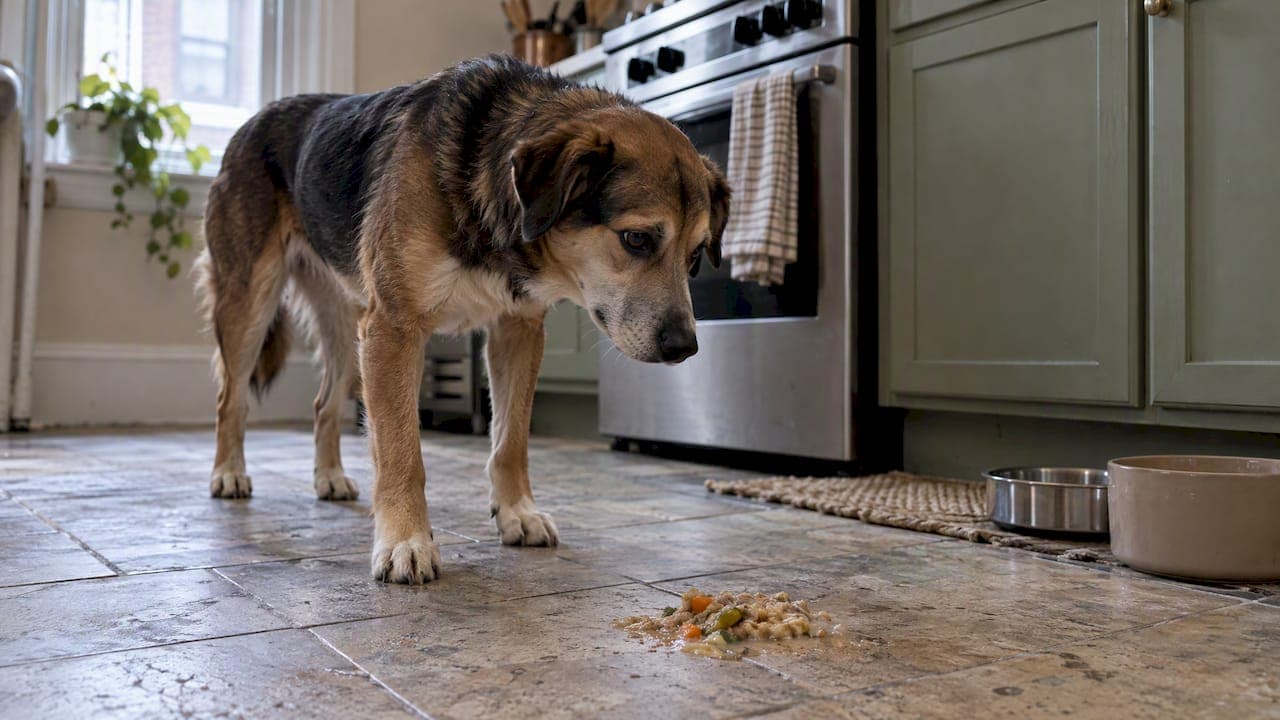
A dog that vomits once, then wags its tail and asks for dinner is usually fine. A dog that vomits repeatedly, turns quiet, or may have swallowed something it shouldn't have needs a veterinarian, and soon. The skill is telling those two dogs apart. This guide walks you through the warning signs, what you can safely do at home while you watch, what to avoid, and what to tell the vet when you call.
TL;DR
- One or two episodes in a dog that otherwise acts normally can often be watched at home for a day or two, with a short rest from food and then small amounts of bland food.
- Go in right away for lethargy, pain, trouble breathing, blood, signs of dehydration, profuse vomiting, or any chance your dog ate a toxin or a foreign object.
- Vomiting that keeps going is not something to wait out. Call earlier rather than later if your gut says something is off.
- Never muzzle a vomiting dog, and call a vet or poison control before trying to induce vomiting.
- Before you call, note when it started, how often, what the vomit looks like, and anything your dog could have gotten into.
Table of Contents
- First, make sure it is vomiting
- When dog vomiting is an emergency
- How many episodes is too many?
- When you can watch at home
- What not to do
- What to tell the vet when you call
- What happens at the vet
- Urgent care or emergency hospital?
- Our perspective: calm care for a sick, scared dog
- Getting your dog seen in Brooklyn
- Frequently asked questions
- Sources
First, make sure it is vomiting
Before you decide how worried to be, check what you are actually seeing. Vomiting is an active event: your dog heaves, drools, licks its lips, and the stomach muscles contract. Regurgitation is passive. Food comes back up, often undigested and often soon after eating, with little warning. The two have different causes, and your vet will ask which one you saw.
Color can add clues. According to the American Animal Hospital Association, red signals blood, yellow points to bile (which helps confirm true vomiting rather than regurgitation), and green may suggest your dog has eaten grass. Use color as information to pass along, not as a way to diagnose at home. A photo of the vomit on your phone is far more useful to a vet than a description.
When dog vomiting is an emergency
Some situations do not call for watching and waiting. Get your dog seen the same day, or go straight to an emergency hospital if we are closed, when you notice any of these:
- Lethargy or weakness. Your dog is unusually flat, won't get up, or can't stand steadily.
- Signs of pain. A hunched posture, a tight or swollen belly, whimpering when touched, or the "prayer position" with the chest down and rear in the air.
- Trouble breathing. Vomiting with labored or noisy breathing can mean your dog has inhaled vomit.
- Blood. Bright red streaks, or vomit that looks like coffee grounds.
- Profuse or repeated vomiting. The University of Missouri veterinary hospital lists lethargy, pain, breathing trouble, blood, dehydration and profuse vomiting as reasons for immediate attention.
- Unproductive retching. A dog that keeps trying to vomit and brings up nothing, especially with a swollen belly, needs a vet immediately.
- Possible poisoning or swallowed objects. Missouri's guidance is to seek more immediate care if you know your pet has eaten something that might be a poison.
The common thread is that your dog is not just throwing up, it is also unwell in other ways. That combination is what turns a stomach upset into a medical problem.
Why dehydration changes the math
Vomiting costs your dog fluid and salts, and a dog that can't keep water down can't replace them. Cornell's veterinary college notes that unresolved vomiting can disturb electrolyte balance and lead to life-threatening dehydration. Small dogs, puppies and seniors have less reserve, so the clock runs faster for them.
You can check hydration in under a minute. The University of Missouri describes two simple tests: look at the gums, which should be moist, and gently pull up the skin over the shoulders, which should snap back quickly. Sticky or dry gums, or skin that returns slowly, suggest dehydration and a need for care. If you see either, don't wait for the next episode.
Swallowed objects and toxins
If your dog may have eaten a sock, a toy, corn cobs, medication, chocolate, grapes, a houseplant or something from the trash, the question is no longer how many times it vomits. Call a vet or a poison hotline right away, even if your dog seems fine. Many dangerous ingestions look harmless for the first few hours.
Everyday items can be riskier than they look. Even something as ordinary as a tea bag can be a poisoning concern, as this piece on green tea risks for dogs explains. When in doubt, bring the packaging, the plant, or a photo of what was eaten, and note roughly how much is missing.
How many episodes is too many?
Owners want a number, and there isn't a clean one. Vets agree on the principle, though. The American Kennel Club's guidance on when to take a vomiting dog to the vet points out that if vomiting continues, it could indicate a more serious problem. Other practices commonly advise a call when a dog vomits several times within a short period, or when vomiting persists beyond a day.
Here is a practical way to think about it:
| Situation | What it usually means | What to do |
|---|---|---|
| One or two episodes, dog bright and normal | Often a minor stomach upset | Short food rest, then watch closely |
| Vomiting more than once or twice, or continuing into the next day | Something may be irritating or blocking the gut | Call your vet the same day |
| Vomiting plus lethargy, pain, blood or breathing changes | Possible serious illness | Go in right away |
| Any suspected toxin or swallowed object | Time-sensitive regardless of symptoms | Call your vet or poison control now |
| Puppy, senior, or a dog with a known condition | Less margin for error | Call earlier than you would for a healthy adult |
If an older dog develops repeated or unexplained vomiting, especially alongside a change in appetite, that is worth a visit even when it doesn't look dramatic. Kidney disease, pancreatitis, and other conditions often start with vomiting that seems mild.
When you can watch at home
The University of Missouri's emergency service says that a healthy pet that began vomiting today and acts fairly normal may be given supportive care at home for 24 to 48 hours, as long as none of the urgent signs above appear. "Healthy" matters in that sentence. It describes an adult dog with no chronic disease, no known swallowed item, and a normal attitude.
Supportive care at home looks like this, following the American Kennel Club's approach for one or two episodes in an otherwise normal dog:
- Withhold food and water for one to two hours so the stomach can settle.
- Offer a small amount of water. Don't let your dog gulp a full bowl.
- If your dog acts normally after several hours and keeps the water down, offer a small amount of bland food.
- Increase slowly over the next day if all goes well.
Watch the whole time. If vomiting returns, if your dog won't drink, or if energy drops, the home plan is over and it is time to call. Puppies are an exception: don't withhold food or water from a young puppy without asking a vet first, because they can run low on fuel and fluid quickly.
What not to do
Don't muzzle a vomiting dog. The American Veterinary Medical Association advises against it, because a muzzle can lead to obstruction or aspiration. If your dog is anxious or painful and might bite, keep a safe distance and let the vet team handle restraint.
Don't induce vomiting on your own. The same AVMA guidance says to contact a veterinarian or poison control first. Some substances do more damage coming back up, and inducing vomiting is wrong for certain dogs and certain toxins. Let a professional decide.
Don't give human medications. Anti-nausea drugs, pain relievers and antacids made for people can be dangerous for dogs, and some mask the signs your vet needs to see.
Don't keep waiting because the dog "seems okay for now." The Association's guidance, as relayed by a veterinarian in the AAHA article, is to treat yourself as your dog's healthcare advocate and to call earlier rather than later when you are concerned.
What to tell the vet when you call
A good history speeds up everything. AAHA notes that a detailed history can provide valuable clues and narrow the list of possible causes. Before you phone, jot down:
- When the vomiting started and how many times it has happened
- What the vomit contains and what color it is (a photo helps)
- Any change in behavior, appetite, thirst, urination or stool
- Diet changes, new treats, table scraps, or bones
- Recent travel, boarding or a dog park visit
- Access to trash, medications, toxins, plants, toys or socks
- Your dog's age, vaccination status and any ongoing conditions or medications
If diarrhea is part of the picture, a stool sample can answer a lot. Our guides on collecting a stool sample, what to expect from fecal tests and testing for Giardia explain how to prepare. If the problem could be dietary, our overview of food allergy in dogs covers when chronic stomach trouble points that way.
What happens at the vet
The visit usually starts with that history and a hands-on exam: gums, hydration, temperature, heart and lungs, and a careful feel of the belly for pain, gas or a mass. From there, the next steps depend on what the exam finds.
Common next steps include:
- Bloodwork and urine tests to check organ function, electrolytes and signs of infection or inflammation. An in-house laboratory shortens the wait for results.
- Fecal testing when diarrhea is present or parasites are a possibility.
- Digital X-rays to look for a foreign object, gas patterns or an obstruction.
- Ultrasound for a closer look at the stomach, intestines, pancreas and other organs.
- Fluids and anti-nausea medication to rehydrate your dog and stop the cycle of vomiting.
Most dogs don't need every test. The aim is to match the workup to what your dog is showing, and to catch the urgent causes early. Because vomiting is a symptom rather than a diagnosis, the cause might be dietary indiscretion, a parasite, an infection, pancreatitis, a medication reaction, a blockage or an underlying organ problem. Your vet narrows it down with the history, the exam and targeted tests.
Urgent care or emergency hospital?
Not every worrying vomiting episode needs a 2 a.m. emergency room, and not every one belongs in a regular appointment. As a rule of thumb, a dog that is bright, drinking and vomiting a little can often be seen by your regular vet or an urgent care service the same day. A dog that is collapsing, struggling to breathe, retching without producing anything, or has a swollen belly should go straight to an emergency hospital. Our own guide to red flags that need an emergency vet rather than urgent care lays out the dividing line in more detail.

If you are unsure which bucket you're in, call. A short phone conversation with a vet team costs you minutes and can save your dog hours of discomfort.
Our perspective: calm care for a sick, scared dog
A vomiting dog is often a frightened dog, and a frightened dog is harder to examine. Nausea, a strange waiting room, slippery floors and unfamiliar smells can stack up. A dog that is already stressed may tense its belly, which makes an exam less informative, and may refuse treats and water, which makes recovery slower.
That is why we built our practice around Fear Free™ handling. In practice that means unhurried visits, gentle restraint only when it is truly needed, and attention to the signs of stress as closely as to the signs of illness. We think a calm dog gives us better information and heals better.

We also know that getting a sick pet into a carrier and across Brooklyn is not always realistic. If your dog is older, nervous, or just too unwell for the car, a home visit can let us assess hydration, examine your dog and plan next steps in a familiar space. Home visits aren't right for every case. A dog with suspected obstruction, collapse or breathing trouble needs the equipment and monitoring of a hospital, and we will tell you so plainly on the phone.
Our advice is the same one we give every client: if something feels wrong, you are probably right. Call early, bring your notes, and let us work out together how urgent it is.
— CAVC
Getting your dog seen in Brooklyn
If your dog is vomiting and you would like a professional to take a look, City Animal Veterinary Center offers urgent care for sick pets, diagnostic imaging and an in-house laboratory for finding the cause, and home visits for dogs who struggle with travel. If you are new to us, our new clients page explains how to get started. Call before you come in, so the team can prepare and tell you the fastest route to care.
Once your dog is feeling better, wellness exams and nutritional counseling are a good place to talk about diet and prevention, especially if stomach upsets are a pattern. And if car rides or clinic visits are what your dog dreads most, our tips on calmer vet visits can make the next trip easier.
Frequently asked questions
How many times can a dog vomit before I should call the vet?
There is no single number that fits every dog. One or two episodes in a dog that is otherwise bright and normal can often be watched, but vomiting that continues or returns warrants a call. Puppies, seniors and dogs with health conditions should be seen sooner, and any vomiting with lethargy, pain, blood or trouble breathing is an emergency.
Can I give my dog anything to stop vomiting?
Don't give human anti-nausea drugs or pain relievers without a vet's direction. For a mild episode in an otherwise normal adult dog, a short food rest followed by small amounts of water and then bland food is the usual approach. If your dog can't keep water down, your vet may use injectable anti-nausea medication and fluids.
My dog threw up yellow liquid. Should I worry?
Yellow usually means bile, which often shows up when the stomach is empty, such as in the early morning. A single episode in a dog that is acting normal is often minor. If it happens repeatedly, or your dog seems lethargic, painful or off its food, call your vet and mention how often it is happening.
Is vomiting with diarrhea more serious?
It can be, because your dog is losing fluid from both ends and can become dehydrated faster. Check the gums and skin snap, and call your vet the same day, sooner for puppies and small or senior dogs. A stool sample can help your vet find the cause.
What should I do if my dog ate something it shouldn't have?
Call your veterinarian or a poison control hotline immediately, before trying to make your dog vomit. Have the product, plant or packaging on hand, and be ready to say how much your dog ate and when. Don't wait for symptoms to appear.
Sources
- Vomiting, Cornell University College of Veterinary Medicine
- Vomiting and Diarrhea, University of Missouri Veterinary Health Center
- Dog Vomiting: When Should You Go to the Vet?, American Kennel Club
- Dog Vomiting: Causes, Diagnosis, Treatment, American Kennel Club
- Why is my Dog throwing up? Vets explain when it's serious, AAHA
- First aid tips for pet owners, American Veterinary Medical Association