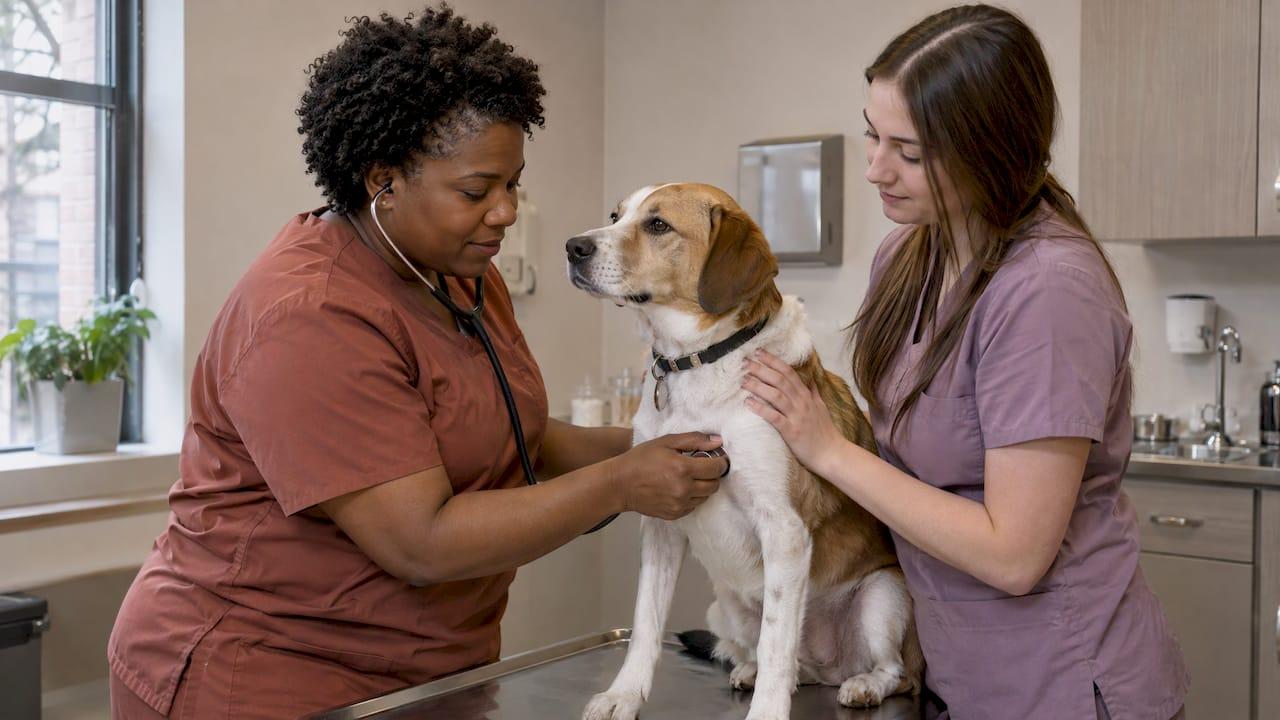
A veterinary visit involves more people than the one in the white coat. The veterinarian diagnoses, prescribes and performs surgery. Veterinary technicians handle much of the hands-on medical care. Veterinary assistants keep animals and rooms safe and ready. Client service representatives run the schedule and your questions, and a manager keeps the practice running. Knowing who does what helps you get answers faster and feel calmer, especially if your pet gets anxious. At City Animal Veterinary Center in Brooklyn, our Fear Free approach depends on the whole team working in the same calm way.
TL;DR
- The veterinarian is the only team member who can diagnose, prescribe medication and perform surgery, and is responsible for your pet's outcome.
- Veterinary technicians are the credentialed medical nurses of the team: intake, blood draws, medications, X-rays, anesthesia monitoring and owner education.
- Veterinary assistants and kennel staff handle restraint, cleaning, feeding and daily care, usually trained on the job.
- Client service representatives and managers handle scheduling, check-in, check-out and the business side, and they shape how the whole visit feels.
- Ask the front desk about logistics, the technician about how to give medication or care at home, and the veterinarian about diagnoses and treatment decisions.
Table of Contents
- The veterinary team at a glance
- The veterinarian: the person responsible for diagnosis and treatment
- Veterinary technicians: the medical backbone of the visit
- Veterinary assistants and kennel staff: the people who keep everything moving
- Client service representatives and managers: the front of the house
- How the team works together during a typical visit
- Who should you ask? A quick guide for pet owners
- What each role may legally do depends on the state
- What this means for anxious pets and busy owners
- See the team in action at City Animal
- Our perspective: care is a team sport
- FAQ
- Sources
The veterinary team at a glance
The American Animal Hospital Association (AAHA), which accredits veterinary hospitals in the US, describes the core team as the veterinarian, the veterinary technician, the veterinary assistant, the client service representative or receptionist, and the office or practice manager. Larger practices add a medical director, lab technicians and specialty staff.
| Role | Main job | What you will notice |
|---|---|---|
| Veterinarian (DVM) | Diagnoses, prescribes, performs surgery, leads care | The exam, the diagnosis, the treatment plan |
| Veterinary technician | Medical nursing, intake, lab work, X-rays, anesthesia, client education | Weighing, history, blood draws, medication instructions |
| Veterinary assistant | Restraint, equipment setup, cleaning, feeding, clerical help | A calm hand holding your pet, a clean exam room |
| Client service representative | Phones, scheduling, check-in and check-out | The first voice you hear and the last person you see |
| Practice or hospital manager | Staff, finances, operations | Mostly behind the scenes |
| Medical director | A veterinarian who leads medical standards | Protocols and quality of care |
| Kennel technician | Care of hospitalized pets | Updates on a pet staying with us |
Titles vary from clinic to clinic, and one person may cover more than one job. The pattern, though, is the same nearly everywhere: the veterinarian directs, and a team of trained people carries out and supports the care.
The veterinarian: the person responsible for diagnosis and treatment
The veterinarian leads the team. According to the National Association of Veterinary Technicians in America (NAVTA), the veterinarian is solely responsible for diagnosing, prognosing, prescribing medication and performing surgery, and is ultimately responsible for all patient care and outcomes. Prognosing means predicting how a condition is likely to progress.
The California Department of Consumer Affairs says the same in its consumer guide to the veterinary team: veterinarians are the only people qualified to diagnose medical problems, prescribe medication and treatment, and perform surgery. California's rules are one state's version, but the principle that those tasks belong to the veterinarian holds across the US.
In practice, this means the veterinarian is the person to expect for:
- The physical exam and the diagnosis
- Decisions about surgery, anesthesia and dental procedures
- Prescriptions and changes to a treatment plan
- Hard conversations, such as a serious diagnosis or end-of-life planning
Veterinarians can also pursue added training. Here at City Animal, that includes areas such as acupuncture, dermatology and pain management alongside traditional medicine.
Veterinary technicians: the medical backbone of the visit
If the veterinarian is the one who decides, the veterinary technician is often the one who does a great deal of the hands-on work. NAVTA states that technicians are educated to serve as the veterinarian's nurse, laboratory technician, radiography technician, anesthetist, surgical nurse and client educator.
Purdue University's veterinary technology program lists their core duties: conducting initial physical examinations, taking patient history, drawing blood, placing catheters, giving medications and vaccines, assisting in surgery and running diagnostic tests such as urinalysis and parasite tests. Purdue calls them the backbone of veterinary medicine because their range of skills frees veterinarians to focus on the work that is legally theirs.

What makes a technician "credentialed"
The American Veterinary Medical Association (AVMA) explains that technicians are graduates of AVMA-accredited programs, usually with an associate's or bachelor's degree, and that almost every state requires them to pass a credentialing exam. Depending on the state, the title may be CVT, LVT, RVT or LVMT. In New York the title is licensed veterinary technician (LVT), and the state's practice guidance describes an LVT as carrying out the supervising veterinarian's medical orders rather than diagnosing, prescribing or operating.
Some technicians go on to specialty certification in areas such as emergency and critical care, anesthesia, internal medicine, behavior and dentistry, according to the same AVMA brochure.
Where you will meet a technician
- At intake. They ask about appetite, energy, stool and medications, then record vital signs.
- During diagnostics. They collect blood or urine and run tests. Our in-house laboratory is part of this workflow, so results can come back during the visit when the case calls for it.
- Around anesthesia. For dental care or surgery, technicians help prepare the pet and monitor during the procedure. If you have a senior pet, our guide to anesthesia safety for senior pets explains what careful monitoring looks like.
- At discharge. They often explain how to give medication, care for an incision or manage diet. AAHA notes that technicians can also handle quick visits such as vaccine updates, weight checks and dressing changes.
Because technicians spend so much time with your pet and with you, they are an excellent person to ask practical questions: how to pill a cat, how to apply ear drops, what to watch for tonight.
Veterinary assistants and kennel staff: the people who keep everything moving
The veterinary assistant role is the least standardized. The AVMA says assistants may be graduates of a NAVTA-approved program or trained on the job, and that no credentialing exam is required. Their work includes restraining and handling animals, assisting with diagnostic tests, feeding and exercising pets, cleaning and disinfecting cages and exam rooms, and clerical duties.
NAVTA adds that assistants usually learn from the veterinarian or a technician, and handle basic duties such as setting up equipment and cleaning the surgery suite and kennels.
For anxious pets, a skilled assistant matters more than most owners realize. How an animal is held, lifted and calmed shapes the whole visit. Gentle handling is a core idea behind Fear Free practice, and our article on calmer vet visits for dogs shows what that looks like from your side of the exam table.
Kennel technicians (or animal care attendants) look after pets who stay in the hospital. Zoetis Petcare's team guide describes the job as making sure hospitalized pets are fed, watered and exercised, watching closely for changes in health or behavior, reporting those observations to the veterinarian, and disinfecting the kennel area to prevent the spread of disease.

Client service representatives and managers: the front of the house
The client service representative (CSR), sometimes called the receptionist, is who you reach when you call. The AVMA says the CSR usually welcomes clients first and is the last person they see, handling appointments, inquiries, greetings and callbacks. The AVMA also notes that a CSR's interactions can shape how a client perceives the quality of the medical care.
Zoetis Petcare adds that receptionists schedule and confirm appointments, update pet records, assess basic health status to judge urgency, and admit and discharge pets. That urgency screening is why it helps to describe symptoms clearly when you call. If your pet has trouble breathing, collapses or has a suspected poisoning, our guide to red flags that need an emergency vet explains when to go straight to an emergency hospital.
Front desks are busy places. Many clinics are looking at tools that take routine calls and scheduling pressure off the team, such as an AI receptionist for animal hospitals that can answer calls and manage bookings.
Behind the front desk, the practice or hospital manager handles staff, finances and logistics, according to AAHA. The medical director is a veterinarian who leads medical operations and keeps the clinic aligned with current standards.
How the team works together during a typical visit
AAHA lays out the flow of a standard visit. It is a useful map of who you will meet:
- You call or book online. The CSR schedules the appointment and may ask why you are coming in.
- Check-in. An assistant or technician weighs your pet. The technician does the intake, asking about history and recording vitals.
- The exam. The veterinarian examines your pet, with a technician or assistant helping with handling.
- Diagnostics. A technician or lab technician collects and runs samples if the veterinarian orders tests. Digital imaging is another example: our guide to how digital X-rays work for pets explains what to expect.
- Behind the scenes. An assistant has cleaned the areas your pet will use.
- Wrap-up. A technician helps with prescriptions and home-care instructions, and the CSR checks you out.
When a case needs a specialist, collaboration continues. AAHA's 2025 referral guidelines say that primary care and specialty teams need detailed, timely communication and shared medical records, and that a hands-on referral is a joint decision between the two teams.
The same team, at your door
If getting to a clinic is hard because of your schedule, an older pet or a pet who dreads the carrier, a house call changes the setting but not the principles. Our home vet visit walkthrough shows the steps, and you can learn more on our home visits page.
Who should you ask? A quick guide for pet owners
People often wonder whether they are "supposed" to ask the veterinarian everything. You are not. Matching the question to the role gets you a faster, better answer.
- Scheduling, records, reminders, directions: the client service representative.
- How to give a medication, change a bandage, feed a special diet, what to watch for at home: the technician.
- What the diagnosis means, whether to proceed with surgery, changing or stopping a treatment: the veterinarian.
- Billing and policies: the front desk or manager.
A survey of veterinary clients published by dvm360 found that people care about who calls them depending on the news. Most expected the veterinarian for bad news, new treatments or difficult decisions, and were comfortable with support staff for normal results. The same survey suggests the veterinarian can ask you at the end of the visit who you would like to hear from. It is a fair question to raise yourself.
Veterinary Practice News describes how well-run clinics route communication: CSRs connect callers to a technician when a technician can answer, such as for medication instructions, while the veterinarian decides who responds to results. A technician might return a call about a positive parasite screen with a prescribed treatment, while the veterinarian calls about an abnormal lab result or a kidney disease diagnosis.
What each role may legally do depends on the state
The division of work is set by state law, so the details differ. The pattern is that more complex tasks need closer veterinary supervision.
- Pennsylvania allows certified technicians to administer anesthesia and perform dental prophylaxis only under direct veterinary supervision, while imaging, medication administration, bandaging and microchip implantation can be done under indirect supervision. Neither technicians nor assistants may perform surgery, diagnose, prognose or prescribe.
- Texas lets a licensed technician, under direct or immediate supervision, induce anesthesia and suture existing surgical incisions.
- California changed its rules with AB 516, effective January 1, 2026. It approves registered technicians and assistants to perform animal health care services not otherwise prohibited under a veterinarian's supervision, and allows technicians to perform dental care, including extractions, under supervision.
- Oregon requires certified technicians to complete an accredited degree, pass a state exam and keep up continuing education, and says non-certified staff may not induce anesthesia or give the rabies vaccine.
For you as an owner, the takeaway is simple. Whatever your state, a licensed veterinarian is responsible for the diagnosis, the prescriptions and the surgery, and trained team members work under that veterinarian's direction. For our Brooklyn patients, the New York rules apply.
What this means for anxious pets and busy owners
Role clarity is not just trivia. It is how a clinic keeps a pet calm.
When every person who touches your pet understands their part, there are fewer handoffs, fewer repeated questions and less waiting in a loud room. Fear Free is a certification program for veterinary professionals. Its individual membership is designed for everyone employed at a practice, from veterinarians and technicians to customer service representatives and practice managers, because stress reduction involves the whole team and not only the doctor.
You can help the team help your pet:
- Tell the CSR when you book if your pet is fearful, aggressive or struggles with the car, so the team can plan.
- Bring a list of medications, supplements and diet details for the technician at intake.
- Practice handling at home. Our guide on cooperative care for dogs breaks it into small steps.
- Write down questions before the exam so the veterinarian can answer them in order.
If you are still deciding which practice fits you, how to choose a veterinarian you can trust covers what to look for in the team as well as the doctor.
See the team in action at City Animal
We are a Brooklyn practice built around calm, compassionate care. Our services include wellness exams, vaccinations, dental care, surgery, urgent care and house calls, with diagnostic imaging, an in-house laboratory and a pharmacy. Every visit is Fear Free, so your pet's stress is part of the plan from the first call. Book a wellness exam or a home visit through cityanimalvet.com.
Our perspective: care is a team sport
Owners often tell us they came in expecting one person, the veterinarian, and discovered an entire team. We think that is the best part of good veterinary care.
A diagnosis matters, but so does how a pet is lifted onto the table, how the intake questions are asked, how the instructions are explained at the door and how the phone is answered when you are worried. For an anxious pet, each of those moments either adds stress or removes it. That is why our Fear Free approach is not a single technique. It is a way of working that we want every member of the team to share.
It is also why we offer more than one way to receive care. Wellness exams, dental care, diagnostics and urgent care at the clinic suit many families. House calls suit the busy professional, the owner of a senior pet or the cat who never forgives the carrier. Holistic options such as acupuncture and pain management sit alongside traditional medicine, so the care plan can follow the pet and not the other way around.
Whatever your question, you can ask us. If we are not the right person on the team to answer it, we will connect you to the one who is.
CAVC
FAQ
What are the different positions in a veterinary office?
Most offices have veterinarians, veterinary technicians, veterinary assistants, client service representatives or receptionists, and a practice manager. Larger hospitals add a medical director, lab technicians, kennel staff and specialty roles. AAHA's guide to the vet care team covers each one.
What is the difference between a vet tech and a vet assistant?
A veterinary technician has completed an accredited program and, in nearly every state, passed a credentialing exam. A veterinary assistant may be trained on the job and no exam is required, according to the AVMA. Technicians perform more advanced medical tasks under veterinary supervision, while assistants focus on handling, cleaning, feeding and support.
Can a vet tech diagnose my pet or prescribe medication?
No. Diagnosing, prognosing, prescribing and surgery belong to the veterinarian. Technicians carry out the veterinarian's orders, such as giving medications, drawing blood and running tests, and then explain home care to you.
Who should I talk to if I have a concern after the visit?
Call the front desk first. The client service representative can route you to a technician for questions like medication or bandage care, and to the veterinarian for anything about the diagnosis or treatment plan. If your pet seems to be in distress, say so right away, and see our guide to when to choose an emergency vet.
Sources
- AAHA: Get to Know Your Vet Care Team
- NAVTA FAQs
- California Department of Consumer Affairs: Protect Your Pet
- Purdue Veterinary Medicine: Comprehensive Guide to Vet Tech
- AVMA Veterinary Team brochure, 2024
- New York State Education Department: LVT practice guidance
- Zoetis Petcare: Your Veterinary Healthcare Team
- AAHA 2025 Referral Guidelines toolkit
- dvm360: Post-appointment follow-up
- Veterinary Practice News: Overwhelmed with callbacks and emails?
- 49 Pa. Code § 31.31
- Texas Occupations Code § 801.364
- California Business and Professions Code § 4840
- Oregon VMA: About Veterinarians and the Veterinary Team
- Fear Free: Veterinary Professional Certification Programs