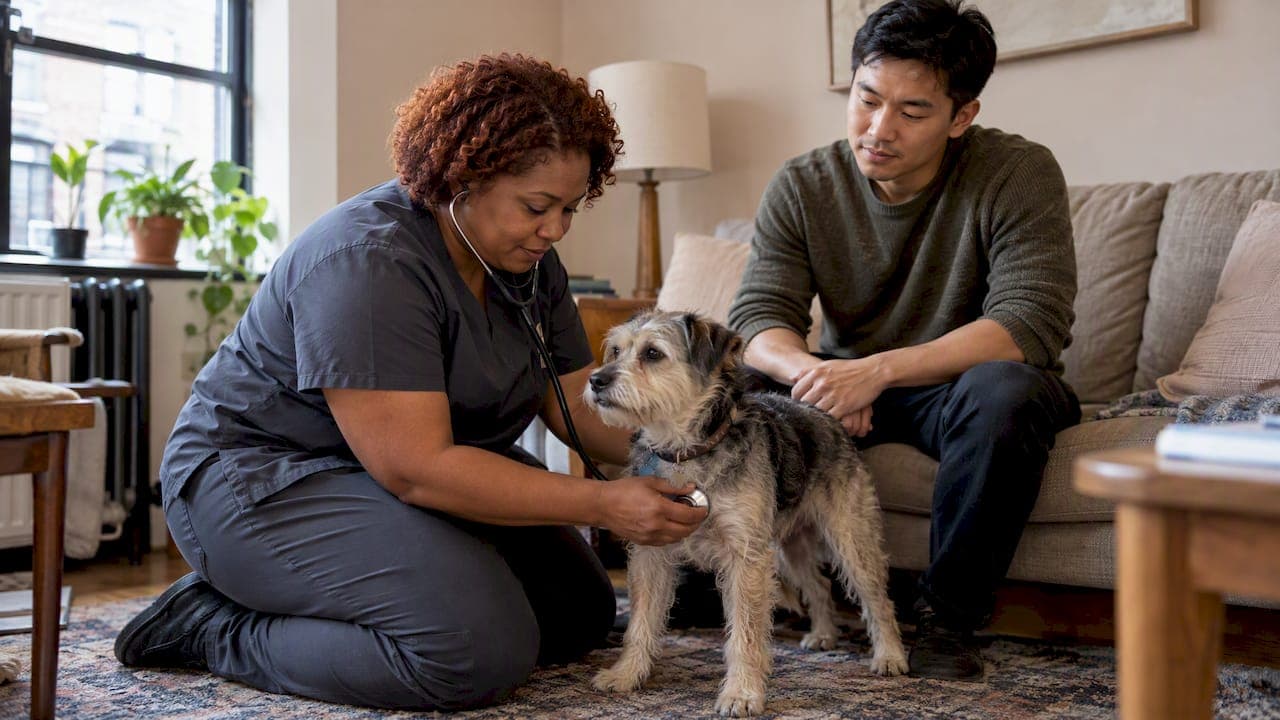
A home vet visit follows the same logic as a clinic visit, just in your living room. You book, you prepare a quiet space and your pet's history, the veterinarian arrives, takes a history, examines your pet nose to tail, does whatever testing or treatment the visit allows, and leaves you with a plan. This guide walks through each stage, including what a house call can and cannot cover, so you know what to expect before the doorbell rings.
TL;DR
- A house call has five stages: booking, preparation, the vet's arrival and history, the exam and any treatment, and a follow-up plan.
- Prepare one quiet room, your pet's records, a list of questions and a list of current medications and supplements.
- Many routine needs fit at home: exams, vaccines, blood work, some imaging, wound care, medications and end-of-life care. Surgery, hospitalization and intensive care generally need a clinic.
- Emergencies do not wait for a house call. Trouble breathing, collapse or uncontrolled bleeding means going to urgent in-person care.
- At City Animal Veterinary Center in Brooklyn we offer home visits alongside our clinic, so your pet can move between the two when needed.
Table of Contents
- Stage 1: Booking and confirming the visit
- Stage 2: Preparing your pet and your home
- Stage 3: The veterinarian arrives
- Stage 4: The examination
- Stage 5: Testing and treatment in the home
- Stage 6: After the visit
- Our perspective: why we take the visit to you
- Book a house call in Brooklyn
- FAQ
- Sources
Stage 1: Booking and confirming the visit
Everything starts with a phone call or a request through the practice's website. Have these ready, because they let the team decide what kind of visit makes sense and how long to set aside:
- Your pet's species, age, breed and approximate weight.
- The reason for the visit: a routine wellness check, a vaccine booster, a limp, a skin problem, a senior pet who no longer handles the car, or a difficult goodbye.
- Your address, building access details (doorman, buzzer, elevator, parking situation) and how many pets are in the home.
- Any history of fear, aggression or sedation needs. Say so plainly. It is information, not a confession.
- Previous records, if your pet has been seen elsewhere.
If you are a new client, our new clients page explains how to get started with the practice.
Can you get a same-day house call?
Sometimes, but it depends on the day's route and the veterinarian's schedule, and no practice can promise it in advance. If your pet needs to be seen today, call and ask directly what is open. If the symptoms sound serious, the team may suggest coming to the clinic or going to an emergency hospital instead, because a clinic has equipment a house call does not.
Confirm the details
Before you hang up, ask for the arrival window, who is coming, what the visit can include, and what you should do with food. Some tests and sedation plans require fasting. Others do not. Do not guess.
Stage 2: Preparing your pet and your home
The American Animal Hospital Association treats preparation as a way to support your pet's emotional wellbeing: reducing stress before, during and after veterinary care can make visits more positive for dogs and cats. A house call already removes the carrier, the car and the waiting room. Your preparation covers what is left.
Set up one calm room
Pick a room with a door, good lighting and a non-slip floor. A bathroom or bedroom works well in a small Brooklyn apartment. Put away loose items, close windows and balcony doors, and remove food bowls and toys that could start a squabble in a multi-pet home.

Separate the other animals
Keep other pets in a different room. Dogs who are curious or protective can make an exam harder, and a cat who is not the patient may still be frightened by a stranger. If your cat hides, do not drag her out before the veterinarian arrives. Tell the team where she hides, and they can plan around it. Our guide to introducing a cat to a dog covers multi-pet homes in more detail.
Gather the paperwork
Collect vaccination records, previous lab results, microchip number, and the names and doses of every medication and supplement. The AVMA recommends keeping your veterinarian informed about medications, supplements, observations and concerns, and the start of the visit is the easiest time to do it.
Write your questions down
Questions have a way of vanishing once someone is standing in your kitchen. Write them on your phone: appetite, thirst, litter box habits, coughing, stiffness on stairs, diet, behavior changes. Note when each started. A short video of a limp, a cough or a strange episode is often more useful than a description.
Practice gentle handling
Begin by getting your pet used to being handled: touching paws, ears and mouth, the way a veterinarian would during an exam. This is standard guidance from AAHA and others, and it pays off at home as much as in a clinic. If your dog is nervous about restraint, our walkthrough on muzzle training for vet visits shows how to build comfort over several days. For dogs who get worked up at the first sight of a stranger, see practical steps for dog vet anxiety. Cat owners can use the cat vet anxiety plan.
Ask about medication ahead of time
Some anxious pets are prescribed a calming medication to give before a visit. This is a decision for the veterinarian, based on your pet's health and history. Never give a dose on your own. If you think your cat might need it, read how pre-visit sedation is handled for cats and raise it when you book.
Stage 3: The veterinarian arrives
Expect the veterinarian to start slowly. A good house call opens with conversation, not equipment. The vet may sit on the floor, let your pet approach, and offer treats if your pet likes them. This matters most for fearful animals. A pet who is allowed to sniff, retreat and return is far easier to examine than one who is grabbed within seconds of someone walking in.
Then comes the history. The veterinarian will ask about:
- Diet: what, how much, how often, and any treats or table scraps.
- Appetite, thirst, urination and stool.
- Energy level, mobility and sleep.
- Vomiting, coughing, sneezing, scratching or other symptoms, with timing.
- Lifestyle: indoor or outdoor, other pets, travel, boarding or daycare.
- Past illnesses, surgeries, allergies and medication reactions.
This is where your notes and records earn their keep. A home visit has one advantage the clinic lacks: the vet sees where your pet actually lives. The bed, the stairs, the litter box location, the floors and the household noise all tell a story that a clinic exam room cannot.
Stage 4: The examination
A mobile wellness exam typically includes a complete history and a nose-to-tail physical exam, followed by a discussion of any concerns. In practice that looks like this:
- Weight and body condition. Often with a portable scale. Weight trends are one of the earliest signs of trouble in older pets.
- Temperature, heart and lungs. The vet listens for murmurs, irregular rhythms and abnormal breathing sounds, and checks gum color and hydration.
- Eyes, ears, nose and mouth. Discharge, redness, tartar, gum disease and loose or broken teeth are noted.
- Skin and coat. Lumps, parasites, hair loss and irritation are checked.
- Abdomen and joints. Gentle palpation checks organs, painful areas and range of motion.
- Neurological and mobility check. How your pet stands, walks and turns.
For a Fear Free approach, the order can change. Gentle handling, treats, soft voices and short breaks are built in, and the vet may do the least upsetting parts first or split the exam across moments when your pet is relaxed. Fear Free is central to how we practice at City Animal Veterinary Center, and a home setting is where it works especially well.
Stage 5: Testing and treatment in the home
What can happen on the spot? According to Zoetis, mobile clinics may offer exams, vaccinations, blood work, ultrasound, X-rays, wound management, medications and euthanasia. The same source notes that surgery, dental care, hospitalization or intensive care may require a hospital, and that house-call vets may need to refer some services. That matches how most practices work, and it is a useful way to sort your expectations.
| Need | Often possible at home | Often needs the clinic |
|---|---|---|
| Wellness exam | Yes | |
| Vaccinations | Yes | |
| Blood and urine sampling | Sample collected at home | Some analysis and repeat testing |
| Minor wound care or ear problems | Often | Deep wounds, anything needing anesthesia |
| Medication refills and adjustments | Yes | |
| Imaging | Limited, depending on equipment | Full digital X-rays and ultrasound |
| Dental cleaning | Exam only | Cleaning under anesthesia |
| Surgery | Rarely | Yes |
| Hospitalization, IV therapy | No | Yes |
| Hospice and euthanasia | Yes | By choice |
How this plays out for you depends on the practice and the equipment the visit team carries, so ask when you book. At City Animal Veterinary Center, house calls connect to the rest of what we do: wellness exams, vaccinations, an in-house laboratory, digital imaging and surgery and dental care in the clinic. If something found at home needs more, your pet is not starting over with a stranger. The same records and the same team follow. If your pet needs an ultrasound, see how we prepare anxious pets and their owners for it.
Who benefits most from the house call
Home visits suit several kinds of households:
- Anxious or aggressive pets, who spiral in carriers, cars and waiting rooms.
- Senior and arthritic pets, for whom a stairwell, a taxi and a slippery exam table are real obstacles.
- Multi-pet homes, where one trip would otherwise mean wrangling several animals.
- Busy professionals, who can fit a visit around a work-from-home day instead of losing half a day to travel.
- Families with puppies and kittens, where the first rounds of vaccines and early advice are easier on a small animal in familiar space.
- Owners facing end-of-life decisions, who want quiet, privacy and time.
If you are comparing a house call with a clinic visit, consider your pet's temperament and the problem you are trying to solve. A routine check for a fearful cat often fits at home. A limping dog who may need an X-ray could be better served by a clinic, or by a house call followed by a clinic visit.
Stage 6: After the visit
Before the veterinarian leaves, make sure you understand three things: what was found, what happens next, and what to watch for. The AVMA advises following agreed treatment plans and asking questions until the instructions are clear. Do not nod along to be polite. If you do not know how to give a pill to your cat, ask to be shown.
A solid wrap-up includes:
- A summary of exam findings and any diagnosis or working theory.
- Written or emailed medication instructions: name, dose, timing and duration.
- Test results and when you will hear back.
- Diet, activity and monitoring guidance.
- A follow-up date or a clear rule for when to call.
- A list of warning signs.
Keep tracking at home
Over the next days, keep a simple log of appetite, water, energy, stool, medication times and anything unusual. After surgery or a procedure, a day-by-day recovery guide for dogs can help you structure what to track and when to update the veterinarian. Share your notes at the next check-in. Small details, like a pet skipping one meal, help the vet decide whether to adjust the plan.
When a house call is not the right answer
A home visit is for planned and non-emergency needs. Go to urgent in-person care, or an emergency hospital, rather than waiting for a house call, if your pet:
- Is struggling to breathe, or breathing with an open mouth (in cats especially).
- Has collapsed, cannot stand or has a seizure.
- Has uncontrolled bleeding or a significant trauma such as being hit by a car or a fall.
- Has a swollen, hard abdomen, repeated unproductive retching, or has eaten something toxic.
- Is straining to urinate with little or nothing coming out, particularly a male cat.
If you are unsure which category your pet falls into, call the practice and describe what you see. Our urgent care team can advise on whether to come in. Do not wait to find out.
Our perspective: why we take the visit to you
People often tell us the hardest part of the vet is not the exam. It is the hour before it: finding the carrier, coaxing a frightened cat into it, the cab ride, the elevator, the waiting room full of barking. For many pets, that is where the fear begins, and it colors everything that follows.

That is why a home visit sits next to Fear Free care in how we think. Removing the trip is a stress reducer in itself. What is left is the part we can control: slow introductions, gentle handling, treats, patience, and time to explain things properly to the person on the other end of the leash.
We also believe in being honest about limits. A house call is a superb way to deliver wellness care, follow-up, comfort and many routine needs. It is not a replacement for a clinic when a pet needs anesthesia, advanced imaging or hospitalization. Our goal is to use the right setting for each problem and keep the same team and records across both. We would rather tell you a clinic visit is better for your pet than stretch a house call beyond what it can safely do.
For anxious pets especially, the combination matters: calm care at home when it fits, a Fear Free trained team at the clinic when it does not.
— CAVC
Book a house call in Brooklyn
If your pet dreads the carrier, struggles with stairs, or you simply cannot fit a clinic trip into your week, our home visit service is built for you. Our team brings Fear Free handling to your door and can bring your pet's care back to the clinic if more is needed.
To plan a visit, start on our home visits page or, if you are new to us, visit the new clients page. Questions about what a visit can include for your pet are welcome when you call. If you are also thinking about what a house call might involve beyond the exam, our guide on house call estimates explains how to ask about the details of a visit before it happens.
FAQ
How long does a home vet visit take?
Plan on roughly the length of a clinic appointment, and ask the practice for a specific window when you book. A routine wellness exam is shorter than a visit for a complex problem, an anxious pet or several animals. A slow, Fear Free pace can add time, and it is usually worth it.
Do I need to be home for the whole visit?
Yes. The veterinarian needs your history, your consent for any tests or treatments, and your help keeping your pet calm. You should also be present to hear the findings and ask questions while the vet is still in the room.
Can a vet vaccinate and run blood tests at my home?
Often, yes. Mobile practices commonly offer vaccinations and blood work along with exams and medications. Samples may be analyzed afterward, so ask when results will arrive. Confirm with your own practice what its visit team carries.
Is a house call suitable for an emergency?
No. Difficulty breathing, collapse, seizures, heavy bleeding or suspected poisoning call for urgent in-person care right away. Call ahead so the team can prepare for your arrival, and do not wait for a home appointment slot.
How should I prepare a nervous cat or dog?
Choose a quiet room, keep other pets away, and let the vet make the first move. Practice gentle handling of paws, ears and mouth in the days before. If your pet reacts strongly to visits, talk to your veterinarian when booking about whether calming medication might be appropriate.
Sources
- Preparing your pet for a successful veterinary visit, AAHA
- Ways to make veterinary visits better for everyone, AVMA
- What Are Mobile Veterinary Clinics? Zoetis Petcare