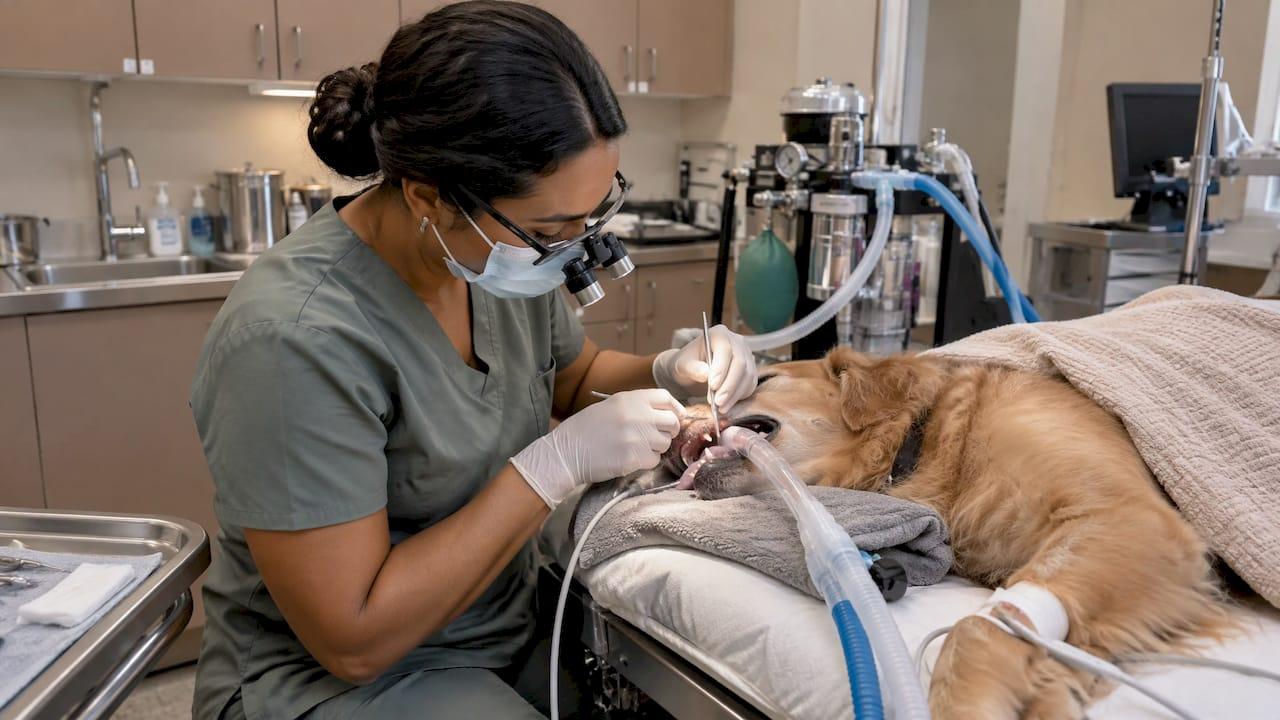
Anesthesia-free dental cleaning for dogs means an awake dog is held still while someone scrapes tartar off the teeth you can see. It looks gentler, but the disease that harms dogs lives under the gumline, where an awake dog cannot be examined or treated. At City Animal Veterinary Center in Brooklyn, we offer dental care built around Fear Free™ handling, so a nervous dog gets a complete cleaning with less stress, not a partial one.
TL;DR
- Anesthesia-free cleaning (also called awake scaling or non-anesthetic dentistry) removes visible tartar only. The American Veterinary Dental College (AVDC) calls that purely cosmetic.
- Periodontal disease starts below the gumline, and probing and dental X-rays need an anesthetized patient.
- Both the AVDC and the American Animal Hospital Association (AAHA) advise against anesthesia-free dentistry.
- Modern anesthesia is carefully screened and monitored, and risk is driven mostly by a dog's underlying health.
- Anxious dogs are best helped by calm, low-stress handling around a real cleaning.
Table of Contents
- What anesthesia-free dental cleaning actually is
- Why it misses the disease that matters
- The risks of scaling an awake dog
- What current U.S. guidance says
- How safe is anesthesia for dogs?
- What about a dog who can't or won't have a full cleaning yet?
- Making a dental visit easier for an anxious dog
- Signs your dog needs a dental exam
- Our approach to dog dental care
- Book a dental exam in Brooklyn
- FAQ
- Sources
What anesthesia-free dental cleaning actually is
The practice goes by several names: non-anesthetic dental cleaning, awake scaling, anesthesia-free teeth scaling. In every version, a groomer or technician restrains the dog and scrapes tartar from the visible tooth surfaces with a hand instrument. AAHA's 2019 dental guidelines define it as scaling and polishing teeth without general anesthesia, and consider it not appropriate because of patient stress, injury, risk of aspiration and lack of diagnostic capability.
Aspiration means inhaling water, debris or bacteria into the lungs. In a proper cleaning, a cuffed breathing tube protects the airway. An awake dog has no such protection.
The appeal is easy to understand. Nobody wants to put a beloved dog under, and a white-looking smile is reassuring. The trouble is that a clean-looking crown tells you almost nothing about the health of the tooth.
Why it misses the disease that matters
Tartar you can see is the smaller problem. The AVDC states that reaching the area beneath the gumline on every tooth is impossible in an unanesthetized patient, and that scraping visible tartar is not an effective way to prevent dental disease.
Here is why that matters:
- Periodontal disease is common. AAHA reports that about 80% of dogs show signs of periodontal disease by age three.
- It hides. Dr. Brook Niemiec, a board-certified veterinary dentist, describes it as a silent problem in which the key damage happens under the gum, out of sight of owners and vets alike.
- Finding it takes tools. Subgingival scaling (cleaning below the gumline), probing each tooth and full-mouth dental X-rays all require general anesthesia to be done safely, according to the same AAHA article.
- X-rays catch what eyes cannot. A veterinary dentist quoted by the American Kennel Club says that without dental X-rays, about 30% of dental disease can be missed, including abscesses, bone loss, fractured teeth and tumors.
If you want to understand how far disease can advance, our guide to periodontal disease stages in dogs walks through each one. For what imaging shows, see how digital X-rays for pets work.
The risks of scaling an awake dog
AAHA warns that owners may wrongly assume the dog was not stressed, pain was managed, and disease was found and treated. Untreated disease can progress quietly, causing pain and more extensive treatment later.
The AVDC's April 2024 statement lists specific problems:
- Injury. Sharp instruments plus a wriggling dog can cut gums, lips or tongue. A veterinary dentist quoted by the AKC describes seeing teeth broken by over-forceful instrument use.
- No subgingival access. The part of the tooth that matters most is not reached.
- No cooperation, pain control or airway protection. These are the three advantages of cuffed-tube inhalation anesthesia.
- Hidden surfaces. The tongue side of the teeth cannot be examined in an awake dog.
- Faster plaque return. Scratches to enamel and soft tissue can make plaque build up faster afterward.
For a dog who is already anxious, restraint is the opposite of what the visit should be. Being held firmly while a stranger works in the mouth can deepen fear of future care.
What current U.S. guidance says
The position has been consistent across the main veterinary bodies. AAHA's dental toolkit calls cleaning teeth without general anesthesia unacceptable and below the standard of care, and says well-monitored inhalation anesthesia with a cuffed tube is essential. The AVDC's 2024 statement says awake scaling is not a replacement for a comprehensive dental procedure under anesthesia.
A related question owners ask is whether a vet can pull a tooth without anesthesia. The AVDC says only veterinarians decide which teeth are extracted and perform extractions. Extraction is a surgical procedure that belongs in a veterinary hospital with pain control, which is exactly what we provide.
How safe is anesthesia for dogs?
This is the real worry behind the search, so let's answer it directly. The AVDC acknowledges that anesthesia is never 100% risk-free, while noting that modern anesthetic and patient-evaluation techniques minimize risk and that millions of professional dental scaling procedures are performed safely each year.
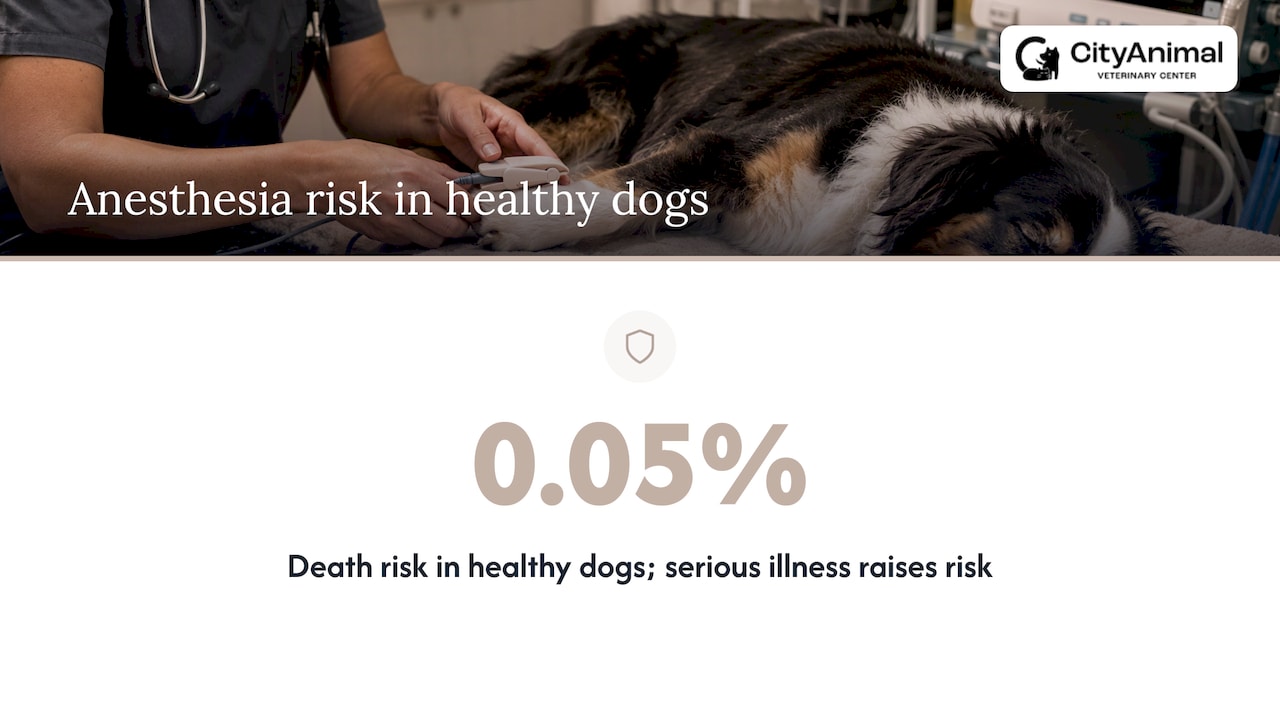
The numbers help. A large UK study of 98,036 dogs and 79,178 cats, summarized by a veterinary evidence review, found anesthetic-related death risk of 0.05% in healthy dogs, versus much higher risk in dogs with serious illness. A 2025 study of 55,019 procedures across 21 countries, reported here, concluded that underlying health drives most of the risk, not the act of anesthesia itself.
That is why screening matters. Before any dental procedure, we recommend an exam and pre-anesthesia bloodwork to check organ function, and we run an in-house laboratory. For dogs in their senior years, see our guide to senior pet anesthesia and our geriatric care service.
Dr. Niemiec, quoted by AAHA in 2026, advises that a managed condition such as a heart murmur or kidney disease should not stop a dog's teeth from being treated, since dental disease can make those conditions worse. That decision belongs with your veterinarian, who weighs your dog's exam and test results.
What about a dog who can't or won't have a full cleaning yet?
Some owners are told their dog is a poor anesthetic candidate. A 2024 study in the Journal of Veterinary Dentistry looked at home care in dogs that had not been scaled. Brushing every other day or a daily dental chew partly removed deposits, and weekly brushing plus a daily water additive improved gum health. No home protocol eliminated deposits or restored the mouth to normal, and the authors say professional scaling should always be considered if general health allows.
The same study stresses that the first step is a credible assessment of how diseased the mouth is. Dogs with heavy deposits and poor gum health need treatment, such as scaling, periodontal surgery or extractions, even when anesthetic risk is higher. AAHA adds that a veterinarian concerned about anesthetic risk may seek help from a board-certified dental or anesthesia specialist.
AAHA calls daily or every-other-day brushing with a soft brush the gold standard of home care between cleanings. For timing, see how often to clean your dog's teeth.
Making a dental visit easier for an anxious dog
Fear of the clinic is a fair reason to look for alternatives, and there is a better answer than skipping anesthesia: lower the stress around a proper cleaning. Our practice uses a Fear Free™ approach, designed to reduce anxiety for pets during visits.
In practice, that means a dog's dental day can be planned around comfort:
- Start with a calm exam. The pre-procedure visit can happen at the clinic or, for dogs who find travel hard, as a home visit.
- Talk through behavior. Our behavior management service supports dogs whose fear makes handling difficult.
- Plan for pain. We offer pain management and acupuncture alongside conventional care.
- Do the full job once. Exam, X-rays and cleaning are done together, so the dog is not put through repeated partial visits.
If a dog needs sedation for X-rays or handling, our article on dog X-ray sedation explains when it is and isn't needed. For a deeper look at the safety side, read our guide to safe dental anesthesia for dogs.
Signs your dog needs a dental exam
You do not need to see tartar to have a problem. Watch for bad breath that lingers, red or bleeding gums, dropping food, chewing on one side, pawing at the mouth, or a new reluctance to be touched near the face. Persistent odor is one of the most common early signs, which we cover in why most dogs get bad breath. A swollen face or sudden refusal to eat is urgent, and our urgent care team can see your dog.
Our approach to dog dental care
We talk with Brooklyn dog owners about this choice often, and our view is simple. A dental cleaning should find and treat disease, not just improve appearance. That takes an exam, probing, X-rays and a protected airway, which is what general anesthesia makes possible, with monitoring and pre-procedure screening to keep your dog safe.
We pair that with what anxious dogs need: gentle, Fear Free™ handling, a team that takes time, home visit options for dogs who struggle with travel, and holistic support such as acupuncture and pain management. Our aim is a dog who leaves with a healthier mouth and is calmer about coming back.
We believe a dog's mouth deserves the same thoroughness as any other part of the body. A clean-looking tooth can hide an abscess, and we would rather find it than hope it isn't there.
Every dental plan we make starts with the individual dog: age, health, temperament and how the mouth looks and feels on exam. Then we build a calm, low-stress day around it.
CAVC
Book a dental exam in Brooklyn
If you are weighing awake scaling because your dog gets frightened, start with a conversation. Our team can examine your dog, explain what a full dental involves and plan a Fear Free™ visit around your dog's temperament. See our dental care service or our wellness exams to get started.
FAQ
Is anesthesia-free dental cleaning effective for dogs?
It removes visible tartar, which is cosmetic. The AVDC says it cannot reach below the gumline on every tooth and is not an effective way to prevent dental disease. Probing and X-rays, which find real problems, are not possible in an awake dog.
How do I get my dog's teeth cleaned if they are very anxious?
Choose a practice that uses low-stress handling and does the cleaning under monitored anesthesia. We use Fear Free™ techniques and can start with a home visit exam for dogs who dislike the car or the clinic. Your veterinarian will tailor the plan to your dog's health.
Can a vet pull a dog's tooth without anesthesia?
Extractions are surgical procedures that only a veterinarian should decide on and perform, according to the AVDC. Pain control and airway protection matter, so extractions are done in a veterinary hospital setting.
Is anesthesia dangerous for my dog?
Anesthesia is never completely risk-free, but modern screening and monitoring keep risk low, and published studies show that a dog's underlying health drives most of it. An exam and bloodwork beforehand help your veterinarian choose a safe plan.
Can brushing replace a professional cleaning?
Brushing is the best home care and clearly helps, but a 2024 study found no home protocol fully removed deposits or restored normal gum health in unscaled dogs. Brushing works best alongside professional cleanings.
Sources
- AAHA 2019 Dental Care Guidelines: Nonanesthetic Dentistry
- AVDC Position Statement on Dental Scaling Without Anesthesia
- AAHA: Why your pet needs dental cleanings under anesthesia
- AKC: Are Non-Anesthetic Dental Cleanings Safe for Dogs?
- AAHA Dental Toolkit
- AVDC: About the AVDC
- Anesthesia-free dental cleaning for dogs: the evidence
- Are dog teeth cleanings safe? What the data shows
- Effectiveness of Dental Homecare Protocols in Unscaled Dogs