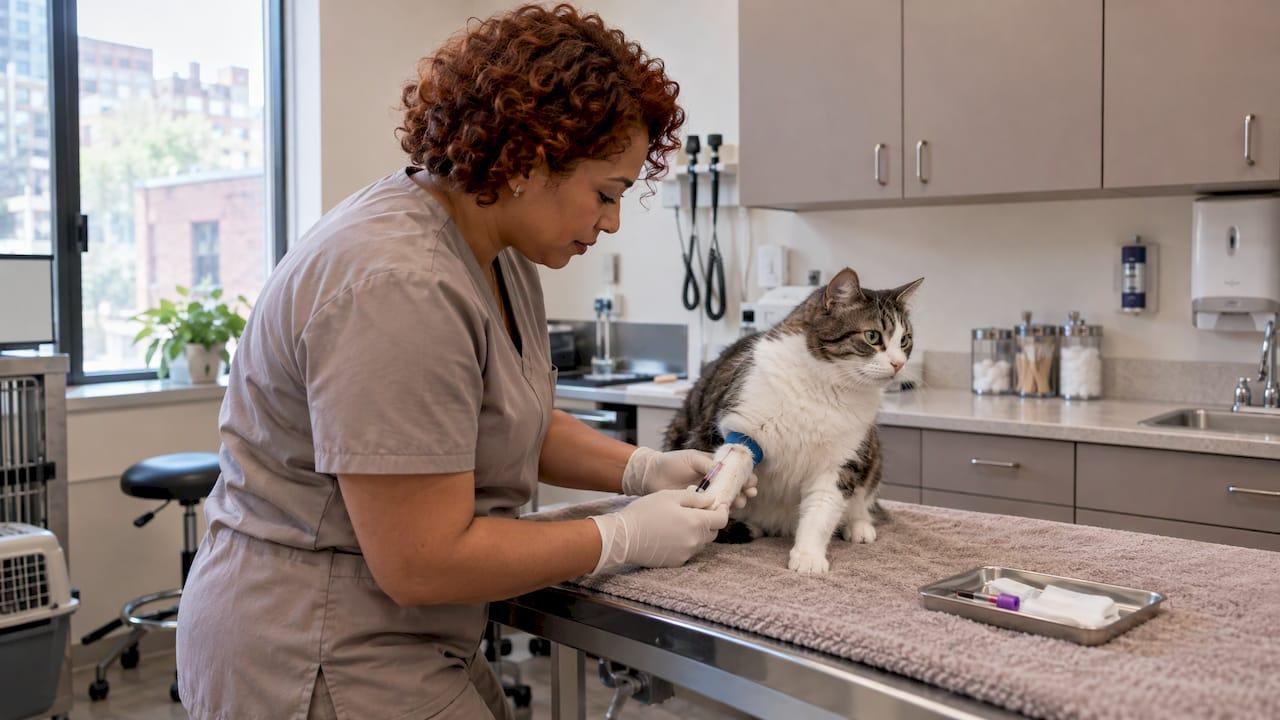
Pre-anesthesia bloodwork is a set of lab tests, usually a complete blood count and a chemistry panel, run before your pet goes under anesthesia so the veterinary team can see how the organs that process anesthetic drugs are working. It turns a plan based on a physical exam alone into one based on measured values. At City Animal Veterinary Center in Brooklyn, we have an in-house laboratory and a Fear Free approach, so the blood draw can be one calm part of a well-prepared procedure day rather than a source of dread for your pet.
TL;DR
- Pre-anesthesia bloodwork usually means a complete blood count (CBC) and a chemistry panel. Many protocols add a urinalysis.
- It checks the blood cells, kidneys, liver and other systems that determine how your pet handles anesthetic drugs and bleeding risk.
- In one university study of healthy dogs, only 13% had every value within the reference range, and results led to changes in the anesthesia plan in most cases.
- Age alone does not decide whether bloodwork is needed. Health status, the procedure and your pet's history do.
- Follow your vet's fasting and medication instructions exactly. Some drugs continue, some stop, and insulin needs special handling.
Table of Contents
- What pre-anesthesia bloodwork is
- Which tests are usually included
- What the results can reveal in a healthy-looking pet
- How results change the anesthesia plan
- Does your pet need it? Age, health and the procedure
- How to prepare your pet for the blood draw
- Bloodwork is one part of a safe plan
- What happens when a value is out of range
- Care at City Animal Veterinary Center
- Our perspective
- FAQ
- Sources
What pre-anesthesia bloodwork is
Anesthesia asks a lot of the body. The liver and kidneys break down and clear the drugs, the heart and blood vessels keep oxygen moving, and the blood has to carry that oxygen and clot properly if surgery is involved. A pet can look and act perfectly healthy while one of these systems is already under strain.
Bloodwork is a snapshot of that internal picture. A small sample is drawn, usually from a leg or neck vein, and analyzed for cell counts and for chemicals that reflect organ function. The result gives the veterinarian a baseline and helps them choose drugs, doses, fluids and monitoring that suit your individual pet.
It applies to far more than major surgery. Dental cleanings, mass removals, spays and neuters, and imaging that needs sedation or anesthesia all involve the same body systems. If your pet is scheduled for surgery or a dental procedure, expect bloodwork to be part of the conversation.
Which tests are usually included
The 2020 AAHA Anesthesia and Monitoring Guidelines (AAHA is the American Animal Hospital Association, the body that accredits many U.S. veterinary hospitals) describe a minimum laboratory database of a CBC, a chemistry panel and a urinalysis. Depending on the patient, a vet may add blood pressure, an ECG, or imaging such as an echocardiogram or ultrasound.
Here is what each piece tells the team:
| Test | What it looks at | Why it matters for anesthesia |
|---|---|---|
| Complete blood count (CBC) | Red cells, white cells, platelets | Flags anemia, infection or inflammation, and low platelets that affect bleeding |
| Chemistry panel | Kidney and liver values, glucose, proteins, electrolytes | Shows how well the organs that clear anesthetic drugs are working, and whether electrolytes are off |
| Urinalysis | Urine concentration and content | Adds a view of kidney function and can reveal problems blood values miss |
| Blood pressure, ECG, imaging (as indicated) | Heart and circulation | Added when the exam or history raises a concern |
Two details explain why the CBC matters. According to the IVIS hematology guide, anemic patients are more prone to tissue hypoxia (too little oxygen reaching tissues), and low platelets, called thrombocytopenia, are the most common bleeding disorder in veterinary medicine. That is why platelets are evaluated in every pre-anesthetic workup.
If you want to understand the numbers on your pet's report, our guide to dog blood work results walks through them line by line. Urine testing has its own preparation, covered in urinalysis in dogs.
What the results can reveal in a healthy-looking pet
Owners often ask whether bloodwork is really needed when their pet seems fine. A study of 100 randomly selected healthy dogs at a U.S. veterinary teaching hospital, published in the Journal of Veterinary Science, puts numbers on it. Only 13% of the dogs had every pre-anesthetic value inside the reference range. The most frequent findings were high mean platelet volume (60%), low mean corpuscular volume (54%), high cholesterol (20%), high potassium (19%), high alkaline phosphatase (17%) and low platelet counts (14%).

Many of these are minor and mean nothing alone. The point is that the screen gives a trained veterinarian something to weigh. A mildly high value in a young, otherwise healthy dog may change nothing. The same value paired with a physical exam finding or a history of vomiting may change a great deal.
How results change the anesthesia plan
In that same study, the anesthesiologists reviewing the records altered peri-operative management in 79% of patients based on the screening results. At least one reviewer chose, for some dogs, to:
- avoid NSAIDs (anti-inflammatory pain drugs) in 63% of cases
- change fluid therapy in 38%
- repeat laboratory testing in 32%
- order further testing in 28%
- change the patient's ASA status, a risk score from 1 to 5, in 13%
- cancel or postpone surgery in 6%
Those adjustments are the practical value of bloodwork. Most of them are quiet: a different pain-control drug, more intravenous fluids, closer monitoring. A small number lead to a pause so a problem can be sorted out first, which is a far better time to find it than mid-procedure.
A 2021 retrospective study in Spain of comprehensive pre-anesthetic assessment in dogs and cats looked at cases where surgery was canceled. In 21.1% the abnormality was first picked up through the physical exam combined with complementary diagnostics, and in another 21.1% through the physical exam alone. That result shows how the exam and the lab work belong together, and no single test makes the decision.

Does your pet need it? Age, health and the procedure
There is no single rule that fits every dog and cat, and a veterinarian who knows your pet decides. Some guidance is helpful, though.
Age alone is not the deciding factor. The ASPCA's anesthesia guidelines for high-quality spay and neuter programs state that age should not determine whether bloodwork is needed. Health status, the potential for disease, and the risk of anesthetic or surgical complications should guide the choice. They add that a minimum database can be run when the physical exam or the patient's history warrants it.
Senior pets are good candidates for anesthesia with proper preparation. The 2023 AAHA Senior Care Guidelines state that advanced age alone is not a contraindication to general anesthesia. For seniors they call for a preoperative physical exam and lab tests focused on kidney function (creatinine) and heart function (NT-proBNP, a blood marker of heart strain), with radiographs or ultrasound when indicated. If your older dog or cat needs a dental cleaning or a lump removed, thorough testing is what makes that realistic. Our article on senior pet anesthesia goes deeper.
Young pets have their own plan. Puppies and kittens heading for spay or neuter surgery are generally healthy, but they are also growing and have little reserve, which is why pediatric fasting limits are shorter (see below). If you are navigating those first months, see our puppy and kitten wellness exam guide.
Pets with known conditions need more. Kidney, liver, heart, endocrine disease and bleeding disorders all change how anesthesia is planned. Cats may also need a blood pressure check.
How to prepare your pet for the blood draw
Preparation is where owners can make the biggest difference to a smooth day. Your veterinarian's written instructions come first. What follows is the general framework from the guidelines, so the instructions make sense when you receive them.
Fasting
The ASPCA guidelines say fasting before anesthesia is ideal for dogs and cats, but withholding water is neither necessary nor recommended. Fasting beyond 4 to 6 hours is not warranted. Juvenile and adult animals should fast a minimum of 4 hours, and pediatric animals should not be fasted for more than 4 hours. AAHA's anesthesia guidelines note that shorter fasts are generally recommended for healthy adults, and abbreviated fasts matter most for diabetic and neonatal patients.
Your vet will give you an exact cutoff time for your pet. Tell them if your pet is a puppy, a kitten, a senior or diabetic, since the timing differs.
Medications
Per the same AAHA guidelines, most chronic medications should continue on the day of anesthesia, including thyroid medication, cardiac drugs such as pimobendan and furosemide, antibiotics, steroids, and behavioral and pain medications. Two groups are handled differently:
- Blood pressure drugs, especially ACE inhibitors such as enalapril and benazepril, should be discontinued on the day of anesthesia.
- Anticoagulants may need to stop about two weeks beforehand, depending on bleeding risk.
- Insulin: a fasted patient should not receive a full insulin dose, because of the risk of low blood sugar.
Do not adjust any medication on your own. Call us before the procedure with a list of everything your pet takes, including supplements, so we can tell you exactly what to give and what to hold.
For anxious pets
A stressed pet can be harder to examine and sample. A Fear Free visit uses gentle handling and a calm environment to reduce that stress. For cats that struggle with travel and clinic visits, see our piece on Fear Free pre-visit sedation for cats. If a carrier-and-car trip is the hard part for you or your pet, you can also read how to prepare for a home vet visit.
Bloodwork is one part of a safe plan
Lab values do not stand alone. The 2020 AAHA guidelines call for a thorough physical examination to be completed and documented within 12 to 24 hours before anesthesia, and repeated just before if anything acute changes. They also note that failure to record a physical exam was reported to raise the odds of death in dogs.
That is why a good pre-anesthetic plan combines several layers: your pet's history, the exam, bloodwork and sometimes urinalysis, blood pressure or imaging, then a monitoring and pain-control plan built around what was found. The results are read in context. A single number rarely decides anything. The full clinical picture does.
How long do results stay valid?
AAHA states there is no evidence for a minimum time frame between lab analysis and anesthesia. It calls 3 to 6 months reasonable when values were normal and the patient is clinically healthy, and it says diagnostics should be repeated right before anesthesia if values or health are abnormal. If your pet has had a wellness panel recently, tell us the date. We will tell you whether it covers the upcoming procedure or whether a fresh sample makes sense.
What happens when a value is out of range
An abnormal value is a reason for a conversation, not for panic. Depending on the finding, your veterinarian may:
- Repeat the test to confirm it, since a sample can be affected by stress, hydration or timing.
- Add targeted tests, such as urine testing, blood pressure, or imaging.
- Adjust the drugs, fluids and monitoring for the procedure.
- Postpone the procedure while a problem is treated.
The percentages in the university study above show that options one to three are far more common than option four. Even when a procedure is delayed, the reason is a safer anesthetic for your pet.
Care at City Animal Veterinary Center
We are a Brooklyn practice that combines wellness exams, an in-house laboratory, diagnostic imaging, surgery and dental care under one roof, with Fear Free handling for pets that dread the clinic. Pain management and geriatric care are part of what we offer too, which matters when the pet in front of us is a senior.
If travel is the barrier, we also provide home visits for pets and owners who find the trip difficult. If your pet has a procedure coming up, or you are not sure whether it needs bloodwork first, contact us through our website and our team will go through the plan with you.
For an urgent concern, our urgent care service is there for exactly that.
Our perspective
Owners tell us the same thing before a procedure: "She seems perfectly fine." We believe that, and it is exactly why we value the lab work. A healthy-looking pet can still have a kidney value, a platelet count or a liver enzyme that changes which drugs we choose and how closely we monitor.
We think of bloodwork as part of a conversation, not a box to tick. The numbers, the physical exam, your pet's history and what you have noticed at home all go into one plan. That is why we care about the details you can tell us: the supplements, the appetite changes, the last time your cat drank much more water than usual.
Our Fear Free approach is part of the safety picture too. A pet that is calm during the draw and the exam gives us cleaner information and a better experience for everyone, you included. For pets that cannot easily travel, a home visit keeps the routine gentle.
Holistic options such as acupuncture and pain management sit alongside conventional care here, so the plan for a senior or a pet with a chronic condition can be built around the whole animal.
CAVC
FAQ
Is pre-anesthetic bloodwork necessary for dogs?
It is strongly recommended in most cases, and the AAHA minimum database for anesthesia is a CBC, a chemistry panel and a urinalysis. Whether a given dog needs the full set depends on health status, history, exam findings and the procedure rather than age alone. Your veterinarian will tell you what suits your dog.
What should I avoid 24 hours before anesthesia?
Follow your vet's written instructions first. In general, food is withheld for a short fasting window of at least 4 hours and not much longer, while water is usually not restricted. Give chronic medications as directed, but ask before giving blood pressure drugs, anticoagulants or insulin, because those are handled differently.
Does bloodwork make anesthesia completely safe?
No single test can do that, and anesthesia always carries some risk. Bloodwork helps the team spot problems and tailor drugs, fluids and monitoring. Combined with a documented physical exam, a clear plan and attentive monitoring, it is a core part of lowering that risk.
Can my older pet have anesthesia?
Yes, in many cases. The 2023 AAHA Senior Care Guidelines say advanced age alone is not a contraindication to general anesthesia. Seniors need a careful exam and lab work focused on kidney and heart function, so the plan fits their needs.
How soon before the procedure is the blood drawn?
It varies by pet. AAHA considers 3 to 6 months reasonable for a healthy pet with normal prior values, and it calls for repeating tests right before anesthesia if values or health were abnormal. Your vet will decide whether recent results are enough.
Sources
- AAHA 2020 Anesthesia and Monitoring Guidelines, Phase 1 preanesthetic planning
- AAHA 2020 Anesthesia and Monitoring Guidelines (full document)
- Effect of routine pre-anesthetic laboratory screening on anesthetic management, Journal of Veterinary Science
- Influence of Comprehensive Pre-Anaesthetic Assessment, Veterinary Sciences
- Hematology in Practice, IVIS
- ASPCA Anesthesia and Analgesia Guidelines
- 2023 AAHA Senior Care Guidelines for Dogs and Cats