A pet health certificate is a short window document inside a long preparation process. The exam and signature usually happen in the last 10 days before you travel, but the vaccinations, microchip and paperwork that make the certificate possible can take weeks or months. For a domestic trip, plan on two to four weeks of lead time. For an international trip, start as soon as you know the destination. At City Animal Veterinary Center in Brooklyn, our pet travel and international health certificate service is built around this sequence, so the exam lands in the right window and nothing is missing when it does.
TL;DR
- Most airlines want a certificate based on an exam within 10 days of departure. Many states accept one valid for 30 days, but the destination sets the rule.
- International trips work backward from the destination's rules: microchip first, then rabies vaccination, a waiting period, then the exam and USDA endorsement.
- USDA endorsement is a separate step after your veterinarian signs. It runs on federal business days, and mailing time counts.
- EU certificates changed in October 2026, so forms and advice from before then may be out of date.
- Book the vaccination and microchip visit early, and the certificate exam for the final window.
Table of Contents
- Why the timeline has two clocks
- Domestic travel: the 10-day and 30-day rules
- International travel: work backward from the destination
- USDA endorsement: the step people forget to budget for
- Planning around your pet, not just the paperwork
- A month-by-month example for an international trip
- Questions to settle before you book the exam
- Book your pet's travel visits with City Animal
- Our perspective
- FAQ
- Sources
Why the timeline has two clocks
People search for "how long does a health certificate take" and get answers from 10 days to six months. Both are right, because there are two separate clocks.
The first is the preparation clock: everything that must be true about your pet before a veterinarian can sign. That means a working microchip, a current rabies vaccination, sometimes a blood test, and sometimes a waiting period after a vaccine.
The second is the validity clock: the short period during which the signed certificate counts. It starts at the exam or the signature, and it is the one that makes people panic at the last minute.
If you manage the first clock early, the second becomes a single appointment. If you ignore the first, you can have a perfectly timed exam and still be turned away.
Domestic travel: the 10-day and 30-day rules
A domestic health certificate is often called a Certificate of Veterinary Inspection, or CVI. It is a form a veterinarian signs after examining your pet and confirming it appears healthy and meets rabies requirements.
Two numbers matter:
- 10 days. Airlines commonly want the exam to be recent. The Florida Department of Agriculture, for example, notes that some airlines will not honor a certificate unless it is within 10 days of the examination. Each airline sets its own policy, so check yours when you book.
- 30 days. The same Florida page states that a pet entering the state from elsewhere needs a certificate issued within 30 days, along with current rabies vaccination documentation for pets 3 months or older. Other states set their own windows, and some are shorter.
The practical rule: use the shortest window among your airline, your destination state and any state you pass through. If the airline says 10 days, you schedule for 10 days, even if the state would accept 30.
If you are driving instead of flying, the airline limit disappears, but the state rule does not. Many families combine a road trip with a stay in a rental cabin or lodge, and those properties often have their own pet rules. It helps to read the pet policies before you book so the vaccination records and any certificate are ready for both the state and the stay.
A sample domestic schedule
| When | What to do |
|---|---|
| 4 weeks before | Confirm the airline's pet rules and the destination state's entry rules. Check that rabies vaccination will be current on the travel date. |
| 3 weeks before | Book the certificate exam for the final 10 days. Ask for an appointment as early in that window as makes sense for your travel date. |
| 7 to 10 days before | Exam and signature. Review every field before you leave: names, microchip number, vaccination dates, destination address. |
| Travel day | Carry the original paper certificate, the rabies certificate and the airline's pet documents. |
This is a planning pattern, not a legal rule. The numbers that bind you are the ones from your airline and destination.
Age and vaccines
Puppies and kittens add a wrinkle. Rabies vaccination generally cannot be given until a pet is around 12 weeks old, and states usually require a pet to have it before entry once it passes a certain age, often 3 months. A very young pet may also be too young to fly. If your family is traveling with a new puppy or kitten, our puppy and kitten care visits under wellness exams are the right place to map out vaccines against your travel date.
International travel: work backward from the destination
For international trips there is no single timeline. USDA APHIS explains that the destination country sets the health requirements, not the United States. APHIS helps with USDA endorsement of the export certificate when the foreign government requires federal countersignature, and it tells travelers to verify requirements for every trip because country pages can change.
That is why the honest answer to "how far in advance" is: as soon as you decide to go. Some destinations can be done in a few weeks. Others need a blood test and a waiting period that stretches into months. Our blog walks through the 10 day window for bringing a dog to Europe and the rabies titer FAVN test for destinations that require it.
The usual order of events
- Check the destination page. Read the APHIS country page for your destination. It lists the certificate, the tests and the time limits.
- Microchip. For EU travel, APHIS requires a working microchip implanted before the rabies vaccination, scanned before each dose. A microchip placed after the vaccine can force you to repeat the vaccine. We place chips as part of our microchipping service, and our guide to microchipping dogs and travel rules explains how it fits.
- Rabies vaccination. The same APHIS France page says that after a primary rabies vaccination the pet must wait at least 21 days, or the manufacturer's recommended immunity period (sometimes 30 days), before traveling. It also says a primary rabies vaccination in the U.S. counts as valid for only 1 year, even if a 3-year vaccine was given.
- Any extra tests or treatments. Some destinations require blood work or a parasite treatment inside a narrow window. For dogs going to Finland, Malta, Ireland or Norway, APHIS requires a tapeworm treatment 24 to 120 hours before scheduled arrival with the non-commercial certificate.
- The certificate exam. A USDA-accredited veterinarian examines the pet and completes the certificate inside the window the destination allows.
- USDA endorsement. The federal office reviews and signs the certificate, then returns it.
- Travel. The original USDA-endorsed paper copy must go with the pet.
Short windows to know about
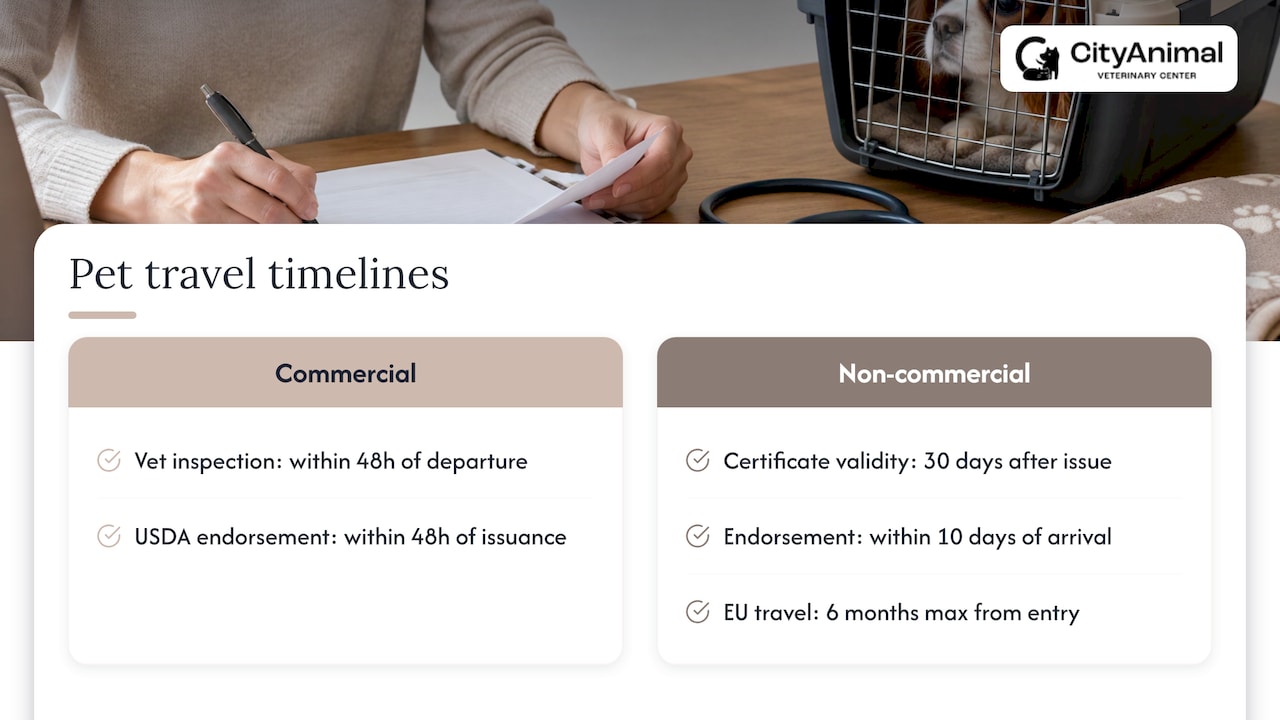
Windows vary enormously by country. APHIS's EU pages show how tight they can get. For commercial movement of pets to the EU, the pet must be inspected by a USDA-accredited veterinarian within 48 hours of departing the U.S., and endorsement must happen within 48 hours after the veterinarian issues the certificate. For non-commercial travel, the certificate is valid for 30 days after the accredited veterinarian issues it, and USDA must endorse it within 10 days of the pet's arrival in the EU. Once in, the pet may travel within the EU for up to 6 months from entry as long as the rabies vaccination remains valid.
The same pages recommend a shortcut worth knowing: have the veterinarian give a fresh 1-year rabies vaccination, after scanning the microchip, 3 to 6 months before travel. Then only one vaccination certificate is needed regardless of your pet's history, and the endorsement review is simpler. This is the kind of detail we build into the plan from the first visit.
What changed in October 2026
New EU health certificates apply to exports from the U.S. under EU regulations 2026/131 and 2026/848. According to APHIS, the new non-commercial certificates took effect October 1, 2026, and the new commercial certificate took effect October 17, 2026. If a checklist, template or friend's advice predates that, treat it as out of date and rely on the current APHIS country page.
USDA endorsement: the step people forget to budget for
A veterinarian's signature is not always enough. Many countries need the certificate endorsed by USDA APHIS, which is what turns a vet's form into an official export document.
APHIS's guidance on working with an endorsement office sets out several facts that shape your timeline:
- There are no in-person or drop-off endorsement services.
- Routine processing is staffed Monday to Friday, 7:00 a.m. to 4:30 p.m. Central Time, excluding federal holidays.
- APHIS advises submitting documents as early as possible within the destination's allowed timeline, and using overnight or Saturday delivery when mailing.
Put those together and you can see how a 10-day window gets eaten. An exam on a Thursday afternoon, a Friday mailing, a federal holiday on Monday and a return shipment can use most of a week. If your destination's window is short, schedule the exam early in the week and avoid holiday weekends.
The Defense Centers for Public Health, writing for military families, notes that endorsement can take several days to mail, sign and return, and advises timing it close to departure while leaving enough time for processing. That is the balance every traveler is managing.
What slows endorsement down
In our experience of how these documents are supposed to work, the common problems are simple ones: a typo in a microchip number, a vaccine date that does not match the vaccination record, a missing field, or a destination that has changed its form. A certificate with errors has to be corrected before it moves forward. Checking each line at the appointment, while your pet is still in the room and the record is in hand, costs minutes. Fixing it after mailing costs days.
Planning around your pet, not just the paperwork
The timeline is also a welfare question. A certificate exam, vaccines, a microchip and perhaps blood work can mean several clinic visits in a short period. For an anxious cat or a dog who dreads the waiting room, that is a lot.
This is where how the visits are done matters. Our team practices Fear Free handling, which is designed to reduce stress at each visit. For cats in particular, our post on cutting vet anxiety with a Fear Free plan shows how preparation at home makes the exam smoother. If getting a pet into a carrier and across Brooklyn is the hardest part of your week, our home visit service brings veterinary care to you for the parts of the process that suit it.

A month-by-month example for an international trip
Here is a sample for a dog going to the EU. It is an illustration of sequencing, not a substitute for your country page.
| Time before departure | Step |
|---|---|
| 4 to 6 months | Read the APHIS country page. Book a visit to scan or place the microchip and give a fresh 1-year rabies vaccination, as APHIS suggests, 3 to 6 months ahead. |
| 2 to 3 months | Confirm the waiting period after vaccination is satisfied and whether any blood test or treatment is needed. Book the exam and, if required, endorsement logistics. |
| 3 to 4 weeks | Confirm airline pet rules, carrier requirements and any treatment dates that fall inside a tight window. |
| Within the destination's window | Certificate exam, review of every field, then USDA endorsement. |
| Travel day | Original endorsed certificate, rabies certificate and microchip documentation in your hand luggage. |
Hawaii and other destinations with their own rules follow a different pattern. Our guide on bringing a dog or cat to Hawaii without quarantine covers that one.
Questions to settle before you book the exam
Before you pick a date, you need four answers:
- What is the airline's maximum age for the certificate?
- What is the destination's maximum age, and does it differ for pets arriving by air, car or ship?
- Does the destination need USDA endorsement, and does it accept digital endorsement or need a paper original?
- Is the rabies vaccination current for the entire trip, including the return?
Our guides on the APHIS 7001 form, finding a USDA accredited veterinarian and what pet owners must do for travel certificates go deeper on each.
Book your pet's travel visits with City Animal
We handle pet travel and international health certificates for pet owners in Brooklyn and the surrounding area. Our team can help you line up the microchip, vaccinations and certificate exam so each one lands in the right place on your calendar, and our in-house laboratory supports the diagnostics some trips call for.
Start with our pet travel and international health certificate page to tell us where you are going and when. If your pet is due for rabies or other shots first, you can also see our vaccinations service.
Our perspective
Most of the stress we see around travel paperwork has the same root: people treat the health certificate as one appointment, when it is the end of a sequence.
We tell families to think in two parts. First, get the pet ready: microchip, rabies vaccination, any waiting period. Second, time the exam and endorsement to the shortest window in play. When the first part is done early, the second part is a calm, ordinary visit.
We also think the visit itself deserves care. Our Fear Free approach is designed to keep pets calmer, and our home visit service exists for owners who cannot easily bring a pet in. A pet who is relaxed at the exam is easier to examine, and an owner who has a plan is easier to help. That combination is what we aim for with every travel client.
CAVC
FAQ
How long is a pet health certificate good for?
It depends on who is asking. Airlines often want an exam within 10 days of departure, and many states accept a certificate valid for 30 days. International destinations set their own limits, and some are much shorter, so use the shortest window that applies to your trip.
Can I get a health certificate the same week I travel?
Sometimes, for domestic trips, if your pet already has a current rabies vaccination and the paperwork is straightforward. International trips rarely work this way, because microchip, vaccine and waiting-period requirements usually have to be met first. Contact us as early as you can and we will tell you what is realistic.
Does every certificate need USDA endorsement?
No. Many domestic certificates do not. International certificates often do, when the destination requires federal countersignature. APHIS publishes country-by-country instructions, and the endorsement step runs on federal business days, so build mailing time into your plan.
How old does a puppy or kitten need to be?
Pets generally need to be old enough to have received rabies vaccination, around 12 weeks, and airlines and destinations may set their own minimum ages. Check both before you plan a trip with a very young animal, and bring your puppy or kitten in so we can review their vaccine schedule against your dates.
Sources
- USDA APHIS: Pet Travel Process Overview
- USDA APHIS: Working With an APHIS Endorsement Office
- USDA APHIS: Pet Travel From the United States to Finland, Malta, Ireland and Norway
- USDA APHIS: Pet Travel From the United States to France
- Florida Department of Agriculture: Travel of Dogs, Cats and Pet Birds in/out of Florida FAQ
- Defense Centers for Public Health: Nearing Your Departure Date