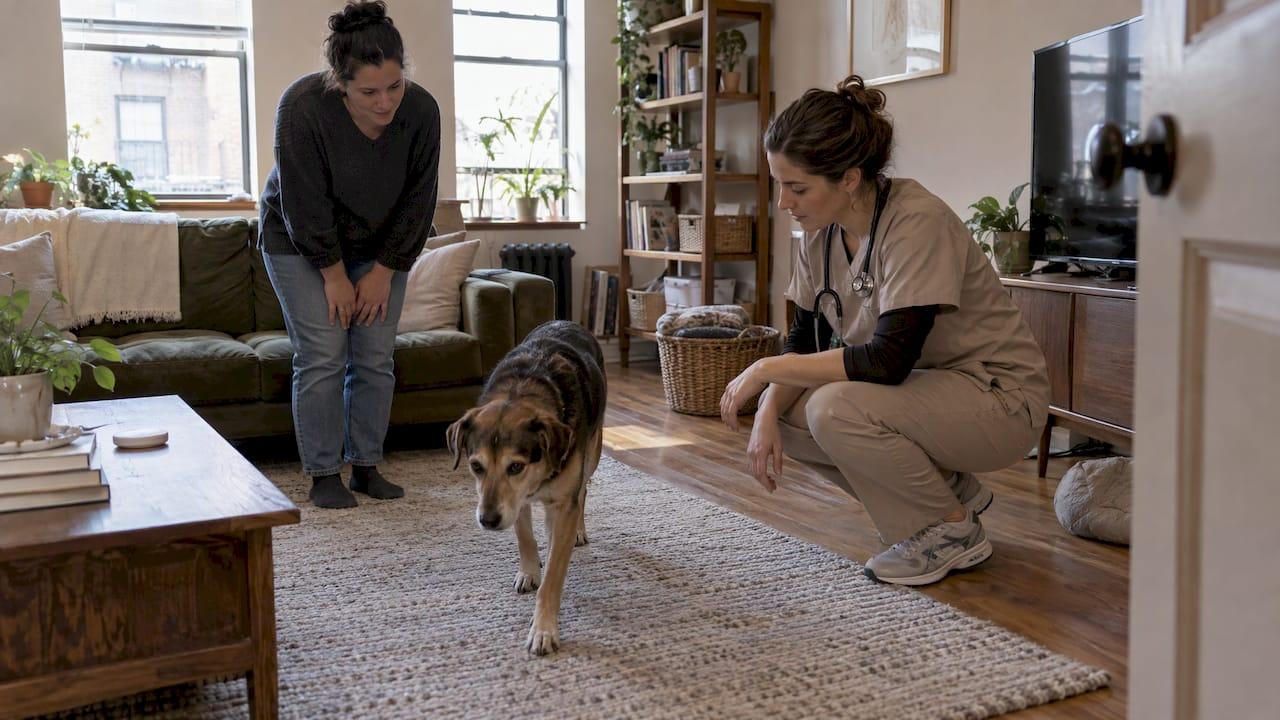
A house call vet brings the exam to your living room. That removes the car ride, the waiting room and the unfamiliar exam table, and it lets the veterinarian see your pet where your pet actually lives. The biggest gains go to anxious pets, seniors, pets with mobility trouble, busy owners and multi-pet homes. Below we explain each benefit, what a visit can and can't cover, and how to decide between home and clinic.
TL;DR
- Home visits remove the stressful trip to the clinic, which matters most for anxious cats and dogs, seniors, and pets who get carsick or hurt in transit.
- Your vet sees how your pet moves, eats and behaves at home, which can give clues that rarely show up in an exam room.
- Home care saves time for busy professionals, owners with limited mobility and families with several pets.
- Home is also a gentler setting for end-of-life care.
- Surgery, advanced imaging and true emergencies belong in a hospital, so a good plan uses both.
Table of Contents
- What a house call vet actually does differently
- Benefit 1: No stressful, risky trip
- Benefit 2: A calmer pet means a better exam
- Benefit 3: The vet sees your pet in real life
- Benefit 4: More time to talk
- Benefit 5: Convenience for people, too
- Benefit 6: Multi-pet households
- Benefit 7: Fewer exposures to other animals
- Benefit 8: A gentler goodbye
- What a home visit can cover
- Who benefits most
- When your pet needs the clinic or the ER
- How to choose a house call vet
- Book a visit with City Animal
- FAQ
- Sources
What a house call vet actually does differently
In a standard visit, you load your pet into a carrier or car, drive, wait among other animals, and then have a short exam in a room that smells of strangers. In a house call, the veterinarian comes to you. The medicine is the same. The setting is not.
That difference shapes everything that follows: how calm your pet is, how much the vet can observe, how much time you get to talk, and how much of your day it takes.
We offer home visits and house call services in Brooklyn as an extension of our practice, so the home visit is backed by a full veterinary center when your pet needs more than a visit at your door can provide.
Benefit 1: No stressful, risky trip
Transport is often the hardest part of a vet visit. Veterinarian Patrick Mahaney notes that house calls spare pets a stressful and potentially dangerous trip to the hospital. He points especially to geriatric, juvenile, mobility-compromised and sick pets that can be jostled in a car.
PetMD also describes the elimination of a stressful car ride, strange people and animals, and a clinical setting as perhaps the biggest benefit of mobile care for pets and their anxious owners.
If your dog gets anxious or sick in the car, the trip alone can sour the whole appointment. Our guide to car travel stress in dogs walks through calmer rides for the visits that do have to happen at a clinic.
Benefit 2: A calmer pet means a better exam
Clinics are busy places. According to Liz McCalley, DVM, on Great Pet Care, loud barking, the scent of other stressed animals, slick floors and bright lights can all make a clinic stressful for pets. Signs of anxiety include:
- Shaking or vocalizing
- Refusing to walk through the door
- Urinating or defecating
- Hiding, hissing or growling
- A tense body
There is a medical reason this matters beyond comfort. DVM360 reports that in a hospital, a surge of adrenaline can make the signs a veterinarian wants to see disappear. A relaxed pet gives a more honest picture of heart rate, gait, posture and comfort.
Great Pet Care notes that mobile visits can help pets anxious about clinics, including almost all cats. If you share your home with a cat who disappears the moment the carrier comes out, a home visit can change the whole experience.
Anxious pets at home and at the clinic
Our approach is Fear Free, and we are a Fear Free certified practice. The goal is to lower fear, anxiety and stress at every step, whether we are in your home or in our Brooklyn center. At home, that means your pet's own bed, your own floor and no unfamiliar animals nearby. For visits that do need the clinic, we have written practical guides on easing dog vet anxiety and cat vet anxiety.
Benefit 3: The vet sees your pet in real life
This is the benefit owners often don't expect. A home visit is also a small investigation.
DVM360 describes how, during a house call, a veterinarian can watch how a pet greets newcomers, how he moves around the home or yard, and how he lives. That includes where he is fed, what the home smells like and what is in the litter box. All of that feeds into recommendations.
Here is what that can look like in practice:
- Mobility: Watching an arthritic dog on your actual stairs or hardwood floors tells a vet more than a few steps on clinic tile.
- Diet and feeding setup: Seeing the bowls, the food storage and the feeding routine helps with nutrition advice.
- Litter box and household layout: For a cat with urinary or elimination issues, the box location, number and type are part of the diagnosis.
- Household dynamics: How a pet reacts to people and other animals at home can inform behavior advice.
Dr. Debora Lichtenberg, VMD, told Petful that for confusing medical cases or behavior consultations, a house call can be invaluable. She gives examples like a house thick with smoke or a dog being handled roughly by children, details that can explain a pet's problems.
PetMD makes a similar point: seeing a pet behave naturally at home, including what it eats and how it interacts with the people and animals around it, is invaluable.
Benefit 4: More time to talk
The quiet advantage of a house call is the conversation. With no waiting room behind the door, owners tend to have room to describe what they have noticed. The PetMD Daily Vet piece says house calls give clients more time to share their perspective.
PetMD's mobile clinic article adds that spending more time with pets and families helps vets build strong emotional connections. For a pet with a long-running issue, a vet who knows your home and your routine makes better decisions.
Benefit 5: Convenience for people, too
Not every barrier is about the pet. Owners may have a packed workday, a newborn, no car (common in Brooklyn), or a physical limitation that makes carrying a cat carrier or walking a large dog to an appointment hard.
PetMD notes mobile services can offer flexible hours, which may include nights and weekends, and accessibility for owners who are elderly or have mobility issues. Great Pet Care lists busy working pet parents and owners with transportation challenges among those who benefit most.
For a busy professional, one appointment at home can replace a half day of commuting, parking and waiting.
Benefit 6: Multi-pet households
If you have three cats and a dog, getting everyone to a clinic is a project. UF Health reports that annual exams, vaccinations and treatment of chronic conditions can all be done during house calls, which are especially great for families with multiple pets. One visit, one trip for the vet, no carriers.
Benefit 7: Fewer exposures to other animals
Waiting rooms put sick and healthy animals in the same space. DVM360 notes that hospital visits carry a risk of contagious disease transmission to and from patients. For a puppy still finishing vaccines, a senior pet with a weak immune system, or a pet recovering from illness, avoiding the waiting room is a practical plus. Ask your vet what is appropriate for your pet's vaccine status.
Benefit 8: A gentler goodbye
Of all house-call services, end-of-life care may be the one owners value most. Mahaney writes that clients much prefer to have their pets pass in the comfortable, familiar and calm environment of home rather than a more public, sometimes harried hospital. Dr. Lichtenberg adds that a house call for euthanasia can be a comfort to both the pet and the owner.
At home, your pet can be on a favorite blanket, and family members can be present without a waiting room around them. You can read about our hospice and euthanasia services, and the way our team supports families through that time.
Our perspective
We built our practice around a simple idea: a pet who is afraid can't show us what is wrong, and an owner who dreads the appointment waits too long to book it. Fear Free care and home visits are two answers to the same problem.
At the center, our team uses a Fear Free approach to keep visits low stress. At your home, we take that further. Your pet is on familiar ground, and we get to see the space, the routine and the relationships that shape their health.
We also think home care works best as part of a bigger picture. Seniors on pain management, cats that panic at the carrier, dogs with arthritis, and families saying goodbye all benefit from a vet who comes to them. When your pet needs digital X-rays, ultrasound, in-house lab work, dental procedures or surgery, our center is ready, and one team keeps the whole story of your pet's care.
We would rather your pet get the right setting for the right need than force every visit into one mold.
CAVC
What a home visit can cover
Mobile and house-call practices commonly handle routine and ongoing care. Examples from research and practice sources include annual exams, vaccinations and chronic condition care, per UF Health. The services most often suited to the home are:
- Wellness exams and senior check-ins
- Vaccinations and preventive care
- Follow-ups for chronic conditions
- Pain and mobility assessments
- Behavior discussions, where the home environment is part of the picture
- Hospice and end-of-life care
To see what we can do at your door, visit our home visits page. If you want a walkthrough of how a visit unfolds, our guide to the home vet visit process explains it step by step.
Who benefits most
Great Pet Care's list of pets and households that may benefit most from mobile care lines up with what we see:
| Household | Why home care helps |
|---|---|
| Pets with clinic anxiety, especially cats | No carrier trip, no waiting room, calmer exam |
| Senior or mobility-limited pets | No stairs, no car transfer, less strain on sore joints |
| Owners with limited mobility or no car | Care comes to you |
| Busy working owners | One appointment, no commute |
| Multi-pet homes | Several pets seen in one visit |
| Pets nearing the end of life | Calm, familiar surroundings |
The source for this grouping is Great Pet Care.
For older pets in particular, home visits pair well with geriatric care and pain management, where watching a pet move in their own space is especially informative.

When your pet needs the clinic or the ER
A house call is a great tool, but it is not the right tool for every situation. Safe use means knowing where the line is.
Diagnostics and procedures. House calls often can't include X-rays, CT, MRI or ultrasound, though portable ultrasound units exist, and surgery is best done in a controlled hospital setting. Dr. Lichtenberg adds that blood work can't be run stat at home. That is where a full practice matters: our center offers diagnostic imaging, an in-house laboratory, dental care and surgery. If your pet needs an ultrasound, our ultrasound prep guide shows how to keep it low stress.
Anesthesia. Procedures that need anesthesia are usually done at the vet's affiliated office or hospital, according to PetMD. For senior pets, our guide to anesthesia safety in senior pets covers what to ask.
Emergencies. Mobile vet services are usually not designed for urgent or life-threatening emergencies. Nearly all emergencies, including severe trauma, toxicities, allergic reactions and heat-related illness, merit hospital-based treatment. If your pet is struggling to breathe, collapsing, bleeding heavily, seizing or may have swallowed a toxin, go straight to a veterinary emergency hospital, and do not wait for a home appointment. Our guide to emergency versus urgent care red flags lists the signs.

How to choose a house call vet
Before you book, confirm a few things. Great Pet Care recommends checking that the veterinarian is licensed to practice in your state, confirming the vet sees your pet's species, and considering a Fear Free certified veterinarian for a nervous, anxious, aggressive or fearful pet.
A few more questions worth asking:
- What can be done at home? Ask which exams, vaccines and treatments are included.
- What happens if my pet needs more? A practice with its own diagnostic center keeps your pet's records and care in one place.
- Which area do you cover? Confirm your neighborhood and the time windows offered.
- How do you handle fearful pets? Look for specific techniques, not just reassurance.
- What should I prepare? A quiet room, good lighting and your pet's history make the visit more thorough, because challenging environments or an unhelpful setup can make exams less thorough.
Book a visit with City Animal
If your pet dreads the carrier, your schedule is packed, or your senior companion struggles with stairs, a home visit may be the easiest way to keep up with care. We combine Fear Free certified, compassionate visits at your home with a full center in Brooklyn for the things that need more equipment. Our home visits page explains how to request one.
If your pet is due for a checkup, see our wellness exams and vaccinations, or contact us at cityanimalvet.com to talk through which setting suits your pet.
FAQ
Are house call vets as thorough as a clinic?
For routine and ongoing care, they can be very thorough, and the home setting adds useful observations. Some tests, such as X-rays, CT, MRI and stat blood work, are generally done at a hospital instead. A practice with its own diagnostic center can move your pet there when needed.
Which pets benefit most from a vet visit at home?
Pets that are anxious at clinics (almost all cats, many dogs), seniors, pets with limited mobility, and households with several animals. Owners with transportation challenges or very busy schedules benefit as well. End-of-life care is another common reason families choose home.
Can a house call vet handle an emergency?
No. Mobile services are generally not set up for life-threatening emergencies. If your pet has trouble breathing, severe bleeding, a seizure, collapse, major trauma or a possible poisoning, go to a veterinary emergency hospital right away.
Is home euthanasia a good option?
Many families prefer it because the pet is in a calm, familiar place and everyone can be present. Your vet can talk with you about timing and what to expect. Our hospice and euthanasia page describes how we support families.
What should I do to prepare for a home visit?
Choose a quiet, well-lit room, gather your pet's records and medications, and write down your questions and observations. Keep other pets calm and nearby if the vet will see them too. Our step-by-step guide covers the details.
Sources
- Benefits of Veterinary House Calls, Daily Vet, PetMD
- Mobile Vet Clinics: What Are They?, PetMD
- Why at-home veterinary visits matter, DVM360
- Mobile Vet Visit: What to Expect, Great Pet Care
- The Benefits of Veterinary House Calls, Petful
- When getting there is over half the battle, try house calls, UF Health